In the sense that for that person, ratings – a.k.a. ‘money’ – are far more important than presenting an as accurate as possible version of reality…
Hence the public belief that ‘media are not to be trusted’.
A reality created by the greed with which we, as a cultured species, attempt to transform everything into money…., power…, or any other kind of ‘influence’/relevance we happen to covet….
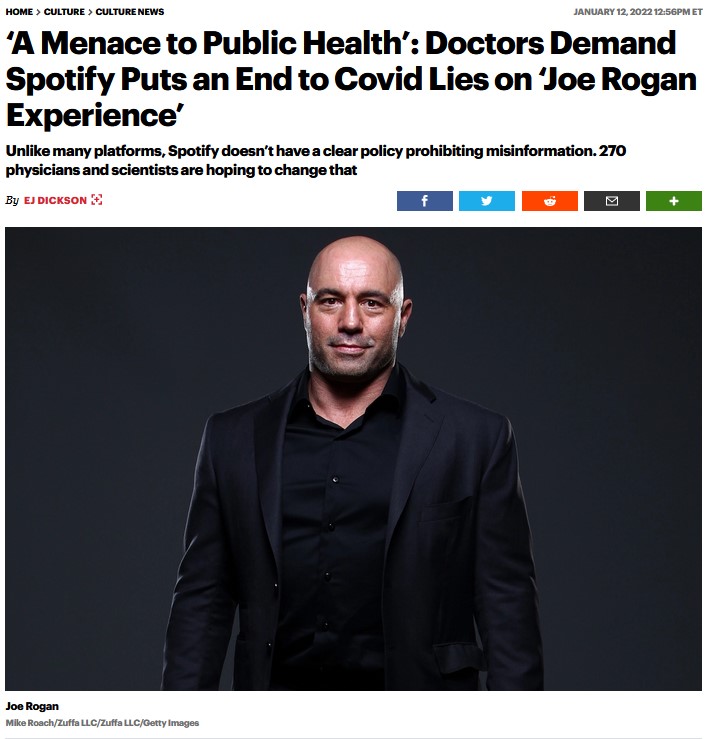
Well, at that time Rogan had just moved his podcast – from September 1, 2020, on Spotify. After receiving $100 million for a “multi-year licensing” deal.
If you don’t know, we’re still in the middle of a pandemic. Caused by SARS Cov2, an airborne virus which kills people. 5,682,971 worldwide when I last checked.
Joe Rogan, the comedian, thought he had to cover the subject. So he had invited a controversial figure, Dr. Robert Malone, for an interview. The interview had become viral. But the ‘information’ being peddled by Dr.Malone had provoked the indignation of his fellow physicians.
As usual in this kind of circumstances, the netizens have taken sides. Some manifest their indignation against the capitalists who make money by spreading false information. Others manifest their indignation against the ‘cancel culture’ which limits the freedom of expression of those who contradict the opinions held by the intransigent majority.
As usual in this kind of circumstances, I try to explore alternative venues of looking at what’s going on. Let me remind those of you who are not familiar with the Romanian language that ‘Nici-chiar-asa’ means ‘not so fast’ (or ‘don’t over do it’) in my native language.
So. Why would a huge number of people – the Malone interview went “viral”, attempt to get information about a raging pandemic by watching a stand-up comedy show? Hosted by a “comedian” who recently had to issue an apology for things which he had said in one of his shows… Those people had been mesmerized by the ‘past experience’ of Dr. Malone? “Who touts himself as one of the architects of mRNA technology”…. Maybe… but those people shouldn’t have googled Dr. Malone’s name before sharing the interview? To their like minded brethren? Before making it viral? They would have learned that Dr. Malone had already been banned from Twitter for spreading misinformation…
‘Those people do not believe that media venues should restrict the freedom of people speaking up their minds’…
Then whatever preventive measure are put in place by the likes of Spotify will amount to exactly nothing!
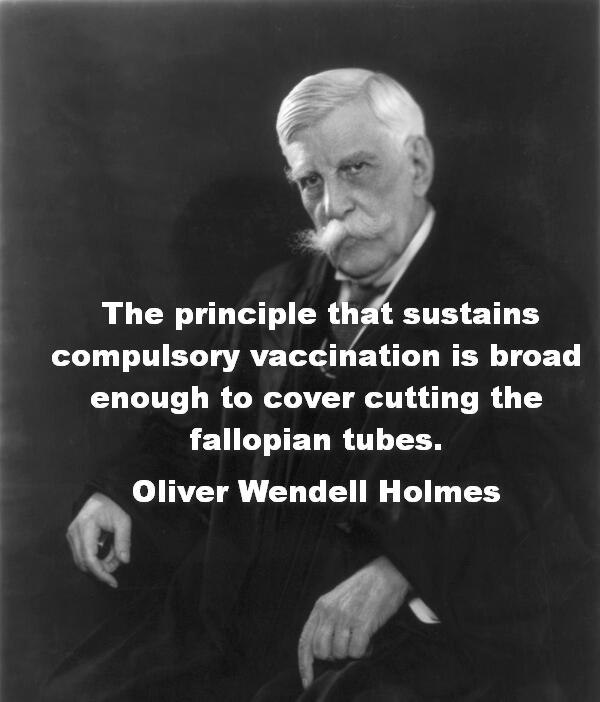
Having no previous intel about this guy, my ‘jerked’ reaction was simple.
‘Leaving aside any principle, a society which cuts ‘fallopian’ tubes will have a lower birth rate while that which vaccinates its children will notice a decrease in healthcare costs. And a lower mortality across the entire age spectrum!’
OK, let’s calm down and google. To find out who was this Oliver Wendell Holmes, after all.
“In that long span of (30) years on the Supreme Court he became acknowledged as one of the most notable jurists of the age—in the opinion of many the foremost. Often he has been called The Great Dissenter because of the brilliance of his dissenting opinions, but the phrase gives a falsely negative emphasis, and his penetration and originality are seen as fully in the opinions in which he expressed or concurred in the majority view of the court as in those in which he was in dissent.”
“Perhaps his best-known phrase is from Schenck v. United States, where he introduced the ‘clear-and-present-danger’ test as a means of limiting the power of the state to restrict speech and illustrated it by reference to a person’s ‘falsely shouting fire in a theater.’ His later development of this test, coupled with his emphasis on a basically unregulated ‘marketplace of ideas,’ was seminal for the development of modern free-speech law. His retirement in 1932 was a national event, and he has remained, along with John Marshall, among the best known of all those who have served on the Supreme Court.”
“Few American jurists are as revered as Oliver Wendell Holmes Jr. A United States Supreme Court justice for close to 30 years, Holmes wrote seminal opinions that were clear and clever and elegantly phrased. It was Holmes who defined the limits of free speech in 1919 by noting that the law did not protect someone “falsely shouting fire in a theater.” And it was Holmes who thoughtfully amended those words a decade later by writing that nothing in the Constitution was more sacred than “the principle of free thought — not free thought for those who agree with us but freedom for the thought that we hate.” By most accounts, Holmes, an upper-crust Bostonian, served the nobler instincts of America’s privileged classes. That is why his reckless majority opinion supporting forced sterilization in a 1927 case remains an enigma. Was it an isolated misstep or something more: an indictment of Justice Holmes and the Progressive movement he appeared to embrace?”
“We have seen more than once that the public welfare may call upon the best citizens for their lives. It would be strange if it could not call upon those who already sap the strength of the State for these lesser sacrifices, often not felt to be such by those concerned, in order to prevent our being swamped with incompetence. It is better for all the world if, instead of waiting to execute degenerate offspring for crime or to let them starve for their imbecility, society can prevent those who are manifestly unfit from continuing their kind. The principle that sustains compulsory vaccination is broad enough to cover cutting the Fallopian tubes. Three generations of imbeciles are enough.“ . . .
Perhaps worst of all, Carrie Buck was not an imbecile. Both she and her mother were deemed “social undesirables” due to a perception of promiscuity which, in Carrie’s case, partially resulted from an illegitimate child who was the product of incestuous rape. This was fairly typical. The linked article describes how “people as young as 10 in North Carolina were sterilized for not getting along with schoolmates, being promiscuous or running afoul of local social workers or doctors.”
In all, more than 60,000 people—including 7,600 in North Carolina—were forcibly sterilized in the United States in the name of “progress.” Progressives of the time lauded the decision in Buck. Individual rights, they firmly believed, should not be allowed to stand in the way of collective progress. Justice Brandeis called Buck an example of properly allowing states the freedom to “meet modern conditions by regulations which a century ago, or even half a century ago, probably would have been rejected as arbitrary and oppressive.””
So. Who was the ‘real’ Oliver Wendell Holmes? That one whose teachings we choose to put forward, of course! Exactly as Justice Holmes had done himself. And why is it our responsibility to choose? Simple. It’s us, and our children, who will bear the consequences. Who will have to live in the environment shaped by those choices.
Cassandra by Evelyn De Morgan (1898, London); Cassandra in front of the burning city of Troy
“Oh God, please make it so that my prophecies won’t come to life!” “I’m sorry Cassandra, that’s what I made Man for. Now, it’s Their job to heed to your warnings!”
The larger your ‘skull’ is, the more ideas – sometimes conflicting ones, you are able to ‘harbor’.
This guy, a 31 years old father of two, is looking forward for a heart transplant.
Meaning that he, and his family, trust the doctors who are going to perform the surgery. Who are going to open up his chest, take his failing heart out, sew the ‘re-cycled’ one in and patch him up again. Doctors who need to hook him up to various machines and to pump him full of chemicals in order to maintain him alive – but unconscious, during the procedure. And who are going to closely monitor him – and, again, administer him a lot of vital drugs, during the rest of his life.
Meanwhile he, and his family, don’t trust the doctors who tell him he needs to get a Covid jab first.
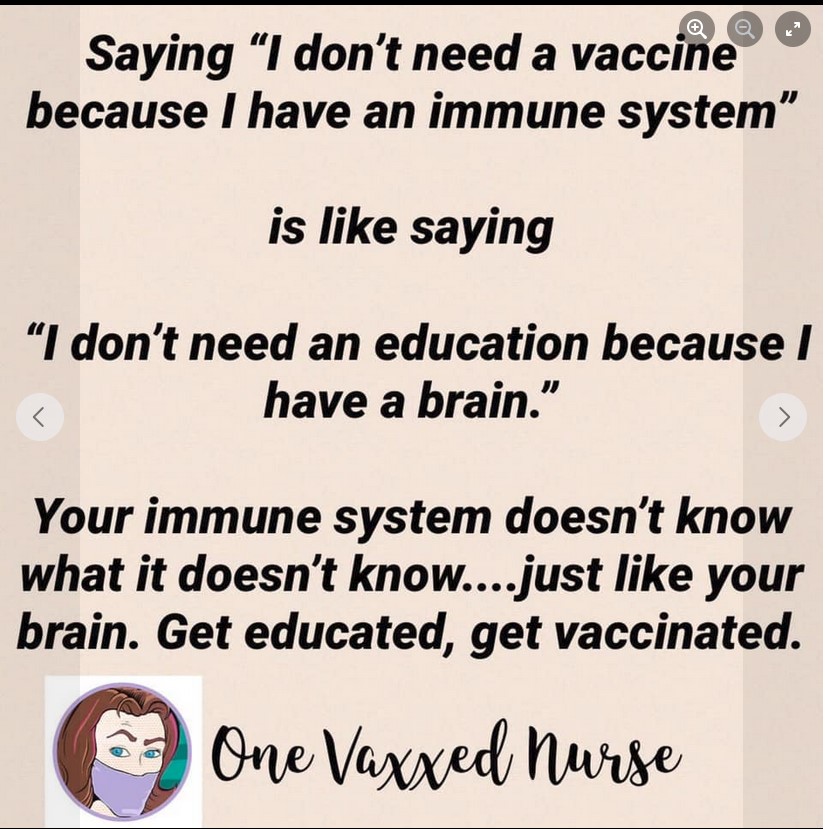
I came across this over the internet. I couldn’t have said it better myself, hence I ‘borrowed’ it. Click on it and read the whole post, it’s very interesting on its own.
Below is the comment I left on the FB wall where it all happened. Don’t see any need to change anything.
“The key words here being “are recognized for”. Real mastery involves knowing your limits. Being recognized as a master by somebody else – the more ‘recognizers’, the worse, tends to annihilate any ‘master’s’ ability to own the very existence of their limits. The intellectual limits are the hardest to notice/accept. ‘Accrued’ age brings about crystal clear evidence about our physical limitations. Accrued knowledge enlarges one’s vision. Puts distance between the observers themselves and the limits of their ability to ‘observe themselves in the act of observing‘.
And if/when the above mentioned accrued knowledge becomes recognized/admired by the (naive) ‘general public’… You don’t have to trust me on this because of my white beard. I have a better argument. I’m an engineer!”
‘OK, and the point of this post is …?’
The fact that there’s no such thing as ‘personal improvement’. Any ‘improvement’ which we might ‘inflict’ upon ourselves derives from our intercourse with the others. Through ‘learning’. All change which happens to us, actually, comes from our ultimately aleatory intercourse with the environment in which we happen to live. From being taught to being ‘influenced’ by the passage of time. All that is ‘personal’ in ‘personal improvement’ is that we do it ‘willfully’.
Much of the change which happens to us goes either unnoticed – up to a point, or is merely accepted by us. ‘Personal improvement’ is chosen by us. And imposed by us upon our own selves.
To do it – ‘improve’ ourselves, that is, we follow ‘suggestions‘. We should keep in the back of our mind that it’s our call to follow – or not, those suggestions.
Disclaimer. I have no idea who the ‘suggested’ guy is. Just googled ‘personal improvement books’ and chosen the most visually appealing – for me, obviously, link. Just wanted to illustrate the deluge of suggestions which is constantly directed at us.
True enough. Good people don’t need laws to tell them how to behave while the ‘cunningly willful’ amongst us will indeed, time and time again, try to circumvent the consequences of bypassing the law.
Then why? Two and a half millennia after Plato had dispensed this piece of wisdom we still have laws. Is there a possible explanation for this apparent aberration? Are we that thick-headed or there’s something else?
To settle this question – to start attempting to settle it, actually, we must first agree upon the difference between good and bad.
Ooops!
‘Everybody knows what good and bad is’ doesn’t really work, right?
In principle… maybe, but when it comes to putting principles into practice… we need guidelines! Just as ‘good fences make good neighbors‘, a clear understanding among the good about where the realm of the bad starts in earnest makes life a lot simpler. For all of us. And the more visible that line is, the simpler our life becomes.
Only this is but half of the actual explanation. Laws do make our life simpler, indeed. Unfortunately, ‘simpler’ doesn’t necessarily mean ‘better’.
As some of you already know, I’ve spent half my life under communist rule. Does ‘Ceausescu’ ring any bells with you?
Under communism, life was a lot simpler than it is now. Presumably, life was a lot simpler under any of the many flavors of authoritarian rules experienced by humanity during its history. This being the reason for no matter how horrible a dictatorial regime had been, there were always some who had regretted when that regime had fallen.
‘OK, so what’s your point? That laws, in general, might be good but the laws which impose an authoritarian regime are bad? You know that you’ve just opened a fresh can of worms, right?’
How do you determine the difference between a good law and a bad one?
There’s no such thing. No law is above good and bad. For the simple reason that we call laws are made by us. We are fallible human beings and everything we make, including our laws, is, and should continue to be, constantly improved.
‘Then you’re nothing more than a ‘closet progressive‘! I knew it! ‘Constant improvement’… yuck! Not to mention the fact that the most important Law comes from God, not from Man!’
I’ve already disclosed that I’m an agnostic. That I have no idea whether a(ny) god had anything to do with what’s happening around/with us. All I know is that all laws, including the Bible – and all other Holy Books, had been written by people. By Humans, that is.
And I also know that there are two kinds of law. ‘Natural’ – as in noticed by us, and ‘synthetic’.
While all laws are ‘artificial’ – ‘written’ by us, the natural ones had been first noticed and only then put on paper. While all laws had been written on purpose – each ‘writer’ had their own reason for doing it, the ‘synthetic’ ones had been put together with a specific goal.
While observing – and when necessary improving, the natural laws benefits all, the ‘synthetic’ ones serve only those who make it their business to impose those laws upon the rest of the community.
While observing – and, when necessary, imposing them upon SOME, improves the prospects of the entire community, designing and imposing ‘synthetic’ laws upon a community will always bring a huge amount of disturbance. Sometimes fatal for that community. Always fatal for the regime attempting it!
‘How about some examples?’
I’ll give you two natural laws and a ‘synthetic’ one.
The law of gravity. Also known as Newton’s Law of Universal Gravitation. This law didn’t need Newton to notice it. The Earth had already been orbiting the Sun for a while before Newton told us why.
‘Do not kill’. A subset of the Golden Rule, ‘Do no harm, if you can help it’. Also ‘natural’ but a lot more ‘fluid’. And, strangely enough, noticed and ‘put on paper’ way before the law of the falling objects… Just think of it! The ‘law makers’ have noticed long, long ago that the communities which follow the Golden Rule fare much better than those whose members treat each-other like dirt. Yet only a few short centuries ago somebody ‘noticed’ that things fall according to a constant rule… and bothered to make it into a law. Was ‘gravity’ too obvious? Inescapable, so why bother? While the Golden Rule worked better when enforced? When the formal rule mandated that even the rulers themselves had to obey the rule?
It’s easy to notice that the first two, the ‘natural’ ones, produce consequences regardless of people observing them or not. Meanwhile, ‘synthetic’ laws are, entirely, the figment of somebody’s imagination. And produce consequences only when/if enough people are ‘seduced’ by the perspectives of those laws being put into practice. Communist rule, for instance, could be put into practice only when enough people had been seduced by Marx’s ideal that all property should belong to the state and be managed by a ‘select’ few. Only then, after those ‘select’ few had, somehow, convinced enough followers, could Marx’s ideas be transformed into laws. And put in practice. With the already obvious consequences…
‘OK, but I still don’t get it! Is there a way to tell whether a law is good or bad before-hand? Before its consequences had become manifest?’
That’s a tall order. And you know that!
Actually, no! There’s no fire-proof method of ascertaining anything before-hand, let alone something made by us.
But there is a next best thing. The ‘natural’ laws are natural because they had been first observed. Only then written into law. And because of things proceeding in this order, whenever something changed those who had noticed the change had adapted the wording of the law to the new reality. Simply because those who had to make do with the consequences of the law being put into practice could not wait too long whenever they had noticed that there was a better way.
People have dreamed of flying since god only knows when but they had learned how to do it only after they had been told that everything is pulled to the center of the Earth. ‘An eye for an eye and a tooth for a tooth’ had been very useful. For a while… Now we use the same principle – do no harm, but we implement it in a more nuanced manner.
People have also dreamed of a fair society. And, frankly, ours is a lot fairer than that of our grand-parents. Because we have constantly improved our ‘manners’. We have not only observed ourselves while living but we’ve also done something when anything went wrong. The problem is – and it’s only one problem here, that not all things can be reversed. Some mistakes can be fully redressed, other compensated … but we’ll have to take with us the consequences of those mistakes. And the longer a mistake is allowed to happen, the more important the consequences. So. ‘Synthetic’ rules are bad not because they have been dreamed up by us. They are bad because those who promote them cannot accept the idea they might have been wrong. The really bad ‘synthetic’ rules were those who could not be changed from within!
Whenever a law maintains that things cannot happen, ever, but in the manner prescribed by that very law, that text is no longer a law. It’s a dictate! It’s dictates that we can do without, not laws. And it’s our job to make out the difference. One way or another.
Disclosure. You haven’t ‘heard’ this from me. I’ve only ’embellished’ some ideas I’ve stolen from Popper, inasmuch as I’ve understood anything from them.
There are two ways in which we may acquire information. The hard way and the reasonable way. By ‘immersion’ or by learning. By ‘getting stronger if lucky enough to survive’ or by making sense of what had happened to others.
„The pandemic’s transition toward becoming a disease that the world can manage more easily and learn to live with. “Really?!?It’s the disease which needs to become something we might be able to learn how to live with?!?””
„That’s how pandemics work. Like the 1918 flu…”
„Well…The virus itself is being passively selected by the naturally occurring ‘evolutionary forces’. We, as a conscious species, act more or less ‘uncoordinatedly’. We develop vaccines, determine that masks are good for us and then refuse to use them to their full potential. Doesn’t make much sense, evolutionary speaking…”
On the other hand, the article is interesting. Like so many other times, the content is ‘somewhat’ different from the click-bait title/presentation….
And, maybe, I should remember you that ‘nicichiarasa’ is the Romanian word for ‘don’t overstep it’, …
You know how much I hate having to admit that I have no clue about something, right?
I didn’t ask you what’s going to happen! Nobody knows that… I only asked you what you feel about it. What’s your impression about what’s going on!
Well… They surely evolved a lot faster than what we’re accustomed with… But none of them reached the point we’ve been expecting… not yet, anymore. And the signs don’t bode well… On the other hand, evolution is like tennis. A sport they had invented and which is very popular among them. Among all of them! Coming back to evolution, no matter what the signs suggest, it’s not over – one way or the other, until the very end. Until the last ball had been played and the last individual had died. Or until the ‘field’ had become unusable…
And what seems to be their biggest problem?
They still have to overcome quite a number of hurdles… the most important being the fact that they haven’t yet learned how to balance their need to maintain their distinct individualities with the reality that they have to coordinate their efforts in order to achieve anything worth mentioning. Including their own survival!
Any possible explanation for this inability of theirs?
The only thing I can think of is their particular sexuality. The more evolved among them have only two sexes. And the roles played by each sex are hugely different! Hence they have a clear idea about what complementarity means but also this strange notion of ‘priority’. Each sex considers itself more important than the other… Starting from here, it’s almost understandable that each individual, as they grow up, attempts to assert their individuality. Defend it from ‘intrusions’. Impose it upon as many of the others as they can… This impulse is so strong that even now, more than 5 generations after one of them – a certain Charles Darwin, had figured out a theory of evolution, most of them still consider that evolution is about the ‘survival of the fittest’…
This being the only difference?
Yep! They check on all other bench-marks… We can review each of them, if you want.









 nicichiarasa