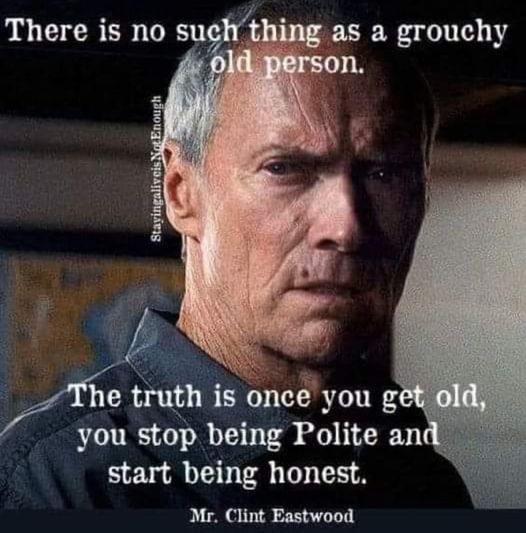
Well, from where I stand – 62 years and counting – ‘grouchy’ starts when people forget that truth – even the naked one – can be ‘exposed’ in a polite manner.
Becoming old doesn’t come with a license to stop caring about how the others feel about things. On the contrary. At some moment in time, each of us will reach ‘the point of no return’. After which we’ll depend on others. Totally! For food, for water, for somebody to change our diapers…
After all, we’ve been lucky enough to reach the ‘golden age’. How about becoming wise instead of devolving into rude punks?
‘Cause the opposite of polite is being rude. Not truthful!
Proper = As it should be. As expected. ‘Clean’. Property=Something which belongs to someone. A mutually respected arrangement among the members a certain community which establishes boundaries. Which members have the right to go ‘there’ whenever they want while all others have to ask for permission before crossing that ‘boundary’. A convention among the members of a certain community about what is the proper thing to do in each ‘patrimonial’ situation. A convention about who has the right to do what to the things which happen to co-exist with the members of the above mentioned community. The above mentioned ‘things’ include the place where the entire community happens to live. ‘Their’ land.
Which brings us to who owns the world. The leaders? As many of them assume? Or the humanity, as Dalai Lama has reportedly said?
How about neither? My point being that we are nothing but guests in this world. We come empty handed and we leave empty handed.
Yes, we need property while dwelling on this planet. But only in the sense of who can do what where. And with the limitation that the ‘what’ we do has to be ‘reversible’. Just as we leave this world with nothing – we leave even our hands here, our presence on the planet has to be ‘discrete’. Has to produce as little disturbance as possible and all that disturbance must disappear in time.
We need to keep the world a proper place. It’s the only place we have. No other home for our children. No other place to spend our last days. Properly.
Marxism is an ideology. Ideologies don’t have errors, they are thought templates used to evaluate a certain situation and to determine what to do next. Ideologies are tools. They can be used properly or improperly. Sometimes, the best use for certain tools is to be left alone. Particularly when you understand they are useless. If you understand they are useless… Hence it’s not Marxism which is full of errors, it’s the Marxists who are barking up the wrong tree.
Which tells us Marx’s brilliant analysis wasn’t deep enough. He had noticed a series of facts but he had failed to notice the bigger picture. He had failed to see that all authoritarian regimes had failed. Under their own weight. Inevitably. And he had failed to notice that all democratic regimes had survived, and thrived, for as long as they had managed to preserve their democratic nature.
Hence the Marxist cure, communism, was stillborn. A tool to be left alone. The attempt to impose yet another authoritarian regime – with no matter how generous intentions – after the overwhelming experience of all other authoritarian regimes failing abysmally, is nothing but the compelling proof of social and historical blindness.
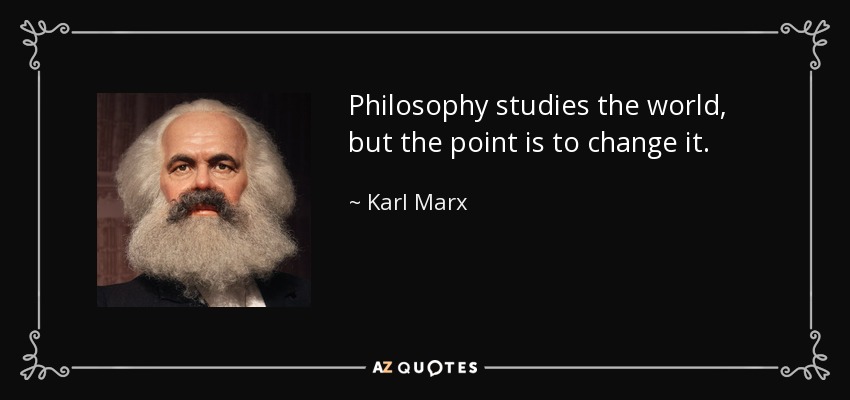
And why start this post by quoting Marx himself? Because that quote is more than enough. More than enough proof for Marx being a bully. It’s OK to ‘change the world’ if you own it. If it was yours… But bearing in mind that there are other people living in the same world… wouldn’t it be nice to ask their opinion about the whole thing? About the changes you want to make? Which changes will dramatically affect the world they live in?!? They are simpletons? Whose opinions are worthless? Because you said so yourself?
There is an old ‘rule’ which maintains that even a broken watch may be accurate. From time to time, if it retains its arms… Twice daily, to be precise!
Same thing is valid for people. From time to time, each of us will utter something which actually makes sense!
Sort of, anyway…
The catch being that in order to ‘prove’ the temporary accuracy of the broken watch you need one in good working order. Or, alternatively, you need a good understanding of time.
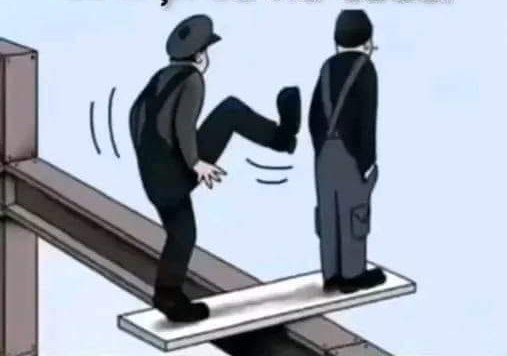
Same thing with Peterson’s uttering. On the face of it, the phrase is catchy. In fact, it’s just as useful as a broken watch. What solace will be felt by the victim of a tough tyrant when that person realizes that no tyrant, however tough, was ever capable of ‘achieving’ anything without the compliance of the weak? Without the compliance of those who had done, in their weakness, what the tyrant had told them to do…
So yes, broken watches are, sometime, accurate. And yes, Petersen is right to tell us that both tough and weak people can wreak a lot of havoc.
But neither of these two pieces of trivia will be useful to us until we’ll understand it’s up to us to put them to good use. To understand the temporary nature of the accuracy displayed by the broken watch and the fact that no man, however tough, becomes really dangerous unless condoned, or even helped, by ultimately hapless weaklings.
The things we believe are what we have in common with those who promote them.
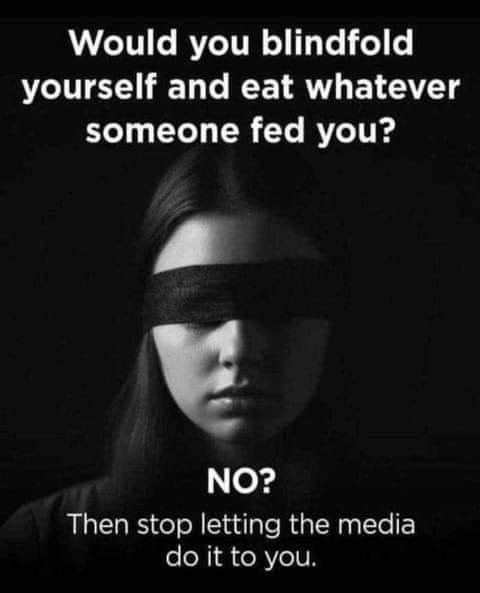
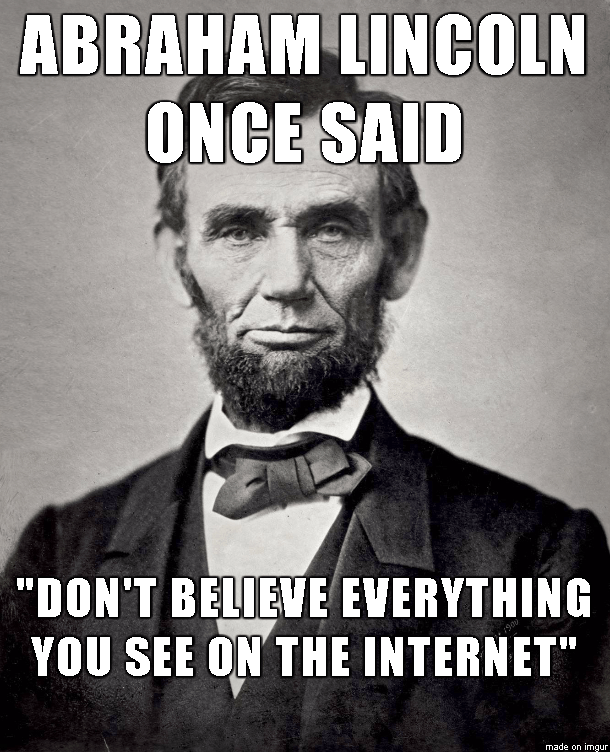
Well, nobody ‘blindly’ beliefs anything published in the media! We use our cognitive biases in order to do that.
The media publishes the things we like to hear. To sell advertising space, to please their sponsors… While those who actually do this, the journalists, appease their consciences with ‘we have to give them what they want’. ‘Cause we actually do ‘buy’ their stuff…
And we believe the things we read in the kind of press we ‘buy’ because we no longer bother to keep in check our cognitive biases!
Who has anything to gain? From this vicious circle spinning faster and faster?
Nobody, really! But we all have something to lose.
Everything, actually!
When was the last time you met a dead person who regretted anything?
According to Schoppenhauer’s take on the matter, we make sense of the world by carefully (?) ruminating the “pictures in our head”. The information which has already reached our ‘inner forum’. Which means that we should be very careful when letting something ‘in’! When reading a text, for example…
‘You should follow science, not scientists. Because scientists can be sold.’
Logically speaking, the phrase makes a lot of sense. Right?
Practically… not so much.
Do we learn everything about medicine before taking the pill prescribed by the doctor? Simply because the doctor might have been sold to the big pharma? Do we learn everything about microwaves before using a microwave oven? Simply because the physicist who had invented the thing might have been sold to the makers of household appliances? Do we stop using planes because they are used to spray our skies?
Literary speaking, what do you make of “scientists can be sold to the highest bidder”?!? Sold by whom? How can anybody sell a scientist? I might understand the notion of a scientist being bought… of a scientist selling his soul, his scientific soul, to the highest bidder… but selling one… Is there a market for scientists?
only because it happens to resonate with something you are already inclined to believe.
I’ve been watching this, on and off, for three days now. And I still can’t make up my mind. Whom to admire more.
The one who performs what he believes to be normal. And somehow manages to include, into that normalcy, the negative feedback he is been dished out by the most powerful agent in his world. Or the other one. Who pursues his side of normal. Who finds in him to investigate when he realizes the two normals don’t fit. And the courage to make amends.
Thank you Elvis Naçi for this conundrum. I’m a better person now. Now that I’ve stated my impotence.
Some people argue that ‘truth lies somewhere in between’ while others maintain that ‘truth is where it is, not somewhere in the middle’.
Well, both sides are right.
Truth is, indeed, “where it is”. The problem being that ‘that place’ is ‘out there’. Not necessarily ‘out of reach’ but definitely out of anybody’s realm. Hence finding ‘that place’ needs a collective effort. In this sense, the truth is, indeed, somewhere ‘in the middle’. In the middle of our converging efforts, if our efforts are honestly targeted.
On the other hand, truth is not ‘somewhere in the middle’. In the sense that truth is not something we can negotiate. We can indeed pursue truth individually but we cannot negotiate the results.
We can settle for a less than perfect truth, if we’re not able to reach ‘the absolute’, but it must be a workable version, not a lukewarm mean. The result of our quest, even if ‘only for a while’, must serve the goal we’ve been trying to reach! If we settle for something only because that something titillates the ego of the majority amongst us… then our efforts have been wasted!
Allow me to conclude that the truth is not somewhere between us but above us. It makes a lot of sense to thread carefully when trying to reach it – lest we stumble during our quest – but we nevertheless need to broaden our perspective. Lest the truth remains hanging just outside of where we’re looking for it.
For ‘man made’ things to happen – for anybody to do anything – three requirements must be met first. ‘Circumstances’, ‘determination’ and ‘opportunity’.
To serve a meal, the chef needs ingredients and tools, willingness to do it and a hungry client. To engage in an act of terrorism, the terrorist needs a certain set of circumstances, the ‘determination’ to do ‘it’ and a ‘trigger’.
Is it far-fetched to compare these two things? Feeding people and killing them?
From a ‘deterministic’ point of view, there’s no difference between deciding to serve a bowl of pasta and deciding to deliver a bomb. The consequences are, obviously, completely different. Supporting life versus taking it away.
There are more differences. Nobody has yet seriously considered banning restaurants and everybody hates terrorism. When subjected to acts of terrorism! Otherwise…
Meanwhile, PKK continues to remain a terrorist organization!
So… Just as food tastes vary enormously, so does various people’s interpretations on what constitutes a terrorist act. The first constant being the fact that food sustains life while terror tends to make it difficult. And the second one being the fact that both restaurants and terrorist acts are community based phenomena.
A restaurant depends on the people who deliver the goods, on those who operate it and on the paying customers who keep the business afloat. A terrorist depends on those who help and facilitate. And a terrorist depends on the rest of the community turning a blind eye towards what’s going on. For no matter what reasons! Until they realize how foolish they have been…
‘But who is a terrorist?’
That’s a very good question! There are up to three types of ‘associates’ in any act of terrorism. The ‘direct operator’, the ‘first hand facilitators’ and the ‘people behind’. While it is quite simple to understand the roles played by the ‘direct operators’ and by the ‘first hand facilitators’, things become murkier when it comes to the ‘people behind’. For some – including for me, the current Iranian leadership are among the ‘people behind’ the Hamas terrorist organization. But what about those who, willingly or unwittingly, make it so that whole communities become ‘restless’? Restless enough to generate terrorists and careless enough to turn a blind eye towards terrorist acts being prepared in their midst?
My point being that just as nobody becomes a celebrity chef overnight, it’s almost inconceivable that anybody might engage in major acts of terrorism without being helped by some and noticed by many. And just as a chef has to be talented to become noticed, a ‘direct operator’ needs to be in a ‘particular’ state of mind in order to operate. But just as an untalented cook is, eventually, ‘set aside’ by a run of the mill community, a willing ‘direct operator’ ends up, literally, being embraced by a ‘triggered’ community. Or is eventually ‘sent away’ by a normal one. By a properly functioning society!
Just before starting this post, I heard somebody commenting on Antonio Guterres’s words: ‘Even if he will not have to resign, he won’t get another mandate’… Now, as a coda, I feel the need to share that comment with you.






 nicichiarasa