Archives for category: Mutual Respect

What are the errors of Marxism?
Marxism is an ideology.
Ideologies don’t have errors, they are thought templates used to evaluate a certain situation and to determine what to do next. Ideologies are tools.
They can be used properly or improperly.
Sometimes, the best use for certain tools is to be left alone. Particularly when you understand they are useless. If you understand they are useless…
Hence it’s not Marxism which is full of errors, it’s the Marxists who are barking up the wrong tree.

If you really need to put your finger on something, if you need to point out a culprit, I give you Marx.
Yes, Karl Marx is your man.
His analysis was brilliant. His diagnostic was spot on.
“Finally, in times when the class struggle nears the decisive hour, the progress of dissolution going on within the ruling class, in fact within the whole range of old society, assumes such a violent, glaring character, that a small section of the ruling class cuts itself adrift, and joins the revolutionary class, the class that holds the future in its hands. Just as, therefore, at an earlier period, a section of the nobility went over to the bourgeoisie, so now a portion of the bourgeoisie goes over to the proletariat, and in particular, a portion of the bourgeois ideologists, who have raised themselves to the level of comprehending theoretically the historical movement as a whole.”
His cure – the mandate he gave to the “bourgeois ideologists who have raised themselves to the level of comprehending theoretically the historical movement as a whole”, and whom he called “communists” – was abysmal.

Which tells us Marx’s brilliant analysis wasn’t deep enough. He had noticed a series of facts but he had failed to notice the bigger picture. He had failed to see that all authoritarian regimes had failed. Under their own weight. Inevitably. And he had failed to notice that all democratic regimes had survived, and thrived, for as long as they had managed to preserve their democratic nature.

Hence the Marxist cure, communism, was stillborn.
A tool to be left alone.
The attempt to impose yet another authoritarian regime – with no matter how generous intentions – after the overwhelming experience of all other authoritarian regimes failing abysmally, is nothing but the compelling proof of social and historical blindness.

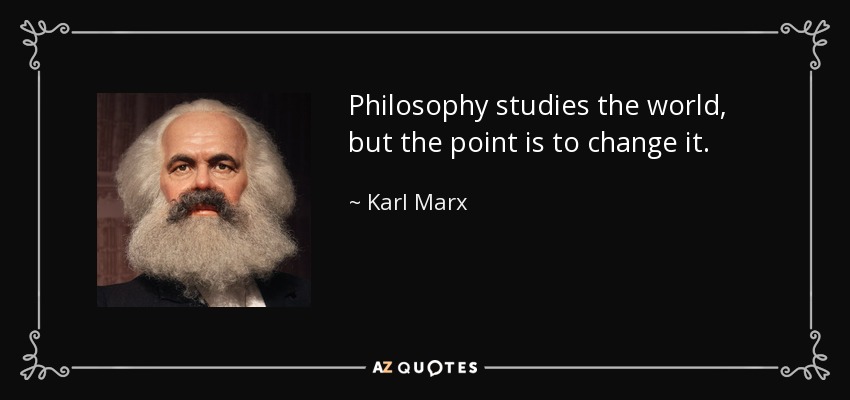
And why start this post by quoting Marx himself?
Because that quote is more than enough. More than enough proof for Marx being a bully.
It’s OK to ‘change the world’ if you own it. If it was yours…
But bearing in mind that there are other people living in the same world… wouldn’t it be nice to ask their opinion about the whole thing? About the changes you want to make? Which changes will dramatically affect the world they live in?!?
They are simpletons? Whose opinions are worthless? Because you said so yourself?

“The lower middle class, the small manufacturer, the shopkeeper, the artisan, the peasant, all these fight against the bourgeoisie, to save from extinction their existence as fractions of the middle class. They are therefore not revolutionary, but conservative. Nay more, they are reactionary, for they try to roll back the wheel of history. If by chance, they are revolutionary, they are only so in view of their impending transfer into the proletariat; they thus defend not their present, but their future interests, they desert their own standpoint to place themselves at that of the proletariat.

The “dangerous class”, [lumpenproletariat] the social scum, that passively rotting mass thrown off by the lowest layers of the old society, may, here and there, be swept into the movement by a proletarian revolution; its conditions of life, however, prepare it far more for the part of a bribed tool of reactionary intrigue.”

As I just said.
Bullly!!!

There is an old ‘rule’ which maintains that even a broken watch may be accurate.
From time to time, if it retains its arms…
Twice daily, to be precise!

Same thing is valid for people.
From time to time, each of us will utter something which actually makes sense!

Sort of, anyway…

The catch being that in order to ‘prove’ the temporary accuracy of the broken watch you need one in good working order. Or, alternatively, you need a good understanding of time.

Same thing with Peterson’s uttering.
On the face of it, the phrase is catchy.
In fact, it’s just as useful as a broken watch.
What solace will be felt by the victim of a tough tyrant when that person realizes that no tyrant, however tough, was ever capable of ‘achieving’ anything without the compliance of the weak? Without the compliance of those who had done, in their weakness, what the tyrant had told them to do…

So yes, broken watches are, sometime, accurate.
And yes, Petersen is right to tell us that both tough and weak people can wreak a lot of havoc.

But neither of these two pieces of trivia will be useful to us until we’ll understand it’s up to us to put them to good use. To understand the temporary nature of the accuracy displayed by the broken watch and the fact that no man, however tough, becomes really dangerous unless condoned, or even helped, by ultimately hapless weaklings.

The things we believe
are
what we have in common
with those who promote them.

Well, nobody ‘blindly’ beliefs anything published in the media!
We use our cognitive biases in order to do that.

The media publishes the things we like to hear.
To sell advertising space, to please their sponsors…
While those who actually do this, the journalists, appease their consciences with ‘we have to give them what they want’. ‘Cause we actually do ‘buy’ their stuff…

And we believe the things we read in the kind of press we ‘buy’ because we no longer bother to keep in check our cognitive biases!

Who has anything to gain? From this vicious circle spinning faster and faster?

Nobody, really!
But we all have something to lose.

Everything, actually!

When was the last time you met a dead person who regretted anything?

The Universe has no other meaning
than that we attach to it.

How do we find that meaning? How do we make sense of things?

“The subjective and the objective,” writes the philosopher, (Schoppenhauer) “constitute no continuum, that which is immediately known is limited by the skin, or rather by the external end of the nerves which lead out from the cerebral system. Within lies a world of which we have no other knowledge than through pictures in our head.” Stephen S. Colvin, 1902

According to Schoppenhauer’s take on the matter, we make sense of the world by carefully (?) ruminating the “pictures in our head”. The information which has already reached our ‘inner forum’.
Which means that we should be very careful when letting something ‘in’!
When reading a text, for example…

‘You should follow science, not scientists. Because scientists can be sold.’

Logically speaking, the phrase makes a lot of sense. Right?

Practically… not so much.

Do we learn everything about medicine before taking the pill prescribed by the doctor? Simply because the doctor might have been sold to the big pharma?
Do we learn everything about microwaves before using a microwave oven? Simply because the physicist who had invented the thing might have been sold to the makers of household appliances?
Do we stop using planes because they are used to spray our skies?

Literary speaking, what do you make of “scientists can be sold to the highest bidder”?!?
Sold by whom? How can anybody sell a scientist?
I might understand the notion of a scientist being bought… of a scientist selling his soul, his scientific soul, to the highest bidder… but selling one… Is there a market for scientists?

only because it happens to resonate with something you are already inclined to believe.

‘Evolution is not about “the survival of the fittest”.
Evolution is about the demise of the unfit!’

What Evolution Is, Ernst Mayr

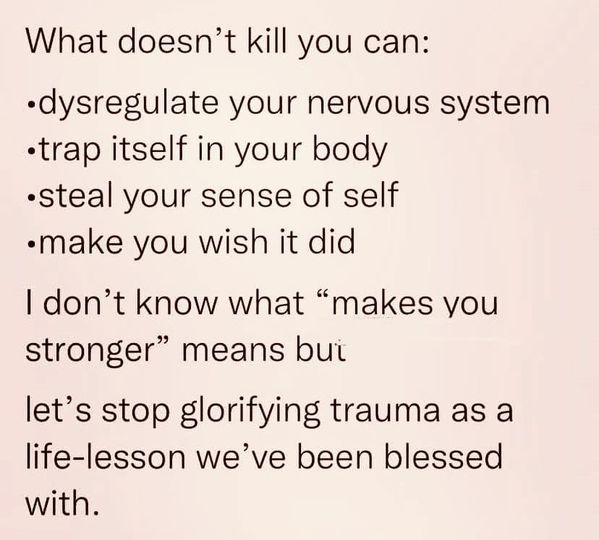
It’s not ‘what doesn’t kill you’ which may make you stronger.
You are! That guy….

But only if you learn enough from the experience!


I’ve been watching this, on and off, for three days now.
And I still can’t make up my mind. Whom to admire more.

The one who performs what he believes to be normal. And somehow manages to include, into that
normalcy, the negative feedback he is been dished out by the most powerful agent in his world.
Or the other one.
Who pursues his side of normal. Who finds in him to investigate when he realizes the
two normals don’t fit. And the courage to make amends.

Thank you Elvis Naçi for this conundrum.
I’m a better person now.
Now that I’ve stated my impotence.

“I can’t make up my mind on this one!”

But maybe I don’t have to.

Some people argue that ‘truth lies somewhere in between’ while others maintain that ‘truth is where it is, not somewhere in the middle’.

Well, both sides are right.

Truth is, indeed, “where it is”.
The problem being that ‘that place’ is ‘out there’. Not necessarily ‘out of reach’ but definitely out of anybody’s realm.
Hence finding ‘that place’ needs a collective effort. In this sense, the truth is, indeed, somewhere ‘in the middle’. In the middle of our converging efforts, if our efforts are honestly targeted.

On the other hand, truth is not ‘somewhere in the middle’. In the sense that truth is not something we can negotiate. We can indeed pursue truth individually but we cannot negotiate the results.

We can settle for a less than perfect truth, if we’re not able to reach ‘the absolute’, but it must be a workable version, not a lukewarm mean.
The result of our quest, even if ‘only for a while’, must serve the goal we’ve been trying to reach!
If we settle for something only because that something titillates the ego of the majority amongst us… then our efforts have been wasted!

Allow me to conclude that the truth is not somewhere between us but above us.
It makes a lot of sense to thread carefully when trying to reach it – lest we stumble during our quest – but we nevertheless need to broaden our perspective. Lest the truth remains hanging just outside of where we’re looking for it.

‘Things’ “did not happen in a vacuum“.

For ‘man made’ things to happen – for anybody to do anything – three requirements must be met first.
‘Circumstances’, ‘determination’ and ‘opportunity’.

To serve a meal, the chef needs ingredients and tools, willingness to do it and a hungry client.
To engage in an act of terrorism, the terrorist needs a certain set of circumstances, the ‘determination’ to do ‘it’ and a ‘trigger’.

Is it far-fetched to compare these two things?
Feeding people and killing them?

From a ‘deterministic’ point of view, there’s no difference between deciding to serve a bowl of pasta and deciding to deliver a bomb.
The consequences are, obviously, completely different.
Supporting life versus taking it away.

There are more differences.
Nobody has yet seriously considered banning restaurants and everybody hates terrorism.
When subjected to acts of terrorism! Otherwise…

Meanwhile, PKK continues to remain a terrorist organization!

So…
Just as food tastes vary enormously, so does various people’s interpretations on what constitutes a terrorist act.
The first constant being the fact that food sustains life while terror tends to make it difficult.
And the second one being the fact that both restaurants and terrorist acts are community based phenomena.

A restaurant depends on the people who deliver the goods, on those who operate it and on the paying customers who keep the business afloat.
A terrorist depends on those who help and facilitate. And a terrorist depends on the rest of the community turning a blind eye towards what’s going on. For no matter what reasons! Until they realize how foolish they have been…

‘But who is a terrorist?’

That’s a very good question!
There are up to three types of ‘associates’ in any act of terrorism.
The ‘direct operator’, the ‘first hand facilitators’ and the ‘people behind’.
While it is quite simple to understand the roles played by the ‘direct operators’ and by the ‘first hand facilitators’, things become murkier when it comes to the ‘people behind’.
For some – including for me, the current Iranian leadership are among the ‘people behind’ the Hamas terrorist organization. But what about those who, willingly or unwittingly, make it so that whole communities become ‘restless’?
Restless enough to generate terrorists and careless enough to turn a blind eye towards terrorist acts being prepared in their midst?

My point being that just as nobody becomes a celebrity chef overnight, it’s almost inconceivable that anybody might engage in major acts of terrorism without being helped by some and noticed by many.
And just as a chef has to be talented to become noticed, a ‘direct operator’ needs to be in a ‘particular’ state of mind in order to operate. But just as an untalented cook is, eventually, ‘set aside’ by a run of the mill community, a willing ‘direct operator’ ends up, literally, being embraced by a ‘triggered’ community.
Or is eventually ‘sent away’ by a normal one. By a properly functioning society!


Just before starting this post, I heard somebody commenting on Antonio Guterres’s words: ‘Even if he will not have to resign, he won’t get another mandate’…
Now, as a coda, I feel the need to share that comment with you.

“Behold, the man has become as one of Us,
to know good and evil.
And now,
lest he put forth his hand and take also of the tree of life,
and eat and live for ever:
Therefore the Lord God sent him forth from the garden of Eden,

to till the ground from whence he was taken.“

Tradition is a collection of knowledge. Which has been agglutinating in time and is used as a ‘benchmark’ by the currently living keepers of the relevant tradition.
‘Relevant’ in the sense that not everything which is still remembered continues to be useful.

Functionally speaking, tradition is both a filter we use to interpret the reality and a guide we use when shaping future action. And we use it simply because the alternative would be to start from scratch whenever we see anything or have to do something. Like a child learning to walk and speak.
Like a child who keeps saying ‘what is this and why do I have to…’
We get many of those answers from the traditions passed over by our ancestors. Without these traditions we would be like a lonely child. A collective child who keeps asking for direction but who gets no answer. Because there’s no one around to answer…

Ideology is also a collection of knowledge. Which has been put together, edited or both at the same time by an ideologue. Or group of ideologues.
Psychologically speaking, ideology and tradition work in the same way. Both as a filter used when interpreting reality and as a guide for future action.

But there are some differences.

Tradition has been vetted by evolution.
Individual traditions have evolved themselves. No modern Jew would ever consider stoning to death “a woman who had been caught in adultery”. Even if this used to be the biblical standard punishment for such a transgression…
Some traditions have disappeared altogether. Because, at some point, they had ceased to be relevant. Their teachings were no longer helpful… At some point, those who were living in those traditions had understood, one way or another, that their particular tradition was suggesting an interpretation of reality which was … wrong! So wrong/useless that the entire tradition had to be abandoned. Like the Egyptian pyramids.
Other traditions are still alive today. Because at least parts of them continue to be relevant for those who keep them. “And God said, Let us make man in our image, after our likeness: and let them have dominion over the fish of the sea, and over the fowl of the air, and over the cattle, and over all the earth, and over every creeping thing that creepeth upon the earth”.

In fact, what we call ‘modern civilization’ is based entirely upon this particular piece of tradition.
We’ve built it together, as children of the same father. We’ve been building it under the authority of the said father, who had given us dominion over everything which was moving under the sun. And the fact that we considered ourselves to be the children of the same father – siblings, hence equals – has given birth to the very notion of human rights.

Ideology, on the other hand, is still fresh. Some of it might make it, some of it might break us.

The bible itself has been nothing more but a piece of ideology. When it was written…
The fact that those who had been inspired by the bible have survived, as a flock, for so long is a strong suggestion that the biblical tradition has been useful. That, overall, the suggestions derived by the ‘keepers’ from this particular tradition have helped them in their quest.

Other ideologies have been less successful…

Communism, for instance.
On the face of it, the communist ideology is a continuation of the christian tradition. People are to be considered equals, resources are to be shared among the members of the community… what more can you wish?
Well, it didn’t work out that way. It actually failed. Abysmally. I know, I’ve been there myself.

I’m not going to delve into why some ideologies work – and live to become traditions – while others fail.
I’m not God, I don’t know everything.
What is plainly visible, for those who want to see, is that authoritarianism – under any ideological pretext – is doomed to fail. This being the reason for which God – or the wise guy who wrote that passage – had banned Man from the garden of Eden. An immortal man would stick to his convictions until it would be too late. Until the heaven would had fallen upon his shoulders….

I cannot end this before sharing with you what prompted me to write it.
The goal of Hamas – ideologically shaped and ideologically imposed upon its followers, regardless of any of the circumstances – is to destroy the state of Israel and to replace it with an islamic state. Is there a ‘promise’ about how people will live once that islamic state would be imposed? Except that they will have to obey?
The goal stated by the communist ideology was equality! Not people’s happiness or anything like that. The way to obtain that goal was a continuous revolution. A sort of jihad, if you will…
Now look at what Hamas has accomplished. At what Marx’s communists had accomplished…

Choose wisely.
‘Cause each of us is born into a tradition. Into a particular tradition…
But ideology is something that each of us chooses. And can give up!

Man has a natural tendency to prey on other people.
This being the reason why humans must be educated
and for which we need a lot of coercive measures.

I strongly disagree.
The first sentence is utterly wrong and the second is brazenly manipulative.

Something which can be educated isn’t ‘natural’. Not in the sense implied above!
People can be educated to eat in a certain manner. As in having ‘table manners’.
People can be educated about what to eat. And what to avoid eating. To avoid eating things which are both delicious and nourishing.
People can be educated even about how much to eat!
But you cannot educate anybody to stop eating!

What is truly natural about ‘Man’ – about all people, actually – is that they need to interact with other people. In order to become full fledged human beings, people need to live among other people.

What can be educated is behavior. How to interact with other people.

People can be educated to cooperate.
Or people can be educated to gang up. And prey on those outside the gang.

Please note that those who gang up in order to prey on others do cooperate among themselves!
Even if that cooperative behavior has a strong hierarchical nature.