Archives for category: Mutual Respect

“America’s abundance was not created by public sacrifices to “the common good,” but by the productive genius of free men who pursued their own personal interests and the making of their own private fortunes. They did not starve the people to pay for America’s industrialization. They gave the people better jobs, higher wages, and cheaper goods with every new machine they invented, with every scientific discovery or technological advance—and thus the whole country was moving forward and profiting, not suffering, every step of the way.”

Ayn Rand

OK, she borrowed this idea from Adam Smith, without mentioning him… let bygones be bygones…

A more interesting endeavor would be to learn something from all this.

‘Abundance was not created by public sacrifices’.
Makes a lot of sense. In a free market everybody gets what they are offered, ideally in close accord to what each of them had brought to the market.

‘Abundance was created by the productive genius of free people who pursued their own personal interest and the making of their own private fortunes’.
Now, whose ‘productive genius’ are we speaking about here?

About Ford’s, for instance, or about that of his workers?

At the time, workers could count on about $2.25 per day, for which they worked nine-hour shifts. It was pretty good money in those days, but the toll was too much for many to bear. Ford’s turnover rate was very high. In 1913, Ford hired more than 52,000 men to keep a workforce of only 14,000. New workers required a costly break-in period, making matters worse for the company. Also, some men simply walked away from the line to quit and look for a job elsewhere. Then the line stopped and production of cars halted. The increased cost and delayed production kept Ford from selling his cars at the low price he wanted. Drastic measures were necessary if he was to keep up this production.

Tim Worstall, Forbes Magazine

Anyway you look at it, both Ford and his workers were acting as ‘rational economic agents’. Ford was paying them the going rates in the industry and they were putting in as little effort as they could afford to.

That went on until Ford came up with a ‘new idea’. “It can indeed be cheaper to pay workers more but to reduce the turnover of them and those associated training costs.” “The point is not so as to be paying a “decent wage” or anything of that sort: it is to be paying a higher wage than other employers. That gets your workforce thinking they’ve got a good deal (for the clear reason that they have got a good deal) and if the workers think they’ve got a good deal then they’re more likely to turn up on time, sober, and work diligently.”

Again, a very reasonable attitude displayed by both parties.
An attitude made possible by the fact that both the car and workforce markets were free.
Ford could hire anybody/sell his cars to whomever had enough money to buy them while his workers were free to leave their previous workplaces and accept Ford’s offer. Or leave him if they found a better one.

And let’s not forget the fact that Ford was not alone, at that time. At the turn of the XX-th century there were hundreds of automobile producers in the US alone and this was one of the reasons for which the workers could afford to be so ‘picky’ – specially those who had some experience.

In this situation – where the market was really free, each party taking good care of their own interest yielded excellent results.
Ford had became one of the leading car manufacturing corporations.
The diligent workers continuously improved their living standards.
The society, as a whole, prospered. And learned, or should have had, the long term benefits of commitment and mutual respect.

What happened after the market was no longer free?

Meaning that instead of hundreds of car manufacturers competing for the best available workers we had for a considerable number of years only three corporations more interested in short term profiteering rather than improving their products?
And instead of diligent workers striving to improve their skills we had union members more interested in their week-end barbecues?

“The U.S. government bailout of the auto industry lasted from January 2009 to December 2013. The Big Three automakers approached Congress in November 2008. They warned that, without the bailout, GM and Chrysler faced bankruptcy and the loss of one million jobs. Ford didn’t need the funds, since it had already cut costs. But it asked to be included so it wouldn’t suffer by competing with subsidized companies.

The Treasury Department invested $80.7 billion from the $700 billion authorized by EESA. It recouped all but $10.2 billion…”

Kimberly Amadeo, thebalance.com

Some of you might tell me that the Japanese car manufacturers operate along more or less the same guide-lines. ‘Cradle to grave’ employment for the workers, a rather opaque management never held accountable until too late…
A very correct observation.
Only there is a huge difference between the Japanese work-ethos and ‘the American Dream’. The Japanese have a long history of being told to ‘fit in’ while most Americans have gradually convinced themselves that ‘getting rich’ is the only possible solution for all their problems…

Considering that both Japan and America seem to have reached two different cul-de-sacs it wouldn’t be farfetched to suggest that both are doing something wrong.

For almost 30 years now Japan has been running in circles. She hasn’t completely lost her edge but hasn’t performed as it used to.
The most worrying indicator – for me, at least, being the fact that they have given up ‘making’ children. As if the present generation doesn’t have much hope for/expectations from the future.
For almost 30 years now the American people has allowed a huge trench to grow larger and larger in their mist. The haves on one side, the have-nots on the other and the rift so wide that they are no longer able hear each-other. A present day Henry Ford would have no idea about how much to pay his workers in order to obtain similar results to those achieved at the start of the XX-th century…

Is there a ‘common cause’ that might explain what’s going on on both sides of the Pacific?
How about both cultural and economic spaces experiencing a somewhat similar decrease in individual liberty, the phenomenon having rather different causes in each of the two cases?

First of all, ‘dedication to duty’ can take you only that far. It is very useful for those wishing to ‘close a gap’ but acts similarly to an ankle weight for those who are in the position to attempt to ‘take the lead’. ‘Dedication to duty’ focuses the attention of the team to ‘obeying the rules’ while ‘taking the lead’ means leaving the ‘straight and narrow’ and venturing into the unknown.
These two situations imply completely different mind frames.

Secondly, those who venture outside the ‘safety of the perimeter’ need to follow a simple rule.

“Leave no man behind”.

” “When you have a conscript army and you can always replenish it just by adding more people, you don’t really have to care about whether they’re happy with what they’re doing,” Springer said.

Now the military had to care about its soldiers as individuals, and the idea that it would never leave them behind became something of a familial bond.

“It’s kind of a contract with the service,” Springer said. “You promise to serve us, we promise not to leave you.” “


You see, time and time again history has hinted to us that freer societies fared better, ceteris paribus, compared to ‘tighter knit’ ones.
For example, subjected to the same communist knut, Poland came out differently than my native Romania.

And while most people agree about Poland being in a better shape than Romania, there is very little agreement about a possible explanation.
Just as most people agree about ‘liberty is good’ while each of those people derive different meanings from the very concept of freedom.

Since it is so hard to coordinate ourselves about the meaning of a ‘simple’ word, how about taking the liberty to ‘agree to disagree’ and turn our attention to another concept?

Mutual respect.

Just think about what liberty would mean without mutual respect.

Can you imagine the liberty of someone driving a M1 Abrams tank on a highway?
Can you imagine what would happen if the driver of the tank wouldn’t treat the others with utmost respect? What would happen if the outraged others would band together and wait for the ‘mad’ driver to burn through his last drop of fuel?

You see, people who have more respect for the rules than they have for each-other end up belonging to a society so tightly knit that it has immense troubles whenever it has to cope with unforeseen situations. Adapt to change.  Confront a catastrophe…
For example, the Soviet Union, Japan and the US have a considerable number of nuclear power plants and have experienced a number of failures. The tightly knit Soviet Union and Japan have displayed commendable individual acts of heroism in the aftermath of such incidents but it was the more individualistic US who has somehow ‘ducked’ any serious experience of this kind.

On the other hand, I see potential trouble when I hear people stating that “My right to swing my fist ends where your nose begins”.
On the face of it, this sounds perfectly reasonable.
Only the whole thing absolutely depends on both individuals involved in it having comparable reach. Do you really think that a guy with twice the ‘wing-span’ of his opponent would continue to stick to this rule if the by-standers would not band together to stuff it down his throat?

My point being that no ‘market’ is really free if its freedom relies primarily on a set of rules instead of depending on a healthy dose of sincerely upheld mutual respect among the participants to that market.
In this instance ‘free’ and ‘freedom’ are perfectly interchangeable with functional/sustainable.

The communist centrally planned economies had failed abysmally  simply because the powerfuls of the day had nothing but contempt for those under their rule.
Japan’s strict set of rules about what constitutes proper behavior in each situation seems to act as a brake whenever decisive action is needed.
America’s new mantra, ‘greed is good’, has time and time again produced speculative bubbles which have inevitably ended up badly. Under its spell, the market actually looses every shred of liberty. Exactly as a hypnotized group of people think of themselves as being free while sheepishly obeying the orders of their herder.
I gather you all know what ‘herd behavior’ means…

Compare Ayn Rand’s words to Adam’s Smith original idea.

“It is not from the benevolence of the butcher, the brewer, or the baker that we expect our dinner, but from their regard to their own interest. We address ourselves, not to their humanity but to their self-love, and never talk to them of our own necessities but of their advantages.”

See what I mean?

Smith sees all ‘market goers’ as equals who freely address each other while Rand applauds “the productive genius of free men” who, in pursuit of “their own private fortunes” had the magnanimity to bestow upon “the people better jobs, higher wages, and cheaper goods with every new machine they invented, with every scientific discovery or technological advance”.

I, for one, fail to detect any shred of actual respect towards “the people” in the behavior so laudatory described by Rand.
And I’ll let you be the judge whether her description fits the current ‘state of the nation’.
Anywhere on the planet, not only in the US.

“and thus the whole country was moving forward and profiting, not suffering, every step of the way.”

jobless men keep going


Each of us tries to deliver themselves from the misery of this world.

We attempt that at the intersection of three realities.

The ‘hard’, the ‘virtual’ and the ‘socially constructed’.

The ‘hard’ one is what Marx called ‘the objective reality’. Whatever exists outside our individual minds. Whatever doesn’t need any confirmation from any of us.
For instance, a rock can very well lay on the bottom of the sea without any conscious agent being aware of its existence. No one might ever become aware of its existence but that actually doesn’t matter. Same thing goes for a man made piece of furniture. The original craftsman might die, the owner also,  and the ‘thing’ might be forgotten in a warehouse – or attic – without its existence, ‘in the hard reality’, being jeopardized in any way.

The ‘virtual’ one is whatever each of us makes of what happens around them. It consists of three, separate yet interdependent, ‘ingredients’. The ‘perceived’ realities, the ‘intended’ realities and the ‘engines’ that make all of them possible – our conscious selves.
I’m speaking of ‘realities’ because each of us is different from all others – hence ‘sees’ slightly differently from all others, cannot inhabit the same place in space – hence ‘sees’ the world from a slightly different perspective, doesn’t have the same goals – hence entertains different intentions.

The ‘socially constructed one’ comprises the aggregate consequences of our efforts. Intended and unintended. Known to us and unknown by us.  Belonging both to the physical and metaphysical realms. As in both the Egyptian pyramids and language being parts of the socially constructed reality.

Please note that the first and third ones are ‘objective’ in Marx’s terms while the second in purely subjective.
It is also worth noting that the ‘hard’ reality is not immune to our efforts and that the ‘socially constructed one’ becomes ‘harder’ with the passage of time. The pyramids dotting the banks of the Nile constitute a very good example of our ability to change the ‘hard’ reality while the Catholic Church – one institution among many – is a good example of a metaphysical construct resilient enough to survive for two millennia.

Another very interesting ‘social construction’ is the concept of liberty.

I find it very interesting because it is simultaneously ‘objective’ and ‘subjective’, ‘natural’ as well as ‘man-made’.
It is objective in the sense that it continues to exist no matter how many individuals subject themselves to abject spiritual slavery.
It is subjective in the sense that each of us understands freedom in their own way.
It is ‘man made’ in the sense that we have coined the concept and minted the words used to describe it.
Yet it is ‘natural’ since we all are made of flesh and blood and need to breath in order to stay alive. And yes, it is us who have invented the dog-collar and the leash we use to restrain the liberty of our dogs. Exactly because it is natural for them to try to be as free as possible.

Since this is but a blog post I’ll fast forward to what I had in mind for today.

The free market.

Which is, evidently, a socially constructed institution.
Supposedly, a place which miraculously transforms “private vices” into “publick benefits“.

Well, I’m afraid that those who have convinced themselves that ‘greed is good’ have understood nothing of Bernard Mandeville’s stark warning.

A market may be fueled by ‘greed’, or even by (evil)’vices’, but it is the freedom of those who partake in that market which keeps everything in check.

The communist centrally planned economies were also fueled by individual lust for power. They failed simply because no small group of people is smart enough to master such complicated matters nor humble enough to see/accept its limitations.

The very same lack of freedom has produced the financial crises of 2008.

‘Greed is good’ is nothing but a rationalization of the current obsession with monetary rewards over the very shortest time frame coupled with a blatant disregard for the longer term consequences of our actions.

And as any drug addict can confirm – whenever they are not ‘feeling high’, entertaining any obsession means loosing one’s freedom.

In reality, actually free markets are fueled by trust, not by greed.
And (self)governed by the fact that each participant is free to define/pursue its own interest and react to anything that is happening inside the market’.
Unfortunately, current markets are no longer free. Not that much because of governmental intervention but mainly because too many of the participants are blindly chasing the same narrowly defined ‘interest’.

“But man has almost constant occasion for the help of his brethren, and it is in vain for him to expect it from their benevolence only. He will be more likely to prevail if he can interest their self-love in his favour, and show them that it is for their own advantage to do for him what he requires of them. Whoever offers to another a bargain of any kind, proposes to do this. Give me that which I want, and you shall have this which you want, is the meaning of every such offer; and it is in this manner that we obtain from one another the far greater part of those good offices which we stand in need of. It is not from the benevolence of the butcher, the brewer, or the baker that we expect our dinner, but from their regard to their own interest. We address ourselves, not to their humanity but to their self-love, and never talk to them of our own necessities but of their advantages.”

Smith’s words could not have been any clearer. Each of the participants to the free market wants something different from the market and each of the participants trusts the others to provide those different somethings – as long as the buyers can satisfy the sellers, of course. Nobody gets robbed while everybody gets whatever specific things they had come for.
In modern terms this would have been described as an ‘everybody wins’ situation.

Compare this with the contemporary mantra.
‘Profit maximization’.
Everybody chasing the proverbial ‘fast buck’
‘Enjoy the moment’ & ‘forget about tomorrow’.

And we continue to kid ourselves about the ‘freedom’ of our markets…

Even funnier is how we have twisted Mandeville’s warning to fit our own narrative.

“Millions endeavouring to supply
Each other’s Lust and Vanity …
Thus every Part was full of Vice,
Yet the whole Mass a Paradise …
The bees, however, are not satisfied to have their viciousness mixed with their prosperity. All the cheats and hypocrites declaim about the state of their country’s morals and pray the gods for honesty. This raises the indignation of Jove, who unexpectedly grants the hive its wish.
BUT, Oh ye Gods! What Consternation,
How vast and sudden was th’ Alteration!
As Pride and Luxury decrease,
So by degrees they leave the Seas.
All Arts and Crafts neglected lie;
Content, the Bane of Industry,
Makes ’em admire their homely Store,
And neither seek nor covet more.

In this way, through the loss of their vices, the hive at the same time lost all its greatness.

Now comes the moral:
THEN leave Complaints: Fools only strive
To make a Great an Honest Hive.
T’ enjoy the World’s Conveniencies,
Be fam’d in War, yet live in Ease,
Without great Vices, is a vain
Eutopia seated in the Brain.

Fraud, Luxury and Pride must live,
While we the Benefits receive. …
So Vice is beneficial found,
When it’s by Justice lopt and bound;
Nay, where the People would be great,
As necessary to the State,
As Hunger is to make ’em eat.

Apparently, Mandeville’s verses do not make much sense.
Why would a hive which had successfully purged itself off all vices find itself in a far worse situation after the cleansing?

Let’s first try to understand what those vices were.

Millions endeavouring to supply
Each other’s Lust and Vanity …
Thus every Part was full of Vice

Let me remind you of the fact that Mandeville had lived, and written, during the same period when the Puritans were trying to impose their strict moral code on the rest of the British society. And for the Puritans any attempt, made by ‘millions’, to supply ‘each other’s lust and vanity’ (a.k.a. various personal needs and fancies) was ‘vicious’ in itself.

The point of the whole thing being that it was not the absence of vices which had brought down the hive but the obtuse single-mindedness with which the vices had been banned. A line of thought very much the same with Durkheim’s ‘normality of crime‘.

And not very much different from our current obsession with (short time) profit!


epicycle-move

“Now, in this tortured model one sees that it is possible to have retrograde motion and varying brightness, since at times as viewed from the earth the planet can appear to move “backward” on the celestial sphere. Obviously, the distance of the planet from the Earth also varies with time, which leads to variations in brightness. Thus, the idea of uniform circular motion is saved (at least in some sense) by this scheme, and it allows a description of retrograde motion and varying planetary brightness.”

Rationality is a beautiful method of relating to the outside world.
It is one of the tools we used to get where we are now.

And, like all other tools, it has its limits.

The most ‘stricturing’ one being the fact that rationality is used by us, individual people.

We are deluding ourselves with the notion that we are rational, reasonable even, human beings. That given the same set of facts each of us is potentially able to find the same ‘truth of the matter’ and only those who are ill indented will reach a different conclusion.

Ptolemy’s epicycles are just a set of the innumerable proofs that we are nothing but skillful rationalizers, far away from the reasonable individuals we believe ourselves to be.

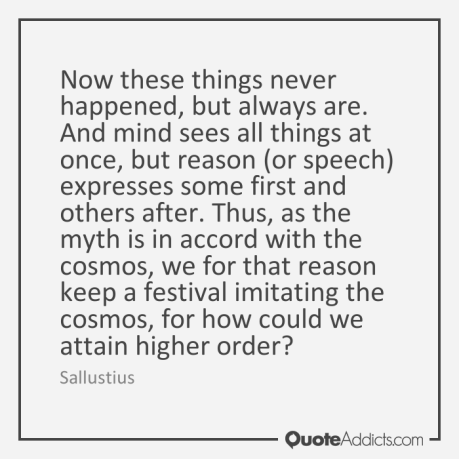
Sallustius to the rescue:

sallustius myths

The ‘things that never happened, but always are’ are the founding myths that keeps it all together for us. From the axioms on which we have built our mathematics to the religious beliefs we have forged while grooming ourselves into humans.

What happens is that not all of us have been groomed along the same myths, and even when that happened not all of us interpret a given myth in exactly the same way.

That’s why Ptolemy had invented the epicycles in his attempt to corral the planets around the Earth while Copernicus was able to propose a much simpler explanation.

Hence the notion of ‘rationalization’.
The most we can do is to honestly put together whatever facts we have at our disposal in our attempt to justify the conclusion we have already reached.
And then to respectfully accept respectfully offered reactions from those around us.

If you think of it, this is how ‘science’ works. Somebody has a hunch, gathers a lot of data, tries to fit them into the hypothesis he had started from and then submits a paper for his peers to review.
If the paper passes that scrutiny it is published – and submitted to even more criticism.
Eventually somebody else has another hunch, which includes, or even completely contradicts, the previous one…

They key words in all this being ‘honestly’ and ‘respectfully’.
Whenever we knowingly alter the facts (fake news, alternative facts,  autism causing vaccines, etc., etc…) to fit our narrative we end up in a huge mess.
Whenever we fail to respectfully examine the work of those around us and reject it before-hand we simply take a different route to the same huge mess.

WWI was the consequence of a stupid game of brinkmanship while the second one had started with a series of blatant lies. During both we had copiously murdered ourselves.

“There is a concept within Western democracies known as “loyal opposition.” It is based on the assumption that, while you may disagree with your opponent when it comes to goals, or even the means necessary to achieve those goals, you do not question your opponent’s basic patriotism or love of country.

My question for both of you: Are you willing to concede that your opponent is a patriotic American whose election does not pose an existential threat to our country?”


“Over at Emory University, political scientist Alan Abramowitz has established that Americans now line up politically according to what they hate, not what they like.

We are 50 years past Loving v. Virginia, the U.S. Supreme Court decision that overturned state bans on interracial marriage. But only three years ago, a Pew Research study found that 30 percent of hard-core conservatives would be “unhappy” if an immediate family member married a Democrat. And nearly a quarter of hard-core liberals felt the same about a family member who wedded a Republican.

We have talked and Twittered and Facebooked our way into this hole. And we will have to talk and Twitter and Facebook our way out of it.”

When your own rhetoric gives you license to commit mayhem. And worse
John Galloway, AJC.com

“the world is not a ‘global community’ but an arena where nations, non-governmental actors and businesses engage and compete for advantage…Rather than deny this elemental nature of international affairs, we embrace it.”

Rings a bell?

Sounds too neoliberal for you?

I’m afraid we are dealing with a huge communication problem here.

For some ‘competition’ has become a dirty word while some others interpret it according to their, narrow, ideology. To fit through their horse blinkers.

To make my point I’m going to use Valentine Wiggin’s Hierarchy of Foreignness. For those of you who are unfamiliar with Orson Scott Card’s work, Valentine is one of the main characters in Ender’s Game.

– An utlänning was defined as a stranger recognized as human from the same planet as a subject, but of a different nation or city. Utlänning means “foreigner” in Swedish.
– A främling was defined as a stranger recognized as human, but from a different planet than a subject. Främling means “stranger” in Swedish.
Raman were defined as strangers recognized as “human”, but of another sentient species entirely. The term was only ever used to refer to the entire species as a whole rather than an individual member. Although not a common word, it may be constructed in Swedish from rå + män, where rå indicates “coarse,” “raw” or “crude” (not refined), and män means “man” or “person.”

Varelse were defined as true aliens; they were sentient beings, but so foreign that no meaningful communication would be possible with the subject. Varelse means “creature” in Swedish.
Djur were non-sentient beings. They were capable of independent thought and action, but their mode of communication could not relay any meaningful information to the subject because the djur itself lacked the capacity for rational thought and self-awareness. Djur means “animal” in Swedish.

It’s simple to understand that this hierarchy is based on the ‘subject’s’ ability to communicate with the ‘foreigner’. But not exclusively! The whole thing also depends on both parties willing to accept the other as a ‘partner’.

In fact the entire Ender’s Game series is about Humankind wagging an all out war with an alien civilization, only to discover that the conflict was produced by a colossal misunderstanding.  Neither of the belligerents had recognized the other as ‘raman’ and, as a consequence, both had treated the other as ‘varelse’. And, eventually, the humans prevailed. The book was written by one of us…
Read the whole series, you’ll have a surprise at the end!

Coming back to ‘competition’, let me remind you that it is nothing else but the most comprehensive form of cooperation.

Not only that the participants do something in common – they all obey the same set of rules and cooperate in throwing out the cheaters – but they also help each-other to become better at whatever they are competing about.

Savvy?

What would any competition turn into if too many participants would no longer obey the rules?

Act as djurs? Obsessed by their own wishes and behaving disdainfully towards all others?


We’ve somehow trained ourselves to discriminate people into ‘thinkers’ and ‘doers’.

As if anybody has ever been able to do anything, anything at all, without first thinking about the matter at hand.

OK, we are still able to react in a more or less ‘reflexive’ manner – for instance most of us no longer ‘think about it in real time’ when walking or biking – but we do consider the matter before starting the ‘exercise’…

How about putting it a little differently? As in ‘talkers’ versus ‘doers’?

You see, people are ‘recognized’ by the manner in which they interact with what surrounds them.

If a guy is adept at growing food he will be recognized as a farmer. Whose intellectual prowess will be gauged by the quality of his vegetables. OK, he also needs some skills and just a little bit of luck but that’s another story.

If another guy is adept at speaking about things that happened in the past he will be recognized as a historian.

And considered to be  a ‘thinker’ while the farmer is always branded a doer…

Maybe because vegetables are easier to gauge than words?

There is indeed a difference between the manner in which those two generic guys think.
Most farmers, specially those who have been trained ‘on the job’, think ‘on the go’ – similar to what happens in our heads when walking or riding a bike, while all historians employ what is known as ‘discursive thinking’.
Farmers also employ ‘discursive thinking’ when consciously planning something or when explaining to someone which is he right way to harvest a certain crop but the entire ‘historic thinking’ consists of very well organized and carefully worded ideas.

You see, the main difference between those two guys is that the farmer’s main goal is to actually do something while the historian mainly needs to convince ‘his peers’.
This is why the farmer’s thinking is concerned almost exclusively with practical things while the historian needs to keep both aspects in balance. Facts are, or at least should be, important – all ‘historical stories’ should be based on facts, right? – but words are at least as important. Whenever the words had not been chosen right, the resulting story was not intelligible. The entire thinking process had been a waste of time.

This very difference also hides a huge danger.
Fake vegetables are way easier to spot than fake ideas, specially when they have been worded by a ‘skilled poet’.

We must give to each its due – agriculture was a huge step forward from hunting and gathering yet modern civilization depends very heavily on discursive thinking – but we must also exert extreme caution when judging the merits of a particular idea by the beauty of the words used to convey it.

Vegetables haven’t hurt anybody yet – as long as they had been grown properly, anyway – while most tragic things that had fallen on our heads had started as ideas. Worded well enough to convince…

Trump has been around for ages.

His buildings litter the world, his marriages were of a very public nature, his involvement with the media generated a lot of (fake?!?) reality (shows), he not only published a number of books – the most interesting, to me, being Think BIG and Kick Ass in Business and Life, but also pretended to educate us using an university he eventually had to close amid huge controversy.

Even if he was wearing a ‘fresh figure’ in politics when he presented his bid for the American Presidency he was nevertheless the epitome of a ‘public figure’.

Nobody could pretend he wasn’t aware of how Trump was going to behave.

Yet the Republican Convention nominated him as candidate, a considerable number of people had voted for him and more than half the Americans had chosen to stay home even if he was on the ballot.

People refraining from casting a ballot is easiest to explain. The alternative wasn’t any better.
Republicans nominating him as candidate is also relatively simple. They wanted so badly to ‘win’ that they had chosen not to consider all the implications.
Same thing goes for those who had voted for him. The majority of them are not the bigoted monsters the ‘other side’ fear them to be. They were just exasperated by what was happening to them.

What is harder to understand is what’s going on after the votes have been counted.

Remember that Trump was the known quantity here. Nothing surprising in his behavior.

What surprises me is that so many Republicans act as if they were hoping he was going to become presidential after the election, that the Democrats have not yet understood that they share the blame for Trump becoming what he is today and that so many of the public take sides instead of joining hands and mitigating the dangers of the current situation.

By ‘mitigating the dangers’ I don’t mean ‘impeachment’ or anything like that.

What I’m trying to say is that too many of us treat Trump as a symbol instead of as the symptom he is.

By either admiring or hating him, as a person, we allow ourselves to be divided into warring parties which no longer communicate effectively and meaningfully.

By either trying to emulate or to destroy him, or others like him, we only throw fresh fuel on an already blazing fire.

How about a little moderation?

We have learned to make, and tame, fire since humankind’s childhood.
In the last 70 years or so we have also learned to tame the atom. We are now able to build both atom bombs and power generating nuclear reactors.

How about re-learning to tame greed? For both money and power?

I’ve recently spent a few days in the Danube Delta.DSC_1146egreta mareWhen traveling on water, I was issued a ‘life-jacket’ – no picture, you all know what one looks like.

At one point, I was joking with the guide.

‘Harnessed like this, no one can do anything but wait to be rescued. It’s impossible to swim wearing such a thing.’
‘Ha!.
You thought this was meant to save your life, didn’t you?
Well, in reality its role is to keep your corpse afloat so that those looking for you wouldn’t have to dredge the river.’

I remembered the joke while reading this article.

“Apple doesn’t purposely make its terms and conditions long and boring and difficult to read. In theory it could shorten them, or summarise them, or pull out a few bullet points at the beginning to let you know if something has changed since you were last confronted with them. But if it was to do so someone could argue in court that insufficient emphasis was placed on something buried further down in the document. And Apple doesn’t want that to happen.”

People tend to treat it as if it was a ‘point’.
A theoretical concept that has been put on a table, studied from all angles, found desirable/unacceptable and which is now aggressively marketed by fervent apostles/rejected by ‘die-heart fundamentalists’.

I’m afraid it should rather be treated as a continuum.

People belonging to diverse cultures who freely decide to live together will, sooner rather than later, generate a meta-culture based mainly on intercultural mutual respect.
People belonging to diverse cultures who have to live together, without previously being asked whether they want this to happen or not, will, later rather than sooner, generate a meta-culture fusing together various cultural segments appropriated from the various cultures that were forced to coexist.
I am fascinated by the fact that both ‘extremes’ can happen simultaneously.
Individuals, usually unaware of what is going on, find ways of cooperating with members belonging to other cultures to impose/reject ‘cultural artifacts’ upon/coming from individuals belonging to other cultures.
The key of all this being a simple matter of ‘perception’.
We find it easier to cooperate with people belonging to cultures which we perceive as  ‘friendly’ and to treat with disdain those belonging to cultures which are different enough to be perceived as inferior. Hence ‘unfriendly’.

About the future, I mean!

no kids

This ‘piece of information’ keeps bouncing inside the Internet and is interpreted in various manners.

From ‘what to expect from leaders who are ‘this’ selfish’ to “I find it trashy and irrelevant. Merkel’s husband has two sons, btw.
Well… Macron’s wife also has her own children. And a few nephews.

What startled me was this reaction.
I’m under the stark realization that the most intelligent of the population have the fewest children, which might not bode well for voting statistics in the future.”

While the observation is, of course, correct, I’m afraid the interpretation attached to it is somewhat ‘confused’.

First if all, it’s not ‘intelligence’ that drives people to give birth to fewer children. Intelligence – coalesced at social level – helps a population to increase its living standard. As such, children no longer die young so parents no longer have to have so many of them. In order to have somebody help you in your older days you no longer have to give birth to more than two or three children.

If intelligence alone would have prevented people from having children Israel and the US would have been at least as ‘childless’ as Japan or most of the European Countries.
On the contrary. The US is still in a better situation than the EU, 1.8 vs 1.6, while Israel thrives at 3.1

Another way of making sense of what’s going on is to consider that people no longer make kids simply because they have reached the conclusion that ‘money’ can just as well help them cope during their older days. Since so few children live with, or at least near, their old parents this no longer seems so farfetched as it may look at first glance…

But what’s going on in Israel? They also have enough money…

The country needs soldiers to defend it’s very existence?

But, you know, Israel is a free country. Those kids could leave anytime before being drafted. As some of them do.

But most of them stay! Freely!

Then how about people giving birth having at least some connection with ‘hope’?
As in people having hope for a better tomorrow? One worth defending?

One worth making children for?

For a long time the Jewish people have written down their thoughts about the world.
At some point, about two thousands years ago, Jesus and his followers reinterpreted those ideas so new books had to be written on the same subject.
Another four centuries later the Councils of Hippo (393 AD) and Carthage ( 397) determined which of those books were to be included in what is currently known as the Bible.

The versions being circulated since were written in Latin, Hebrew, ancient Greek, Aramaic, ancient Armenian, etc.

By 1500 almost nobody but some of the priests were able to read any of them.

So Luther had decided he had to translate it. Into German.

And changed the world.

“Luther’s Bible introduced mass media, unified a nation, and set the standard for future translations.”

Since then, because modern languages are a work in progress, the Bible has been practically rewritten many times over.

Here are three versions of how Cain and Abel were born. Genesis 4:1-2.

And Adam knew Eve his wife; and she conceived, and bare Cain, and said, I have gotten a man from the Lord.

And she again bare his brother Abel. And Abel was a keeper of sheep, but Cain was a tiller of the ground.”

King James Version

Now Adam knew Eve his wife, and she conceived and bore Cain, saying, “I have gotten[a] a man with the help of the Lord.” And again, she bore his brother Abel. Now Abel was a keeper of sheep, and Cain a worker of the ground.

English Standard Version

“Adam made love to his wife Eve, and she became pregnant and gave birth to Cain. She said, “With the help of the Lord I have brought forth a man.” Later she gave birth to his brother Abel.

Now Abel kept flocks, and Cain worked the soil.”

New International Version

What next? I’ve counted 106 different versions, all written in English, on a Wikipedia page…

Luther had translated it because almost no one living in his times was able to read it by themselves.
Nowadays it seems that anybody who cares about the matter, writes their own!

I was under the impression that religion was meant to bring us together…

The Tower of Babel

11 Now the whole world had one language and a common speech. As people moved eastward,[a] they found a plain in Shinar[b] and settled there.

They said to each other, “Come, let’s make bricks and bake them thoroughly.” They used brick instead of stone, and tar for mortar. Then they said, “Come, let us build ourselves a city, with a tower that reaches to the heavens, so that we may make a name for ourselves; otherwise we will be scattered over the face of the whole earth.”

But the Lord came down to see the city and the tower the people were building. The Lord said, “If as one people speaking the same language they have begun to do this, then nothing they plan to do will be impossible for them. Come, let us go down and confuse their language so they will not understand each other.”

So the Lord scattered them from there over all the earth, and they stopped building the city. That is why it was called Babel[c]—because there the Lord confused the language of the whole world. From there the Lord scattered them over the face of the whole earth.”

Who is scattering us now?
Why are we doing this to ourselves?