Archives for category: human rights

People are very passionate when discussing about their future and their rights.
As they should be.

Children are a very strong ‘avatar’ for our future while the rights to live and to freely dispose of our bodies two of the most important rights.

And this is where things get really complicated.

Some people advocate mandatory vaccination against the most dangerous diseases.
Some people advocate women’s absolute freedom to have an abortion – a few of them extending this right up to the last moment of the pregnancy.

Other people believe that vaccines are mostly benefiting the big pharma and choose not to immunize their children.
Other people believe in the absolute right of the fetus to live – so much so that some of them would even ban all contraceptive methods.

The ‘interesting’ thing here is how this four categories of people intersect each-other.

A lot of the people who advocate women’s right to have abortions also advocate the mandatory vaccination of children while a lot of people who consider abortion a mortal sin also consider vaccination to be inspired by the devil.

Now let me get this straight.
You have the right to ‘kill’ your baby inside the womb but you should not be allowed to let them die of a preventable infectious disease?
You are to defend a fetus, at all costs and against all consequences for the mother, as long as they inhabit the womb only to let them catch whatever preventable infectious disease might come across their path?

Consistency is over-rated?

We really need to restart using our common sense?

donald-trump-andy-borowitz

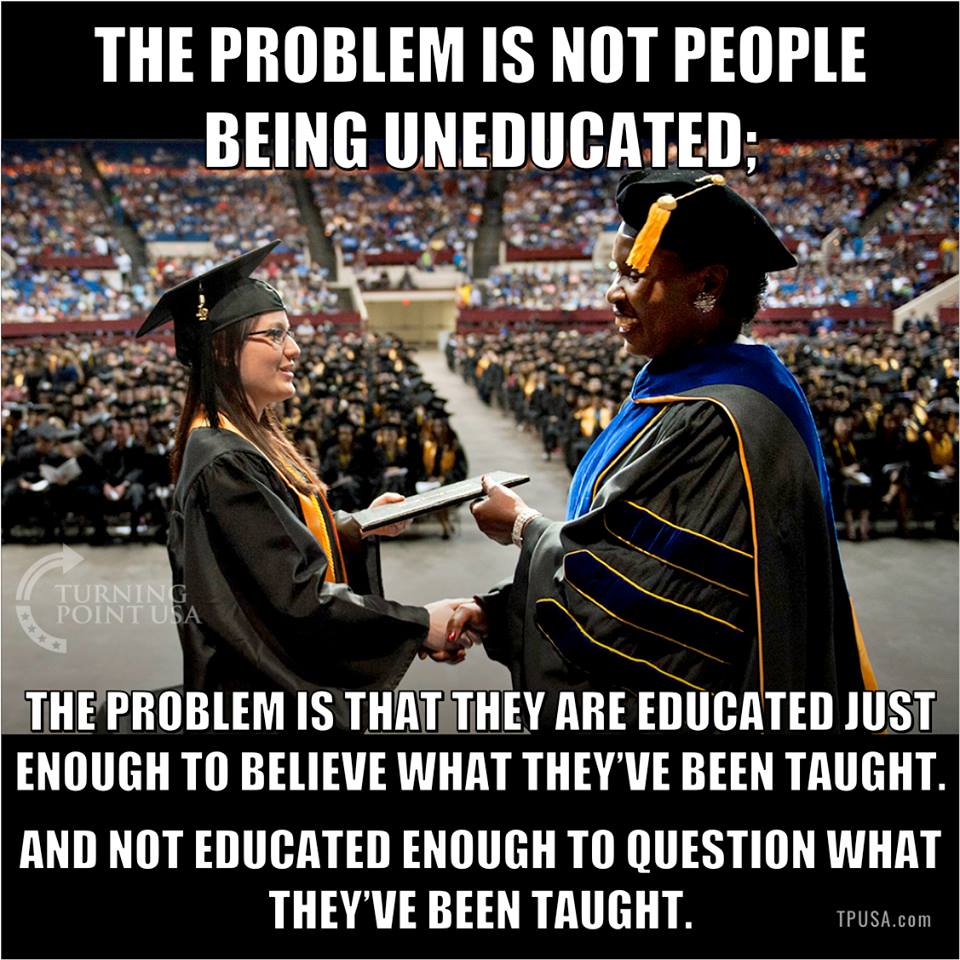
Besides the fact that calling someone an “ignorant” is a very ‘Trump’ thing to do in the first place, what if the real problem is that we have allowed ‘it’ to become a ‘system’ in the first place?

This way, after the process of learning and teaching has become a ‘system’, the ‘open market’ for ideas has become a very well – actually very badly – controlled oligopoly.
Learning means seeing and understanding the world around us. Teaching means passing around, and forward, the above mentioned knowledge and the meaning we’ve made out of it. Which ‘passed around knowledge and meaning’ shapes the way the ‘students’ go further. Deepen the knowledge and build future meaning.
In fact the very breadth of our species future depends on how past learned knowledge and built meaning had been passed around.
And what we have today, the current ‘social unease’, is the product of the manner in which we have been taught to see the world. Of the meaning we find in it.

Trump, as a social phenomenon, is nothing but yet another symptom of the current ‘malaise’. The incapacity of the contemporary society to make room for everybody is, simply put, a consequence of  information no longer flowing freely around. Of information being, tighter and tighter, controlled by the ‘system’.
The simple fact that Trump, if elected, has promised to put his stamp on the ‘system’ only proves this point…

Coming back to the ‘system’, the only way to fix it is to open it up, widely. If we continue to allow ‘it’ to divide us into ‘insiders’ and ‘outsiders’ (read ‘properly educated’ and ‘ignorant’) we will actually perpetuate ‘the problem’.

chded7au4aadm5

2500 later

Rio 2016: The Syrian Refugee who swam for her life – all the way to the Olympics. BBC.Com

At some point in time 12 tribes of nomadic herders had settled down on the banks of Jordan.

Conditions were good so they had enough time to think about things further than meeting their immediate needs.
For me it doesn’t matter much whether their religious teachings were a gift from their God or just a product of their own minds. The fact that they are choke full of useful advice for all of us and that the sharpness of that advice has not been dulled by the passage of time should be enough. We’d better continue to pay attention.

“For this reason was man created alone, to teach thee that whosoever destroys a single soul of Israel, Scripture imputes (guilt) to him as though he had destroyed a complete word, and whosoever preserves a single soul of Israel , Scripture ascribes (merit) to him as thoough he had preserved a complete world. Furthermore, (he was created alone) for the sale of peace among men, that one might not say to his fellow ‘my father was greater than thine’, and the minim might not say ‘there are many ruling powers in Heaven; again to proclaim the greatness of the Holy One, blessed be He: for if a man strikes many coins from one mould, they all resemble one another, but the supreme king of kings, the Holy One, blessed be He, fashioned every man in the stamp of the first one, and yet not one of them resembles his fellow. Therefore every single person is obliged to say: the world was created for my sake”

How come, then, that we are still killing each other in an organized manner?

OK, some go bonkers and kill themselves.
Some go so bonkers as to blame others for their unhappiness. They decide to go out with a bang and to kill as many of the ‘others’ as possible in the process.
The number of people going bonkers is naturally swelled by the present economic and social crises. Emile Durkheim, one of the fathers of sociology, had written an entire book on the subject, more than a century ago.

I can dig all this. It’s unacceptable but sort of explainable – aberrant behavior is not un-natural. That’s what evolution is for, to weed out aberrations that are too unfit to survive.

What completely baffles me is how come two and a half millennia after some simple herdsmen have demonstrated such acute but also noble thinking, some of us, most of whom pretend to be sophisticated intellectuals, continue to fashion religious teachings and ethnic/cultural values into wedges.
And use them to drive us into warring factions.

Why are they still doing this?
Why are we still heeding to their prodding?

Not only that we allow ‘them’ to ‘organize’ civil wars that kill hundreds of thousands of us and drive millions of the rest in exile but then we also allow some of ‘them’ to rule over some of the media that, supposedly, keep us informed.

“Unfortunately, some of the celebration was overshadowed by a completely unnecessary “omission” or outright censorship by Hungary’s public broadcaster. Refugee athletes are participating in the Rio Summer Games. Yusra Mardini, originally from Syria, is one of them and she has garnered a great deal of media attention, including in the Toronto Star.

“In the water, Yusra Mardini feels alive. In the water, Yusra Mardini swam for her life. In the water, Yusra Mardini helped to save the lives of many others”–writes Rosie Dimanno in The Star. The 18 year old ended up winning in the one hundred metre butterfly heat on Saturday. Not too long ago, Ms. Mardini had to swim to safety, fleeing her war-torn homeland, through Turkey and then across the waters in Greece. She and her sister swam for over three hours straight and, incredibly, made it to Europe safely. (They also helped save the 20 people that were in the boat they had been towing during those three hours) She trained for the Olympics in Germany.

Disappointingly, during the Hungarian public broadcaster M4′s coverage of the one hundred metre butterfly, they completely and seemingly deliberately neglected to mention Ms. Mardini. Jenő Knézy Jr., who is reporting live from Rio on behalf of the public broadcaster, mentioned four out of the five females competing–the only one he did not utter at all was the name of the Syrian refugee. It was as though she did not even exist– even though viewers could see her on their television screens. Mr. Knézy managed to avoid mentioning her, even after she won.

The hvg.hu news site wondered aloud after the incident: “Is it forbidden to even utter the name of a refugee on Hungarian public television?”

Mr. Knézy claims to have made an innocent mistake, when he forgot to mention the name of the winner of the competition.” (Christopher Adam, Hungary wins gold, breaks record on Olympics Day 1, but why did public television censor the coverage? August 7, 2016, hungarianfreepress.com)


“The Brexit vote may or may not have been a tragedy, but Prime Minister Viktor Orban of Hungary appears determined to follow with a farce. On Monday, he scheduled a referendum on keeping out refugees for Oct. 2, further threatening to undermine the weakened European Union. The referendum question — “Do you want the European Union to be able to order the mandatory settlement of non-Hungarian citizens in Hungary without parliament’s consent?” — is a textbook example of voter manipulation.

This isn’t really designed to address the EU’s plan to settle 1,294 refugees in Hungary — the country’s share of the 160,000 people that European authorities have proposed resettling from the Middle East. Hungary and Slovakia are already suing the EU over the refugee quotas, and, in theory, Orban could veto any such plan. The referendum will help him prop up his domestic popularity and give him a “democratic” bargaining chip with other EU leaders — even though his strategy will be glaringly obvious because the question is framed in a way that produces only one answer.

Direct democracy’s biggest vulnerability may be that it can be subverted by political players who ask the people loaded, incomprehensible or otherwise rigged questions.”

“Orban has no one to correct him. Earlier this year, Hungary’s Supreme Court approved the referendum question. So now a Hungarian voter has a choice between agreeing with Orban or effectively recognizing that the EU can do whatever it pleases in Hungary without any national authorities having any say. The only other option is not to show up, thus refusing to be manipulated. If enough voters do that, Orban will be made to look a fool. But given the combined popularity of Orban’s party, Fidesz, and the hard-right Jobbik, whose thunder Orban is trying to steal with the vote, there’s a good chance the turnout will be sufficient.” (Leonid Bershidsky, Hungary’s Manipulative Referendum, July 5, 2016, Bloomberg.com.

Going back to Durkheim’ Suicide,  there is something there that I find of enormous importance. After studying how suicide rates vary, both in time and across borders and religions, Durkheim has noticed that each suicide act was indeed determined by the individual itself who, in his turn, was influenced by prevailing socio-economic conditions but that there could be noted another very important influence.
The members of the Jewish communities were the least likely to commit suicide, the Catholics came next while the Protestants were the most likely to end their lives, of those belonging to any of these three categories.
Durkheim explained this phenomenon by using  the concept of ‘social solidarity’ – for a society to survive its members need to stick together.
Then Durkheim went further and elaborated on the matter. ‘While it is good for a society to develop strong bonds among its members – the Jews have survived for so long and against such odds, these ties must not be allowed to become strong enough to stifle the individuals – otherwise that society would loose its ability to innovate, hence to adapt itself to the inevitable change that befalls upon its head, no matter what.’An equilibrium has to be met between social solidarity – which pushes us to think alike and to align ourselves to the values shared by the entire community – and individual freedom – that which allows each of us to depart, somewhat, from the social norms without being punished by the rest of the society.

I’m going to use, again, the Jews as an example. They have survived, as a people, for so long and against such odds that they must have done something right. Well… they do take care of their own and they do cherish individual autonomy.

After all they are the ones who came up with ‘God created Man in His image’. Hence all men are considered equal – because they have been cast in the same mould – and assigned a spark of ‘something special’.

Jews have done well in this world. Given the circumstances and until some of us have completely lost their minds.
Why don’t the rest of us follow their example?

They don’t kill each-other!
Not physically and not even symbolically.
No matter how much two of them might hate their respective guts, when push comes to shove  they’ll help each-other out of the mess.

Why have we, the goyim, ignored for so long such a fine example?
Why do we continue to do so even now, after we’ve found out that the only one Planet we can call home is rather small and that no one seems to be coming, anytime soon, to rescue us from ourselves?
And even if there was anybody who could have done this… would any of you lift a finger to help a bunch of quarreling idiots who are continuously threading on each-others toes? Specially when/if each of us would get their due after their death…

Then why would He?

Why would He help us before we start helping each-other?

At some point some of our ancestors figured that saving for tomorrow some of today’s bounty might increase the chances of survival for those who consistently practiced the habit.

Probably this happened in the temperate regions, where’s a marked difference between seasons and where the cool winters make it easier to store food.

And this is how thrift has become a commendable behavior.

Flash forward to the Enlightenment.

Drawing heavily from the Christian tradition prevalent in that cultural area – ‘God made Man in His own likeness’ – the ‘enlightened’ thinkers of the era determined that ‘Men were (created) equal’ – since all of them bore a certain likeness to the same standard.

Hence they must enjoy equal rights too. Including the right of pursuing happiness.

Go ahead. Click that link and read all about it. The guy writes a lot better than I’ll ever be able to. He even has an PhD on the subject.

The only problem is that he’s got it upside down. Using logic as a flash light to flush out happiness is like raping a woman in order to help her experience an orgasm.

But there’s another way to get there.

Csickszentmihalyi, who also has an PhD in psychology, noticed that people are a lot more likely to experience happiness by doing things and enjoying the results of their work than when trying to reach happiness ‘directly’. Even if he still uses the same term, “pursuit of happiness“, his approach is completely different from the one I mentioned first.

In this second scenario, happiness is no longer a goal per se but simply an indication that we are on the right track.

Towards what?

I simply don’t know.

I started with what our ancestors figured out. Imagine, for a moment, what those guys felt when a handful of them were gathered around a fire inside a cave, in the middle of February, munching on some fried meat that had been ‘preserved’ sometime in the autumn, specially when the north-easterly winds were howling outside. Was it happiness?

Again, I don’t know.
But please consider this: Did those guys stash wood, smoke hams and gather berries all autumn so that they might enjoy some moments of happiness in February or they did it in an attempt to survive the winter?

So why do we keep speaking about ‘gratification‘?
What’s the real difference between ‘instant’ and ‘delayed’ gratification? As long as we continue to see it as ‘the ultimate goal’?
A junkie who stretches his stash of dope for longer is any wiser than his mate who ‘enjoys’ his in one go?

last day 1

last day 2

grandson of sweetie pie

Grandson of TV’s Miss Sweetie Pie gunned down in St. Louis. (AP)

“St. Louis police say they found Andre Montgomery dead at a home Monday night. A second man was taken to a hospital in critical condition with gunshot wounds.
Police say that after someone shot Montgomery, the second man ran upstairs to help him. A third man who was in the home saw the second man carrying a gun and shot that man because he feared for his safety.”

So.
A guy invites some people in his home.
Judging by the way in which they interact they don’t know, or at least don’t trust, each-other.

Somebody – not necessarily from among the invited guests, shots the host.
Somebody else – presumably alerted by the noise, draws a gun and hurries to assist the victim.
A third person, fearing “for his safety”, draws his gun and shots the good Samaritan, simply because he was carrying a weapon.

Is there anything to be learned from here?

OK, by somehow removing all privately owned firearms in America, personal safety, on average, would be somewhat improved. But since something like that would be very unlikely to happen let’s concentrate on something more plausible.

How about taking grater care about who enters your home?

And something else.
Ever since reading about this I cannot stop thinking about the similarity between cars and guns.

Both are tools and both are dangerous. Yet almost everybody has the right to buy one.

But no-one is entitled to use a car without a license while so many people advocate that everybody should be allowed to carry guns, everywhere.

37 000 people dead and 2.35 million people injured or disabled as a consequence of road accidents. Per year.

32 000 people dead by fire arms. Per same year. 60% of them being suicides while roughly 34% are classified as homicides.
On top of this another 67 000 people are injured, per year, by fire arms.

Some could say that there is not any significant difference between the two situations and, as a consequence, a carry permit would not change much.
Are you sure about that?

Currently most guns do not follow their owners when they leave their houses – for various reasons. This is why I’m afraid that if more and more people would chose to carry their weapons, things would become a lot more complicated.

Not because people are bad or ill intended.

Simply because most ‘civilians’ are not trained to asses dangerous situations in an effective manner nor the necessary skills to use their weapons safely.

You see, defending your home – everybody else but you and your family becomes an enemy in this scenario, is very different from trying to help in a complex setting. When people might freak out at the sight of yet another gun.

That’s why not all those who own a gun should ‘drive’ them around without a license.

After all, how safe would you feel when driving in a country where no driver’s license is necessary and where DUI is not forbidden?

iqvl1s8v8lzmbki8xjyy

“Administrators at the Success Academy—a network of high-performing charter schools in the New York area—are standing behind what they call a model teacher, who was caught on camera ripping up homework and berating a first grade student for answering a math problem incorrectly.”


I totally disagree with this kind of behaviour.
Having said that let me offer you a glimpse of what’s going on in the minds of those who accept or even promote it:
Shouldn’t we be working at both ends of the problem?
Educate the educators about how to motivate the children to learn without crippling their souls AND educate the employers and their agents (managers) about how treating your work force with due respect would yield way better results than using mockery/belittlement as a motivation tool?
And shouldn’t we also be educating ourselves about the fine difference between spoiling a child and helping him/her into becoming a fully-fledged adult (a ‘man’ in the un-gendered meaning of the word)?

p03j0k3f

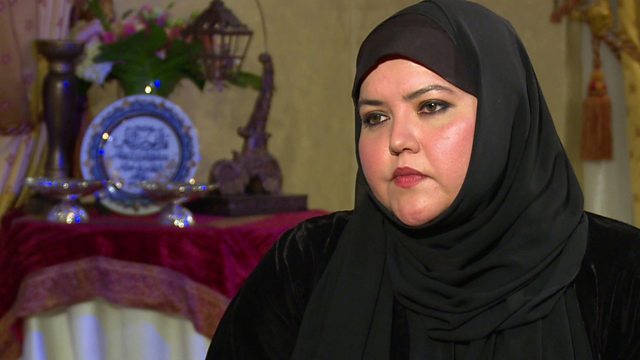
“Saudi women need to ‘think like men’

Gender segregation in Saudi Arabia has sometimes led to “immaturity”, a Saudi businesswoman and member of Jeddah’s municipal council has told BBC HARDtalk.”


I published yesterday a post on this subject. In Romanian.

Today I stumbled upon another article which uses almost the very same manipulative tools. In English this time.

legal public urination

“Of all the things one could think of that New York City needs more of, public urination doesn’t immediately come to mind. But New York’s City Council, which is so far left it almost collides with the right, is about to make it happen thanks to it’s Speaker, a Puerto Rican nationalist who supports terrorists and rejects the Pledge of Allegiance.”

 Now can someone explain to me how can decriminalizing something be interpreted as an encouragement towards that something?
And what’s the use of making it a crime to urinate or to drink in public? A crime? Something that will be written into your rap sheet and follow you all your life?
Let’s imagine for a moment that you are a 19 year old who had one too many beers. And had to take a leak. A cop happens to be in the area. Now tell me what are the chances that he’ll look the other way if you’re white? And if you’re black?
Do you understand, at least now, what the ‘liberal official who sponsored this change’ meant by ‘helping the minorities reach their full potential’?
Who’s going to give a real chance to a ‘minority’ with a criminal record? Who has the time to check that his only crime was ‘public urination’? Or that he had a beer in front of his porch? Not exactly in front of his porch, because he used to live in a ‘public housing facility’ but you get the general idea…
Reality check no 1.
How about providing some places where people can relieve themselves? Porta-johns for instance? Or functional public rest-rooms in all New York subway stations?
Now I’m wondering what the author meant by “But New York’s City Council, which is so far left it almost collides with the right, is about to make it happen thanks to it’s Speaker, a Puerto Rican nationalist who supports terrorists and rejects the Pledge of Allegiance.“?
What has the Pledge of Allegiance have to do with anything? What’s the relevance of the Speaker’s ethnicity, beyond the fact that belonging to a minority increased her awareness of the way the minorities are treated by some of the law enforcement officers?
And how come a ‘supporter of terrorism’ has been elected Speaker in the first place?
What’s going on here?
lp
“A day after Leela moved in, she came home visibly upset. I asked what happened. Apparently, the doorman had blocked her from entering the building, refusing to believe that the keys she was carrying were legitimately hers. She had to convince him to check the approved tenants list before he allowed her to go to her own home.The incidents piled up. Things that may seem small to someone who doesn’t endure these experiences, but that in aggregate soured her daily life. The cabs that wouldn’t stop when she tried to hail them but hit the brakes and backed up when they saw she was with me. The clerks asking her to verify her ID every time she presented a credit card. The smiles at me from neighbors and barely concealed scowls at her when I turned away. The usual catcalls and crude comments when she walked alone. It quickly became clear that although we shared the same day to day life, her existence was profoundly different from mine.

The event that brought it to a head was when she pressed ‘PH’ in the elevator and the other occupant, a white male, asked which penthouse apartment she was going to clean. The idea that she lived there didn’t occur to him. When I heard about it, my indignation was palpable. It was the indignation and disrespect she lived with every day and that was alien to me.”
….
“What I didn’t realize was that we are stuck in our own heads far more than we can appreciate and that empathy has limitations. As a white male, I can convince myself that I understand racism and sexism, but it’s far more intellectual than visceral. My point of view is distorted by the culture I exist in.”
Peter Daou, “My Rude Awakening on White Males, Brown Females and #BlackLivesMatter

Now consider this:
Mothers usually have a ‘disproportionate’ influence over their (small) children.
This translates into the psychological well being of the mothers having a huge influence on the general behavior of the next generation.
In a so called ‘normal’ family – composed of a father and a mother – whatever ‘bad moments’ that happen to the mother can, and sometimes even are, mitigated by the father.
But the sad reality is that there are a lot more Afro-American single mothers than white single mothers – relative to the demographic composition of the population.
And we still wonder about how come the Afro-American teenagers and young adults are the cause of so many unpleasant incidents – relative to the demographic composition of the population, of course…

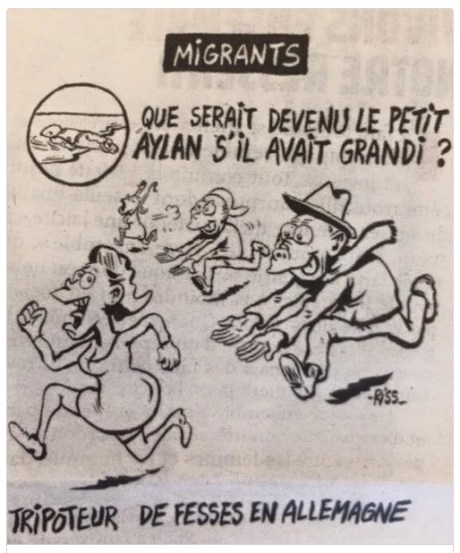
tripoteur de fesses en allemagne

‘J’ai etait Charlie’ when the barbarians tried to silence it.
Not because I agreed with everything that was published there but because I believe that it’s unacceptable to try to kill somebody – unless that somebody tries to murder you, of course.

Having said that I must confess that I find it harder and harder to understand what’s going on in Charlie’s mind.

“Charlie doit être là où les autres n’osent pas aller. Pour cette couverture, je voulais dépasser telle ou telle religion et toucher à des choses plus fondamentales. (…) En affirmant les choses clairement, ça fait réfléchir. Il faut bousculer un peu les gens, sinon ils restent sur leurs rails”

(Charlie must go where others do not dare to. For that I’m willing to leave behind specific religious ideas and reach deeper levels. … By speaking frankly (about a subject) one can convince the others to take the matter into consideration. Sometime you need to jolt people (outside their comfort zone) otherwise they’ll stay put on their tracks).

OK, I can agree with that. Even if I think that some of the ‘jolts’ are distasteful, to say the least,  the principle is correct.
But there is a small problem here. If the jolt is too powerful the target will not get just outside its comfort zone – and into the ‘thinking mode’ – but directly into a full-fledged rage. A state of mind which rejects reason and sends the brain into a frenzy, looking for arguments with which to annihilate the original message.

2233252_136_charlie

This, for instance, might be considered rude but it’s impersonal enough to prod some individuals into considering whether following blindly into someone’s steps  – just because that someone pretends to have God’s blessing – might be a wise thing to do.
In fact this message works precisely because it offers food for thought. Each of the viewers might interpret it according to their own ‘Weltanschauung’ but the ultimate responsibility for the interpretation lies with the viewer, not with the cartoonist.

This is why I can’t agree with the cartoon about Aylan.
There is no option there. The message is clear. Aylan would have grown up to be a sex-molester, no doubt about that – at least in the eyes of the cartoonist.

And this just isn’t fair.
Because killing hope is a lot worse than actual murder.

Yes, we need to take great care about how we help the migrants to find a place among us. No doubt about that.
The point being that corralling them into a ghetto won’t solve anything. On the contrary.

“When it comes to assimilating new arrivals, Europe could learn a thing or two from America, which has a better record in this regard. It is not “culturally imperialist” to teach migrants that they must respect both the law and local norms such as tolerance and sexual equality. And it is essential to make it as easy as possible for them to work. This serves an economic purpose: young foreign workers more than pay their way and can help solve the problem of an ageing Europe. It also serves a cultural one: immigrants who work assimilate far more quickly than those who are forced to sit around in ghettos. In the long run most children of migrants will adopt core European values, but the short run matters too.” (The Economist, Migrant Men and European Women, Jan 16th, 2016)


not2bdemocracy

Enter a caption

Our nation did not become great because our form of government was created as a socialist, communist, or any form of democracy; it was specifically created as a constitutional republic.

I’ve been trying for some time now to figure out the origin of this huge confusion.

Yesterday, during an exchange on this subject, a FB friend of mine used this link to prove her argument:

An Important Distinction: Democracy versus Republic


And there it was, laying in plain sight, THE explanation I was too blind to find it by myself.

It is important to keep in mind the difference between a Democracy and a Republic, as dissimilar forms of government.

Come again?!?

Since when democracy has become a “form” of government?
If you want to discuss about forms of government you have basically two: republican and monarchic. In a republic the head of state is changed from time to time, sometimes in a more or less democratic manner, while in a monarchy it is customary for that head of state to be replaced only after his death and by a person which has already been known for quite a while.

That was not what you had in mind? You meant what kind of interaction exists between the governed and the government?
‘Cause only in this realm we may speak about the difference between democracy – where the population has a say about its fate – and dictatorship – where the rulers don’t give a damn about the wishes of those who allow themselves to be ruled from above.

Don’t believe me?
Then please consider the British Empire. It is headed – nominally – by a monarch who has had no power for the last two hundred years or so and has NO – absolutely NO – constitution. Yet its democratic traditions can be traced down to the Magna Carta – a ‘compact’ signed in 1215 between the King (John of England) and his ‘free subjects’.

I used ‘ ‘ around ‘free subjects’ to highlight the fact that this is an oxymoron AND that the basic function of Magna Carta was to solve that oxymoron.
It actually doesn’t matter much what was written in that compact. The very fact that the King – erstwhile considered an almost divine person who until then had absolute power over his subjects and the land under his control – sat down at the same table with some of his erstwhile subjects and by his own signature conceded that they were “free” (‘all free men have a right to justice and a fair trial‘) signifies the dawn of a new kind of interaction between those at the no longer opposed ends of the society.

OK, things didn’t evolve smoothly. The Magna Carta wasn’t enforced in earnest until a lot later but still, the bird was out of the cage.

My point being that until we understand that the difference between ‘republic’ and ‘democracy’ is the same as the one between apples and oranges – and that we should stop comparing them – we are stuck.

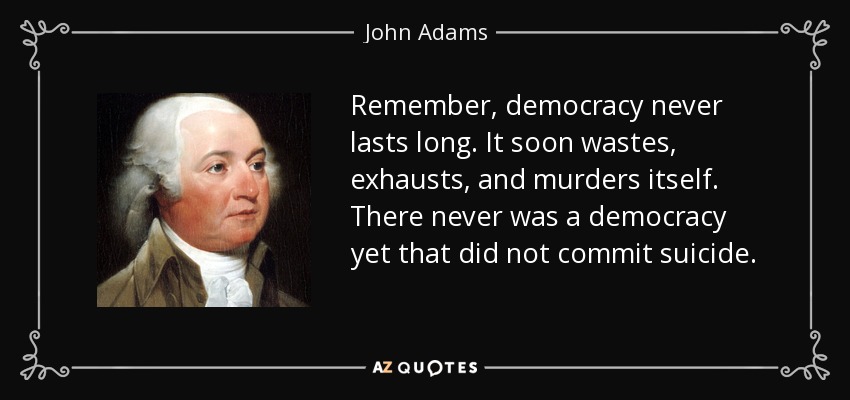
So, am I somewhat implying that John Adams was wrong?

quote-remember-democracy-never-lasts-long-it-soon-wastes-exhausts-and-murders-itself-there-john-adams-0-19-42

Not at all. All I’m saying is that he used a poetic license and that the quote is not only incomplete but also used in a misleading way.

“I do not say that democracy has been more pernicious on the whole, and in the long run, than monarchy or aristocracy. Democracy has never been and never can be so durable as aristocracy or monarchy; but while it lasts, it is more bloody than either. … Remember, democracy never lasts long. It soon wastes, exhausts, and murders itself. There never was a democracy yet that did not commit suicide. It is in vain to say that democracy is less vain, less proud, less selfish, less ambitious, or less avaricious than aristocracy or monarchy. It is not true, in fact, and nowhere appears in history. Those passions are the same in all men, under all forms of simple government, and when unchecked, produce the same effects of fraud, violence, and cruelty. When clear prospects are opened before vanity, pride, avarice, or ambition, for their easy gratification, it is hard for the most considerate philosophers and the most conscientious moralists to resist the temptation. Individuals have conquered themselves. Nations and large bodies of men, never.”

OK, he made the same confusion between ‘forms’ of government and social relationships between the people and those in power, only this is an understandable mistake. But, to his merit, he made it amply clear that it is the very “passions” of the people that “when unchecked, produce the same effects of fraud, violence, and cruelty”!

This is precisely the job that every constitution – not only the republican ones – is called to fulfill. Or a powerful enough tradition – please remember that the British ‘Empire’ has no constitution to this day.

Coming back to the notion of democracy I must add that it might not work properly, no matter how well written the constitution that presides over the process, unless the people who uses this form of collective decision making entertains the proper mental and moral attitude.
If the entire society isn’t permeated by enough mutual respect among its members then what Adams had warned us against is about to happen – regardless of any constitution. Or even under the cloak of the existing one.

You see, proper democracy works because it creates a frame where all those interested in the matter – all stake-holders – have the opportunity to express their grievances. This way the society is able to find out what doesn’t work properly and to take the appropriate measures.
But if there is not enough mutual respect going on around, things may become ugly, eventually. Just as Adams told us. When mutual respect weans out we stop caring about anything else but our own personae and ‘passions’ are no longer ‘checked’.
Society no longer acts like an organism and people become divided into smaller ‘mobs’ whose leaders fight each-other – sometimes under a democratic disguise – for followers.

That’s when democracy ceases to be a venue for a civilized debate about ideas and become an arena for the bloodiest sport of them all. Politician-ism.

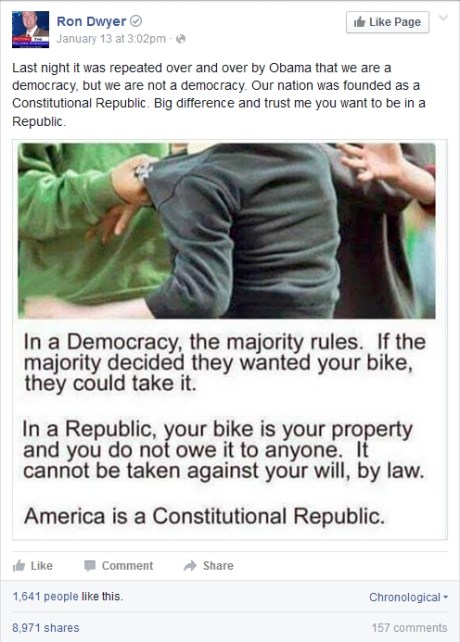
That’s when some people start thinking like this.
democracy, bikes

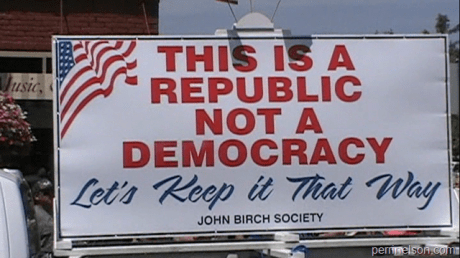
Or even like this:
jbs_3

Let me tell you something.
I’ve been living under a republican regime for all my life. Only for the first 30 years that republic was a communist one. It even had a constitution – and at the first glance it wasn’t such a bad one. But believe me, you don’t want to experience that kind of republic.

What you really want is true democracy, the one where people respect each-other. It doesn’t matter if that happens in a republic or in a kingdom. It is enough that it works, and for that to happen it is enough for the people to ‘check their passions’.

And mind you!  Whenever 51% of the voters band together to confiscate the bikes that the others have acquired through honest means, that’s no longer democracy but mob rule. Something that could very easily degenerate into communism. That’s what you want to avoid, not bona fide democracy.