Archives for category: evolution

Whence comes nihilism, the uncanniest of all quests?
by Lou Keep

Friedrich Nietzsche was most famously concerned with the problem of nihilism. All societies, in his view, rely on implicit value judgments. If the foundations of these are lost, he predicts terrible consequences: widespread apathy or violent, fanatical attempts to reclaim a sense of purpose, or perhaps both. We talk about values a lot, and we know they do something, but we have little idea how. Compounding this is uncertainty over their loss. Nihilism is not a choice or intellectual commitment, but a thing that comes upon you. As Nietzsche put it in 1885: ‘Nihilism stands at the door. Whence comes this uncanniest of all guests?’

Part of the answer comes from understanding how values connect to knowledge and action. In Seeing Like a State (1998), the political scientist James C Scott classifies knowledge in two ways: epistemic knowledge, which can be quantified, theorised and transmitted in abstract, and metis (from the classical Greek), which concerns knowledge gained from practical experience, such as personal relationships, traditions, habits and psychological states. Metis governs local experience: farming the family’s land, for example, rather than agronomic study. We all recognise it; it’s why we hire for experience. For instance, Jane and Martha have identical diplomas, but if Jane’s first shift was on Tuesday and Martha’s was in 1970, then Martha will have certain tricks and habits to expedite her work. Still, it’s not easy to quantify just what that is: Martha has metis, and metis can’t easily be reproduced. If it were trainable, it would have been in Jane’s training.

Scott’s genius is to compare metis to local traditions. Over a long enough time, habits and behaviours are selected for and passed down, just as evolution selects helpful traits. A successful group will institutionalise an irreducibly complex set of cultural tools that relate to its environment. Since these are metis, and not epistemic, they won’t always be obvious or quantifiable. Scott recounts dozens of examples of customs that might appear backwards, confused, unscientific – yet when they’re banned or discouraged, productivity collapses. He calls this the problem of ‘legibility’.

Epistemic theories rely on isolated, abstracted environments capable of taxonomy, but these are far removed from the dynamic, interconnected systems of nature and human culture. Metis, by contrast, develops within complex, ‘illegible’ environments, and thus works with them. But that also means its application is limited to a specific act, rather than a broader theory. Outsiders want to know why something works, but locals will explain it in a language unintelligible to them.

These practices and traditions are, of course, more than work experience. They’re used to efficiently solve political problems. In The Righteous Mind (2012), the social psychologist Jonathan Haidt describes Balinese rice farmers who needed to coordinate irrigation along a river. Since they were politically divided into small familial units – called subaks – they needed to rely on means older than governance to ensure cooperation:

The ingenious religious solution to this problem of social engineering was to place a small temple at every fork in the irrigation system. The god in each such temple united all the subaks that were downstream from it into a community that worshipped that god, thereby helping the subaks to resolve their disputes more amicably. This arrangement minimised the cheating and deception that would otherwise flourish in a zero-sum division of water. The system made it possible for thousands of farmers, spread over hundreds of square kilometres, to cooperate without the need for central government, inspectors and courts.

This still occurs. A 2017 paper by the economists Nathan Nunn of Harvard University and Raul Sanchez de la Sierra of the University of California, Berkeley mentions gri-gri, a magical powder that witchdoctors manufacture. In 2012, following a period of widespread banditry and state insecurity in the Democratic Republic of the Congo, gri-gri came to a village elder in a dream. Applying this powder made the user bulletproof, and it worked so well that neighbouring communities swiftly adopted it. The reason was simple: groups fight better than individuals, and more people will dare to fight if they believe they are bulletproof. Hence, a village using gri-gri was more likely to survive.

Gri-gri and water temples are kinds of metis, but they require belief in larger structures: respectively, magic and gods. However these structures first developed, it’s critical that they rest on more than mere faith or tradition. Shared values provide conviction for greater actions, but those values are certified by the success of those actions. Gri-gri’s success is an empirical testament to magic, and its utility inclines one towards trusting more activities by witchdoctors. Nunn and Sanchez de la Sierra point out that

many of [the spells] appear to provide individuals with a greater sense of security and confidence, which could serve to … reduce their anxiety and thus improve their performance. For example, most of the spells provide protection, whether it be from drought, disease, attacks on the village or even to harm potential thieves – and thieves also believe in their efficacy, which acts as a deterrent.

In other words: these practices and institutions serve several different roles, all bound up in one another. This intermingling exacerbates the problem of legibility.

When we discuss changing values, we often think top-down: a new and persuasive ideology that took hold for intellectual reasons. What Scott and the adoption of gri-gri suggest is the opposite: the motive force of values requires a degree of certainty that is dependent on action. It was gri-gri’s empirical demonstration that allowed it spread it to neighbouring villages, not its poetry. The inverse to this is also important: we can improve on a specific task, but other roles need time to sediment and evolve. Trade the temples for a government, and you have zero-sum bickering. Explain the game theory behind gri-gri, and no one will fight with it. The utility of a cultural institution first allows adoption, but its maintenance allows metis ample time to tinker and perfect.

If we’ve lost faith in certain values, then I doubt this was because of academic debates. The 20th century profoundly changed labour, technology and social organisation in the Western world. It’s hard to imagine that this didn’t change metis, or render older forms of metis irrelevant. While the values of metis might still be desired – or even identified with – they lack the same certainty they once had. Nothing can prove them and thus justify the higher claims. ‘Faith without works is dead,’ as the Bible said, but faith without metis is unbelievable.

A top-down view of value implies that we can simply create new reasons for living, that the ideology itself is its own proof. But if values come bottom-up, then man’s quest for meaning cannot be separated from his labour. They are the same.

[object Object]

This article was originally published at Aeon and has been republished under Creative Commons.

https://aeon.co/ideas/whence-comes-nihilism-the-uncanniest-of-all-guests

“legible” versus “illegilbe”…

After all, metis remains – for now, illegible simply because we haven’t yet found a way to ‘read’ it.

And to write it back in a teachable form!

Or, to put it in a more concise manner, we haven’t got, yet, to the bottom of it!

The key word here being we.
WE haven’t got to the…
It all boils down, again, to the limited nature of our consciousness!

The human head works like an organic computer.
It has a ‘hard’ component. Which is actually soft. The brain tissue.
And many levels of ‘software’.

You might want to skip this introductory part if you’re not familiar with/interested in how computers work
The ‘machine code’. The inner workings of the brain. The ‘things’ which continue to function when we’re not at all conscious. Breathing, coordination of the of various organs which keep us alive, etc.
‘Assembly language’. The level which works on ’emotions’/’feelings’. A not yet conscious baby suckles when hungry and cries when uncomfortable. A patient with dementia is not a ‘fully functional human being’ but can learn/retain many human functions.
‘High-level language’. Human conscience. While the ‘machine code’ and the ‘assembly language’ levels run in the ‘background’, human conscience constantly evaluates ‘what’s going on’ and decides ‘the next move’.

Humans, like computers, work a lot better when ‘put together’.
Each individual’s human conscience develops only ‘in concert’ with other people while the most powerful computer chip is ‘dead’ before the operating system has been installed. A (mature) individual human being might survive in isolation, but not for very long. A computer is completely useless if not ‘put to work’ by an ‘operator’. Alone or ‘inside’ a network.

Computers can ‘cooperate’ because we made them so.
Even if using various operating systems and communication protocols, we – humans, have developed them – computers, in such a way that we can communicate with them and they can communicate among themselves.

For humans to be able to communicate among themselves, they need a common language.

Computers do not need to coordinate among themselves. We’ve made them, instructed them, in such a manner that they (still) do what they are told.

For humans to be able to coordinate themselves – to act in a congruent manner, they need to use – or at least to acknowledge, the same referential system.

To think ‘alike’ or, at least, to acknowledge that ‘those who do not think like me/us might have a point’.

Historically speaking, humankind has achieved ‘coherence’ through the use of ‘religion’.

‘Reality’ – which was far more complex ‘before’ simply because the unknown is the place where fantasy is free to give birth to anything, had to be tamed. Translated into ‘operable’ things. Into generally accepted concepts. Into generally accepted ‘myths’.
And for as long as a given set of ‘foundational myths’ had maintained their ‘magic’, the religion which had been developed starting from those myths had continued to be ‘the coalescing factor’ for the community which believed those myths. Or, at least, behaved as if those myths were still ‘valid’.
Whenever those myths had failed – or were no longer enough, the corresponding religion had been quickly replaced. By another.
This was the heave-ho approach. Wholesale replacement of the referential system, which is both ‘wasteful’ and time-consuming.

In time, people have learned that it was far more ‘efficient’ to pay ‘lip service’ to each-other’s opinions
when the other side was too ‘strong’ for outright ‘coercion’. Read “conversion”.

When/where things had become ‘ripe’, some people had invented ‘science’.

Science, like religion, is a manner of thinking. A manner of translating reality into something which can be managed by the human brain.

Religion relies on a set of ‘axioms’. Which had been considered true – by those who had established any given religion, at the moment when that particular religion had been established. When freshly acquired knowledge diverges too far – and too convincingly, from the until then generally accepted ‘founding myths’, the religion which depends on those myths conserving their ‘allure’ is abandoned in totum.

Science, on the other hand, relies on a different set of ‘beliefs’.
Derived from the basic tenet of the Judaeo-Christian creed and no less axiomatic but still different.
The point being that instead of trying to fit any new information into the previously held set of ‘teachings’ science mandates the diligent use of the ‘scientific method’ whenever we attempt to evaluate any ‘piece of knowledge’:

Reproducibility: ‘do I find/learn the same thing each and every time I examine this phenomenon/class of objects using this particular procedure?

Peer review: Does everybody else who examines the same subject, using the same procedure, reach the same results? In earnest?

Falsifiability: Does the subject of our musing have a correspondent in reality? Are we concerned about something which has consequences? Can this particular ‘piece of knowledge’ be proven wrong? Or, at least, incomplete?

The three paragraphs above have described the scientific method yet I still have to mention the Judaeo-Christian belief without which science makes absolutely no sense.

“Then God said, “Let Us make man in Our image, after Our likeness, to rule over the fish of the sea and the birds of the air, over the livestock, and over all the earth itself and every creature that crawls upon it“.

According to the Old Testament, God had made man to “rule… over all the earth itself”. Which means that God was going to refrain himself from performing other miracles. The Earth being entrusted to the rule of man means that man was going to ‘see’ the same thing each and every time he was looking at the same thing. From that moment, ‘things’ were going to ‘happen’ in a ‘rigorous’ manner. No more ‘hanky-panky’, no more divine intrusion. From then on, things were going to happen according to the ‘law’. ‘Regularly’, hence ‘reproduciblely’. In a consistent manner!
Again according to the Old Testament, ‘God had made man in His image’. Hence all men – and women, had been created equal. In the same image, that is. And all men – and women, harbor something ‘special’. A spark of divinity! They have all been created in the image of God itself, hence they all should respect each-other. And each-others’ opinions! Hence ‘peer-review’.
All that remains to be ‘explained away’ is the small matter of falsifiability. Of science concerning itself only with verifiable subjects. Which brings us back what was the man supposed to rule over. ‘The earth itself’. The realm of reality. Man – men and women, were supposed to rule over ‘reality’, not over other people.
They were supposed to concern themselves with ‘evident’/measurable things found ‘on earth’, not with ‘fancy’ figments of ‘unaccountable imagination’.

Ooops!
If both religion – well, at least the Judaeo-Christian one, and science depend on the same axiom/fundamental myth, then where’s the difference?
As I mentioned before, whenever fresh knowledge contradicts ‘irreparably’ the before held religious convictions, the community who upholding those convictions reaches a ‘passage rite’. Has to either ‘close its eyes’ – actually denying reality, or change its religion. The very definition of the ‘heave-ho’ approach.
For those using the ‘scientific method’, things are a lot simpler. And smoother. For them, reality suffers a constant change. Piece-meal instead of wholesale. ‘Easy-does’ it instead of ‘gung ho’.

One other thing before I let you go.

“If you’re not a scientist, and disagree with scientists about science, that’s not disagreement! You’re just wrong!”

Well, this is the most unscientific thing I’ve read for a long time.
What comes next makes absolute sense. If you apply the scientific method to “Science is not truth. Science is finding the truth.” you determine that the message is consistent, agreed among the peers and falsifiable. Science can be misused and, potentially, the very meaning of the word can change in time. For now, the generally accepted meaning of ‘science’ is, indeed, ‘the path towards truth’. And, by definition, all scientific knowledge is considered to be ‘improvable’. Hence forever ‘not yet true’.
Coming back to the ‘disagreement’ part, this is an obvious ‘sleigh of hand’. For starters, ‘scientists’ do not concern themselves with ‘science’. Each of them controls an area of expertise. Which is not the entire science…
Furthermore, what does it mean ‘you’re not a scientist’?!? You don’t have a formal accreditation? Anybody who uses the scientific method when examining the reality is a scientist, regardless of their credentials.
I presume the author meant well. There are quite a few people out there who are in the ‘business’ of sowing doubt. Who contradict whatever ‘starts their ire’. Who very ‘skillfully’ spin apparently convincing words about subjects of utmost importance. But if we want to remain true to our words, if we want to remain on the straight and narrow path to truth, we must convince our audience with arguments. We must un-spin those ‘words’ in a rigorous manner.
Using the very same set of ‘spinning skills’ downgrades us to ‘their’ level.
As the saying goes, ‘Don’t allow your opponents to drag you to their level of expertise. Remain on yours. Any attempt to beat the other guy using their weapons will, more often than not, yield the undesired result. For the obvious reason that they have used those weapons for far longer than you’.

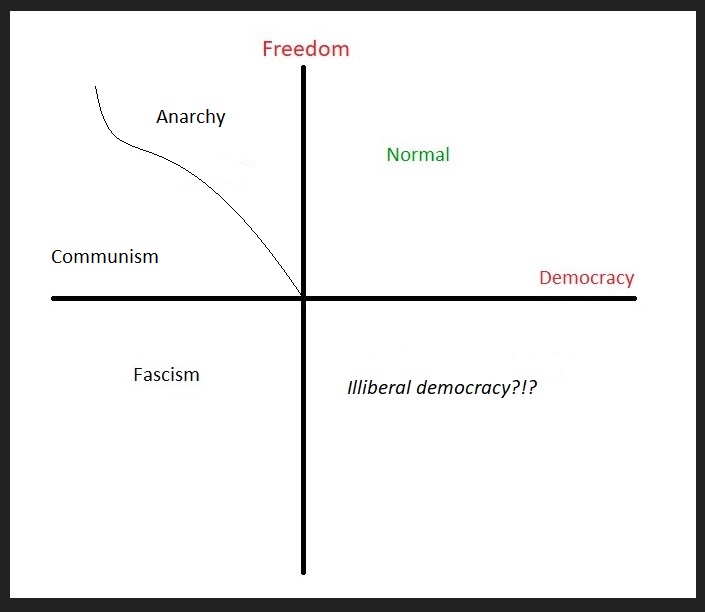
‘Most people confuse liberty and democracy. They are not the same.’

Liberty and democracy are not the same indeed.

Like my left hand is not the same with my right one.

But I need both in order to lead what I consider to be a normal life.

Most people – specially if they get help, can survive without a hand. Or without either liberty or democracy.

But without both… without both hands or without both liberty and democracy… I’d be at somebody else’s mercy!

‘What?!?
What kind of liberty is there under communist rule???’

You see, liberty has two ‘faces’. Two dimensions.
Three, actually, but I’ll be talking about only two of them in this post.

There is the ‘inner liberty’ and there is the ‘socially sanctioned liberty’.

Liberty itself is a human concept.
We have noticed something, wondered about it, named it and then attempted to understand it.
This was, and continues to be, a collective effort.

In some places ‘liberty’ had appeared ‘naturally’.
There was enough liberty naturally sloshing around, hence the circumstances were right for those who had happened to live there at the right time to notice it. Furthermore, the conditions had been right again for the entire community to be able to agree among themselves about the concept and about how to use it/put in practice their new intellectual achievement.

Other places have not been so lucky.
They had been close enough, geographically and socio-historically, to notice the ‘birth of liberty’ but their specific conditions were not ‘right enough’. Many people living there coveted liberty but the local conditions made it impossible for liberty to take hold.
In these places ‘inner liberty’ – individually assumed freedom, can be found a lo more easily than presumed by those unfamiliar with the local realities.

Yet other places had it even worse.
Initially on the path towards liberty – and democracy, they have somehow stumbled.
For whatever causes – internal and/or external, something went wrong. People became disappointed enough to give up not only democracy but also liberty. Including their own, individual inner freedom.

A somewhat intermediary situation constitutes the third abnormal quadrant.
The people involved have given up their liberty – partially, but those running the show continue to use (‘pretendingly’) democracy as a window dressing to hide their true intentions.

The last hundred years or so have been extremely relevant in this matter.
All communist regimes had fallen. Under their own weight.
Most fascist/nazi regimes are no longer with us. Had been so ‘arrogant’ – read self destructive, that their neighbors had to do something about them. Had created so much disruption around them that those whose very existence was endangered had been forced to spring into action.
‘Illiberal democracy’ is a rather new ‘development’. Would be fascist/nazi dictators don’t have all circumstances aligned to make their final move so they have to make do with what there is at their disposal. The local population is ‘despondent’ enough to pay attention to their arguments but not desperate enough to follow them into the ‘unknown’. Hence this oxymoronic abomination.

‘Illiberal democracy’…
On the other hand, the spin doctors promoting illiberal democracies hope to be able to reap the benefits of democracy – the population being ‘rather favorably disposed’ towards the government while having to pay less ‘lip service’ to individual human rights.
A balancing act, with no safety net, which is alluring to those reckless enough to attempt it but which will end up badly. Sooner rather than later.

But the most interesting ‘combination’ – for me, at least, is Anarchy.
In the sense that those who ‘swallow’ the lure are self delusional.
They have somehow convinced themselves that their, own, liberty somehow trumps the liberty of everybody else. They feel so strong, so immune to any outside influence, that they would willingly accept to live in a no rule environment. Without understanding that ‘no rule’ means ‘no holds barred’.
They actually don’t realize that unfettered liberty actually means ‘Each of us free against all others’.
This being the reason for which Anarchy, as a political arrangement, has never survived for long enough to be noticed. Except as a transitory phase.

Many people interpret Darwin’s Evolution as ‘the survival of the fittest’.
Ernst Mayr, What Evolution Is, made is crystal clear that ‘evolution is not as much about the survival of the fittest as it’s about the demise of the unfit. Read the book, it’s well worth the time. https://www.scribd.com/document/358382958/Ernst-Mayr-What-Evolution-is-PDF

The meme above had been shared by somebody who was convinced that “Covid is solely a mental disease programmed into the minds of the masses to further ingratiate themselves in their loving servitude to their slave master tyrants“.

The fact that we have so many, and so conflicting, views on such a simple natural law as the law of evolution means that… we don’t know shit!

Hence Samuel Adams was right.
Since we know basically nothing, none of us should have ‘authority’ over others. Each of us should be free. To do as they please. To follow exclusively the ‘laws of nature’.

Which one of them?
Darwin’s – as some of us have chosen to interpret, or Mayr’s?

‘Survival of the fittest’ or ‘The demise of the unfit’?
‘I’m stronger than you so move over’ or ‘If you don’t agree with our commonly shared values, please find another place to live?’
‘Free against all else’ or ‘free together with everybody else’?

.

.

.

Third-World Country? No. Sorry, it’s Seattle…

There are so many of us who consider that ‘if you can’t pull your weight, you don’t deserve to live’…

On the other hand, there was a moment in time when the Brits had abolished the institution of debtor’s prison… And a second moment, no less significant, has been the Marshall Plan.

You see, for whatever reason, an individual or a business might fail. Sometimes, even a whole continent might fail…

Until recently – historically speaking, debtor’s prison was abolished in 1869 and the last war reparations had been extracted after WWI – it was a matter of ‘one strike, you’re out’. One mishap, for what ever reason – bad luck was enough – and you were practically reduced to ‘servitude’. If somebody else didn’t bail you out, your chances of getting out ‘alive’ were very slim. No matter whether you were an individual, a business or even a country.

Interestingly, the first who was allowed the protection of bankruptcy was the business sector, countries came next – but only if they were sovereign states, while individuals are not yet completely out of the woods.

Now, where would any of you prefer to live? In the XIX-th century Britain or in the XXI-st century Britain? Ceteris paribus. As in ‘conserving all other ‘variables’ ‘. Given the fact that hot water was practically absent in XIX-th century Britain, I’d prefer the present century anytime.

Was ‘bankruptcy’ the only explanation for the economic take-off which happened after the second half of the XIX-th century?
Probably not but it surely helped. Just as the present day Europe owns a lot to the Marshall Plan.

Then why aren’t we extending a more helpful hand to more of those who have ‘stumbled’?

https://www.thegazette.co.uk/all-notices/content/100938

‘On the face of it’, it makes perfect sense.

But why bother?

If I’m on the ‘right’ side, why would I make it easier for the other guy?
If on the ‘wrong’ side, why not just switch sides? Why would I bother to straighten the tree? Against the wishes of those who have a lot to lose in the process?

From the other side of the looking glass, things are a lot simpler.

‘Fiat justitia, ruat caelum’ is a warning, not a behest.

‘Make sure that justice is served, unless you want the heavens to fall on your shoulders’ is what any open minded reader of history makes of this ancient adage…

The fact that we concentrate our attention on what justice means for each of us is a measure of our individualism.
Of our nearsightedness…

Our respective individualities, each and everyone of them, have grown into what they are now in a social context.
None of us can exist for long, let alone protect and develop their individuality, in solitude.

We need the others.
We, each and everyone of us, need to belong. To a community.

To a functional community!
To a community where each individual is cherished.
Where each individual can develop its potential.

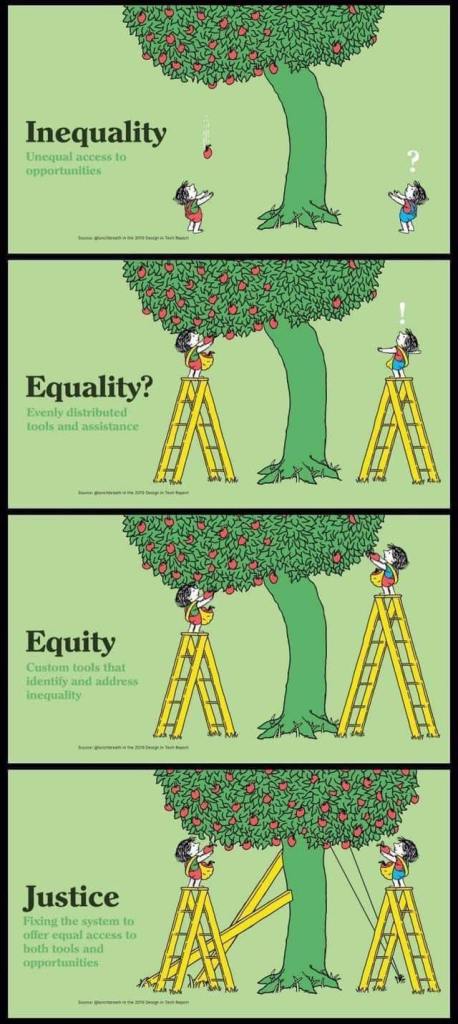
Where each individual has the opportunity and the tools to develop their potential.
For his own good, in concert with the main interest of entire community.

Survival.
Things remaining as they should be.

Us toiling here, on the surface of the Earth.
The heavens perched safely up there.

Justice must be served if things are to remain as we, each and all of us, need them to be.

Can we do without it?
And if not, how much of it?

– If ‘no government’, then who would pay for the army we need to defend ourselves?

Ooops… you’ve just answered the ‘why does Russia ‘encourage’ the trolls who push ludicrous libertarian ideas’ question. Which trolls attempt to achieve two things at once. Weaken the concept of free government and give libertarian-ism a bad rep. Transforming libertarian-ism into yet another form of extremism.

Let’s get serious and try to find an answer to ‘why, and how much of it, do we need government?’

The boring one would be: ‘Whenever one government falls, another one takes over. The interregnum is always bad so… let’s get used to it’.

‘Getting used to it’ works only for very short expanses of time. Left on its own, all ‘government’ becomes sloppy. So sloppy that it soon becomes such a burden that even the most ‘used to it’ lose their patience.
Government, all of them, need to be kept on a tight leash. Otherwise it will soon cease to perform as intended.

– But if you have to keep it on a tight leash, why bother with any in the first place?
Can’t we do without such a bothersome pet?
What’s the point of the whole thing, anyway?

Instinctively, we’re against ‘government’ for two reasons.
It costs us a lot and it used to represent the interests of the ruler.

Until 10 000 or so years ago, we didn’t need ‘government’.
People were living more or less like the modern day Sun People still do. In the Kalahari desert… small bands roam the place, living of the land. The bands are small – so that they might find sustenance, they don’t have any ‘private’ property to protect, hence they don’t need government. Neither did our ancestors.

As soon as people ‘invented’ agriculture – raising ‘tame’ animals at first and working the land soon after, things had changed dramatically.
The advent of agriculture brought two things. An increased productivity and private property.
Soil has not been born equal. Both pastures and arable land can be good, passable or bad. People wish to have the best. Those who already have it are willing to defend it and those who don’t are willing to steal it.
Increased productivity means that those who produce are able to hire people to protect their ‘means of production’. Their property. As a consequence of fighting for it, some people accumulate more and more of it.
More and more ‘means of productions’ – property, means an ever increasing need for ‘management’ and an ever increasing need for ‘protection’. Soon you have a very ‘wealthy’ owner – the lord of the place, call it what you like or use the name given to him by his subjects, the people who perform the day to day management of the ‘whole-sale property’ and those who protect it from ‘marauders’. Both the ‘managers’ – read ‘government’, and the ‘protectors’ – read ‘army’, used to be under the direct supervision of the local lord.
For a while – for as long as the lord kept everything in balance, everybody was happy. The ‘peasants’ were happy because thy were safe, the ‘managers’ were happy because the wise lord used to appreciate their work and ‘compensated’ them accordingly, the ‘protectors’ were happy because they were well fed and taken care of. According to this article, the great Egyptian had been built by willing people, not by slaves.
https://www.harvardmagazine.com/2003/07/who-built-the-pyramids-html
But soon enough, the lord had become estranged from his people. Government had become an instrument used to extract more and more wealth from the peasants while the army was used to protect the government against the people and, whenever possible, to increase the property of the ruling lord by stealing some from the neighboring ‘lords’. The ’empire’ was born.

But this development could take place only in certain circumstances. Where those below the ruling lord had nothing more to do than to obey. Where the best subject was the disciplined one. Where autonomous thinking and imagination were frown upon by the ruler. Where one mind was enough.
Whenever the ‘environment’ mandated the individuals to remain relatively autonomous, proto-democratic forms of self government had been experimented. From the nomadic pastoralists of the Central Asia to the sailing communities in Ancient Greece and Medieval Scandinavia. Those driving herds or sailing ships need to be a lot more independent-minded that those who just tile the earth. No offense intended here! Simple observation will notice that where the geography of the place had allowed it, somebody had ‘built’ an empire. The Nile Valley, the Middle East, the Russian plain, China, Mexico…
Where ever the geography of the place was fragmented enough by sail-able sea, proto-democratic forms of self-management had been developed. The sailing Ancient Athens versus the land-locked Sparta, Medieval Scandinavia versus Medieval France…

Fast forward to present day.
When we have two forms of government.
The more or less democratic ones. Those under whose ‘guidance’ discussions like the present one can happen.
And the more or less authoritarian ones. Which actively discourage autonomous thinking.

Mind you, there are no ‘perfect’ governments.
There’s no perfectly democratic arrangement anywhere on Earth. Because we are imperfect human beings.
And there’s no ‘perfect’ authoritarian government. Because no government can survive for long if it attempts to centralize the decision power. The closer a government gets to being perfectly authoritarian, the smaller is the crisis needed to topple it. Unless it is supported from the out-side but that’s another topic.

So. It is fairly simple to understand how authoritarian governments fail. Too much ‘stiffness’ makes it impossible for authoritarian governments to evolve. To find solutions for whatever challenges pop up constantly.

But what can go wrong with the collective forms of self-rule? With the participative forms of social self management? Otherwise known as democracies?
Lack of enough popular involvement. Due to a sense of apparent safety, initially. And to a feeling of apparent impotence, soon after.
Lack of enough fore-sight. Those who should know better become distracted, for whatever reasons.
Too much opportunism. More and more of the ‘insiders’ use ‘the power of the government’ to fulfill their own, private, goals instead of making sure that ‘government’ works properly.

And what does that mean?

A government works properly when the community which self manages itself using that particular (form of democratic) government survives in the long run.
When those momentarily working inside the government make things happen for the community at large.
When people, both inside and outside the government, follow, in spirit, Kennedy’s words.

Am I being naive?
Maybe… But wouldn’t it be a nice thing to have?
A nice thing to chase, anyway?

And what better way to chase ‘it’ than voting for people who at least pretend to be honest? Who at least make the ‘right’ noises? Whom we can hold accountable whenever they break their promises?
Instead of voting for those who promise barrels and barrels of ‘pork‘?
https://grammarist.com/idiom/pork-barrel/

Ideological pork or hands-on pork, I don’t know which is worse…

– In which direction?

– I thought we were talking about a glass ceiling, not a glass bottom…

You see, we have to deal here with the difference between depth and thickness.

A ‘coat of paint’ has a certain thickness – we know where it starts and where it ends, while a sea has a certain depth. We know it’s there, we know where it starts – at the surface of the water, but we’re never exactly sure where it ends. How deep it actually is!

Another way to put this would be to compare the depth of human consciousness with the thickness of the cerebral cortex.
The depth of the reality we perceive using our brain and the thickness of the cerebral tissue where this perception takes place.
The depth of the reality we, humans, have built during our history inside the relatively shallow portion of the Earth where we feel at home.

We use a small number of phonemes to communicate among ourselves.
A relatively small number of words to convey hugely complicated concepts.
Two digits, 0 and 1, to build artificial intelligence… inside a wafer thin ‘slab’ of doped silicon.

– OK, enough introduction. How about making in clear what you really meant?
A glass ceiling or a glass bottom?

Whether it is a glass ceiling or a glass bottom is a matter of perspective.
A matter of where you are when looking at it. Above or below.
The only thing which really matters being the fact that you see it despite of it being made of glass.
Despite it being transparent.

Transparent to our eyes but not to our conscious mind.

– But if it’s already transparent, why is it such a big thing to break through it?
We already know what’s behind/above it…

Seeing is not the same thing as knowing… just as 0 and 1 scribbled on a computer chip is not enough to make an intelligent computer…

Some say that history repeats itself until we figure out what it meant in the first place.
Others maintain that history’s first ‘helping’ comes as a tragedy while the second becomes a farce.

Well, I’m afraid things are a little more complicated.

For starters, history doesn’t do anything.
History is nothing but a string of events. Considered noteworthy and written down by some of those who have survived the above mentioned events.
NB, ‘winning’ is not necessary. Being able to survive – and to write, of course, is!

It is us who consider some of the events we have witnessed – or read about, to be noteworthy.
It is us who attempt to draw meaning from what we ‘hear about’.
It is us who are arrogant enough to believe we have learned anything.

Which brings me to the next step.

We live in a huge reality.
But see only a small portion of it. Understand even less than that.
But consider ourselves rational human beings. We are convinced that what we do – the decisions we reach and then put in practice, are based on reason. And good will!!!

Day to day practice tells us that individuals make mistakes.
I’ll leave ‘alone’ the actual ‘criminals’, I’m going to consider – for the scope of this post, that all of us act in good faith, all of the time.
Hence we need a mechanism to cope with the ‘honest mistakes’ made by every one of us.
No matter how low or how high in the ‘pecking order’.
No matter how feeble or how powerfull each of us is.
How much decision power each of us musters at any one moment.

We need a ‘procedure’, an ‘opening’, for each of us who sees something going amiss to be able to tell the others that ‘the emperor is naked’.

That’s what ‘democracy’ is for.

But there’s a caveat here.

Like history, democracy is a human concept. A man-made ‘tool’!

Each of the individual members of the group using this tool is ‘limited’. Has a limited knowledge and a limited ‘processing power’. By definition… Otherwise, democracy wouldn’t have been necessary in the first place. If at least one of the individuals involved would have been omniscient, they would have – somehow, climbed to the pinnacle of the hierarchy.
The fact that all imperia – all ‘arrangements’ where one individual garners a lot of power over a complex system comprising of many other people, have inevitably collapsed is a very powerful empirical proof for my assertion.
Further more, the number of individuals involved in any democratic arrangement is also limited. Also by definition. There’s no place on Earth – there are no humans living someplace else, for an infinite number of people. Hence even the ‘aggregate understanding of things’ any democracy might reach is also limited. Fallible, that is.

Thus even democracies need to follow rules. They just cannot ‘vote’ whatever their members wish to happen…

The first rule, of course, being you should not vote ‘against’ the rules of nature. You cannot, for instance, abolish Newton’s gravity by voting it ‘unlawful’…
The second rule being that the individuals comprising the democratic arrangement have be convinced that each of them is equivalent. Not equal, that’s impossible, but ‘equivalent’. That each of them should be able to vote, that each of them should have only one vote and that each of them should have the opportunity to voice their concerns. In a nutshell, that all of them have equal rights and that nobody – no individual or a smaller number of people than the entire ‘congregation’, has the right to tell anybody else what to do. Or what to refrain themselves from doing.

Now, that I have reached this point, let me go back to history.

The first ‘democratic arrangement’ known to us was the Ancient Athens.
It had evolved, for while, as an increasingly democratic form of government. During this time, the city’s fortune and influence in the region had grown almost constantly until Pericles had ‘bent’ the democratic principles so that he could yield more influence. Almost two centuries of democratic ebbing on and off followed until Philip II of Macedonia had taken over entirely. As a consequence, Athens’ influence had waned and then disappeared entirely.
The second one had dawned in Scandinavia, during the Viking era.
That democratic seed had, in time, spread in Europe, America and, gradually, in many other countries.

In the US, for example, at first only the white men were involved in the democratic process. They were the ones who voted and who were elected into office. Gradually, the democratic ‘rights’ had been extended to the female portion of the society and to the ‘members of the other races’. These successive ‘extensions’ had been parts of the general improvement of the society as a whole. During this period – not necessarily due to but certainly simultaneously with, the entire population lived better and longer lives while the country as a whole had become more and more powerful. The energy and potential of the population – of an ever increasing proportion of the population, had been put to better and better uses.

Simultaneously, individuals – an ever increasing proportion of the individual members of the society, with the criteria of sex, gender and race gradually losing the previously held power of discrimination, had enjoyed more and more power. More and more autonomy to determine their own fate.

Which brings us to the current developments in the US.

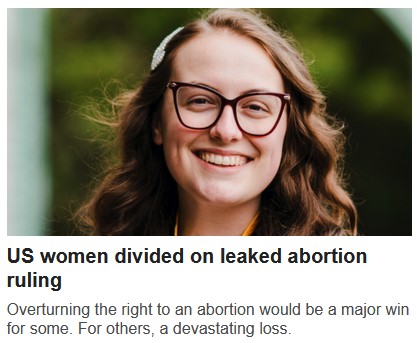
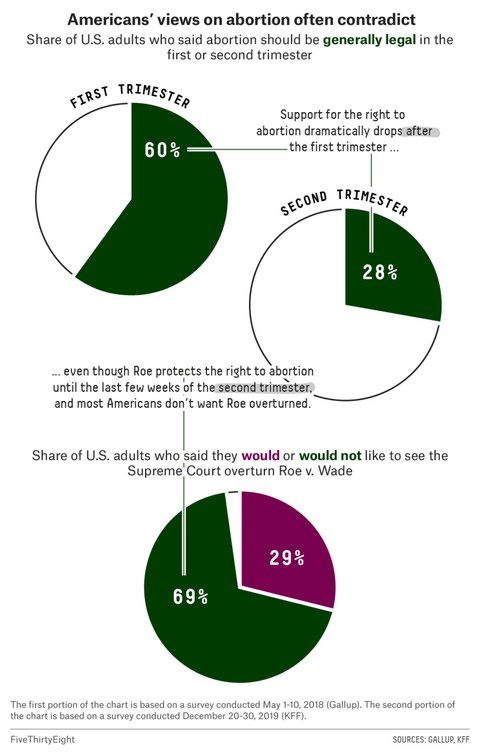
Some people, far from a majority of “The People”, would like to see the ‘other end’ of Roe v Wade.
‘These’ people seem to have somehow convinced a majority of the Justices sitting in the Supreme Court not only to hear their plea but also to ‘consider it in a favorable manner’.

In other words, a very small number of people – five out of nine, are going to restrict a previously granted right which had been enjoyed for almost 50 years by more than half of the American Population.

‘You have got it completely wrong!
Scotus isn’t going to prohibit abortion. Only the states can do that!’

Do you remember what the Civil War had been fought over?
Basically, the Confederates were claiming that individual states had the right to determine which people were to be considered ‘free’ while the ‘others’ kept maintaining that all people, regardless of their skin color, were free. That individual freedom was something which had to be determined at federal level, not by each ‘individual’ state.
Nowadays we have the very same thing. Some states claim it’s their ‘right’ to tell ‘their’ women whether, and in which circumstances, they may – or not, have an abortion.

Not a very ‘appealing’ proposition.
It opens the door for individual states claiming more and more ‘rights’ over their ‘specific subjects’.

The absolutely baffling thing about this whole development is the fact that those who want Roe v Wade to be repelled claim they do this in order to enhance individual rights (to live). I can understand that. I even sympathize with them. Ending a life, even that of an embryo, is not something to be treated easily.

But for a minority to impose their point of view – no matter how sound it might appear to some of us, to a majority… that cannot be, either, taken lightly.

After reading this interview for a second time, I asked myself: ‘Why are you paying so much attention to this guy?!? After all, he doesn’t say anything new…’

Then it hit me!

“Russia” and “we” are two different things.

Russia, the country, cannot indeed afford to “lose”. To ‘lose it’, to be more precise.
Russia will survive, no matter how many more ‘mistakes’ the morons currently running it will commit.

“We”, on the other hand, are the ones who can. And eventually will. Lose. Everything.

And the longer those “we” are allowed by Russia itself to run the Kremlin, the worse it will be.
For everybody. Us – the rest of the world, included.

‘But when will this nightmare end?’

That I don’t know.
All I know is that it will eventually do that. End.

Look at the picture above.
When have you seen anything more British than that?
OK, fake British. Make-believe British. But British nonetheless.

That was which hit me.
That during its entire history, Russia had tried to emulate Britain.
The Russian elite has for ever tried to rise itself to ‘British standards’. From Peter the Great to Putin.
All the while convincing the Russian People that the road they were trundling on was unique…

The sooner the ordinary Russians will figure out that they have been misled – and enough of the elite will understand that British-ness is good only for the Brits, they will make peace.
Among themselves.
With the their Ukrainian cousins.
And with the rest of the world!