I’m afraid things are a little bit more complicated. In this translation, the Turkish proverb puts the onus on the ‘forest’ for what’s going on. Which isn’t helpful. It somehow validates the notion that ‘people’ get what they deserve. The way I see it, the responsibility belongs to the wooden handles. The axes – the steel parts, do what is in their nature to do. Axes split wood, dictators dictate… and so on. On the other hand, those who ‘help in the process’… While it also is in their ‘wooden’ nature to be helpful, the handles do not necessarily have to attach themselves to forest hacking axes. While it is in their nature to give advice, analysts and pundits do not necessarily have to court the Trumps/Putins/Xis of this world.
Blaming the people for voting for those who are being put forward by very skill full political promoters is not that different from blaming the victim of a rape. Yes, she should have known better than to drink that much at the party but the rapist didn’t necessarily had to take advantage of her.
Equality has become ‘the’ thing. But things are not that simple. Not simple enough to be explained/solved in such a trivial manner. Equality is a theoretical concept. It doesn’t exist, as such, in nature. Nor in practice. Two ‘objects’/issues/items are declared, by us, to be equal if the differences between them are smaller than a threshold. Instated, again, by us. Mathematics – a theoretical field by excellence, being the only domain where the difference between two equal ‘objects’ is exactly zero. On the other hand, societies where people consider themselves to be equal fare better than those where the differences between people are ‘manifest’. Hence ‘equality’ must be important, right? ‘Societies where people consider themselves to be equal’… The key word here is “consider”, not “equal “. In this situation, equality is not only a concept but also a value.
The fact that a functional majority of the people living in those societies consider themselves to be equal creates a certain ‘environment’. A situation where those people actually complement each-other. A society which works as an organism. Not as a shoal of fish nor as a simple herd. A society which works a community.
A single parent can raise children. But two parents do it a lot easier. And, in most cases, better. A single parent can adopt children. But no single parent, man or woman, is able to give birth to a child without being helped by a member of the ‘opposite sex’. Societies where people consider men and women to be equal fare a lot better than those entertaining other beliefs. Which doesn’t negate the fact that men and women complement each-other. In a lot more situations than those in which they merely reproduce themselves. Economies where the market is free fare a lot better than those where the economic decisions are made in a centralized manner. The communist camp – where the economies were run by the party, had crumbled under their own weight. Which strongly suggests that no matter how skilled it may be, a central planner will never be able to balance such a complicated process as a whole society/economy. Monopolistic situations, where decision making became too concentrated, invariably ended up in a pile of mess. Another proof that no decision maker, no matter how skilled/well intended, was ever capable of managing, by itself, a really complicated situation. What is the real difference between a free market and one where decision making is concentrated in an unsustainably small number of hands? Or heads? Economic agents are equal? Suppliers are equal among themselves, buyers are equal among themselves and suppliers are equal with buyers? Or suppliers complement each-other in adequately supplying the market while buyers and suppliers complement each-other in maintaining the market afloat? Which brings us back to where we have started. Where people who complement each-other have reached the conclusion they’d better consider their complements as equals. And treat each-other as such.
Word of mouth has it that a dissatisfied customer will be more vocal than a happier one. A search over the internet yields unconvincing results. The statistical jury seems to be still out on this one.
A misspell in the search window unveiled something a lot more interesting.
Are we aware of all this? Probably not. Statistically speaking…
And this is important why?
Being able to recognize anger makes it easier for us to deal with conflict. Individuals who do it better have more chances to survive when involved in dangerous situations. Or even to turn them around. To find ways in which to use conflict in a profitable manner. Profitable for them… And only time will tell for how long! Communities adept at taming conflict into something useful have greater chances to survive than those less able to deal with it.
Now, where are we in this moment? Do we talk to each other? Are we aware of what’s going on around us? Cognizant enough to take the appropriate measures? Or do we just vent out our bile? Creating such an environment that no coherent answer will be presented when needed?
Are we, each of us, part of the solution? Or we just create more and more problem?
The way I see it, capitalism is an environment. A ‘place’. A ‘way’ for people to do ‘economy’. What people do in that place depends on the place itself but also on how they choose to do things. This being the reason for which the American capitalism is different from the European one. And both completely different from the Chinese version. In this sense, capitalism doesn’t actually work. Not by itself! If those dwelling in this ‘place’ act freely – as in ‘free market’ – then the whole ‘thing’ remains ‘sustainable’. Not ‘good for everybody’, not always ‘nice’ but nevertheless ‘fair’. As in ‘you have a fair chance of reaching the other end’. Not to get necessarily rich but to make the ends meet!
The alternative to capitalism… if you take your ideological blinders off, you notice that there’s none! Socialist/communist countries are/were also capitalist. The difference being that their economies are/were centrally planned. Their markets are/were anything but free! This being the reason for which communism had crumbled under its own weight. And for which in all places where the market is not free enough the ‘thing’ is not sustainable!
‘After a trip abroad, the Thinker from Cernavoda and the Sitting Woman will be available for the locals.’
What makes us think that the Thinker is thinking while the Woman is just sitting?!?
Is there any meaning in this?
Newton had only described gravity, he didn’t invent anything. Noticed it – like many others before him, thought about it – more (better?) than all those before him, and came up with a deeper meaning for the whole ‘falling thing’. Nobody cared to contradict him. Because everything, once exposed, was so obvious!
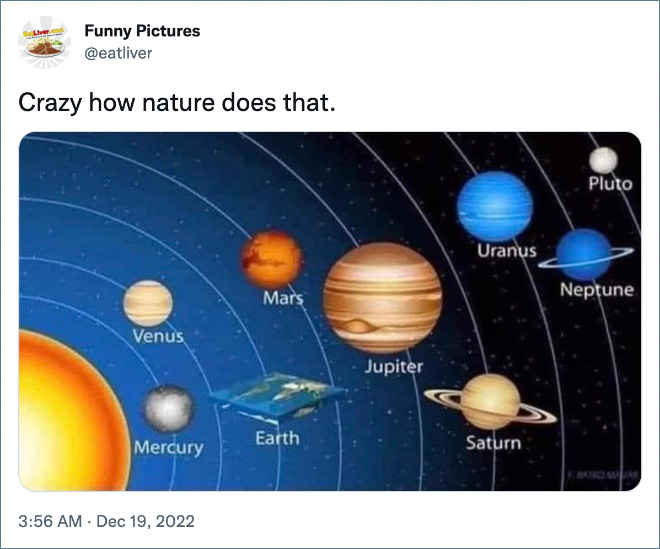
I’ll make a break here and wonder… what does the Flat Earth Society think about gravity?
Had your laugh? OK, let’s move on.
Darwin had also noticed things. Thought about them. Really hard. And put together a theory. Which continues to be considered a theory because not everybody is yet convinced… OK, things are a little harder to swallow. Specially the part with us being relatives, no matter how distanced, with Judy…
Furthermore, the evolution thing is not as obvious as the gravity thing… most of us would have to take Darwin’s word for it… something we don’t do that easily, specially if/when we dislike – for what ever reason, the outcome.
Then why do we ‘swallow’ – line, hook and sinker, however implicitly, the names affixed on those two prehistoric figurines?!? Because they are obvious? Just as obvious as gravity?
The guy must be thinking and it’s obvious that the woman is just sitting?!?
Or is it that we believe what we want to believe? We attribute meaning according to our own standards. Then stick to our opinion. Almost no matter what…
How about He nursing a hangover and She guarding him against predators?
7 years after the accord had been signed, and never implemented, Putin had ordered his army to invade, again, Ukraine. Using Lukashenko’s Belarus as a springboard.
As of now, all five people who had signed the accord had failed. In more ways than one. None of their stated goals have been achieved. The three democratically elected leaders had failed in the sense that they had not been able to prevent the escalation of the conflict. The two dictators have not, as of yet, been able to fulfill their ‘promises’.
For almost a year now, Ukraine had been able to defend itself against the Russian aggression. In the first days of the ‘special operation’, Ukraine had managed to do this alone! Only after the initial surprise had given birth to hope, the ‘west’ had started to send in meaningful assistance. Which strongly suggests that a people which is in control of its own fate – as in ‘democratically decides its own future’ – has a greater ability to fight than a people sent to the battle field at the whims of a dictator.
One by one, the democratically elected signatories of the Minsk agreement had been replaced. One way or another, all of them peaceful. Not necessarily as a consequence of this particular failure but, nevertheless, they are no longer able to make any other hugely significant mistake. The two dictators continue to dictate. To make mistakes and to defend their previous mistakes. To cause misery.
Looking at the whole thing from a distance, the situation is simple.
Unfortunately, things are even worse. Not only that power is magnetic to the corruptible but also most ‘ordinary’ people tend to have a hard time acknowledging mistake. Once committed, even by the most incorruptible person, a mistake gets a life of its own. And works hard at convincing the perpetrator to ‘hide’ it. Hence to commit even worse mistakes.
Now, why is power magnetic for the corruptible? Because power makes it possible for the ‘agent’ to ‘hide’ a lot of mistakes!
The way I see it, people have a knack for learning on the run. The shape of the learning curve and the duration of the process depends on the particulars of each situation but all people eventually get there. Those who survive to that point, of course…
What’s to be learned from all this?
The obvious, my dear Watson!
All those five powerful agents in the picture above have failed. Yet the French and the Germans fare a lot better than the Russians and the Belorussians while the Ukrainians fight better than the Russians.
What’s the main difference between those two ‘sides’?
Those who fare better change their leaders more easily and more often? Before their mistakes pile up? And become ‘too big to fail’?
‘Join them’ as in: ‘What you were doing was worthless. That being the reason for which you were not able to beat them. Hence you must turn coats and join them. In what they were doing’? Or ‘join them’ as in: ‘Regardless of who’s right or wrong, they are more powerful than you. In order to preserve yourself, you must cave in. And join them. In what they were doing and in how they were doing it!’?
There’s a third manner of putting it. ‘This is the democratic thing to do. If there are more of them than you, you must join them. There is wisdom in numbers, you know!’
I’m afraid all three ‘as in-s’ are wrong!
If you live in a democracy, you had already joined them. The very essence of a democratic arrangement is that you may keep your convictions even if the majority has made up its mind to proceed in another direction. You sometimes must follow – because you have already joined them, but you always may bring along your ‘luggage’. Provided that your luggage doesn’t endanger the community, of course. What if the community considers your luggage to be dangerous and you disagree? Then maybe the bond between you and the rest of the community isn’t that strong after all… In this case, you may have to weigh the pros and cons… Also, you must seriously consider the possibility that the relation between you and the community may not be based on ‘true love’ … it more likely belongs to the ‘friends with benefits’ category…
Do you tend to side with the powerful? Are you comfortable with delegating your ‘feel good’ to an outside agent? Are you aware that no matter what those outside agents promise, what they have in mind is their own interests? Not yours, theirs! Are you aware that ‘they’ are not your ‘servants’? That unless you live in a democracy, there’s no way to keep them accountable? ‘Stockholm syndrome’ means anything for you? How about ‘postponing the inevitable’? ‘Sweeping under the rug’?
Are you that afraid to change your mind? Under your own steam? Why ask for other incentives but those provided by mere reason? What else do you need besides arguments in order to make up your mind??
And where did this notion of ‘beating’ came from?
What are we fighting for?!?
One last thing. ‘Why me?’ is a very good question. Because there’s no one else!
No man is an island, Entire of itself. Each is a piece of the continent, A part of the main. If a clod be washed away by the sea, Europe is the less. As well as if a promontory were. As well as if a manor of thine own Or of thine friend’s were. Each man’s death diminishes me, For I am involved in mankind. Therefore, send not to know For whom the bell tolls, It tolls for thee.
Destination first. If you know where you’re going, getting there will be a lot simpler.
According to Daniel Moynihan – “you are not entitled to your own facts”, facts are obvious. So obvious that doubting their existence, their factuality, would push us beyond the realm of the reasonable. Appropriating facts – transforming them into ‘private property’, banishes the perpetrator from the community….
Hm…
Let me put it differently. Moynihan had said something. What was it? A fact? Or an opinion?
Currently, we – well, most of us – believe that freedom of opinion is the cornerstone of our Weltanschauung. When it comes to facts… We’re OK with the definition – we do use the word/concept, quite extensively – but we seem to have some problems when dealing with the actual reality. Remember the still famous ‘alternative facts’?
Let me add something personal to all this. My opinion about ‘facts’.
The current definition is somewhat incomplete. We take something for granted. To the tune of no longer mentioning it. We assume all of us see the elephant in the room and no longer talk about it.
For something to become a ‘fact’ we have to notice it. First. And then we have to agree among ourselves about its meaning!
Things used to fall down since …. We’ve been discussing the matter since… we’ve learned how to speak! But gravity had become a fact only after Newton had noticed the famous apple, wrote about it and we agreed. Gravity had become a fact, and continues to be one, only because his contemporaries had agreed with Newton on this matter. And we continue to believe Newton was right!
In this sense, alternative facts have been with us since day one. Well, something like that… God had told something to Adam and Eve, the serpent had said something else… and the rest is history! For some…
Newton had said something to us. And most of us had chosen to believe him. Or ignore his words… Darwin had said something to us. Many of us have chosen to believe him. To accept his arguments about the matter. While some others have chosen to dispute Darwin’s findings. To actively negate Darwin’s explanations about how we’ve got here.
Gravity is a fact while Evolution is still a theory. Statistically speaking, of course.
In this sense, Moynihan was wrong. For his words to ‘hold water’, we must to agree on how to separate facts from opinions. Until we agree among ourselves about how to determine ‘factualness’, we’ll keep having to deal with ‘alternative facts’.
I actually cannot wrap this up before ‘unveiling’ my litmus test for factualness. Consequences.
Does it have consequences?
Yes? It’s a fact! No? Then it’s not – not yet, at least – a ‘fact’. It did happen – otherwise we wouldn’t be speaking about it. It even does have consequences – we do speak about it, but that occurrence doesn’t yet have meaningful consequences. It is not a ‘factual’ fact.
The answer, like always, is to be found inside the question which generates it.
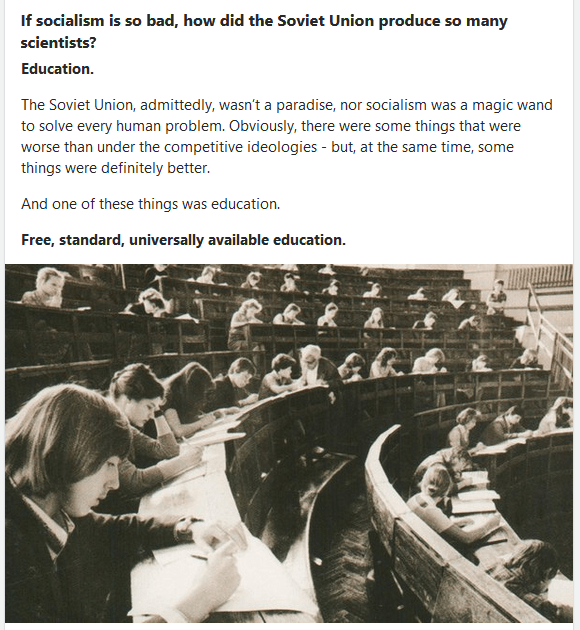
“If socialism is so bad, how did the Soviet Union produce so many scientists.”
The key word here is ‘produce’. First of all, Russia did have an important cultural and scientific tradition to start with. Secondly, the communist leaders – mostly Lenin but more or less all of them, had a clear understanding of the literacy gap which separated Russia from the rest of the world. Filling that gap was the first step towards Russia/the Soviet Union becoming a First Tier country. Hence the ‘free, standard, universally available education’.
But there’s a caveat here. When we’re speaking about education – in the West, we mean ‘everything already known to man’. Students are allowed to read everything in the library – except for certain places in the US, but those are exceptions. When we speak about the education in the Soviet Union we must remember that each of the ‘free, standard and universally available’ aspects had its own limitations. It was free in the sense that everybody – well, almost – had the right to apply for it. Actually getting it was something else. It was standard in the sense that it was standardized. Only what was deemed safe/useful was allowed to reach the students. It was universally available in the sense that everybody was subjected to some form of education. Much of which was nothing more than indoctrination…
Finally, let’s remember that the Soviet Union was able to produce scientists only for so long. Until it collapsed under it’s own weight…
Moral of the story?
Producing scientists is not enough. Science teaches you only how to do whatever you want to do. What to want… that’s something else!





 nicichiarasa