Archives for category: Economy

About half of our manufactured goods come from China. From half-way around the world. A shipping container needs about a month to arrive to Rotterdam from Shanghai. While ordering the merchandise takes some five minutes over the internet.

Shanghai is in China. A country so far away that hourly wages are a fraction of those in Europe. Or in the US. That being the reason for so many of our manufactured goods coming from there.

China is a country so far away that it took more than a month for the rest of the world to find out that a pandemic was brewing in Wuhan.
China is a country so far away that the CDC expert embedded in China’s Disease Control Agency was deemed useless by the current American Administration.

China is a country close enough for the Chinese tourists to had been a staple for the Italian hospitality industry. “5.3 million overnight stays in 2018
China is a country far enough for an “official opening ceremony” to had been “held at the Auditorium Parco della Musica, a multicultural complex, in the Italian capital on Tuesday, at the presence of Italian Minister of Cultural Heritage, Activities and Tourism Dario Franceschini and Chinese Minister of Culture and Tourism Luo Shugang.”

The ceremony was held because “2020 has been designated the China-Italy year of culture and tourism, as the year marks the 50th anniversary of China-Italy diplomatic ties.
“Tuesday” was the 21st of January 2020.

The same day

  • United States confirms its first case in Washington state, a man who traveled to the Wuhan area.
  • China confirms two additional deaths, a sixty-six-year-old man and a forty-eight-year-old woman
  • New cases are announced in China, including in Beijing, Shenzhen, and Shanghai.
  • Chinese state media raises number of confirmed cases to 291 and confirms 15 medical workers in Wuhan have been diagnosed with pneumonia.
  • Hong Kong confirms its first case, a person in their thirties.
  • Taiwan confirms its first case, a woman in her fifties.

The above timeline was ‘borrowed’ – through the Internet, of course, yet another example for how close we are of eachother, from https://www.thinkglobalhealth.org/article/updated-timeline-coronavirus on 3/28/2020, 12:30 GMT
Which Internet pulls us together by pooling information/data while simultaneously rips us apart by feeding us a constant stream of fake news.

We are so close together that you can send/receive almost everything (from) almost everywhere.
We are so close together that everybody who has a smart phone can see their similarly equipped buddies halfway across the world.

We’re so far apart that we still have to make up our collective mind about which comes first. The Economy or the People.
We’re so far apart that we haven’t figured out yet that there’s no such thing as a running economy without enough able bodied and mentally sane people. To produce, transport, distribute and buy the things we need.
We’re so far apart that we haven’t yet figured out that the present number of people cannot survive – let alone maintain a decent living standard, without a running economy.

Smarter people than me are already prepping for the aftermath.
For the opportunities which will have ripened by then.

Which, let’s face it, is a wise thing to do. Most of us would have done it. Prepping for what we fear. And for what we covet.

Also wise would be for us to remember that everything we experience today – the good and the bad of it, together, is the consequence of how we have chosen to use the opportunities opened up by the previous crisis.

And by that before it …

I’m sure you’ve already learned everything worth knowing about how to flatten the curve…

My post is about something else.
About the need to think with our own heads.
Individually. Each on their own.

More damages are caused by the manner in which we have chosen to react than by the pathogen itself.

‘Then what should we do?’

I don’t know. And I just told you to stop taking cues, blindly.

There is something I do know.
Nobody can get out of something like this on its own. Alone.
And another thing. If we get out of it as a herd, we’ll very soon end up in another trap.

‘Damned if you do, damned if you don’t… I really can’t figure out what you want to say….’

OK.
We, humans, are social animals.
We not only raise our young – all mammals do that, we raise them in a social context. We live in groups and we raise our children to belong there.

Living in a social context has consequences. From being prone to infestation to having adopted specific behaviors.
Humberto Maturana is actually convinced that our very conscience – ‘our ability to observe ourselves while observing‘, a paraphrase, is a product of us leading our lives in close community.

One of these specific behaviors is the herd instinct.
Whenever in a dire strait, the members of a group pay a lot more attention to the rest of the group than in the ‘peaceful moments’.
This has two bright sides and one huge drawback.

All members of a group paying close attention to the others makes it easier for those who need it to get attention. And help.
All members of a group paying close attention to the others makes it easier for the group to follow when one of them finds a way out.
All members of a group paying too close attention to the others makes it very likely that the entire group will dash out at the first opportunity. Without checking first where they’re going to land. Nor whether there are any other opportunities.

Another specific behavior is ‘opportunism’.
Some of us have figured out that by keeping their chill in a crises they are more likely to identify whatever opportunities might exist in that moment.
And the deeper the crises, the bigger the opportunities.

Theoretically, these two should work like a charm.
The opportunists keep their chill, look around, identify the best way out and the rest of the herd follows them to safety.
A win-win situation.

Yeah… but!

Wouldn’t it be a way lot better whether all (or, at least, ‘more’) of us would keep their chill? Wouldn’t we be able to identify even more ways out?
It would take a lot more time? We’d need to discuss things over, to negotiate… we’d have to exert a lot of discretion…
True enough. Hence we’d need to evaluate two things. First, how urgent the dangerous situation is and, then, whether a better alternative would be worth searching.

And something else. In a ‘follow me blindly’ situation there’s no going back. The consequences for a hasty choice might be tremendous.

We might end up with more people being hurt by our blunder-some reaction than by the cause which had spooked us.

Yet another specific behavior is responsibility.
Living in a social context means that, sooner rather than later, individuals are censored for their actions. By the rest of the community or, sometimes, by the stark reality.
Unfortunately, sometimes entire communities are censored, by the stark reality, for not behaving responsibly. For not imposing responsibility upon their members.

For not taking enough time before choosing between flight and fight.

Let me put things into perspective.
How many of you have chosen to continue smoking despite having been warned?
How many of you have emptied the shelves despite being told there’s enough for everybody? Or that there will be soon enough?
How many of you do not smoke in the presence of your children? Because you know it will hurt them?
How many of you have taken active measures to protect the elderly? For the very same reason…

As for the economy being the main casualty of the present scourge…
I’m afraid ‘the economy’, as we know it, has been dying for quite a while now. That’s why it is so susceptible to SARS CoV-2.

The Ancient Greeks had come up with the concept of ‘oeconomia’ as the art of making the ends meet. Adam Smith had described the free market as the place/environment where competing agents made it so that people – solvent demand, could satisfy their needs.
Nowadays, too many of us understand/accept ‘economy’ as the art of getting rich. ‘Free’ in ‘free market’ is understood as ‘free’ to do anything you want. Because very few are asked to answer for the long term consequences of their actions.

The economy, as the manner in which we cooperate towards fulfilling our needs, has fallen prey to our gluttony. And to our nearsightedness.
Greed is not good. And SARS CoV-2 is only an eye opener, not the cause for the current implosion.

I thought I had it all figured out.

I had already learned that individuals needed to preserve their self esteem. The good opinion they have built about themselves during their entire lives.
This being the reason for which most self made people see their own efforts as the main reason for their status. While being adamant that Lady Luck had played no role whatsoever in their advancement…

I had also observed that all imperia had eventually failed. No matter what kind of imperia… Political dictatorships, commercial monopolies, abusive families…
For no other reason than dictators’/patriarchs’ tendency to drive away those who don’t kowtow to their opinions.
Which attitude effectively empties the structures led by authoritarian figures of any ‘alternative’ expertise. Of any other expertise but that of the leading figure. And since no expertise was ever infinite – not even Napoleon’s, the end of all imperia had been sealed from the moment when a single will had imposed itself over the entire structure.

OK, from the outside everything made sense. The added figures matched the measured total.

But something still bothered me.
As a constant rebel, I perfectly understood those who chose to leave instead of bowing to the higher authority.

But why act in a dictatorial manner in the first place?
Why drive away all those who might come handy in a dire strait?
Why not replace those who choose to leave with equivalent people? Instead of favoring increasingly obedient ones?
Specially when speaking about very intelligent people… and very few individuals have ever arrived at the top of any complicated structures only because Lady Luck had a crush on them …

Yesterday, when discussing the subject with my father – we each support different political parties and Romania had just elected it’s president, he told me: “You had been lucky enough to never have had to make a compromise. That’s why you can afford to think like this!”
We were using Romanian. I used ‘can afford’ to convey what he said to me because I’m not aware of a closer English equivalent. Maybe I could have used ‘allow yourself to think like this’…
Anyway, that was the moment when it struck me.

That past ‘compromises’ tend to compromise our ability to see the forest for the trees.
That whenever somebody aired an opinion which even slightly contested any of the compromises we ever had to make in our pasts we perceived it as an aggression. As if our self esteem was under assault. No matter that the ‘assailant’ had no way of knowing that we had to compromise our own beliefs at one point.
The simple fact that we remember that moment is enough. We’ve found ways to soothe our souls. We’ve already have invented excuses. Otherwise we wouldn’t have been able to function… But we’ve never been able to really come to terms with ourselves. We’ve never forgiven our own weaknesses. Never assumed them in earnest.

And this is how past ‘mistakes’ continue to haunt us.
Preventing us from accepting advice.
Because ‘deep down’ we feel the urge to continue the path we have already chosen’. That being the easier way to preserve our psychological well being. Our mental consistency…

Further reading:
Cognitive Dissonance
Customer cancels Zomato order for sending non-Hindu delivery boy.

For a (free) market to function, at all, it needs active economic agents.
Which economic agents need, in their turn, certain amounts of concentrated resources at their disposal. A certain amount of ‘capital’. Regardless of who owns it. Or disposes of it.

In this sense, no matter where each of them finds itself on the individual to socialist spectrum, all societies are ‘capitalist’.

On the other hand, individual capitalists – economic agents, do not need a free market to thrive. The do indeed need a market to sell their products/services, only that market does not have to be free. On the contrary, even.

OK, no monopolistic market has survived for long. And all monopolies have eventually failed. Even those who had grown ‘too big to fail’!

But go and tell this to any of those who happen to be at the helm of a monopoly… be it of economic or political nature …

While ‘fitting’ discount priced toilet paper into my new second hand car, something struck me.

DSC_6406

In many ways, we are a first generation.
And by ‘we’ I understand what Americans call ‘the baby-boomers’.

We are the first generation to use toilet paper ‘en masse’. Have you noticed the hole in the Farmer’s Almanac?
We are the first generation to witness new cars becoming less reliable than the older ones. Not to mention less ‘honest’… remember the scandal regarding the Diesel engines emissions…
We are the first generation who has not witnessed a large scale war. As a consequence, very few of us had to flee conflict. My paternal grand parents had to leave their country behind after WWI while my mother was trice displaced during WWII. During my ‘tenure’, I’ve only read about those who had to flee the war in ex-Yugoslavia. Or Syria… We’ve met refugees, indeed, only all of them had come from other continents. While our parents/grandparents had to flee themselves. Had relatives and/or friends who had to run for their lives.
We are the first generation whose children expect to have a harsher life than ours.

Would this be enough explanation for the demographic decline we witness in Europe? And in other civilized places? Japan, South Korea…
As in ‘the reason for which less and less of our children have children of their own’?

OK, and where’s the link between my discount priced toilet paper and the demographic decline?

The fact that we don’t want to get our hands dirty is absolutely normal!
Who, in their right minds, would want such a thing?
There is a second fact though. Which cripples us. We haven’t yet learned that, from time to time, people do have to get their hands dirty in order to survive.

And people actually died because of this.
Boeing was so eager to cut costs – and corners, that didn’t even consider doing the ‘right thing’. ‘Getting their hands dirty’ and treating the 737 Max 8 as the new type of aircraft it really was. Before two of them having crashed due to pilots haven’t been properly trained for the new flying conditions.
Boeing should have designed the plane starting from a clean sheet  and the FAA should have  certified it as such.

There’s a lot of dry wood in the forests around us. It stays there for a while. Only from time to time something happens that starts a fire.

Fill a room with a mixture of oxygen and hydrogen – at ‘room temperature’, and nothing happens. Strike a match and… you get a big noise and a little water. Don’t try this at home, you won’t live to tell the story. The noise is really big.

White phosphorus has to be kept under water. Whenever it gets in contact with humid air at a temperature above 30 degrees Celsius it starts to burn. And it cannot be extinguished in any other way than by submerging the whole thing under water.

Put a TNT stick (make sure it isn’t dynamite) into fire and it will simply burn. Fuse it properly and it will detonate whenever you ‘tell’ it to.

Let’s consider life now.

All the chemical elements, and a huge number of the organic molecules, which are the building blocks of any living organism have been around for eons while ‘life’ is a relatively recent occurrence.

Males and females – both animals and plants, roam around freely. Yet no offspring appears before something happens between a male and a female. This – the need for something to occur outside the individual organism, is valid also for bacteria – they need certain conditions to multiply, and viruses – which need the assistance of other, suitable, organisms.

Whenever conditions are right enough, sooner or later ‘life’ will surely appear. Or so it has happened all over our Earth. Till now, at least.

Whenever a living organism follows it’s normal set of instructions – its DNA remains fully functional, everything goes ‘as advertised’. If, by any reason, enough DNA is damaged beyond repair, the hell breaks loose. Being diagnosed with Cancer is enough to blow up even the most stable mind.

I’ve kept the most striking similitude for the last.
Both combustion and life continue only as long as certain conditions are met. Both need enough oxygen and fuel/nutrition.

There are also two big differences between them. One regarding ‘time’ – the successions of ‘moves’ which constitute the processes, and the other regarding ‘space’.

Combustion follows a set of pre-existing rules.  The chemical composition of the combustible might change the ignition temperature but that’s all it can do. Or it may add – as it’s the case for explosives, the possibility of detonation. But, again, both combustion and detonation follow a set of rules which are valid ‘across the board’. For all combustible and explosive substances.

On it’s turn, life follows two broad sets of rules. It has to obey all those which govern chemistry and physics – read combustion and detonation, and, on top of that, it has it’s own set of detailed instructions. Which vary from species to species.

I’ve left for the end the difference regarding ‘space’ because this one is very simple.

‘Combustion’ will extend all over the place where combustible is ‘continuous’, in a single ‘event’, while ‘life’ is, by definition, about finite organisms which multiply to make ‘good use’ of the available resources.
This being the reason for which combustion stops whenever the combustible available in an enclosed place is exhausted while life can resist a certain period of ‘famine’.

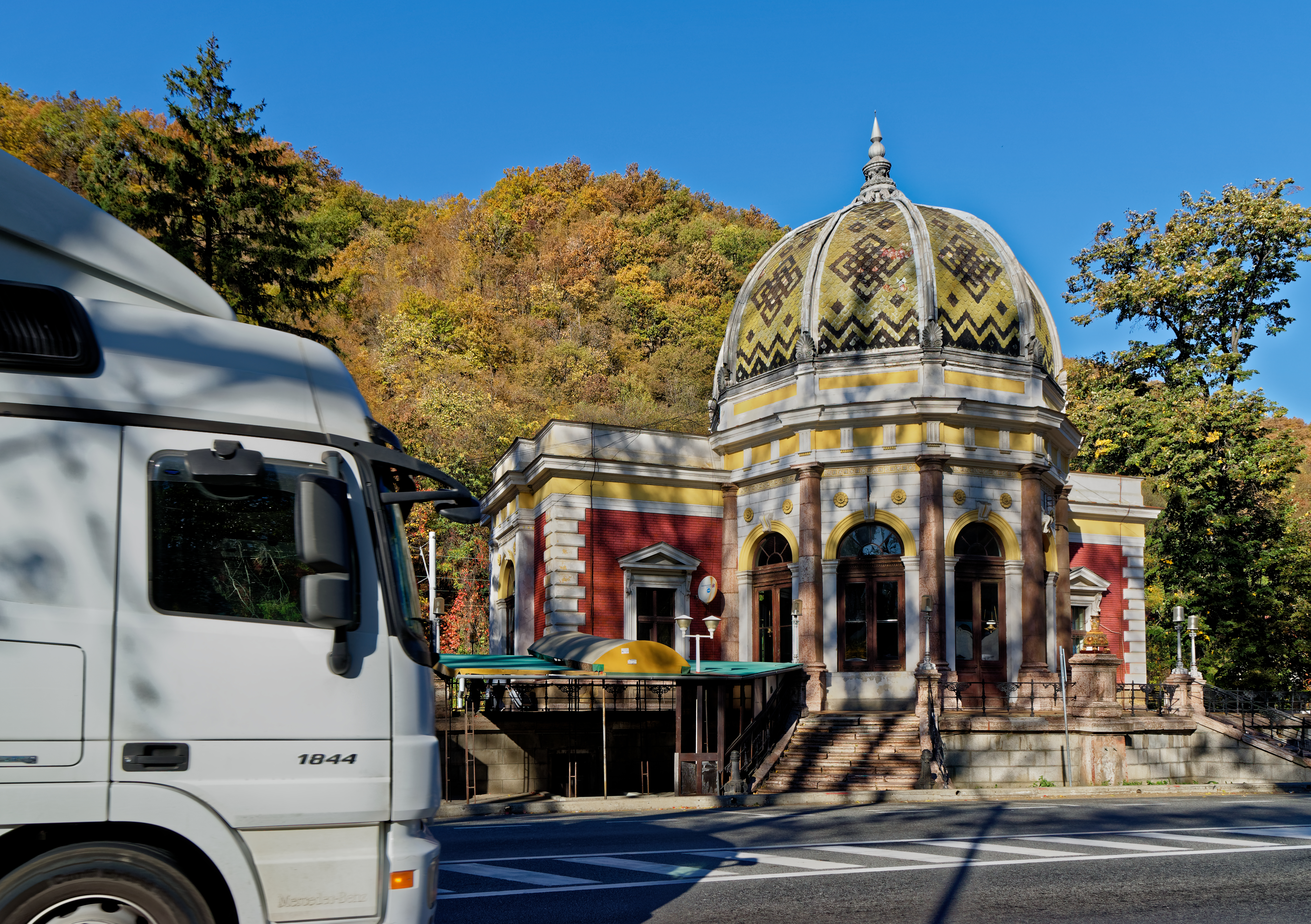
Gara Herculane (1878-1886) is the oldest, and the most beautiful, railway station in Romania.
Like most others, after having performed wonders for all of us for more than a century, it has been made obsolete by trucks and automobiles.

DSC_0688

By clicking the picture you’ll be able to browse more images taken in and around the place.


More than 30 years ago, a very good friend of mine had emigrated from then communist Romania to the US. Ten years later he landed  a job with a huge Japanese corporation, his previous position having been that of COO for a way, way smaller corporation. One where the owners were not only involved in running the business but also ‘close’ enough to the ‘daily hustle’.
After a few weeks he phoned me. He was utterly dejected. ‘It’s as if I’m back in Romania, working for a state owned enterprise. Nobody cares for anything but the hide on their own backs. And they act very narrow-mindedly. They lie to their bosses, don’t share work related knowledge with their co-workers and so on, without realizing that by behaving in this manner they actually weaken the structure which ‘feeds’ them. Furthermore, those in charge don’t care about anything else but their fat ‘compensation packages’, not realizing that, on the longer run, their behavior is leading to ruin. Meanwhile, the shareholders  – from ‘far-away’, don’t realize what’s going on. Until too late, of course.’

Some 25 years ago, another good friend of mine had emigrated to Canada. He currently works, as a contractor, for a huge Canadian corporation. A few weeks ago he was here for a short vacation and we had a chat. ‘Nobody cares for anything anymore. The contracting agencies don’t give a damn whether the people they send over are actually able to do the work, the bosses don’t understand, or care, very much… it’s as if we, the ex-communists, have came back from their future…’

Even the ‘family run’ businesses have lost their edge. Their owners are no longer ‘close’ to their employees and the businesses are very quickly sold to the highest bidder. And incorporated into ever-growing entities…

The two friends I already mentioned said that ‘whenever a corporation grows big enough, it starts to resemble a state’. My own experience concurs.

Only I’d take a step further.

‘Whenever an organization grows big enough, those who ‘inhabit’ it start behaving as if employed by a state/state-owned entity’. As if their job/position is theirs to be had/defended by birth-right. A feudalism of sorts.

And these people end up passionately defending the organizations which give meaning to their lives.
As they are! Simply because any change in the organization would imply a change, for the worse, in the fate of the individuals defending the current status.

And why would any individual behave in such a short-sighted manner?

“Every position in a given hierarchy will eventually be filled by employees who are incompetent to fulfill the job duties of their respective positions.”

Peter

BTW, when was the last time you came across the concept of ‘company culture’?


“Capitalism has generated massive wealth for some, but it’s devastated the planet and has failed to improve human well-being at scale.”

Drew Hansen, Unless It Changes, Capitalism Will Starve Humanity by 2050,
Forbes, feb. 9, 2016.

I’m afraid we are dealing with a huge confusion.
Capitalism hasn’t generated anything and hasn’t starved, nor fed, anybody.
People did!

Capitalism is nothing more, nor less, than a particular manner in which we, ‘the people’, relate to property while ‘the free market’ is one of the manners in which economies are run.

And here’s the place where things become ‘murky’.

‘Oekonomia’ is Greek for ‘making ends meet’.

“The annual labour of every nation is the fund which originally supplies it with all the necessaries and conveniencies of life which it annually consumes, and which consist always either in the immediate produce of that labour, or in what is purchased with that produce from other nations.

According therefore, as this produce, or what is purchased with it, bears a greater or smaller proportion to the number of those who are to consume it, the nation will be better or worse supplied with all the necessaries and conveniencies for which it has occasion.

Adam Smith, An Inquiry into the Nature and Causes of the Wealth of Nations, 1776

The way I read it, Smith sees ‘wealth’ as people’s/nation’s ability to supply for their ‘necessaries and conveniencies’.
In other words, ‘to make ends meet’.

How we define our needs, the manner in which we choose to fulfill them and what we are disposed to ‘spend’ in the process… is our responsibility.

So.
What is it that we need/want?
A healthy planet? Clean air/water/soil and a fair opportunity for each of us to earn their keep?

Or a dog eats dog type of contest for ‘who has the biggest pile of money’?

Capitalism can encompass both.

Unfortunately, the second scenario has nothing to do with ‘making ends meet’.
On the contrary!