Archives for category: corruption

As I promised you some time ago, let’s have a look at ‘property’.

As you recall, I was arguing that we, humans, are only ‘qualitatively’ different from the rest of the animals. In the sense that we do everything that they do – and nothing really new or different, only that we do it ‘better’. And more ‘evenly’.

In my previous post, I was dealing with ‘trade’. So I’ll use ‘trade’ to explain what I mean by ‘more evenly’.

All living things are made of three things.

An inside, a membrane and a set of instructions which deal with two things.
How the whole thing should be structured in order to able to live and how the inside should interact with the outside – through the membrane, in order for the organism to remain alive and replicate itself.

My previous post dealt with individual organism trading food (a.k.a. matter) and information with their outside. It also dealt with manners in which trade can be performed.
Directly – as in barter, or indirectly – using symbols.
The most simple barter is breathing. Exchanging gases with the environment. Or foraging – individual organisms ingest food and water and excrete poop and urine.
‘Trading’ information is a little more complicated. An individual organism can be endowed with genetic information by it’s parents, presented with information by some of its peers – bacteria or playmates, taught by its voluntary or involuntary teachers or it can glean information by itself through mindful observation. Also, trading information is more complicated than trading food because information can be either ‘hardware’ or ‘software’. DNA inherited from the parents (received from peers/’invaders’) being ‘hardware’ while information gleaned through observation or during training being ‘software’.

Everything described in the previous paragraph is common for all living organisms, including humans.

My point being that we’ve been trading, from the ‘beginning’, far more items than any of  the other living things – plants and/or animals.
OK, an individual whale will eat far more than an individual human being. But whales eat, basically, one or two things. While we, humans, will throw down our throats almost anything that we fancy. Including some stuff which will actually hurt us.

But the real interesting thing is the manner in which we ‘trade’ information. We not only observe keenly what happens outside our consciousness (not just outside our-bodies, simply outside the shell that harbors our ‘mind’) but also translate that information into symbols and then communicate that symbolic information with our fellow human beings.

And here’s the catch.

I mentioned earlier that every individual organism consists of an inside, a membrane which keeps it together and a package of information.
For survival purposes, each organism must consider all its three components as being its own and to defend them ‘to the bitter end’. Or else…
Which is congruent to what happens in the real world… Membranes are relatively hard to penetrate, there are some defense mechanisms which at least attempt to take of any intruders – the immune system, for example….
More over, the more ‘sophisticated’ organisms also defend ‘their’ territories and the local resources they have identified and claimed as being theirs. If you don’t believe me, just try to take a bone from any normal dog which isn’t yours.

You see, not even ‘property’ is exclusively  specific to humans…. We have created the concept, we actually define ourselves using our possessions… yet we share this trait with all other living organisms… even if they don’t know anything about it…

Remember what I just said about us being able to trade ‘symbolic’ information? To ‘formulate’ the information before trading/sharing it?
Same thing happens with ‘property’.

For a dog, a bone is its property as long as it happens to be in his snout. And most dogs have no problem in attempting to ‘steal’ a bone from another dog – as long as the other is not way bigger, a pup or some-other special cases.

Meanwhile, most humans would painstakingly respect other people’s property.
Simply because, for us, property has also meaning. Besides ‘survival value’

NB. In English, ‘property’ is not exclusively about possession. Its root, ‘proper’, means from ‘clean’ to ‘as it should be’.

Let’s take it one step at a time.

A guy hires a woman. A ‘working girl’, to be precise.

After a while, an attorney pays a hefty sum to the working girl and has her sign a confidentiality contract.

When asked about the whole thing, the guy first said that he didn’t know much about anything and then that he had reimbursed the hush money to the attorney.

The attorney apparently gets a lot of money from somebody else. Which somebody else might be, now or become in in the future, in a conflict of interests with the organization presently run by the guy who had once hired a working girl.

It becomes apparent that the attorney is a confidante of this guy. Or, in plain English, that this attorney takes care of the dirty laundry that ‘happens’ around this guy.

It also becomes apparent that this attorney is not satisfied with the amount of money he gets from this guy. That this guy is not his only client. And that this attorney is not very particular when accepting other clients.

What am I to understand from all this?

This guy is cheap?
This attorney is very greedy?
This guy is not very particular when choosing who takes care of his dirty laundry?

Some of my right-of-center friends maintain that political correctness is a leftist aberration while some of my left-of-center friends are convinced that most conservatives are bigoted male chauvinists cum white supremacists cum LGBTQ+ haters.

I’m afraid both are mistaken.

The way I see it, none of this has anything to do with left nor right and everything to those on each side of the divide driving themselves into self allocated and mutually exclusive corners.

Otherwise said, this dichotomy is a consequence of populism.
People residing in each ideological corner are constantly barraged with messages telling them exactly what they have prepared themselves to hear.
People residing in each corner are constantly barraged with messages deemed appropriate by those who reckon there is something to be gained, by ‘them’, from keeping those people as far apart as possible.

Maybe now, that Cambridge Analytica has just hit the fan, we’ll start to understand how fake this whole thing is.

And I can’t wrap this up without mentioning something which really bothers me.

“As I said in my How to Fail book, if you are not familiar with the dozens of methods of persuasion that are science-tested, there’s a good chance someone is using those techniques against you.

Scott Adams, blog.dilbert.com

The ‘run of the mill’ populism is directed towards the ordinary people. Which have a valid excuse for not knowing what’s happening to them.
Political correctness is a self sustaining bubble which was generated and is maintained  inside a supposedly more sophisticated medium.

Intellectually more sophisticated medium….

political correctness zizek

Hopefully, Zizek’s arguments will help us puncture this bubble!
Click on the picture above and see for yourself.

As most other words, loyalty describes a ‘multidimensional interval’ rather than the ‘precise something’ most of us usually expect.

What kind of loyalty?
Loyal to whom/what?
How far would it go?
How is it affected by the passage of time?/How does it change the passage of time?

I’ve been mulling over this subject for more than 10 years now…

For me, this is closely related to the famous “Prisoner’s dilemma”.
You now, where two guys break the law together, get caught, are indicted for two felonies and the prosecution  has solid evidence only for the lesser charge. The two guys are held in separate cells, with no way to communicate, and are pressed hard to confess of the higher charge and/or to betray the other guy. During the interrogation each of them learns that:
– If both betray, each of them gets 2 years in prison.
– If one betrays and the other stays mum, the snitch walks and the ‘mute’ gets 3 years.
– If both shut up, each of them gets a year for the lesser charge.

Interesting enough for somebody who was never in such a situation. And it gets even more interesting if you start reading what the ‘pundits’ have to say about the whole thing.

The ‘cold rationalists’ maintain that it’s only logic for both of them to betray, simply because this is the only sure way to avoid the longer sentence. You never know what the other guy might do in a pinch, right?
The more down to earth, specially those with a more ‘intricate’ knowledge of the ‘underworld’, will loose no time to point out that something like that won’t happen if the the pair belongs to the mob…
Those with economically biased minds will be quick to point out that both of them should shut up simply because this way the team would ‘minimize the aggregate cost’.
Last but not least, sociologists will consider that it’s a good thing, for the society at large, that the criminals tend to be more disloyal than the law abiding citizens – otherwise crime would be even harder to fight than it is now.

Confused?

Then let be present the situation from the ‘loyalist’ point of view.

The ‘what’ of the matter has to do with the proportion between ‘blind’ and  ‘willingly/knowingly assumed’. A mobster will be loyal because he has no other alternative – he’d walk into a self-sprung trap if he’d snitch on his partner while a true friend/brother would be loyal for completely different reasons.

Loyal to a person? To a ‘moral value’? To a ‘time honored tradition’? To a ‘local custom’?
If both guys were loyal to each other…
If both were loyal to ‘do no harm unto others’ they wouldn’t have got here in the first place…

As far as ‘distances’ are involved… In the standard example, as ‘formalized’ by Albert W. Tucker, there’s a relatively small difference between what both of them ‘get’ if both of them snitch and what the ‘mute’ would get if the other one would choose ‘the easy way out’. It’s only fair to presume that the pressure for both of them to betray the other would be far bigger if the ‘betrayed mute’ would be ‘rewarded’ with ten years instead of three while ‘mutual betrayal’ would remain at two each.

Time… isn’t this the most interesting dimension? Where you can only look, but never actually go, back and where haze always increases with distance …
Time, where the ‘good’ kind of loyalty helps those who ‘practice’ it and where bad loyalty constitutes an extremely heavy dead-weight …

How to tell ‘good’ from ‘bad’ in this case?

Consider the long term fate of the provinces/countries controlled by organized crime or by any-other form of dictatorship. No capo/dictator/authoritarian figure would ever be able to impose his will over the rest of the population, absent the loyalty of his supporters…

OK, loyalties are what defines us. What keeps us in one piece. What keeps all of us together.
In fact, the few of us who have no loyalties are nothing but sociopaths.

“Joseph Newman argues that the sociopath has an attention bottleneck that allows him to focus only on one activity or train of thought, to the exclusion of others. Researchers, including Howard Kamler, say that the sociopath lacks not “moral” identity but self-identity altogether.”

Hence, it’s up to the rest of us to spot them and to protect ourselves against them.

How?!?

By not extending misplaced loyalty towards them, of course!

Sociopaths are people who have little to no conscience. They will lie, cheat, steal and manipulate others for their own benefit. They know exactly what they are doing, they just don’t care because they don’t think that way. If you are naive enough, they will brainwash you into doing exactly what they say and what they want which is the only time a sociopath is truly happy.

‘They know exactly what they are doing’…

What’s keeping us from doing the same thing? From keeping at least an eye open for those who demand undeserved loyalty? Under which ever disguise and under which ever pretense?

Survival of the fittest“.

Evolution is not about survival of the fittest but about the demise of those unable to adapt. Even if the difference seems trivial this approach has vast consequences. As Ernst Mayr explains it What evolution is, (Basic Books, New York, 2002) one can never know what “best” may mean, in any situation. First of all because (Werner Heisenberg, Herbert Simon, Dan Ariely) you can never have a complete picture of anything and secondly because in the real world ‘situations’ are changing constantly – Panta Rhei.
So the only relevant test is survival, being able to cope with whatever comes along and not the brilliance with which one might be able to solve a very particular problem, at a particular moment in time.

Division of labor

After understanding ‘survival’, it’s a lot easier to figure why social strategy functions better than sheer individualism: by creating the right environment for its members to become specialists a complex team will cope better when confronted with  different complex situations than a mob composed of identically qualified members.
With the caveat that this arrangement works only as long as every member of the team realizes that it’s better for him to belong than to get out and only as long as all the members of the said team act consistently as if ‘one for all and all for one’. Otherwise put, complex teams where each has it’s own more or less indispensable role work properly only as long as most of the members continue to be ‘socially intelligent‘.

For those who feel there is an apparent contradiction here please note there are two levels of analysis/interaction.
Individually, each of us has to take care of him/herself (and his/hers immediate family).
Socially, each of us has the duty to evaluate the other members of the group and to exchange information with them about the well being of the whole group.

This can be taken even further. Whenever a subgroup becomes too ‘specialized’ –  as is in ‘becoming so preoccupied with it’s own well being as to stop caring about the rest’, its own survival is in danger. Time and time again, history shows us that those who become estranged from the rest of the society end up badly. Creating problems for the entire society, true, but ultimately their behavior amounts to a form of suicide. Callous royals end up on the chopping block, seemingly indestructible dictators end up at the hands of angry mobs… Erstwhile top of the feeding chain (too big to fail?!?) companies end up broke or bailed out by the government…

Politics versus Economics

I’m constantly amazed by the fact that politics and economy have grown so apart from each other and each of them so disconnected from reality.
Politics has become a constant struggle for administrative power while economy has ‘metastasized’ into a battle field where the foot soldiers struggle to survive while the big brass  gorge themselves with ‘money’.

Nowadays, too many politicians have forgotten that their job is to figure out, in close cooperation with the rest of the society, how to solve the various problems which  challenge us on a daily basis. Too many of them do nothing but fight among themselves, each of them attempting to impose their particular vision on all of us.
In the same time, the economic mechanism is no longer geared towards ‘making the ends meet’ – the original meaning of the Greek word oikonomia.
Our not so distanced ancestors have invented a self governing mechanism which very efficiently allocated the available resources to those who were able to put them to good use. Adam Smith described this mechanism as ‘the free market’.
Presently, we’ve corrupted this previously self leveling mechanism into a collective MMA arena where the heavier knock the wind out of the weaker in the name of ‘king profit’.

All this because we mistakenly believe free market capitalism to be an ideology when it is nothing but a mechanism for allocating resources.
The best to date, admittedly, but only as long as we’re wise enough to preserve the freedom of the market.
And as soon as we’ve mistakenly ‘anointed’ profit as the most important goal of any economic venture… the market had ceased to be free!  You see, profit is the best measure for efficiency – which, in its turn, is the best indicator for economic survivability, yet efficiency itself is pointless if the needs of the market are not met. Smith’s famous characters – the baker, the brewer and the butcher, went to the market to meet the needs of their customers. They became comfortably well off because they were successful in meeting those needs in an efficient manner, not because they were successful in cornering the market… as some of the present day tycoons are teaching us

Why do I maintain that a ‘profit obsessed’ market is no longer free?
Well, simply because the participants to such a market are just as free as those addicted to heroin. Both kind of addicts think of nothing but the object of their addiction and are oblivious to everything else. As in blind to everything else!
And I’m sure you all agree with me that being blind is detrimental to being able to stay alive. Specially so for those unaware of their blindness!
Or unaware of their addiction…


Part II ended on the Western side of the Mediterranean sea, right before WWII.
Which, by the way, was a consequence of the WWI victors making a terrible mistake.

For the III-rd part we have to cross to the Eastern side of the aforementioned sea and to fast forward to the aftermath of WWIII. The Cold One, if you haven’t figured that out by yourselves.

I’m going to make a small detour now and bring back a subject that I’ve already mentioned.
The changing nature of war itself.
Up to the start of WWI we had war as a conflict between ethnic/imperial chieftains while from then on really important wars had been started by ethnic/imperial chieftains and won by the attacked democracies. The key word here being ‘won’.
Which is not exactly true.
Those wars had not as much been won by the victors as lost by the aggressors. All that the democracies had to do was to (actively) resist long enough for the aggressors to rot from within and crumble under their own weight.
Actually all three WWs had been lost from the first moment. Simply because the aggressors had been inflexible ‘imperiums’ – social systems where the decision making mechanisms were controlled from the top in a more or less absolute manner.

Let’s go back to Syria.
What we had here was a population who had lost patience with being mistreated by a dictator and which, somewhat encouraged by what was going on globally, had tried to ‘buck the rider’. To carve a better future for themselves.

Just as in Spain, almost a hundred years ago, things had become way more complicated than they should have been.
Opportunists of all persuasions and from almost all over the world have jumped in to the occasion. And all those who could have dragged their asses instead of doing something useful for the longer term did exactly that. Dragged their asses and done nothing.

The parallel is staggering. Unfortunately things are becoming far worse and far more complicated.

In Spain, the world had perceived the whole movement as being predominantly of a communist nature. Which, eventually, made it so. Perception wise, in this case.
In Syria, the world perceived the whole movement as being predominantly of an islamist nature. Which, eventually, made it so. Simply because only the islamists of the world became involved, while all the rest did next to nothing. On the really ‘progressive’ side, that is.

In Spain, the only ‘outside’ power which had intervened decisively was the loser of the previous WW. More precisely, the decisive intervention was carried on by the  dictatorship established over the population which had felt mistreated after WWI.
In Syria, the ‘outside’ power which intervenes decisively, helping the ‘regressives’, is the loser of the previous WW. More precisely, the most effective outside intervention is carried on by the authoritarian regime established over the population which had felt mistreated after the Cold War. In Syria’s case we also have a second intervention on the side of the ‘regressives’, carried on by yet another authoritarian regime established over yet another population which feels mistreated by some of the most powerful governments on this Planet.

Then we have the popular sentiment in the rest of the World.
In Spain, people from some 50 nations had volunteered to fight on the Republican side. Very few of them entertained any communist convictions and most of them had a place of their own where to return after the war was over. And when they did return, they were welcome to do so.
Syria has also seen her ‘fair share’ of volunteers. But there’s a marked difference here. While those who went to fight on the Republican side in Spain were animated by some romantic ideals, most of the aliens who came to fight in Syria were driven by a sort of desperate ennui and an acutely perceived lack of any perspective in their countries of origin.
While those who went to Spain did it to help the Spaniards fulfill their dream, those who went to Syria were hoping to carve a piece of land where to build theirs.
While those who went to Spain were welcomed back by their families and neighbors, those coming back from Syria are shunned by their relatives and investigated by the authorities of the states they are returning to.

And the most complicated aspect of the whole thing is ‘separatism’.

To be continued.

Remember Midas, the character who, after being granted a wish by a grateful Dionysus, “asked that everything he touched would turn into gold“?
And who was happy as a pig in mud after his wish was fulfilled … only to find out that he was going to die of hunger since everything he touched did turn into gold? Including his beloved daughter who had enthusiastically embraced her father upon his return from the fateful meeting with Dionysus?

Under the Violent Crime Control and Law Enforcement Act of 1994, the “Three Strikes” statute provides for mandatory life imprisonment if a convicted felon: (1) has been convicted in federal court of a “serious violent felony”; and (2) has two or more previous convictions in federal or state courts, at least one of which is a “serious violent felony” (the other offense may be a serious drug offense). The sentencing enhancements in this law can have a significant impact on a criminal defendant.

Now wait a minute! What has this got to do with anything?

Well, more than two and a half millennia after Midas had driven himself into a tight corner we continue to ignore his lesson. As a species…

And the key words here are ‘continue to’.

The axe.

Very soon after our flint knapping ancestors discovered that a shaped stone is very useful at chopping wood they tied it to a shaft and started bashing the heads of their neighbors with it.

stone axe

‘Corrupting’ tools into offensive weapons, strike one.


Articulated language.

Soon after learning to fight our fellow humans, we started to speak to each-other.
It might have started while hunters tried to coordinate their efforts or when strangers tried to barter things… Does it really matter?
For me, it’s enough that very soon after we learned to speak we were masters in the art of lying.

internet lies lincoln

Corrupting words into lies, strike two

Money.

At some point in our more recent history, we discovered that it was easier for each of us to learn a particular skill and to exchange goods among rather than each of us providing for all his (family’s) needs. Eventually we invented money and replaced barter with proper trading.
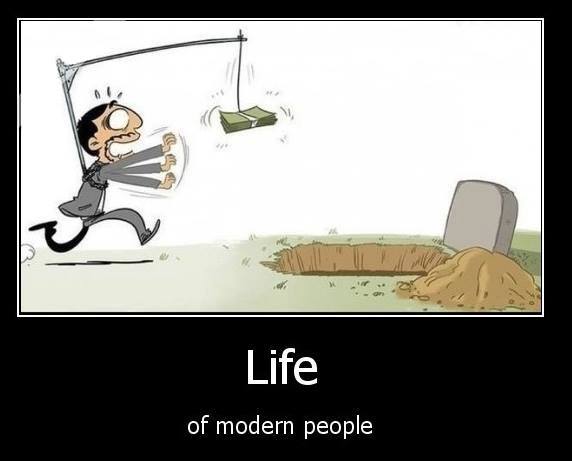
Soon after, some of us forgot that money was meant to facilitate trade and started to hoard it.

follow the money

Elevating money to stardom against all historical advice, strike three.


Are you wondering whether I’ve lost it entirely?
Neah… just came home from the movies…

All the money in the world

Since the movie ended on the bright(-ish) side, I’m going to remind you that Midas also found a way out of his predicament.
The ‘golden’ King begged Dionysus to lift the cursed blessing bestowed upon his head, was instructed to wash his hands and everything else he wanted turned back to its original state in the Pactolus River – in present day Turkey, and presto, everything was fine again.

There’s only one small problem left.
Where are we going to wash our hands…. or should we cleanse our minds first?

Hopefully, before experiencing the hunger pangs which had driven Midas to wisdom…


I keep hearing about this issue and I can’t stop wondering about how parallel to each other are those defending this idea with those denying its merits.

Pro:

-Robots are eating more and more jobs so more and more people will end up hungry.
-AI will make robots so productive that it will be far more efficient to use robots than human workers.
-A decent income is a human right.

Con:

-This is a socialist move, hence it will end up in failure – no other reason offered.

As it is obvious to all, both sides score big.

Yes, including ‘a decent income is a human right’ and ‘all socialist ideas end up in failure’.

Then what are they fighting each-other about?!?

Let me rephrase that.
WHY are they fighting, in the first place?

Because neither listen to what the other has to say… as simple as that…

Let me discuss some of the practicalities involved.

Robots eating up jobs and AI being able to continually increase financial efficiency are so evident that they do not deserve much consideration.

‘All socialist moves ended up in failure’.
We need to define socialism in order to make sense of this sentence.
Mainly because ‘socialism’ is one of the most abused words nowadays, on a par with liberalism. Sometimes they are even considered synonyms…
Well, ‘liberalism’ comes from liberty and  bona fide liberalism is concerned with individual freedom.
Socialism, on the other hand, comes from social. And is concerned with the the workings of the entire society.
The point being that there are two types of socialism. One which is ‘somewhat’ synonym with liberalism – the ‘reverse’ side of liberalism, actually, while the latter is the exact opposite.

I’m not making any sense?

Let me start from the other side.
All forms of socialism which have failed have been excessively centralized forms of government. And it was because of that excessive centralism that they had failed, not because of being ‘socialist’. The evident proof being that the same thing has happened with all right-wing dictatorships, which had used the very same excessively centralized decision making mechanism – the totalitarian government …

Which brings us back to the problem at hand.

For Universal Basic Income to work – or Guaranteed Basic Income, as some insist on calling it, it has to be financed.
Through taxes, right? Which means that those owning the robots would have to be somehow convinced to give up a huge proportion of their profits… Then why bother in the first place…? Why start any businesses, at all?
We’ll have the government run the whole show? Remember what history teaches us about centralized decision making?

So?!?

Well, not all is lost while there’s still hope!

Let me rearrange the arguments.

We not only live in an inherently limited space, with inherently limited resources, but we’ve also finally started to understand our predicament. Which calls for as much efficiency as possible.
Only for a different kind of efficiency than that we’ve accustomed ourselves to.

Until recently, we’ve been trying to get as much money under our belts as possible. Without much regard for anything else.
That’s why we’ve been cutting down secular forests, feeding almost all the fish we’ve been pulling from the oceans to the domestic animals we were raising for their meat, polluting our breathing air, selling our fellow humans which happened to had a different skin color than ours into slavery… As if there was no tomorrow…

Slowly, we’ve started to realize that this won’t work for very much longer.

That no matter whether we’re responsible for the global warming – or if it’s real at all, sooner or later we’ll exhaust the planet.
OK, it is highly plausible that we’ll discover/learn to use new classes of resources.
But this eventuality doesn’t constitute, in any way, a valid reason for us to continue squandering the meager resources we have at our disposal.

Hence the need for increased efficiency.

Only this has to be a different kind of efficiency. The kind that focuses on minimizing waste instead of maximizing profits. The kind that recycles because it makes obvious sense, not because it is cheaper.

Along the same path we’ll discover that it would make a lot of sense to help the less developed nations to catch up with the most advanced ones.
For starters, because the ‘advanced economies’ no longer need cheap workers. They use robots instead.
Secondly, because better living people tend to have less children than those struggling to survive. And we’ve already agreed about the planet being rather limited…

Nothing too fancy… until now, right?

Well, the next item will be trickier..

Remember that Ford had raised dramatically the wages he paid to his workers?
With tremendous results?

OK, his reasons were not the ones, generally but erroneously, attributed to him.
He didn’t do it to ‘encourage’ his workers to buy cars from him… or because of philanthropy…

Actually, it was the turnover of his staff.

At the time, workers could count on about $2.25 per day, for which they worked nine-hour shifts. It was pretty good money in those days, but the toll was too much for many to bear. Ford’s turnover rate was very high. In 1913, Ford hired more than 52,000 men to keep a workforce of only 14,000. New workers required a costly break-in period, making matters worse for the company. Also, some men simply walked away from the line to quit and look for a job elsewhere. Then the line stopped and production of cars halted. The increased cost and delayed production kept Ford from selling his cars at the low price he wanted. Drastic measures were necessary if he was to keep up this production.”

But, whatever Ford’s reasons were, the long term results have been abundantly clear.
Nowadays people who build cars are being paid well enough to afford buying the same kind of cars they are building. At least in the advanced economies…

What happened was that Ford, in order to keep the assembly line going, paid his workers as much as he afforded to. With spectacular results.
While nowadays most employers tend to ‘compensate’ their employees with as little as possible. Which makes perfect economic sense… doesn’t it?

The same economic sense which used to drive us into “cutting down secular forests, feeding almost all the fish we’ve been able to pull from the oceans to the domestic animals we were raising for their meat, polluting our breathing air, selling our fellow humans which happened to had a different skin color than ours into slavery… As if there was no tomorrow…”

See what I mean?
Instead of attempting to mandate a ‘Guaranteed Basic Income’, calculated by the central government and financed through forcefully levied taxes, how about hiring as many people as it would make sense, let them work as little days per week as they want and pay them as much as we can afford to instead of programmatically replacing as many of them with robots and paying the remaining ones as little as we possibly can?

OK, some of us won’t get as rich, as fast, as our grand-fathers did… So what? None of us can eat even close to what our grand-fathers used to… and food is a lot cheaper, anyway…

This is would be a considerably shorter way to get more people out of poverty than any scheme concocted by any government and it would have the same snow-ball effect as Ford’s wage increase had.

Economists describe this as Rostow’s ‘take off effect’.


For attaining adequate finance for take off it is necessary that:

(a) The community’s surplus over consumption does not flow into the hands of those who will utilize it by hoarding, luxury consumption or low productivity investment out-lays;

(b) Institution for providing cheap and adequate working capital be developed;

(c) One or more sectors of the economy must grow rapidly and the entrepreneurs in these sectors must plough back a substantial portion of their profits to productive investment; and

(d) Foreign capital can profitably be utilized for building up social and economic overheads.”


Obviously, any attempt to instate a guaranteed basic income, (except for those too young, too old or otherwise un-able to pull their weight, of course) would grind any ‘take-off’ to a stand-still.

And no, getting people out of poverty is not a valid goal, per se.
Poverty is a relative thing, which relies more  on feelings than on hard reality.
The real problem with poverty is that it reduces the ability of poor individuals to lead meaningful lives. Poor people are a lot less autonomous than self sufficient ones, meaning that decision making ability is impaired by the fact that they need to focus their attention on the short term time span.

This whole thing has long term consequences on societal level.

Remember what I said about centrally planned socialist countries constantly failing.
About all dictatorships eventually crumbling under their own weight, because of too much decision power being concentrated in too few hands?

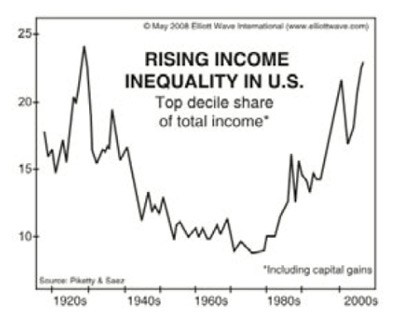
Excessive wealth polarization produces the same results. Economic decision becomes too concentrated, political decision follows through and…

What next?
The world has already experimented with communism. Didn’t work.
It also experienced two economic meltdowns, exactly when wealth polarization was at relative peaks.
income-inequality-08

When are we going to learn anything from what happens to us?
Why do we continue to waste the accumulated lessons collectively known as ‘history‘?


Language is the tool we use when we consciously transmit, receive or glean information.

While the ‘transmitting&receiving’ part is rather simple, ‘consciously and ‘glean’ might need some explaining.

You’ve all heard about ‘body language’.

Actors use it consciously to convey emotion and sometimes even meaning while profilers use it to glean information unconsciously distributed by their marks.

Artists use specific ‘modes of expression’ – language, actually – to convey emotion/subliminal meaning to sometimes unsuspecting audiences.

Skillful ‘communicators’ have learned how to chisel a message – using most common words, printed or spoken – to obtain ‘maximum impact’.

By now I’m sure you’ve already gleaned what I meant by “‘consciously’ and ‘glean'”.
Contrary to popular belief, only one half of those ‘immersed’ in communication need to be conscious of what is going on in order for language to be in use.

Actors can influence their audience without the audience being privy to acting tools.
All of us freely distribute a lot of information about ourselves – through walking, eating, manner of speaking, etc., etc. – which can be ‘deciphered’ with ease by those knowledgeable in this trade.
All of us are inundated by all kinds of advertisement – commercial, political, religious, you name it – but very few of us are aware of the full picture which is being played for us.

In a sense, those of us who can sense anything are like any device connected to the internet.

If it’s connected, it can be hacked‘.

But nothing’s as bad as it seems.
Devices can be plugged off or fire-walled while we can stop watching crap.
And, of course, we can put our brains to work, in earnest, before buying into anything which is hurled towards us.

The current “Me too” campaign – long overdue, should be an eye opener.

Pointing out the perpetrators is a good start and we have a long way to go.

If we want to significantly reduce sexual harassment we need to examine ourselves, men and women, in a mirror.

How many times, as men and women, have we heard other men bragging about their sexual exploits, and said nothing?
How many times have we learned about other men using their rank/position to sexually impose themselves upon women, our colleagues, and did nothing?

And these were the easy ones…

Who raised and educated the present generation of sexual predators? Their mothers and fathers? Their teachers and neighbors? Who had put together the ‘sex sells’ culture which currently permeates everything?
How many women had voted for the ‘American Pussy Grabber’, despite the fact that he had proudly bragged about the whole thing? Why so many women, including ‘his’ wife, agreed that receiving oral sex in the Oval Office was something completely different from ‘having sex with that woman’?
How many women, including actresses, have used their charms to snare their bosses/business partners? And got away with it?
Why is it that in most countries the legislation which punishes the ‘working girls’ does not incriminate their clients?