Archives for category: cooperation

I keep hearing about this issue and I can’t stop wondering about how parallel to each other are those defending this idea with those denying its merits.

Pro:

-Robots are eating more and more jobs so more and more people will end up hungry.
-AI will make robots so productive that it will be far more efficient to use robots than human workers.
-A decent income is a human right.

Con:

-This is a socialist move, hence it will end up in failure – no other reason offered.

As it is obvious to all, both sides score big.

Yes, including ‘a decent income is a human right’ and ‘all socialist ideas end up in failure’.

Then what are they fighting each-other about?!?

Let me rephrase that.
WHY are they fighting, in the first place?

Because neither listen to what the other has to say… as simple as that…

Let me discuss some of the practicalities involved.

Robots eating up jobs and AI being able to continually increase financial efficiency are so evident that they do not deserve much consideration.

‘All socialist moves ended up in failure’.
We need to define socialism in order to make sense of this sentence.
Mainly because ‘socialism’ is one of the most abused words nowadays, on a par with liberalism. Sometimes they are even considered synonyms…
Well, ‘liberalism’ comes from liberty and  bona fide liberalism is concerned with individual freedom.
Socialism, on the other hand, comes from social. And is concerned with the the workings of the entire society.
The point being that there are two types of socialism. One which is ‘somewhat’ synonym with liberalism – the ‘reverse’ side of liberalism, actually, while the latter is the exact opposite.

I’m not making any sense?

Let me start from the other side.
All forms of socialism which have failed have been excessively centralized forms of government. And it was because of that excessive centralism that they had failed, not because of being ‘socialist’. The evident proof being that the same thing has happened with all right-wing dictatorships, which had used the very same excessively centralized decision making mechanism – the totalitarian government …

Which brings us back to the problem at hand.

For Universal Basic Income to work – or Guaranteed Basic Income, as some insist on calling it, it has to be financed.
Through taxes, right? Which means that those owning the robots would have to be somehow convinced to give up a huge proportion of their profits… Then why bother in the first place…? Why start any businesses, at all?
We’ll have the government run the whole show? Remember what history teaches us about centralized decision making?

So?!?

Well, not all is lost while there’s still hope!

Let me rearrange the arguments.

We not only live in an inherently limited space, with inherently limited resources, but we’ve also finally started to understand our predicament. Which calls for as much efficiency as possible.
Only for a different kind of efficiency than that we’ve accustomed ourselves to.

Until recently, we’ve been trying to get as much money under our belts as possible. Without much regard for anything else.
That’s why we’ve been cutting down secular forests, feeding almost all the fish we’ve been pulling from the oceans to the domestic animals we were raising for their meat, polluting our breathing air, selling our fellow humans which happened to had a different skin color than ours into slavery… As if there was no tomorrow…

Slowly, we’ve started to realize that this won’t work for very much longer.

That no matter whether we’re responsible for the global warming – or if it’s real at all, sooner or later we’ll exhaust the planet.
OK, it is highly plausible that we’ll discover/learn to use new classes of resources.
But this eventuality doesn’t constitute, in any way, a valid reason for us to continue squandering the meager resources we have at our disposal.

Hence the need for increased efficiency.

Only this has to be a different kind of efficiency. The kind that focuses on minimizing waste instead of maximizing profits. The kind that recycles because it makes obvious sense, not because it is cheaper.

Along the same path we’ll discover that it would make a lot of sense to help the less developed nations to catch up with the most advanced ones.
For starters, because the ‘advanced economies’ no longer need cheap workers. They use robots instead.
Secondly, because better living people tend to have less children than those struggling to survive. And we’ve already agreed about the planet being rather limited…

Nothing too fancy… until now, right?

Well, the next item will be trickier..

Remember that Ford had raised dramatically the wages he paid to his workers?
With tremendous results?

OK, his reasons were not the ones, generally but erroneously, attributed to him.
He didn’t do it to ‘encourage’ his workers to buy cars from him… or because of philanthropy…

Actually, it was the turnover of his staff.

At the time, workers could count on about $2.25 per day, for which they worked nine-hour shifts. It was pretty good money in those days, but the toll was too much for many to bear. Ford’s turnover rate was very high. In 1913, Ford hired more than 52,000 men to keep a workforce of only 14,000. New workers required a costly break-in period, making matters worse for the company. Also, some men simply walked away from the line to quit and look for a job elsewhere. Then the line stopped and production of cars halted. The increased cost and delayed production kept Ford from selling his cars at the low price he wanted. Drastic measures were necessary if he was to keep up this production.”

But, whatever Ford’s reasons were, the long term results have been abundantly clear.
Nowadays people who build cars are being paid well enough to afford buying the same kind of cars they are building. At least in the advanced economies…

What happened was that Ford, in order to keep the assembly line going, paid his workers as much as he afforded to. With spectacular results.
While nowadays most employers tend to ‘compensate’ their employees with as little as possible. Which makes perfect economic sense… doesn’t it?

The same economic sense which used to drive us into “cutting down secular forests, feeding almost all the fish we’ve been able to pull from the oceans to the domestic animals we were raising for their meat, polluting our breathing air, selling our fellow humans which happened to had a different skin color than ours into slavery… As if there was no tomorrow…”

See what I mean?
Instead of attempting to mandate a ‘Guaranteed Basic Income’, calculated by the central government and financed through forcefully levied taxes, how about hiring as many people as it would make sense, let them work as little days per week as they want and pay them as much as we can afford to instead of programmatically replacing as many of them with robots and paying the remaining ones as little as we possibly can?

OK, some of us won’t get as rich, as fast, as our grand-fathers did… So what? None of us can eat even close to what our grand-fathers used to… and food is a lot cheaper, anyway…

This is would be a considerably shorter way to get more people out of poverty than any scheme concocted by any government and it would have the same snow-ball effect as Ford’s wage increase had.

Economists describe this as Rostow’s ‘take off effect’.


For attaining adequate finance for take off it is necessary that:

(a) The community’s surplus over consumption does not flow into the hands of those who will utilize it by hoarding, luxury consumption or low productivity investment out-lays;

(b) Institution for providing cheap and adequate working capital be developed;

(c) One or more sectors of the economy must grow rapidly and the entrepreneurs in these sectors must plough back a substantial portion of their profits to productive investment; and

(d) Foreign capital can profitably be utilized for building up social and economic overheads.”


Obviously, any attempt to instate a guaranteed basic income, (except for those too young, too old or otherwise un-able to pull their weight, of course) would grind any ‘take-off’ to a stand-still.

And no, getting people out of poverty is not a valid goal, per se.
Poverty is a relative thing, which relies more  on feelings than on hard reality.
The real problem with poverty is that it reduces the ability of poor individuals to lead meaningful lives. Poor people are a lot less autonomous than self sufficient ones, meaning that decision making ability is impaired by the fact that they need to focus their attention on the short term time span.

This whole thing has long term consequences on societal level.

Remember what I said about centrally planned socialist countries constantly failing.
About all dictatorships eventually crumbling under their own weight, because of too much decision power being concentrated in too few hands?

Excessive wealth polarization produces the same results. Economic decision becomes too concentrated, political decision follows through and…

What next?
The world has already experimented with communism. Didn’t work.
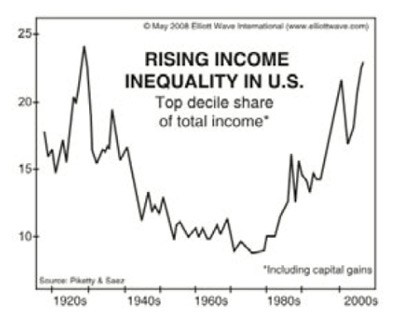
It also experienced two economic meltdowns, exactly when wealth polarization was at relative peaks.
income-inequality-08

When are we going to learn anything from what happens to us?
Why do we continue to waste the accumulated lessons collectively known as ‘history‘?


ignoramus

Imagine now that Reagan, or his speech writer, would have used a single different word …

It isn’t that people are ignorant, it’s just that they know so much that isn’t so.

From a friend’s FB wall:

“African proverb:
Every morning in Africa, a gazelle wakes up.
It knows it must run faster than the fastest lion or it will be killed.
Every morning a lion wakes up.
It knows it must outrun the slowest gazelle or it will starve to death.

It doesn’t matter weather you are a lion or a gazelle.
When the sun comes up, you better start running.”

(from The World Is Flat, by Thomas L. Friedman)

It seems that the modern world is gradually becoming more and more ‘African’.
We’re so busy running ourselves out that we’re failing to remember the essential.

That we’re people.
Neither gazelle nor lion!
And that most of us have long ago left the jungle and now live in cities!

How about ‘taking five‘ from our incessant quest for trinkets and use the time to remember “togetherness”?
As in “communion”?

In the civilized world, ‘Dog eat dog’ was supposed to be an exception, not an everyday occurrence…

Ruthless acquisition or competition, as in With shrinking markets, it’s dog eat dog for every company in this field. This contradicts a Latin proverb which maintains that dog does not eat dog, first recorded in English in 1543. Nevertheless, by 1732 it was put as “Dogs are hard drove when they eat dogs” (Thomas Fuller, Gnomologia).”

PS.
After reading this, my son pointed out that lions are the only cats which hunt cooperatively on a constant basis.
Could this be the reason for which they are seen as the royals of the animal world?

We were discussing ‘worst possible scenarios’ on Facebook and somebody mentioned ‘climate change’.
I must add here that the exchange was ‘framed’ by ‘skin in the game‘, a concept used by Nassim Nicholas Taleb in his rather don-quixotic quest for more responsible decision makers.

OK, the whole domain of climate change is riddled with epistemological holes.
Linear models are used to approximate processes we barely know anything about.
‘Starting points’ have been, again and again, been proven wrong.
I could go on for hours.

I’ll make a small parenthesis here and inform you that according to a fresh study things might be far worse than we’ve reckoned. This paper, published by Nature.com, suggests that Earth’s oceans used to be far cooler than we’ve previously thought they were.

In this context, one of the participants made the following remark:
the burden (of proof) should fall on those calling for changes, for the rather obvious reason that we could suggest changes all day long. Only a few can be implemented.

Hard to argue with that, right?

But which changes are we talking about here?

A change in our manner of interacting with Mother Nature?
Costly, indeed, financial wise, but nowadays technologically possible.

Or about the changes we’ve already – unwittingly, most of them, imposed upon our ‘spaceship’?

We’ve dramatically changed the ‘use of land’. Agriculture and transport – yes, roads and railways have a huge impact – have changed the very nature of what’s going on on a considerable portion of the Earth’s surface.
We’ve dramatically changed the composition of the atmosphere. And I’m not talking about CO2 yet. CFCs, pesticides, NOx and SOx gases, etc., etc….
And, last but not least, we’ve reversed a trend which had been going on for hundreds of millions of years. Photosynthesis used to transform atmospheric CO2 into organic matter, some of which has been steadily accumulated as coal and crude oil.

So, about which changes should we worry first?

Or, in SITG terms, whose skin should bear the brunt of change?

Ours or our children’s?

“Between 1970 and 2010, the number of administrators in health care grew more than 3000%, while the number of physicians grew about 200%, according to the Bureau of Labor Statistics. During that same 40 years, U.S. health-care spending rose 2300%. Doctors’ fees account for only 8 cents of the health care dollar. Where do you think the other 92 cents are going?”  (Marni Jameson Carey, Focus on Health Coverage Misses the Point, Forbes.com, Oct 24, 2017)

A few years ago I was arguing that profit was overrated.
It seems that Forbes, a magazine which cannot be accused of any socialist tendencies, has reached a somewhat similar conclusion.

Even more interesting is the solution proposed by Forbes to the health care problem.

A return to the free market!

Free from what? Who says the American health care market is not free?
Well, click on the quote above and see what Forbes has to say about this…

But what happened? How did we get here?

Well, the free market described by Adam Smith was an environment where people used to fulfill their needs by selling their wares.
The butcher sold meat and bought everything else he needed, the brewer sold beer and bought everything else he needed, the baker… and so on!
OK, there  was a certain kind of competition which kept the things in check. The butchers competed against other butchers, the brewers…
And because of this competition, all traders – those who wanted to survive, anyway – streamlined their operations and became more and more efficient. Hence profitable.

I mentioned the link between the survival of a commercial enterprise and its ability to generate profit.
Apparently, it doesn’t make much sense to elaborate on this. Bear with me, please.

The whole point of the free market is the division of labor. Besides its freedom, of course.
Each of us does what he knows better and then we trade our respective wares. This way all of us fare better than if each of us would have had to produce everything each of us needs to survive.
In this scenario, competition – between ‘bakers’, for example – is actually a tool which makes it so that the market, as a whole, doesn’t waste resources. When the less efficient bakers are ‘encouraged’ to find something else to do, the entire market is better off. And so on.
In this sense, profit is only one indicator – and a very good one – of how able to survive is a certain commercial venture. But not the only goal of the entrepreneur who started/runs the enterprise. What he wants is to make an as good as possible living by doing what he knows best, in close collaboration with the other participants to the free market.

Adam Smith had written his books some two and a half centuries ago.
And the free market had served us well, for a while.
Just look at what we’ve accomplished in these two and a half centuries.

But, just as Forbes points out, things are no longer going in the right direction.

Why?

Simply because the market is no longer free!

Not only because some of the participants have become ‘heavy’ enough to crush all competition. This is only the lesser part of the problem.
The really big one, and so well hidden that it’s almost invisible, is that too many of us have become obsessed with the same thing. Money!

Life-of-modern-people

Profit has become THE absolute goal of everything we do. Too many of those who participate in the free market no longer want to collaborate with the others but simply want to get rich. By any (legal) means.

Some say this is a good thing.
They invoke Adam Smith’s words as a justification for their beliefs.

I beg to differ.

The simple existence of our current obsession has profoundly altered the very nature of the market. Which is no longer free.

Because WE are no longer free. When too many of us are obsessively concentrated on the same thing, they will necessarily disregard all other options. And the rest have no other option but to follow.

This is not freedom!

Mesmerized people can not be described, by outside observers, as being free.
Regardless of how they consider themselves.


Language is the tool we use when we consciously transmit, receive or glean information.

While the ‘transmitting&receiving’ part is rather simple, ‘consciously and ‘glean’ might need some explaining.

You’ve all heard about ‘body language’.

Actors use it consciously to convey emotion and sometimes even meaning while profilers use it to glean information unconsciously distributed by their marks.

Artists use specific ‘modes of expression’ – language, actually – to convey emotion/subliminal meaning to sometimes unsuspecting audiences.

Skillful ‘communicators’ have learned how to chisel a message – using most common words, printed or spoken – to obtain ‘maximum impact’.

By now I’m sure you’ve already gleaned what I meant by “‘consciously’ and ‘glean'”.
Contrary to popular belief, only one half of those ‘immersed’ in communication need to be conscious of what is going on in order for language to be in use.

Actors can influence their audience without the audience being privy to acting tools.
All of us freely distribute a lot of information about ourselves – through walking, eating, manner of speaking, etc., etc. – which can be ‘deciphered’ with ease by those knowledgeable in this trade.
All of us are inundated by all kinds of advertisement – commercial, political, religious, you name it – but very few of us are aware of the full picture which is being played for us.

In a sense, those of us who can sense anything are like any device connected to the internet.

If it’s connected, it can be hacked‘.

But nothing’s as bad as it seems.
Devices can be plugged off or fire-walled while we can stop watching crap.
And, of course, we can put our brains to work, in earnest, before buying into anything which is hurled towards us.

The current “Me too” campaign – long overdue, should be an eye opener.

Pointing out the perpetrators is a good start and we have a long way to go.

If we want to significantly reduce sexual harassment we need to examine ourselves, men and women, in a mirror.

How many times, as men and women, have we heard other men bragging about their sexual exploits, and said nothing?
How many times have we learned about other men using their rank/position to sexually impose themselves upon women, our colleagues, and did nothing?

And these were the easy ones…

Who raised and educated the present generation of sexual predators? Their mothers and fathers? Their teachers and neighbors? Who had put together the ‘sex sells’ culture which currently permeates everything?
How many women had voted for the ‘American Pussy Grabber’, despite the fact that he had proudly bragged about the whole thing? Why so many women, including ‘his’ wife, agreed that receiving oral sex in the Oval Office was something completely different from ‘having sex with that woman’?
How many women, including actresses, have used their charms to snare their bosses/business partners? And got away with it?
Why is it that in most countries the legislation which punishes the ‘working girls’ does not incriminate their clients?

past future byron prophecy

OK, I’m willing to admit that the past gives us a strong indication about what may happen in the future. Hence it might be a very good prophet!

The best?… that would depend on how each of us interprets the notion.
The notion of prophecy, of course.

And since the best( ?!?, 😉 ) way to understand an action is to figure out the motivation behind it…

Let me start with the beginning.

What is a prophecy?

In fact there are two kinds of prophecies. Of promises, actually.
‘Don’t do that or you’ll have to face the consequences’ and ‘if you’ll do such and such, your reward will be this’.

Only very few of the prophets have been using such a clear language. Most of them have preferred to use a much more convoluted manner of expression.
Quite understandably.

First of all, because these were ‘second hand’ promises.
They were not uttered directly by the promising agent but by a more or less ‘self appointed press secretary’. Who had no sure way of knowing whether he had at least a working understanding of the message he was supposed to deliver to his peers, whether they were going/able to understand/accept the message in it’s entirety nor whether they were going/able/willing to abide to all its intricacies.

Secondly, and this is applicable specially to the ‘don’t do it’ kind of prophecy, let’s examine what may happen if/when people do heed to a professed  prophecy.

I’ll consider the ‘positive’ case first.

If people do ‘the right thing’, and the reward promptly arrives, they think/feel ‘it is rightfully theirs’, no question asked. The prophet is seldom remembered. And in the rare cases when people do remember they’ve been foretold, the extended thanks rise very rarely above ‘lip service’ level.

If people think they have done ‘the right thing’ but are unaware they have ‘trespassed’, one way or another, they expect ‘their’ reward. Which, usually in this situation, never comes.
Who’s more likely to shoulder the blame? Remember that the people are not aware of not having fulfilled their bidding!
The prophet?
You nailed it!

And there’s a strong possibility that he might get nailed himself!

Let’s examine the ‘negative’ case now.
The one where the prophecy is ‘don’t do that, or else!’

People might choose to heed to the warning. Hence no punishment. Again, the prophet is usually forgotten along the way. Mainly because the bad things he kept speaking about never came through/true. Or even worse, he may be laughed at. But he’s happy. He has helped his people avoid experiencing a bad thing.
Or people might choose to ignore the warning. Hence experience the punishment.
Or, even worse, the people might try to ‘do the right thing’ and fail. For what ever reason. Who would be the most likely to be held responsible by the masses, or blamed by the politicians? For making an incomplete,  or mistaken, prophecy…
An even stranger situation develops when the ‘judge’ decides to give ‘his’ people another chance. And postpones the (well deserved?!?) punishment. Is it possible that the people might decide to ignore altogether the prophecy, completely misinterpreting both the prophecy and the misericordia displayed by the judge?
Quite annoying for the prophet, right?

Boring?
You might consider that I didn’t consider all possibilities… for instance that when the reward comes without (in spite?) all demands having (not) been fulfilled. The prophet becomes a laughing stock, right?

Anyway, the whole thing was intentionally meant to be somewhat boring.
This way your attention wasn’t mesmerized and you had a fighting chance to figure out my real point.

Go back up and glance at Byron. He looks back but his body faces the future.

We are the ones called to presently transform the past into the future.
Glancing back tells us where we come from and what we have at our disposal.
Yet we have only one option. To go forward.
To survive and, maybe, to prosper.

Yes, we have a lot of carry-on luggage.
But it’s up to us to use that luggage as a resource or to trundle it along as a burden.

Another prophecy…

do as the Romans do.

According to UrbanDictionary.com, “it has become shortened so often, some people don’t get it anymore. It’s an analogy making use of the strict rule of the ancient Roman empire”

Wikipedia mentions that it’s “a proverb attributed to Saint Ambrose”, meaning “that it is advisable to follow the conventions of the area in which you are residing or visiting.”

OK, seems sensible to follow the rules, specially when their are enforced vigorously. Furthermore, why rock the boat – specially when visiting a place? Or shortly after you’ve just moved in?

How about after becoming familiar with the local mores?


fall of Rome


Could there be anything more behind these words?

The proverb dates from an era when Rome was the center of the world. Of the Mediterranean world, anyway…
Could it also mean ‘do as the Romans do and you’ll share into the benefits enjoyed by the rest of them’? In line with ‘don’t rock the boat, lest the others will throw you out’?

In other words, the proverb suggests that ‘herding is good for you’.

Which is true. Most of the time, anyway.

Specially when you know when to bail out…

In this context I must remind you that mighty Rome ended up being sacked by a succession of rogue thieves… some of them hired by the emperors to guard the borders because the Roman citizens had became too ‘adept’ at ‘panem et circenses’ to bother anymore with bearing arms…

It seems that not all things done by the Romans were actually worth doing.

How about exercising our brains instead of sheepishly following the herd?
No need to insult the others, ‘rock the boat’ or anything else dramatic.
Just honestly give them the reasons for your dissent.
If they are wise – and you are right, of course, they’ll come your way.

If not… you should either follow the rules… or change the herd.


Farfetched?

Somebody was asking the other day on Facebook “how can you prove that a table doesn’t exist?”
The answer, ‘walk through the place where that table is supposed to stand’ is so obvious that it hurts.

So, was that table real or not?

You see, a table may exist in two kind of places. In a store/room/backyard and in the imagination/memory of the guys who designed/made/owned it. It can remain ‘in storage’ long after it was forgotten by everybody and/or can be remembered long after it was destroyed.
A tree, on the other hand, can exist – and die, without anybody ever noticing it. Or could have been lovingly planted and taken care of by somebody. Who might die even before the tree ever reaching maturity…

But how can any of us determine whether a table, or a tree, is real or not?

By attempting to walk through it, and hurting ourselves, we only determine that there’s something there. Not at all that we’d hurt ourselves by hitting a tree or a table…

OK, there’s yet another possibility.

reality figment

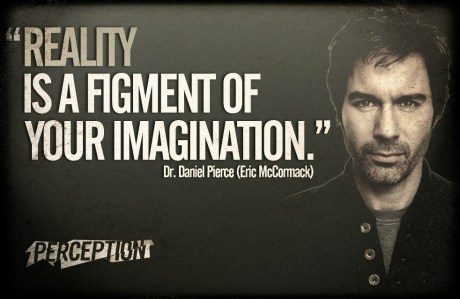
Dr. Pierce – who, by the way, was produced by the imagination of a screen-writer, reminds us that neurologically there’s no way of telling apart a dream/nightmare/vision from a ‘legitimate’ perception.

So.
Then it would be possible for whatever each of us perceives on a daily bases to be nothing but some-kind of an elaborate multidimensional movie. Or prank. Played on each of us by some extremely bored ‘arcade operator’. Or by a lab-technician performing some kind of an experiment… In this scenario all other people each of us has ever met would be nothing but characters imagined by the guy who had written the script/devised the experiment…
A slightly different scenario would be that our planet (the whole world?) is a theater, we are the spectators and most of what we perceive is the movie which is played on (for?) us. In this variation we are free to speak amongst us (discuss the movie?) and this would be the explanation for why our perceptions are coordinated so well. After all, all English speakers use the same word for table/tree and most of us are able to differentiate between a table and a chair. Or between a tree and a weed…

Or we could take a completely different road!
There’s a guy, Humberto Maturana, who has reached the conclusion that most humans are not simply aware but also aware of their own awareness. And that this is what really makes us human.
In fact, his ideas make a lot of sense. A dog is aware. If house trained, it will not pee inside and most of them are able to differentiate between their owners and some strangers. But it takes a fully functional human being to step outside of themselves and examine their actions/status.

Without this very self awareness, none of us would be considering ‘reality’. We’d simply walk around the table/tree or directly through the clear space and never waste a second considering whether the table/tree is real.

Or what reality really is.

In this scenario, reality is more like a table than like a tree.
It resembles a tree in the sense that it existed long before any of us ever thought about it and it is like a table in the sense that in order to consider it we need to imagine it first.

Reality exists.
In both scenarios and along both roads. It doesn’t matter whether in the first one we are fed fake sensations and led to believe whatever the screen writer wants us to believe. In order to do that, the screen writer has to exist in the first place. We also have to exist, otherwise there wouldn’t be anyone to watch the movie!
OK, maybe what we perceive has nothing to do (very little?) to the real reality. But that doesn’t mean that a certain reality doesn’t exist at all. Even in the first scenario.

Coming back to the second road, we cannot pretend that OUR reality exists outside us.
Yes, there is a reality – THE reality, which lurks somewhere outside our reach.
What we’re able learn from it, and all we’ll ever be able to learn, is what we’ll be able to imagine first.

Think of it. What do we do when we come across something new?
First we try to classify it among our memories. In fact we try to remember whether we already have a word for it. One imagined by one of our ancestors.
If not, we imagine one ourselves.
And only then we can proclaim that the new thing has been discovered. That it has become ‘real’.