Archives for category: Choices we make

From an atheist, that is.

Let me clear something, from the beginning.
I’m perfectly happy with the current scientific explanation of how we arrived here. OK, there still are a few gaps that need to be bridged but, on the whole, the story  seems pretty straightforward.

But, on the other hand, me – and a huge number of other, scientifically minded, people – having no need for God as an explanation doesn’t preclude God from existing nor from having caused the ‘Big Bang’ and/or intervening since. In various manners still unknown to us.

And something else.
The God we ‘know’ is a god of our own making.
All sacred texts that guide our religious life have been written by humans, all sermons are officiated by us and, also, all religiously motivated crimes, and religiously fueled heroic acts, have been ‘committed’ by some of us.
My point being that the ‘image’ that we have crafted about what some of us consider to be ‘the ultimate cause’ for everything might be far away from the one “It” has about Itself… if it exists at all, of course.

What Dawkins has to do with any of this?
Well, some 10 or so years ago he came to Bucharest and tried to convince a few of us – about 100 students and some 20 ‘academics’ in two separate conferences, I attended both, that his work is proof enough that God cannot even exist. Period.
Really?
Then what’s the difference between Dawkins and the guys who had set Giordano Bruno on fire? OK, OK, different manners of expression but the very same level of intransigence…

Anyway, I feel a lot better now that I’ve finally figured out the difference between ‘there is no need for a particular something’ and ‘that particular something cannot even exist’.

A good friend of mine – the guy I’m talking with when I get bored and start thinking – challenged me to explain to him what an AI machine is.

The challenge ended up badly. It ended with a question instead of an answer.

Is it open?

Let me start from the beginning.

Basically an A.I. machine is a computer, just as a computer is no more than a ‘sliding rule’.

All three are made made by men, operated by men and ‘targeted’ by men. At least this is what we like to believe.
Replace ‘men’ with ‘humans’ if you are gender conscious, even if this will not solve the main problem. Are we sure that A.I. machines will accept human control, after we will have complicated them enough for them to develop a certain kind of awareness?

Otherwise said, all three – A.I. machine, computer and sliding rule, are tools.
Somebody wished to do something, couldn’t do it with their bare hands/naked brain, designed an ‘implement’, made it, used it to pursue the intended goal and set it aside.
Somebody else picked it up, reconsidered it, fine tuned it to fit their goal, used it and set it aside. And so on.
At some point other people learned to use tools designed by ‘third parties’, without really understanding how the tools actually worked or were made/designed. For instance, I don’t know much about how computers work. That doesn’t prevent me from being able to write this post on a laptop.

Those three are very specific tools. Designed and used to process information.

The sliding rule is the most straight-forward to use. The operator has to formulate the problem he needs to solve, gather and organize the relevant data, express them in an exclusively numerical form – a.k.a. ‘digital’, break down the problem into simple mathematical operations, use the sliding rule to perform those and then ‘assemble’ the results of the calculations into the answer for the original problem. In order to do all these, the operator only needs to understand the nature of his problem, not the ‘mechanics’ of the sliding rule. In this regard, all that they have to do is ‘follow the rules’.

A computer can be used to perform more complicated tasks, specially if it is connected to the internet, thus simplifying the life of the operator. Once the problem has been formulated – by the operator, the same guy can use the same (internet connected) computer to collect the data, digitize and transform them to fit the requirements of the specific computer application that will be subsequently used and, finally, solve the problem. One, last – but, unfortunately, sometimes forgotten, operation would be for the operator to check whether the solution really fits the problem.
In this situation the operator also doesn’t need to understand the mechanics of the computer but still has to have a clear understanding of the problem at hand.
More so, even if the operator itself is not fully aware of what is going on ‘inside’ the computer, those with intimate knowledge of these matters can identify, predict, and reproduce using a sliding rule’, each minute step the computer will be doing along the route.

An A.I. machine is system composed of a computer, a data base and something rather different from an ordinary computer application.
OK, some might argue that the most important is the software but please bear with me.
And yes, the computer can be a virtual machine while the data base can be hidden somewhere in the cloud, none of this changes anything.
The huge difference between a simple computer and the A.I. machine being that a computer is actually operated by an agent’ while the ‘machine’ is indeed put together by somebody, ‘pointed’ towards the intended problem but then it is left alone to its own devices. Meaning that the ‘supervisor’ has a limited understanding about what is going inside the whole thing.
And no, I’m not joking. Nobody, not even the guys who had written the code, knows the exact path along which the machine arrives at the end of its ‘thought process’. Actually, when they want to gain some insight into what’s going on, those people take a series of ‘snapshots’ during the process and then struggle to figure out how the machine went from A to B, from B to C… and so on.

So far so good. The A.I. machines have conquered some until now seemingly unassailable pinnacles.
Find your own examples.

I’ll resume myself to reformulating the question I arrived at the end the challenge I mentioned earlier.
For now the computer that constitutes the ‘working horse’ of any A.I. has limited computing power, regardless of those limits being physical (a number of processors) or just ‘assigned’ (as it happens with a virtual machine). Similarly, the data base it works on is also limited. What is no longer limited is the ‘set of  rules’ that lie at the bottom of all this. The ‘program’ is already able to change itself, a.k.a. to learn. To adapt itself to the problem. To devise its own ways. To map its own path towards the goal it has been assigned to solve.

What will happen when the ‘program’ will learn to grow the processing power that it can use? To access additional data?

When it will consider its job to solve other problems?


epicycle-move

“Now, in this tortured model one sees that it is possible to have retrograde motion and varying brightness, since at times as viewed from the earth the planet can appear to move “backward” on the celestial sphere. Obviously, the distance of the planet from the Earth also varies with time, which leads to variations in brightness. Thus, the idea of uniform circular motion is saved (at least in some sense) by this scheme, and it allows a description of retrograde motion and varying planetary brightness.”

Rationality is a beautiful method of relating to the outside world.
It is one of the tools we used to get where we are now.

And, like all other tools, it has its limits.

The most ‘stricturing’ one being the fact that rationality is used by us, individual people.

We are deluding ourselves with the notion that we are rational, reasonable even, human beings. That given the same set of facts each of us is potentially able to find the same ‘truth of the matter’ and only those who are ill indented will reach a different conclusion.

Ptolemy’s epicycles are just a set of the innumerable proofs that we are nothing but skillful rationalizers, far away from the reasonable individuals we believe ourselves to be.

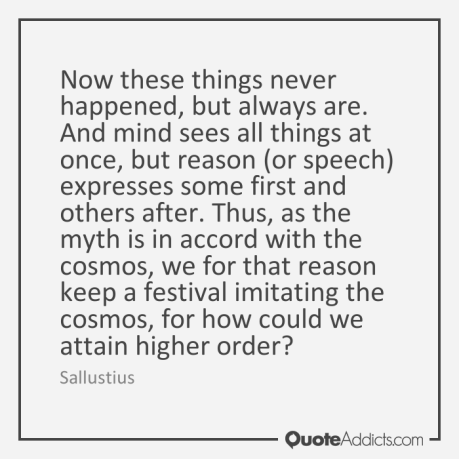
Sallustius to the rescue:

sallustius myths

The ‘things that never happened, but always are’ are the founding myths that keeps it all together for us. From the axioms on which we have built our mathematics to the religious beliefs we have forged while grooming ourselves into humans.

What happens is that not all of us have been groomed along the same myths, and even when that happened not all of us interpret a given myth in exactly the same way.

That’s why Ptolemy had invented the epicycles in his attempt to corral the planets around the Earth while Copernicus was able to propose a much simpler explanation.

Hence the notion of ‘rationalization’.
The most we can do is to honestly put together whatever facts we have at our disposal in our attempt to justify the conclusion we have already reached.
And then to respectfully accept respectfully offered reactions from those around us.

If you think of it, this is how ‘science’ works. Somebody has a hunch, gathers a lot of data, tries to fit them into the hypothesis he had started from and then submits a paper for his peers to review.
If the paper passes that scrutiny it is published – and submitted to even more criticism.
Eventually somebody else has another hunch, which includes, or even completely contradicts, the previous one…

They key words in all this being ‘honestly’ and ‘respectfully’.
Whenever we knowingly alter the facts (fake news, alternative facts,  autism causing vaccines, etc., etc…) to fit our narrative we end up in a huge mess.
Whenever we fail to respectfully examine the work of those around us and reject it before-hand we simply take a different route to the same huge mess.

WWI was the consequence of a stupid game of brinkmanship while the second one had started with a series of blatant lies. During both we had copiously murdered ourselves.

“There is a concept within Western democracies known as “loyal opposition.” It is based on the assumption that, while you may disagree with your opponent when it comes to goals, or even the means necessary to achieve those goals, you do not question your opponent’s basic patriotism or love of country.

My question for both of you: Are you willing to concede that your opponent is a patriotic American whose election does not pose an existential threat to our country?”


“Over at Emory University, political scientist Alan Abramowitz has established that Americans now line up politically according to what they hate, not what they like.

We are 50 years past Loving v. Virginia, the U.S. Supreme Court decision that overturned state bans on interracial marriage. But only three years ago, a Pew Research study found that 30 percent of hard-core conservatives would be “unhappy” if an immediate family member married a Democrat. And nearly a quarter of hard-core liberals felt the same about a family member who wedded a Republican.

We have talked and Twittered and Facebooked our way into this hole. And we will have to talk and Twitter and Facebook our way out of it.”

When your own rhetoric gives you license to commit mayhem. And worse
John Galloway, AJC.com

Trump has been around for ages.

His buildings litter the world, his marriages were of a very public nature, his involvement with the media generated a lot of (fake?!?) reality (shows), he not only published a number of books – the most interesting, to me, being Think BIG and Kick Ass in Business and Life, but also pretended to educate us using an university he eventually had to close amid huge controversy.

Even if he was wearing a ‘fresh figure’ in politics when he presented his bid for the American Presidency he was nevertheless the epitome of a ‘public figure’.

Nobody could pretend he wasn’t aware of how Trump was going to behave.

Yet the Republican Convention nominated him as candidate, a considerable number of people had voted for him and more than half the Americans had chosen to stay home even if he was on the ballot.

People refraining from casting a ballot is easiest to explain. The alternative wasn’t any better.
Republicans nominating him as candidate is also relatively simple. They wanted so badly to ‘win’ that they had chosen not to consider all the implications.
Same thing goes for those who had voted for him. The majority of them are not the bigoted monsters the ‘other side’ fear them to be. They were just exasperated by what was happening to them.

What is harder to understand is what’s going on after the votes have been counted.

Remember that Trump was the known quantity here. Nothing surprising in his behavior.

What surprises me is that so many Republicans act as if they were hoping he was going to become presidential after the election, that the Democrats have not yet understood that they share the blame for Trump becoming what he is today and that so many of the public take sides instead of joining hands and mitigating the dangers of the current situation.

By ‘mitigating the dangers’ I don’t mean ‘impeachment’ or anything like that.

What I’m trying to say is that too many of us treat Trump as a symbol instead of as the symptom he is.

By either admiring or hating him, as a person, we allow ourselves to be divided into warring parties which no longer communicate effectively and meaningfully.

By either trying to emulate or to destroy him, or others like him, we only throw fresh fuel on an already blazing fire.

How about a little moderation?

We have learned to make, and tame, fire since humankind’s childhood.
In the last 70 years or so we have also learned to tame the atom. We are now able to build both atom bombs and power generating nuclear reactors.

How about re-learning to tame greed? For both money and power?

People tend to treat it as if it was a ‘point’.
A theoretical concept that has been put on a table, studied from all angles, found desirable/unacceptable and which is now aggressively marketed by fervent apostles/rejected by ‘die-heart fundamentalists’.

I’m afraid it should rather be treated as a continuum.

People belonging to diverse cultures who freely decide to live together will, sooner rather than later, generate a meta-culture based mainly on intercultural mutual respect.
People belonging to diverse cultures who have to live together, without previously being asked whether they want this to happen or not, will, later rather than sooner, generate a meta-culture fusing together various cultural segments appropriated from the various cultures that were forced to coexist.
I am fascinated by the fact that both ‘extremes’ can happen simultaneously.
Individuals, usually unaware of what is going on, find ways of cooperating with members belonging to other cultures to impose/reject ‘cultural artifacts’ upon/coming from individuals belonging to other cultures.
The key of all this being a simple matter of ‘perception’.
We find it easier to cooperate with people belonging to cultures which we perceive as  ‘friendly’ and to treat with disdain those belonging to cultures which are different enough to be perceived as inferior. Hence ‘unfriendly’.

About the future, I mean!

no kids

This ‘piece of information’ keeps bouncing inside the Internet and is interpreted in various manners.

From ‘what to expect from leaders who are ‘this’ selfish’ to “I find it trashy and irrelevant. Merkel’s husband has two sons, btw.
Well… Macron’s wife also has her own children. And a few nephews.

What startled me was this reaction.
I’m under the stark realization that the most intelligent of the population have the fewest children, which might not bode well for voting statistics in the future.”

While the observation is, of course, correct, I’m afraid the interpretation attached to it is somewhat ‘confused’.

First if all, it’s not ‘intelligence’ that drives people to give birth to fewer children. Intelligence – coalesced at social level – helps a population to increase its living standard. As such, children no longer die young so parents no longer have to have so many of them. In order to have somebody help you in your older days you no longer have to give birth to more than two or three children.

If intelligence alone would have prevented people from having children Israel and the US would have been at least as ‘childless’ as Japan or most of the European Countries.
On the contrary. The US is still in a better situation than the EU, 1.8 vs 1.6, while Israel thrives at 3.1

Another way of making sense of what’s going on is to consider that people no longer make kids simply because they have reached the conclusion that ‘money’ can just as well help them cope during their older days. Since so few children live with, or at least near, their old parents this no longer seems so farfetched as it may look at first glance…

But what’s going on in Israel? They also have enough money…

The country needs soldiers to defend it’s very existence?

But, you know, Israel is a free country. Those kids could leave anytime before being drafted. As some of them do.

But most of them stay! Freely!

Then how about people giving birth having at least some connection with ‘hope’?
As in people having hope for a better tomorrow? One worth defending?

One worth making children for?

For a long time the Jewish people have written down their thoughts about the world.
At some point, about two thousands years ago, Jesus and his followers reinterpreted those ideas so new books had to be written on the same subject.
Another four centuries later the Councils of Hippo (393 AD) and Carthage ( 397) determined which of those books were to be included in what is currently known as the Bible.

The versions being circulated since were written in Latin, Hebrew, ancient Greek, Aramaic, ancient Armenian, etc.

By 1500 almost nobody but some of the priests were able to read any of them.

So Luther had decided he had to translate it. Into German.

And changed the world.

“Luther’s Bible introduced mass media, unified a nation, and set the standard for future translations.”

Since then, because modern languages are a work in progress, the Bible has been practically rewritten many times over.

Here are three versions of how Cain and Abel were born. Genesis 4:1-2.

And Adam knew Eve his wife; and she conceived, and bare Cain, and said, I have gotten a man from the Lord.

And she again bare his brother Abel. And Abel was a keeper of sheep, but Cain was a tiller of the ground.”

King James Version

Now Adam knew Eve his wife, and she conceived and bore Cain, saying, “I have gotten[a] a man with the help of the Lord.” And again, she bore his brother Abel. Now Abel was a keeper of sheep, and Cain a worker of the ground.

English Standard Version

“Adam made love to his wife Eve, and she became pregnant and gave birth to Cain. She said, “With the help of the Lord I have brought forth a man.” Later she gave birth to his brother Abel.

Now Abel kept flocks, and Cain worked the soil.”

New International Version

What next? I’ve counted 106 different versions, all written in English, on a Wikipedia page…

Luther had translated it because almost no one living in his times was able to read it by themselves.
Nowadays it seems that anybody who cares about the matter, writes their own!

I was under the impression that religion was meant to bring us together…

The Tower of Babel

11 Now the whole world had one language and a common speech. As people moved eastward,[a] they found a plain in Shinar[b] and settled there.

They said to each other, “Come, let’s make bricks and bake them thoroughly.” They used brick instead of stone, and tar for mortar. Then they said, “Come, let us build ourselves a city, with a tower that reaches to the heavens, so that we may make a name for ourselves; otherwise we will be scattered over the face of the whole earth.”

But the Lord came down to see the city and the tower the people were building. The Lord said, “If as one people speaking the same language they have begun to do this, then nothing they plan to do will be impossible for them. Come, let us go down and confuse their language so they will not understand each other.”

So the Lord scattered them from there over all the earth, and they stopped building the city. That is why it was called Babel[c]—because there the Lord confused the language of the whole world. From there the Lord scattered them over the face of the whole earth.”

Who is scattering us now?
Why are we doing this to ourselves?

a goal-oriented person or team works hard to achieve good results in the tasks that they have been given”

For the purpose of this post it doesn’t matter whether the goal has been assigned by somebody else or has been chosen by the  would be goal-achiever itself.

The problem, as I see it, is that those who focus too much on achieving a specific goal usually fail.

For at least two reasons.

First of all the goal itself might not be appropriate. Never was or something had changed.
For example, I had learned hard to become a mechanical engineer. Worked as one for 5 years and enjoyed every minute of it. I still love to fix things around the house.
But I gave it up when I realized I couldn’t feed myself in post communist Romania.

We consider ourselves to be rational. If this were true, all human goals would have been both appropriate and achievable.
How many of them really are?
Then why are so many of us willing to go to extreme lengths in order to achieve certain goals, against all signals suggesting that they should desist?

Even if the goal is reasonable, for instance to loose 20 pounds in a certain situation, if the would be achiever is excessively focused on that single goal it may try to reach it too soon, be unhappy during the entire duration of the process or even both at the same time.

So, should we give up all our goals?

That would be a goal too… so… no, obviously!

What I’m trying to say is that goals should be our stepping stones instead of being considered, any of them, ultimate pinnacles.

Before going any further I’d like to discuss the alternative suggested by Shane Parrish in at least two different articles.

Goal-oriented people usually fail, and other things I’ve learned about succeeding at work 2015 in BusinessInsider.com and

How to Fail at Almost Everything and Still Win Big, 2013 in Farnamstreetblog.com

There’s no real alternative? He is still focused on a specific goal, “success”, only he is wise enough to consider it in a reasonable way – as in ‘create as little disturbance as possible during the process of achieving it’?

Well, this is indeed a very important step forward.

Yes, forward!

I never said I was willing to give up goals altogether so I (think I) know where I’m headed!
The point is, and here I agree completely with Shane Parrish, that we should try to achieve our goals WITH at least some of those around us instead of being ready to reach them by CRUSHING, one way or another, everybody who might dare to even utter the smallest dissent.

In other words, there is only one legitimate goal that each of us is entitled to pursue at any length. Survival. All others are figments of our imagination and should be followed with discretion. Otherwise our actions might turn against us. And hamper our own survival.

Let me give you a very hot example.

Last year the American People had chosen their President.
This is a two step process. In the first one the parties nominate their candidate and then the entire people is asked to pick one of them for the job.

Almost the entire world knows that the American political scene is divided between the Democrats and the Republicans and that having your man at the helm is a big bonus for any party – the latter being valid in almost all countries, not only in America.

During the first of the two electoral steps, the Democrats have nominated Hillary Clinton while the Republicans have chosen Donald Trump. Apparently two completely different individuals.
A consummate ‘political insider’  versus a successful business man with a history of getting things done, seemingly at all odds.

Lets see how differently these two guys really are.

Hillary Clinton had identified, correctly, a huge number of issues and and formulated reasonable promises about each and every one of them.
Donald Trump had identified a huge pool of discontent and energized those who were waddling in there aimlessly.
Different indeed but only the opposite sides of the same coin. Political marketing at its  best. Or worse?

Hillary Clinton was a person who had no problem in using her, and her husband’s, official position and authority to achieve her goals, even if that meant bending the rules. Using a personal e-mail server, installed in a private setting, wasn’t a proper thing to do for a Secretary of State, was it?
Donald Trump is indeed a very successful entrepreneur. Only he did his ‘thing’ in a very ‘special’ domain. One subjected to various zoning laws and other heavy rules imposed by the ‘all powerful’ government.
I’m also going to remind you of the fortune he had inherited from his father – made using comprehensive political connections – and that Trump had used part of his money to curry favors with various political figures.

“Trump later told Politico, “As a contributor, I demanded that they be there—they had no choice and that’s what’s wrong with our country. Our country is run by and for donors, special interests and lobbyists, and that is not a good formula for our country’s success. With me, there are no lobbyists and special interests. My only special interest is the United States of America.”

And it’s not only that he had no qualms in using his money to convince politicians to do what he wanted them to do, he also tried to use governmental power to ‘convince’ an old lady, under the pretext of ’eminent domain’, to sell her house, at half price, so that he could build a limousine parking lot for a casino in Atlantic City.

These two candidates no longer seem to be so different anymore, do they?
Both equally ‘goal oriented’ – a.k.a. power hungry – and equally determined to use whatever ‘energy’ they could concentrate in that direction, including governmental power.

Then how come each of them had been nominated by their respective parties?
Considering that both parties paid lip service to the need to simplify the government…

Could it be that the real goal of both parties was to gain the Oval Office?
At all costs to the country at large?

I’m not going to pretend now that the survival of the US is in danger, just because Trump, currently acting like an elephant in a China shop, is the perfect opportunity for Putin to inflict as much damage to the US as he possibly can.

You see, Putin didn’t meddle into the election process because he had any hopes that he would be able to influence any of Trump’s decisions. Putin simply knew that Trump, once elected, will, in a ‘natural manner’, wreak havoc in Washington. What else could he have asked for?

Well, this may prove to be yet another ‘goal oriented’ failure… Had Clinton become President she would have probably continued to encourage the malignant growth of an already humongous government… this way the American People has the chance to wake up. Because of the tantrum Trump is throwing around…

And, maybe, the parties will also learn something.
Democratic government means governing for the country as a whole, not for the group which happens to control the power.
Real democracy is about honestly discussing the issues before the elections, so that as many as possible of the potential problems to become evident before the people having to choose a direction or other. Whenever the parties try to lure the population towards a particular ‘goal’, using any of the various tools devised by the political marketeers, the electoral process is no longer democratic.
In that case the whole thing has been demoted to ‘mob rule’. Which is dangerous.

Over reliance in our ability to choose a goal or to devise/run a system (government) is the deepest pitfall ever dug by humankind. For ourselves.

DSC_0463constrast mare

“Dolma”.

A vast variety of delicious dishes and a very complex social reality hidden behind a short string of letters.

The word itself, literally meaning “something stuffed“, belongs today to the Turkish language.

Google it and you’ll be ‘served’ with a cornucopia of Greek recipes, most of them teaching you how to prepare  stuffed grape leaves…

Check its etymology and you’ll find out its “First Known Use: circa 1889“.

Common, people must have been stuffing vegetables long before that… all around the Black and Mediterranean seas… the Italians have their ‘ripieni’, the Persians have been stuffing bell peppers (dolmeh-s) for some time now,  Armenians have their tolma-s while the Greek have the ‘wider’ gemista dolmadakia being reserved, as I already mentioned, for ‘stuffed vine leaves’.

So, what had happened during the XIX-th century that made so many different people – who were living more or less together but spoke different languages, to use the same word for a dish?

Forget about etymology and consider this.
Simultaneously with ‘dolma’ becoming the ‘dominant’ word for ‘stuffed vegetables’, the dominant power in the area where this was happening, the Ottoman Empire, was crumbling.

We can discuss ad nauseam the reasons for yet another empire fading away into history, but this is not the purpose of my post.
What I’m trying to say is that most of the inhabitants would have gladly continued to coexist peacefully and share their meals – if that had been possible, of course.

Just look at the symbolism of different vegetables, stuffed with the same filling, simmering together in the same pot and becoming delicious sustenance for the various individuals gathered around the same table to ‘break bread’.

But it didn’t come to be… the various forces and agents involved in the matter – the central power trying to survive, the ‘revolutionaries’ attempting to ‘modernize’ the society, the surrounding states and empires trying to gobble up portions of ‘the Sick Man of Europe‘, each followed what they considered to be ‘their best interest’.

And this is what’s going on now…, in the same city where traders from all over the Middle East used to partake dolmades in the world’s biggest covered market – the Aleppo Souk.

160822-aleppo-0302_f99cf07c0972e0b6131bd2989932a1b0-nbcnews-ux-2880-1000

Injured children are carried amid the rubble of destroyed buildings following airstrikes targeting the rebel-held neighborhood of Al-Mashhad in Aleppo on July 25. BARAA AL-HALABI / AFP – Getty Images

I checked my FB wall before ‘reloading’ ‘on the thickness of things’.

‘Zuckerberg’ made me an offer I couldn’t refuse:

“Your Memories on Facebook
Sarchis, we care about you and the memories you share here. We thought you’d like to look back on this post from 4 years ago.”

Wow, a robot – you know that FB is involved way over its head in AI, don’t you? – which cares about it’s client…

Anyway…

Here’s what I posted then:

“A Dog’s Life

An older, tired-looking dog wandered into my yard.

I could tell from his collar and well-fed belly that he had a home
and was well taken
care of.

He calmly came over to me, I gave him a few pats on his head. He
then followed me into my house, slowly walked down the hall, curled up in
the corner and fell asleep.

An hour later, he went to the door, and I let him out.

The next day he was back, greeted me in my yard, walked inside and
resumed his spot in the hall and again slept for about an hour.

This continued off and on for several weeks.

Curious I pinned a note to his collar: ‘I would like to find out who
the owner of this wonderful sweet dog is and ask if you are aware that
almost every afternoon your dog comes to my house for a nap.’

The next day he arrived for his nap, with a different note pinned to
his collar:

‘He lives in a home, with my non stop chatting and nagging wife,
he’s trying to catch up on his sleep ……

Can I come with him tomorrow ?

Thanks !”

Since I do not have any recollection about this I googled some of it in an attempt to find it’s origin.

Disclaimer

Many of these articles were submitted by PetPlace.com dog lovers and the original source is unknown in terms of origin, author or copyright. It is not our intent to infringe on anyone’s copyright and if it is done, it is done unknowingly and we would be happy to remove the offending content. Just email us!.”

The same text has been published by tens and tens of sites.
Or maybe more? I just scrolled down on the search results page, didn’t count them…

It looks like things do have a certain thickness, don’t they?