Archives for category: alternative ways of acquring knowledge

Whence comes nihilism, the uncanniest of all quests?
by Lou Keep

Friedrich Nietzsche was most famously concerned with the problem of nihilism. All societies, in his view, rely on implicit value judgments. If the foundations of these are lost, he predicts terrible consequences: widespread apathy or violent, fanatical attempts to reclaim a sense of purpose, or perhaps both. We talk about values a lot, and we know they do something, but we have little idea how. Compounding this is uncertainty over their loss. Nihilism is not a choice or intellectual commitment, but a thing that comes upon you. As Nietzsche put it in 1885: ‘Nihilism stands at the door. Whence comes this uncanniest of all guests?’

Part of the answer comes from understanding how values connect to knowledge and action. In Seeing Like a State (1998), the political scientist James C Scott classifies knowledge in two ways: epistemic knowledge, which can be quantified, theorised and transmitted in abstract, and metis (from the classical Greek), which concerns knowledge gained from practical experience, such as personal relationships, traditions, habits and psychological states. Metis governs local experience: farming the family’s land, for example, rather than agronomic study. We all recognise it; it’s why we hire for experience. For instance, Jane and Martha have identical diplomas, but if Jane’s first shift was on Tuesday and Martha’s was in 1970, then Martha will have certain tricks and habits to expedite her work. Still, it’s not easy to quantify just what that is: Martha has metis, and metis can’t easily be reproduced. If it were trainable, it would have been in Jane’s training.

Scott’s genius is to compare metis to local traditions. Over a long enough time, habits and behaviours are selected for and passed down, just as evolution selects helpful traits. A successful group will institutionalise an irreducibly complex set of cultural tools that relate to its environment. Since these are metis, and not epistemic, they won’t always be obvious or quantifiable. Scott recounts dozens of examples of customs that might appear backwards, confused, unscientific – yet when they’re banned or discouraged, productivity collapses. He calls this the problem of ‘legibility’.

Epistemic theories rely on isolated, abstracted environments capable of taxonomy, but these are far removed from the dynamic, interconnected systems of nature and human culture. Metis, by contrast, develops within complex, ‘illegible’ environments, and thus works with them. But that also means its application is limited to a specific act, rather than a broader theory. Outsiders want to know why something works, but locals will explain it in a language unintelligible to them.

These practices and traditions are, of course, more than work experience. They’re used to efficiently solve political problems. In The Righteous Mind (2012), the social psychologist Jonathan Haidt describes Balinese rice farmers who needed to coordinate irrigation along a river. Since they were politically divided into small familial units – called subaks – they needed to rely on means older than governance to ensure cooperation:

The ingenious religious solution to this problem of social engineering was to place a small temple at every fork in the irrigation system. The god in each such temple united all the subaks that were downstream from it into a community that worshipped that god, thereby helping the subaks to resolve their disputes more amicably. This arrangement minimised the cheating and deception that would otherwise flourish in a zero-sum division of water. The system made it possible for thousands of farmers, spread over hundreds of square kilometres, to cooperate without the need for central government, inspectors and courts.

This still occurs. A 2017 paper by the economists Nathan Nunn of Harvard University and Raul Sanchez de la Sierra of the University of California, Berkeley mentions gri-gri, a magical powder that witchdoctors manufacture. In 2012, following a period of widespread banditry and state insecurity in the Democratic Republic of the Congo, gri-gri came to a village elder in a dream. Applying this powder made the user bulletproof, and it worked so well that neighbouring communities swiftly adopted it. The reason was simple: groups fight better than individuals, and more people will dare to fight if they believe they are bulletproof. Hence, a village using gri-gri was more likely to survive.

Gri-gri and water temples are kinds of metis, but they require belief in larger structures: respectively, magic and gods. However these structures first developed, it’s critical that they rest on more than mere faith or tradition. Shared values provide conviction for greater actions, but those values are certified by the success of those actions. Gri-gri’s success is an empirical testament to magic, and its utility inclines one towards trusting more activities by witchdoctors. Nunn and Sanchez de la Sierra point out that

many of [the spells] appear to provide individuals with a greater sense of security and confidence, which could serve to … reduce their anxiety and thus improve their performance. For example, most of the spells provide protection, whether it be from drought, disease, attacks on the village or even to harm potential thieves – and thieves also believe in their efficacy, which acts as a deterrent.

In other words: these practices and institutions serve several different roles, all bound up in one another. This intermingling exacerbates the problem of legibility.

When we discuss changing values, we often think top-down: a new and persuasive ideology that took hold for intellectual reasons. What Scott and the adoption of gri-gri suggest is the opposite: the motive force of values requires a degree of certainty that is dependent on action. It was gri-gri’s empirical demonstration that allowed it spread it to neighbouring villages, not its poetry. The inverse to this is also important: we can improve on a specific task, but other roles need time to sediment and evolve. Trade the temples for a government, and you have zero-sum bickering. Explain the game theory behind gri-gri, and no one will fight with it. The utility of a cultural institution first allows adoption, but its maintenance allows metis ample time to tinker and perfect.

If we’ve lost faith in certain values, then I doubt this was because of academic debates. The 20th century profoundly changed labour, technology and social organisation in the Western world. It’s hard to imagine that this didn’t change metis, or render older forms of metis irrelevant. While the values of metis might still be desired – or even identified with – they lack the same certainty they once had. Nothing can prove them and thus justify the higher claims. ‘Faith without works is dead,’ as the Bible said, but faith without metis is unbelievable.

A top-down view of value implies that we can simply create new reasons for living, that the ideology itself is its own proof. But if values come bottom-up, then man’s quest for meaning cannot be separated from his labour. They are the same.

[object Object]

This article was originally published at Aeon and has been republished under Creative Commons.

https://aeon.co/ideas/whence-comes-nihilism-the-uncanniest-of-all-guests

“legible” versus “illegilbe”…

After all, metis remains – for now, illegible simply because we haven’t yet found a way to ‘read’ it.

And to write it back in a teachable form!

Or, to put it in a more concise manner, we haven’t got, yet, to the bottom of it!

The key word here being we.
WE haven’t got to the…
It all boils down, again, to the limited nature of our consciousness!
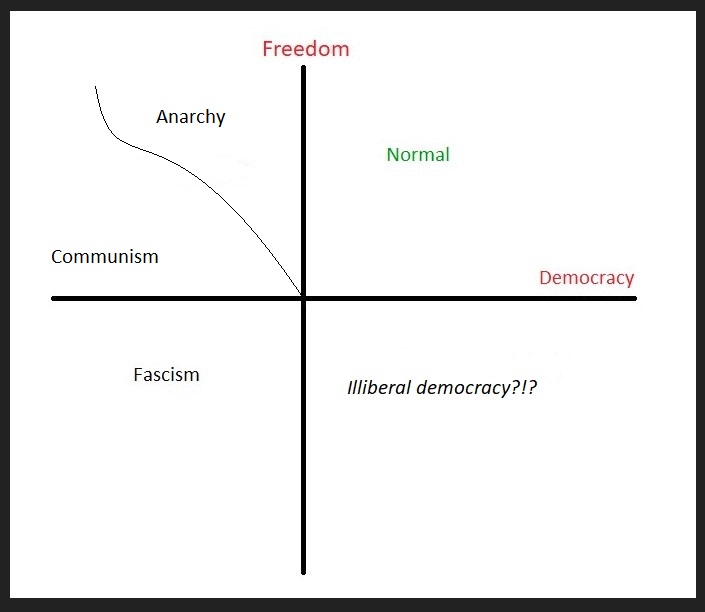
‘Most people confuse liberty and democracy. They are not the same.’

Liberty and democracy are not the same indeed.

Like my left hand is not the same with my right one.

But I need both in order to lead what I consider to be a normal life.

Most people – specially if they get help, can survive without a hand. Or without either liberty or democracy.

But without both… without both hands or without both liberty and democracy… I’d be at somebody else’s mercy!

‘What?!?
What kind of liberty is there under communist rule???’

You see, liberty has two ‘faces’. Two dimensions.
Three, actually, but I’ll be talking about only two of them in this post.

There is the ‘inner liberty’ and there is the ‘socially sanctioned liberty’.

Liberty itself is a human concept.
We have noticed something, wondered about it, named it and then attempted to understand it.
This was, and continues to be, a collective effort.

In some places ‘liberty’ had appeared ‘naturally’.
There was enough liberty naturally sloshing around, hence the circumstances were right for those who had happened to live there at the right time to notice it. Furthermore, the conditions had been right again for the entire community to be able to agree among themselves about the concept and about how to use it/put in practice their new intellectual achievement.

Other places have not been so lucky.
They had been close enough, geographically and socio-historically, to notice the ‘birth of liberty’ but their specific conditions were not ‘right enough’. Many people living there coveted liberty but the local conditions made it impossible for liberty to take hold.
In these places ‘inner liberty’ – individually assumed freedom, can be found a lo more easily than presumed by those unfamiliar with the local realities.

Yet other places had it even worse.
Initially on the path towards liberty – and democracy, they have somehow stumbled.
For whatever causes – internal and/or external, something went wrong. People became disappointed enough to give up not only democracy but also liberty. Including their own, individual inner freedom.

A somewhat intermediary situation constitutes the third abnormal quadrant.
The people involved have given up their liberty – partially, but those running the show continue to use (‘pretendingly’) democracy as a window dressing to hide their true intentions.

The last hundred years or so have been extremely relevant in this matter.
All communist regimes had fallen. Under their own weight.
Most fascist/nazi regimes are no longer with us. Had been so ‘arrogant’ – read self destructive, that their neighbors had to do something about them. Had created so much disruption around them that those whose very existence was endangered had been forced to spring into action.
‘Illiberal democracy’ is a rather new ‘development’. Would be fascist/nazi dictators don’t have all circumstances aligned to make their final move so they have to make do with what there is at their disposal. The local population is ‘despondent’ enough to pay attention to their arguments but not desperate enough to follow them into the ‘unknown’. Hence this oxymoronic abomination.

‘Illiberal democracy’…
On the other hand, the spin doctors promoting illiberal democracies hope to be able to reap the benefits of democracy – the population being ‘rather favorably disposed’ towards the government while having to pay less ‘lip service’ to individual human rights.
A balancing act, with no safety net, which is alluring to those reckless enough to attempt it but which will end up badly. Sooner rather than later.

But the most interesting ‘combination’ – for me, at least, is Anarchy.
In the sense that those who ‘swallow’ the lure are self delusional.
They have somehow convinced themselves that their, own, liberty somehow trumps the liberty of everybody else. They feel so strong, so immune to any outside influence, that they would willingly accept to live in a no rule environment. Without understanding that ‘no rule’ means ‘no holds barred’.
They actually don’t realize that unfettered liberty actually means ‘Each of us free against all others’.
This being the reason for which Anarchy, as a political arrangement, has never survived for long enough to be noticed. Except as a transitory phase.

‘On the face of it’, it makes perfect sense.

But why bother?

If I’m on the ‘right’ side, why would I make it easier for the other guy?
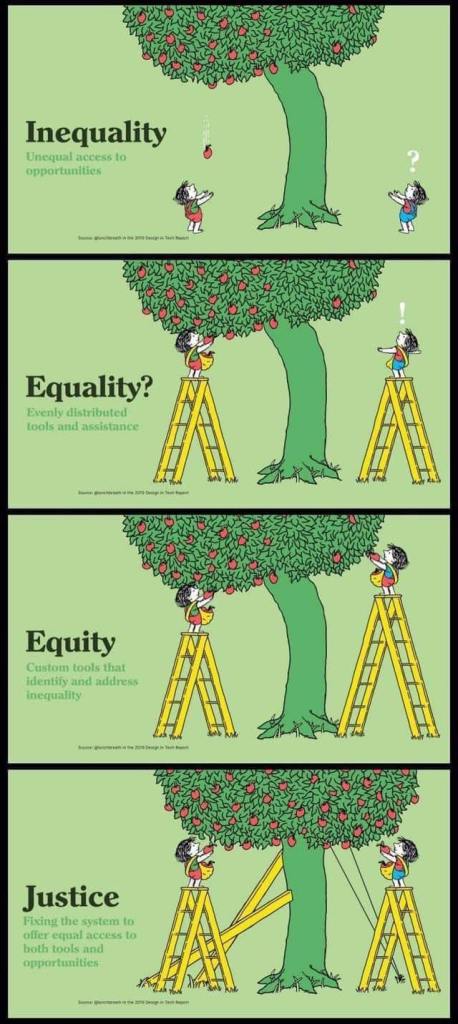
If on the ‘wrong’ side, why not just switch sides? Why would I bother to straighten the tree? Against the wishes of those who have a lot to lose in the process?

From the other side of the looking glass, things are a lot simpler.

‘Fiat justitia, ruat caelum’ is a warning, not a behest.

‘Make sure that justice is served, unless you want the heavens to fall on your shoulders’ is what any open minded reader of history makes of this ancient adage…

The fact that we concentrate our attention on what justice means for each of us is a measure of our individualism.
Of our nearsightedness…

Our respective individualities, each and everyone of them, have grown into what they are now in a social context.
None of us can exist for long, let alone protect and develop their individuality, in solitude.

We need the others.
We, each and everyone of us, need to belong. To a community.

To a functional community!
To a community where each individual is cherished.
Where each individual can develop its potential.

Where each individual has the opportunity and the tools to develop their potential.
For his own good, in concert with the main interest of entire community.

Survival.
Things remaining as they should be.

Us toiling here, on the surface of the Earth.
The heavens perched safely up there.

Justice must be served if things are to remain as we, each and all of us, need them to be.

After Putin ordered the Russian army to invade Ukraine, the rest of the world ‘took sides’.

Some sided with Putin, many extended a helping hand to Ukraine – for various reasons, and others felt their lives have been ‘disturbed’.

This morning I almost blew my top.
I was listening to the radio. A usually decent station. Usually decent and, like all of us, imperfect.

The news anchor was interviewing an ‘expert’. An Ivy League Professor of International Relations and other blah-blahs. I’m not giving their names because I want them forgotten, not even more famous than they already are.

‘Is there any chance for this conflict to end in a negotiated manner?’
‘Yes, if/when both sides will find a mutually acceptable solution.
For example, if the Ukrainian side would accept a referendum in Donbass – and in Crimea, and if the Russian side would accept UN inspectors to validate the process. This would be in line with the general accepted policy of self-determination and ….’

OK, and where’s the difference between what Putin keeps saying and what I’ve just heard?!?

Two non-Ukrainians telling Ukraine what to do…

I’m going to set aside, for now, what these two – wait, three! – people are saying.
That Ukraine, the Ukrainian People, should give up a piece of their land.
My immediate interest lies in ‘who these three guys think they are’?!?

OK, only those who don’t want to see haven’t yet found out that Putin is a dictator.
But for a renowned Ivy League Professor to elaborate a scenario according to which the UN would supervise a referendum where an occupied population would have the opportunity to vote whether they want ‘their’ aggressor to maintain its control over the already occupied territory….

Would that distinguished Professor be comfortable with a referendum – equally supervised by the UN, taking place in California? Which California had already been occupied by Mexico? For which referendum, the Californians were asked where they want to live? Whether Mexico should continue its occupation or should the Mexican army retreat behind the internationally recognized border?

No, I don’t think the Professor has been paid by Putin. Or ‘compensated’ in any other way by the ‘red Satan’.
I just consider he was not paying real attention to what he was saying.
He had just opened his mouth and verbalized what his mind was churning.
The current ‘events’ have disturbed his pleasant existence to such a degree that he really needs this ‘fly in the ointment’ to ‘fly away’.

He is so ‘driven’ by his ‘need’ that he is no longer ‘patient’. He just can’t ‘stop talking’ for long enough to realize how fast Putin’s propaganda machine will make ‘good’ use of his ‘verbalizations’…

‘See, the good Professor confirms what our Beloved Leader has already done.
It’s the Ukrainians who are not reasonable!
They should first change their leadership then come back into Mother Russia’s arms.’

When are we going to understand?

Don’t tell others what to do unless you are prepared to ‘take advice’ yourself…
And, for your own good, don’t trade your future freedom for your present comfort!

Can we do without it?
And if not, how much of it?

– If ‘no government’, then who would pay for the army we need to defend ourselves?

Ooops… you’ve just answered the ‘why does Russia ‘encourage’ the trolls who push ludicrous libertarian ideas’ question. Which trolls attempt to achieve two things at once. Weaken the concept of free government and give libertarian-ism a bad rep. Transforming libertarian-ism into yet another form of extremism.

Let’s get serious and try to find an answer to ‘why, and how much of it, do we need government?’

The boring one would be: ‘Whenever one government falls, another one takes over. The interregnum is always bad so… let’s get used to it’.

‘Getting used to it’ works only for very short expanses of time. Left on its own, all ‘government’ becomes sloppy. So sloppy that it soon becomes such a burden that even the most ‘used to it’ lose their patience.
Government, all of them, need to be kept on a tight leash. Otherwise it will soon cease to perform as intended.

– But if you have to keep it on a tight leash, why bother with any in the first place?
Can’t we do without such a bothersome pet?
What’s the point of the whole thing, anyway?

Instinctively, we’re against ‘government’ for two reasons.
It costs us a lot and it used to represent the interests of the ruler.

Until 10 000 or so years ago, we didn’t need ‘government’.
People were living more or less like the modern day Sun People still do. In the Kalahari desert… small bands roam the place, living of the land. The bands are small – so that they might find sustenance, they don’t have any ‘private’ property to protect, hence they don’t need government. Neither did our ancestors.

As soon as people ‘invented’ agriculture – raising ‘tame’ animals at first and working the land soon after, things had changed dramatically.
The advent of agriculture brought two things. An increased productivity and private property.
Soil has not been born equal. Both pastures and arable land can be good, passable or bad. People wish to have the best. Those who already have it are willing to defend it and those who don’t are willing to steal it.
Increased productivity means that those who produce are able to hire people to protect their ‘means of production’. Their property. As a consequence of fighting for it, some people accumulate more and more of it.
More and more ‘means of productions’ – property, means an ever increasing need for ‘management’ and an ever increasing need for ‘protection’. Soon you have a very ‘wealthy’ owner – the lord of the place, call it what you like or use the name given to him by his subjects, the people who perform the day to day management of the ‘whole-sale property’ and those who protect it from ‘marauders’. Both the ‘managers’ – read ‘government’, and the ‘protectors’ – read ‘army’, used to be under the direct supervision of the local lord.
For a while – for as long as the lord kept everything in balance, everybody was happy. The ‘peasants’ were happy because thy were safe, the ‘managers’ were happy because the wise lord used to appreciate their work and ‘compensated’ them accordingly, the ‘protectors’ were happy because they were well fed and taken care of. According to this article, the great Egyptian had been built by willing people, not by slaves.
https://www.harvardmagazine.com/2003/07/who-built-the-pyramids-html
But soon enough, the lord had become estranged from his people. Government had become an instrument used to extract more and more wealth from the peasants while the army was used to protect the government against the people and, whenever possible, to increase the property of the ruling lord by stealing some from the neighboring ‘lords’. The ’empire’ was born.

But this development could take place only in certain circumstances. Where those below the ruling lord had nothing more to do than to obey. Where the best subject was the disciplined one. Where autonomous thinking and imagination were frown upon by the ruler. Where one mind was enough.
Whenever the ‘environment’ mandated the individuals to remain relatively autonomous, proto-democratic forms of self government had been experimented. From the nomadic pastoralists of the Central Asia to the sailing communities in Ancient Greece and Medieval Scandinavia. Those driving herds or sailing ships need to be a lot more independent-minded that those who just tile the earth. No offense intended here! Simple observation will notice that where the geography of the place had allowed it, somebody had ‘built’ an empire. The Nile Valley, the Middle East, the Russian plain, China, Mexico…
Where ever the geography of the place was fragmented enough by sail-able sea, proto-democratic forms of self-management had been developed. The sailing Ancient Athens versus the land-locked Sparta, Medieval Scandinavia versus Medieval France…

Fast forward to present day.
When we have two forms of government.
The more or less democratic ones. Those under whose ‘guidance’ discussions like the present one can happen.
And the more or less authoritarian ones. Which actively discourage autonomous thinking.

Mind you, there are no ‘perfect’ governments.
There’s no perfectly democratic arrangement anywhere on Earth. Because we are imperfect human beings.
And there’s no ‘perfect’ authoritarian government. Because no government can survive for long if it attempts to centralize the decision power. The closer a government gets to being perfectly authoritarian, the smaller is the crisis needed to topple it. Unless it is supported from the out-side but that’s another topic.

So. It is fairly simple to understand how authoritarian governments fail. Too much ‘stiffness’ makes it impossible for authoritarian governments to evolve. To find solutions for whatever challenges pop up constantly.

But what can go wrong with the collective forms of self-rule? With the participative forms of social self management? Otherwise known as democracies?
Lack of enough popular involvement. Due to a sense of apparent safety, initially. And to a feeling of apparent impotence, soon after.
Lack of enough fore-sight. Those who should know better become distracted, for whatever reasons.
Too much opportunism. More and more of the ‘insiders’ use ‘the power of the government’ to fulfill their own, private, goals instead of making sure that ‘government’ works properly.

And what does that mean?

A government works properly when the community which self manages itself using that particular (form of democratic) government survives in the long run.
When those momentarily working inside the government make things happen for the community at large.
When people, both inside and outside the government, follow, in spirit, Kennedy’s words.

Am I being naive?
Maybe… But wouldn’t it be a nice thing to have?
A nice thing to chase, anyway?

And what better way to chase ‘it’ than voting for people who at least pretend to be honest? Who at least make the ‘right’ noises? Whom we can hold accountable whenever they break their promises?
Instead of voting for those who promise barrels and barrels of ‘pork‘?
https://grammarist.com/idiom/pork-barrel/

Ideological pork or hands-on pork, I don’t know which is worse…

– In which direction?

– I thought we were talking about a glass ceiling, not a glass bottom…

You see, we have to deal here with the difference between depth and thickness.

A ‘coat of paint’ has a certain thickness – we know where it starts and where it ends, while a sea has a certain depth. We know it’s there, we know where it starts – at the surface of the water, but we’re never exactly sure where it ends. How deep it actually is!

Another way to put this would be to compare the depth of human consciousness with the thickness of the cerebral cortex.
The depth of the reality we perceive using our brain and the thickness of the cerebral tissue where this perception takes place.
The depth of the reality we, humans, have built during our history inside the relatively shallow portion of the Earth where we feel at home.

We use a small number of phonemes to communicate among ourselves.
A relatively small number of words to convey hugely complicated concepts.
Two digits, 0 and 1, to build artificial intelligence… inside a wafer thin ‘slab’ of doped silicon.

– OK, enough introduction. How about making in clear what you really meant?
A glass ceiling or a glass bottom?

Whether it is a glass ceiling or a glass bottom is a matter of perspective.
A matter of where you are when looking at it. Above or below.
The only thing which really matters being the fact that you see it despite of it being made of glass.
Despite it being transparent.

Transparent to our eyes but not to our conscious mind.

– But if it’s already transparent, why is it such a big thing to break through it?
We already know what’s behind/above it…

Seeing is not the same thing as knowing… just as 0 and 1 scribbled on a computer chip is not enough to make an intelligent computer…

What happened:

And what various people make of it:

Two idiots go on a fishing trip.
They rent all the equipment – the reels, the rods, the wading suits, the rowboat, the car, and even a cabin in the woods.
They spend a fortune.
The first day they go fishing, but they don’t catch anything. The same thing happens on the second day, and on the third day. It goes on like this until finally, on the last day of their holiday, one of the men catches a fish.
As they’re driving home, they’re really depressed. One guy turns to the other and says
“Do you realise that this one lousy fish we caught cost us $1,500?!?”
The other guy answers
“Wow! It’s a good thing we didn’t catch any more!””

“On his evening walk Tony finds an ancient pottery bottle half buried in the silt down the river next to an old rusted-out van. Carefully examining the bottle, he notices that it still has a stopper in it, and there is some kind of writing etched around the neck of the bottle. Using his shirtsleeve, Tony gently begins to rub the mud from the bottle, to see if he can decipher the characters.
To his surprise, a thread of smoke oozes from around the stopper and the bottle begins to shake violently. With a sudden POP the stopper flies off and a genie appears before him, its arms folded in the traditional genie manner.
“Thank you for freeing me!” cries the genie. “I have been trapped in that bottle for over a thousand years!”
The genie continues “In return for releasing me, I will give you a reward of one million dollars. However, Tony, I must warn you, if you accept it, the person you loathe most in this world will get twice as much. Do you accept the reward with these terms?”
“Of course I’ll take it!” Tony replies with a smile “My family could use the money!””

“Every Friday night after work, Dave would fire up his barbeque on the shore of the lake and cook a venison steak.
All of Dave’s neighbours were Catholic and since it was Lent, they were forbidden from eating meat on a Friday.
The delicious aroma from the grilled venison steaks drifted over the neighbourhood and was causing such a problem for the Catholic faithful that they finally talked to their priest.
The Priest came to visit Dave, and suggested that he become a Catholic.
After several classes and much study, Dave attended Mass… and as the priest sprinkled holy water over him, he said “You were born a Lutheran and raised a Lutheran but now you are a Catholic”.
Dave’s neighbours were relieved, until Friday night arrived and the wonderful aroma of grilled venison filled the neighbourhood again.
The Priest was called immediately by the neighbours and he rushed over to Dave’s place clutching a rosary and was prepared to scold him, he stopped and watched in amazement.
There stood Dave, clutching a small bottle of holy water which he carefully sprinkled over the grilling meat and chanted to it:
You were born a deer, you were raised a deer, but now you are a rainbow trout“.”

“OK, I had a laugh. And your point is?”

If the first two were such idiots, where did their money come from?
If the guy who hates his family is wise enough to accept the genie’s offer, what is it that still makes the rest of us to actually kill each-other?

“And the third joke? What hidden meaning do you have for that one?”

“A turkey was chatting with a bull.
“I would love to be able to get to the top of that tree” sighed the turkey, but I haven’t got the energy”.
“Well, why don’t you nibble on my droppings?” replied the bull. “They’re packed with nutrients”.
The turkey pecked at a lump of dung and found that it gave him enough strength to reach the lowest branch of the tree. The next day, after eating some more dung, he reached the second branch. Finally, after a fourth night, there he was proudly perched at the top of the tree.
Soon he was spotted by a farmer, who shot the turkey out of the tree.
Moral of the story: Bullshit might get you to the top, but it won’t keep you there.”

After reading this interview for a second time, I asked myself: ‘Why are you paying so much attention to this guy?!? After all, he doesn’t say anything new…’

Then it hit me!

“Russia” and “we” are two different things.

Russia, the country, cannot indeed afford to “lose”. To ‘lose it’, to be more precise.
Russia will survive, no matter how many more ‘mistakes’ the morons currently running it will commit.

“We”, on the other hand, are the ones who can. And eventually will. Lose. Everything.

And the longer those “we” are allowed by Russia itself to run the Kremlin, the worse it will be.
For everybody. Us – the rest of the world, included.

‘But when will this nightmare end?’

That I don’t know.
All I know is that it will eventually do that. End.

Look at the picture above.
When have you seen anything more British than that?
OK, fake British. Make-believe British. But British nonetheless.

That was which hit me.
That during its entire history, Russia had tried to emulate Britain.
The Russian elite has for ever tried to rise itself to ‘British standards’. From Peter the Great to Putin.
All the while convincing the Russian People that the road they were trundling on was unique…

The sooner the ordinary Russians will figure out that they have been misled – and enough of the elite will understand that British-ness is good only for the Brits, they will make peace.
Among themselves.
With the their Ukrainian cousins.
And with the rest of the world!

A beautiful country, inhabited by a beautiful and proud people who ‘generate’ such beautiful music…
Yet this is how their freedom looks like!

Two successive dictatorial regimes, the first headed by Fulgencio Batista and the second by Fidel Castro…

Read what brittanica.com has to say about each of them. Just click their names.

Then tell me why are we, any of the democratic countries in the world, still making business with any of the dictatorial regimes still plaguing the Earth?
Why do we continue to harbor any of the yachts owned by corrupt oligarchs? Or their money?