Archives for category: 1989

A făcut cineva un banc pe net.
Care banc deschide oportunități cât se poate de interesante.

Care este ‘lățimea de bandă’ a limbajului?
Cât de mult înțeles poate fi înghesuit într-un număr limitat de cuvinte? Și, mai ales, cât de mult din acest înțeles poate fi recunoscut ca atare și ‘recuperat’ de către cei care intră în contact? Cu acele cuvinte…

Cel care a pus la cale gluma nici măcar nu le-a menționat. Jumătate dintre comentarii fac referire la ele… la legume!
Din punct de vedere ‘logic’, are sens. Pentru a număra fructele, trebuie mai întăi să le alegem. Să vedem dacă nu cumva sunt amestecate cu alte chestii. Cu legume…

Ce sunt fructele?
Mere, pere, căpșuni, cireșe… chestii dulci, pe care le mănânci, de obicei, după masă. Ca atare, sub formă de desert sau chiar de dulceață.
Sau chestiile alea pline de semințe pe care le fac plantele după ce se scutură petalele florilor…
Ce sunt legumele?
Chestiile alea pe care ni le îndesau mamele noastre pe gât, în numele alimentației sănătoase. Bucăți din plante, proaspete sau gătite, care trebuie mestecate mult înainte de a putea fi înghițite. Și care țin, la o adică, de foame.
Sau niște plante care au o anumită particularitate. Rădăcinile lor adăpostesc niște bacterii fixatoare de azot. Și ca urmare a acestei simbioze, plantele respective – legumele – îmbogățesc pământul în care cresc. În loc să-l sărăcească.
Vechii locuitori ai Mexicului cultivau porumb amestecat cu dovleac si fasole. Dovleacul și fasolea – amandouă legume – ajutau porumbul să crească. Porumbul, la rândul lui, oferea sprijin și umbră legumelor. Toate trei îi hrăneau pe strămoșii mexicanilor.
Bunicii noștrii roteau culturile. Din când în când puneau trifoi. Care e tot o legumă. Din punct de vedere botanic…

Toate informațiile astea sunt înghesuite în doar două cuvinte. Fructe și legume.
Și acum, că toată lumea are tot felul de dispozitive conectabile la internet, informațiile astea sunt cât se poate de disponibile. Nu mai e nevoie să le fi învățat dinainte.

Ar trebui totuși să ținem minte ceva.
Să verificăm ce se ascunde în spatele cuvintelor. Care sunt, de cele mai multe ori, mai largi decât par la prima vedere!

Doar că pentru asta avem nevoie de exercițiu!
Adică avem nevoie să ne învățăm singuri…

Să nu mai punem botul!
Să ținem cont de faptul că nu toți cei care ne vorbesc au cele mai bune intenții. Cu privire la noi…
Poate ar fi bine să verificăm și ce au făcut la viața lor înainte de a le crede promisiunile!

Și ca să nu termin brusc, ‘legumă’ mai înseamnă ceva. O persoană aflată în stare ‘vegetativă’. Care trăiește dar care nu prea e ‘de față’. Din cauze obiective – a suferit un atac cerebral, de exemplu – sau subiective.
‘Nu mai sta ca o legumă!’… Nu-i mai lăsa pe alții să te păcălească!

M-am împiedicat pe internet de chestia asta.
Unii ar sesiza contribuția inteligenței artificiale care a fost însărcinată cu ‘ortografia’.
Alții ar admira abilitatea cu care a fost strecurată șopârla. 7 mere verzi și două (mere) roșii. Sau 7 mere (verzi) și două tomate roșii?!?
Horticultorii ar sări de cur în sus. Toate sunt fructe! Chiar dacă sunt fructele unor plante din categoria legumelor, vinetele, dovleceii, ardeii și roșiile sunt tot fructe. Au semințe, sunt fructe!

Pe mine mă interesează altceva.
Comentariile. Pe care le găsiți aici. Din care rezultă foarte clar cât de puțini ‘s-au prins’. Și cât de mulți se consideră suficient de ‘geniali’. Suficient de ‘geniali’ pentru a răspunde…

Se tot face vorbire, în spațiul public și pe toate canalele, despre nevoia de educație. Despre ‘analfabetism funcțional‘…
Avem aici cel mai bun exemplu de alfabetism disfuncțional. De oameni care au știut să citească dar care nu s-au prins. Lasă că n-au ținut minte de la botanică despre cum stă treaba cu fructele. Care n-au ‘reținut’ că și legumele fac fructe! Care n-au știut să ia în serios avertismentul „doar pentru genii”. Care nu s-au obosit, având la îndemână un dispozitiv conectat la internet, să caute scurt „vânata fruct sau legumă”.

De unde și diferența dintre „analfabetismul funcțional”, termen oficial folosit de cei care se vaită cu privire la cât de needucată este nația, și alfabetismul disfuncțional. Realitatea cruntă!

Analfabetul funcțional funcționează. Cel puțin conform logicii după care funcționeză limba română.
Analfabetul funcțional este un om care se descurcă, „funcționează”!!!, chiar dacă nu știe să citească!
Abia alfabetul disfuncțional este persoana care nu înțelege suficient din ce este în stare să buchisească!

Și nu e vina lui!
Alfabeții disfuncționali au ajuns așa ca urmare a procesului educațional prin care au trecut.
Proces educațional început la școală și ‘desăvârșit’ prin expunerea constantă la texte care conțin expresii precum „analfabetism funcțional”. Și alte chestii asemenea….

Că tot veni vorba.
De azi dimineață tot anunță la radio „extinderea codului roșu de ploi”.
Dacă te iei după logica exprimării, urmează să plouă pentru că au emis meteorologii codul corespunzător.
Dacă te iei după ce spun comentatorii, trebuie să dezafectăm centralele pe cărbune pentru că așa ne spune Comisia Europeană…
Băăă! Meteorologii au emis codul ala ca să ne avertizeze! Aparatele lor le spun că este o probabilitate foarte mare, aproape o certitudine, că urmează să plouă! Mult!
Tot așa și cu centralele alea. ‘Oamenii de știință’, „specialiștii”, au ajuns la concluzia că dacă mai pompăm mult bioxid de carbon în atmosferă meteorologii vor fi nevoiți să emită din ce în ce mai multe coduri din ce în ce mai roșii. De caniculă, de furtună… Așa că Uniunea Europeană ne dă șpagă să închidem centralele alea odată! Și noi nu suntem în stare să le luăm banii…

Despre asta e vorba. Aici e deosebirea dintre analfabetismul funcțional și alfabetismul disfuncțional.
Unii vorbesc fără să știe – sau fără să realizeze consecințele minciunilor pe care le înșiră – iar alții citesc și nu mai înțeleg nimic.
Realitatea fiind că n-a prea mai rămas mare lucru … neînțeles! Sau de înțeles…


Remus Ștefureac explică foarte bine de ce diasporenii români au votat diferit față de cei moldoveni.

Unii, adică românii, au plecat mai ales de la țară. Statistic vorbind. Și muncesc, în mare parte, cu cârca.
Ceilalți, adică basarabenii din Republica Moldova, au plecat mai ales din ‘oraș’. Tot statistic vorbind.

Drept pentru care românii și-au exprimat mai ales frustrarea iar basarabenii mai ales aspirațiile.
Românii sunt scârbiți de porcăriile făcute de politicieni. Iar în localitățile mai mici oamenii ‘de rând’ ‘se trag de șireturi’ cu politicienii locali. I-au tot votat, pe cei perindați la putere, pentru că nu aveau pe altcineva. Știau ce le poate pielea dar nu aveau alternativă.
Basarabenii știu. Știu că trebuie, neapărat, să intre în UE!

Cuvintele lui Remus Ștefureac pun degetul pe rană. Explică foarte clar ce este de făcut. De către politicieni.

Ai noștrii să-și facă curățenie în ogradă.
Ai lor să împingă lucrurile mai departe.

Aceleași cuvinte se constituie și într-un avertisment.
Românii, deja la adăpostul Uniunii Europene și sub umbrela NATO, au pretenții. Nu mai acceptă mizeriile pe care le-au suportat până acum.
Moldovenii se lasă încă mobilizați. Către idealul din zare.
Românii, deja ‘înăuntru’, merg cu capetele în pământ. Îi apasă grijile. Văd toate crapăturile din trotuar. Știu foarte bine cine a furat asfaltul. Cine a pus bordurile…

Putin le-a promis basarabenilor o himeră. Cuvinte goale și o mână de arginți.
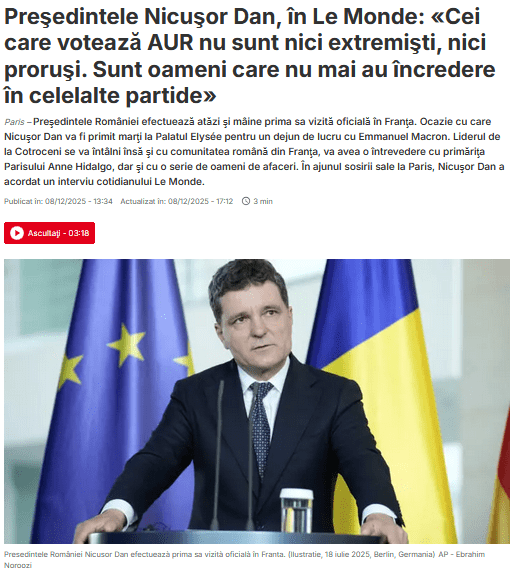
AUR a instrumentalizat nemulțumirea perfect justificată a oamenilor de rând.

Putin a pierdut vremea. Pentru că a incercat să întoarcă istoria înapoi.
AUR încearcă să ‘dați-vă voi jos ca să mă urc eu’. Faptul că AUR face jocul lui Putin este important doar la nivel macro.

Pentru moldoveni era esențial să voteze așa cum au făcut-o. Țelul lor este cât se poate de clar. Pentru toată lumea.
Pentru români… Românii, care se cred la adăpost, au țeluri. Fiecare pe al său. Fiecare votant are obiectivul lui. Unii să-i dea odată jos pe ‘ăștia’, alții să…

One of the most celebrated personages in the history of the West.
He revolutionized military organization and training;
sponsored the Napoleonic Code, the prototype of later civil-law codes;
reorganized education; and established the long-lived Concordat with the papacy.
He was the moving spirit behind the intertwined series of conflicts known as the Napoleonic Wars, which had revolutionary repercussions, both militarily and politically,
in Europe as well as other parts of the world.
https://www.britannica.com/biography/Napoleon-I

Exasperated, the XIX-th century France had decided to change everything.

Please note that despite the rather inept leadership offered by the last three kings, France was the dominant European power of the moment. Economically, demographically and militarily.
Exasperated people tend to make rather poor decisions.

Napoleon Bonaparte was permitted to rise to power. To absolute power…
He yielded that power in such a way that he had angered most of his neighbors. Most of France’s neighbors… Which had banded together and defeated him. Twice.

Which was a premiere.
A bully put down by an alliance… A bunch of autocrats put off by another who decided they had enough.

The same template was used against Germany’s dictators. Both Wilhelm II and Hitler had been put down by coalitions. By people fed up with their antics.
A somewhat similar thing happened during the Cold War. A bullying regime, the Soviets, was kept in check by an informal ‘coalition of the willing’. ‘Informal’ in the sense that NATO was only the ‘tip of the iceberg. In reality, the Soviet Union had been defeated by the ‘free world’ working in concert.

Nowadays, ‘living in interesting times’, we witness another coalition taking shape.
Three authoritarian leaders ‘pushed together’ by a fourth one… By the antics perpetrated by a guy pretending to uphold freedom. Absolute freedom…!

Evolution is not about ‘survival of the fittest’.
Evolution is about the demise of the unfit.

Ernst Mayr, What Evolution Is, 2001

Well, it actually makes a lot of sense.

Being healthy is relative.
On having a diagnostic hanging over your head.

Here’s another way of looking at things.

Functional versus dysfunctional.
For as long as one is functional, that person is not a burden for anybody. Regardless of any diagnostic.
Even a dysfunctional person can be useful for those around them. Even if that person is completely dependent on those taking care of them. A good word spoken at the right moment makes wonders.

So yes, I would also love to die ‘healthy’. As in trying to do my best to be useful.
At least, to be as light a burden as possible.

On the other hand, health is yet another virtual thing. ‘Virtual’ as in man made…
Until not so long ago, ’cause of death’ for people over a certain age was always ‘old age’.
No longer. No matter how old the deceased, the body is transported to a medical facility and the particular cause of death is forensically determined.
It makes perfect sense. Scientifically speaking. There is no such thing as too much data, specially when it comes to something as precious to us as human life.
And it raises a ‘somewhat’ unreasonable kind of hope. That sometime, somehow, all causes of death will be mitigated. Diagnosed and treated.
That life will become ‘longer’. That we, humans, will live if not forever… then until an accident will happen to shorten our destiny.

Can you imagine something like that?
People living for 3 or 4 hundreds of years?

No retirement.
No risk taken.
No change…

“Our measures do not tell us whether philosophy majors
go on to apply their newfound abilities in the service of truth and justice
or, conversely, for personal gain and glory.
Settling that question would require gathering a different kind of evidence.”

Reading it, https://theconversation.com/studying-philosophy-does-make-people-better-thinkers-according-to-new-research-on-more-than-600-000-college-grads-262681, brought back to memory another research subject. Linking a ‘reasonable consumption of alcohol’ to various health benefits.
A quick google search produced this:

The paper I found now, https://www.phcc.org.nz/briefing/glass-half-full-alcohols-health-benefits-cardiovascular-disease-still-controversial-and, is quite thorough.
More importantly, for me, it raises the points which bothered me when I first found out about the claim. On FB, more than five years ago.
I’ll put it in my own words.

Being able to drink for a relatively long time means one had a fairly strong health at the start of the whole process. And at least some degree of self-control.
Otherwise the drinker would have very soon become ill, an alcoholic, suffered some accidents… or any combination thereof.

Same thing regarding the findings of the first study.
Take a number of smart people. One has to be smart in order to be interested in philosophy! And able to graduate…
Train those people’s abilities. Help them develop whatever they’re good at. And like doing…
Then wonder about the good results you’ve achieved!

Writing this post made me realize that it goes far deeper than this.
No, this is not a self-congratulatory study. Far from it.
It’s stark warning!

“Public trust in higher education has hit record lows in recent years, according to polling by the Lumina Foundation and Gallup. Meanwhile, the rapid advance of generative AI has threatened the perceived value of a traditional college degree, as many previously vaunted white-collar skills are at risk of being automated.
Yet now more than ever, students must learn to think clearly and critically. AI promises efficiency, but its algorithms are only as good as the people who steer them and scrutinize their output.
The stakes are more than personal. Without citizens who can reason through complex issues and discern good information from bad, democracy and civic life are at risk.”

This paper is not about the virtues of learning!
It’s about us.
So many of us still have so much more to learn about the virtues of learning…

One possible explanation for what’s going on is that not enough of the learned people “go on to apply their newfound abilities in the service of truth and justice“.
Me starting this post with the distinct feeling that this was a self-congratulatory study is yet another confirmation of the generalized distrust which permeates the whole society.
We’ve reached that stage where we primarily look for reasons to refute.
Some say a little paranoia is good for you. That it keeps you safe.
I’m afraid we’ve reached exactly where ‘they’ want us to be.
Distrusting, paranoiac people cannot do anything together.

Constantly looking over your shoulder will never lead you forward.
Will only make you, us, susceptible to manipulation.
Remember, in this context, how many reasonable posts we get from people supporting various horrendous ideas.
How many ‘think with your own head’ messages we get from those ‘also’ promoting MAGA. How many times Putin says he only makes ‘reasonable’ demands.

How can we build trust?
I don’t know how but I do know we don’t have any alternative.

We either learn to respect each-other, and build trust together, or become subjects.
And I’ve already been a subject. To a communist regime. Don’t want to repeat the experience.

Fenomenologia este un curent filozofic care se concentrează pe studiul
structurii experienței, așa cum se manifestă în conștiință,
fără a recurge la explicații cauzale sau la metodele altor discipline.
Se concentrează pe esența lucrurilor, nu pe fapte sau teorii”
AI Overview propusă de Google pentru „fenomenologie definiție”

Teoretic, unu și cu unu fac doi.
Dar asta doar pentru că așa am hotărât noi.
Să dăm câte un nume pentru fiecare chestie încolonată în ceea ce noi considerăm a fi ‘șirul numerelor întregi’.
Și cum ‘chestia’ care îndeplinește condiția =1+1 s-a nimerit să fie cea botezată de noi cu numele doi…

Bat câmpii?
Stați să vedeți ce urmează…

Deci.
Tot teoretic, două doctorate înseamnă de două ori mai multă deșteptăciune confirmată oficial decât un doctorat.
Simplu, nu?
Conceptul cheie din spusa de mai sus fiind „deșteptăciune confirmată oficial”, bineînțeles.

„Tema centrală va fi așadar viața ca încercare, viața ca ispită, idee care prelungește considerațiile heideggeriene anterioare făcute în marginea epistolelor paulinice în privirea îngrijorării, nevoinței vieții.
Heidegger sesizează în textele lui Augustin și o altă tensiune, anume aceea dintre tendințele genuine ale vieții factice (care motivează experiența creștină) și tendințele conceptualizatoare și teoretizante, de proveniență neoplatonică, prin care datul genuin al facticității este deturnat în sensul său originar, și astfel acoperit, obturat, falsificat.
Așadar, cursul lui Heidegger despre Augustin se va construi pe doua fronturi. Pe de o parte, va fi vorba de tensiunea dintre tendințele genuine ale vieții factice creștine și tendințele teoretizante care provin din aluviunile conceptuale pe care le întrebuințează tacit Augustin, idee ce se situază în descendența considerațiilor privind critica primatului teoreticului (fenomenologia ca știință originară pre-teoretică).”

Pe cealaltă parte, cred că am bătut destul câmpii. Că ați înțeles deja ce vreau să spun.
Cristian Ciocan, autorul rândurilor de mai sus (Întruchipări, Studiu de fenomenologie a corporalității, Humanitas, 2013) are și el două doctorate. Tot două doctorate… Universitatea din București, 2006 și Paris IV Sorbona 2009.

OK, sunt câteva diferențe între cele doua situații.
Din păcate, există și o trăsătură de unire. Între ele…
Se justifică una pe celălaltă! Adică se explică între ele. Se ‘normalizează’ dacă vă place mai mult genul ăsta de exprimare.
Privindu-se una pe cealaltă, ca într-un soi de oglindă, cele două situații devin cât se poate de transparente. De inteligibile…

Mă pregăteam să …
Și mi-am dat seama că!

Mai bine închei cu o amintire.
Undeva prin clasa a VII-a am descoperit revista Săptămâna. A lui Eugen Barbu.
Nu eu, ci prietenul meu cel mai bun. Care le avea pe astea cu literatura. Nu mai țin minte ce îi atrăsese atenția, cert este că erau multe lucruri interesante acolo. Chiar pentru niște copii, așa cum eram noi.
În afară de chestiile interesante, erau și unele extrem de hazlii. Din când în când, dădeam peste niște texte scrise în stilul folosit de dl. dr. Ciocan. Râdeam cu hohote. Nu erau la fel de complicate precum exemplul de mai sus, cele mai multe erau din zona criticii literare, dar exprimarea era la fel de pompoasă. Efectul la fel de … hazliu, pentru noi. Pentru noi, niște puști care le citeam cu dicționarul în mână. După care ne întrebam: „Da’ de ce nu vorbește ca oamenii? Cui se adresează? Cei care sunt capabili să înțeleagă cuvintele astea abracadabrante nu au nevoie să le traducă cineva ‘ce a vrut să spună autorul’”.

Things happen.
The consequences of which

reshape what we call ‘reality’.

‘Things happening’ is how ‘reality’ works.
Is how we came about…

Believers and nonbelievers alike, all of us are consequences of ‘things happening’. ‘Naturally’ or ‘as commanded by God’.

‘Reality’, on the other hand…
What we call ‘reality’ is determined by ‘us’.

(What we call) reality is the consequence of things happening inside itself.
Consider a huge cauldron full of ‘events’. What’s going on inside that cauldron, each stage ‘reached’ by its content depends on what happened inside that cauldron. And to that cauldron if we accept the ‘god’ hypothesis.
Which ‘god hypothesis’ only compounds the reality. Which can be construed as being simple, evolving in an unhindered manner, or being run by a (bunch of) god(s).
Examined in this manner, the existence of a putative god doesn’t change much, does it?

Reality being shaped by what’s happening inside it leads to further considerations:
We, humans as part of this reality, have had played a role in all this. And continue to contribute to the process.
We, humans, as part of this reality, are one of the many consequences engendered by this whole ‘evolutionary’ process.

Another way of looking at this produces another train of thoughts.
Until we had reached the conscious state, things had happened exclusively in a ‘natural’ manner.
Furthermore, until that moment there was no difference between ‘natural’ and ‘non-natural’.
For the simple reason that there was nobody to make it…
Nobody able, let alone willing, to make that difference!

The gist of today’s post being the fact that we are shaping reality according to our wishes.
Not entirely, not fully aware of what we’re doing, yet our actions have more and more important consequences.

Let me give you an example.
Until not so long ago – historically speaking, all empires – most socio-political arrangements, usually known as ‘states’, functioned as authoritarian regimes – used to crash under their own weight, had been crushed by the competing empires ‘happening’ in their vicinity or a combination thereof. The Western part of the Roman empire, weakened by the mistakes perpetrated by its rulers, had been ‘dismantled’ by the nomadic people who fancied the riches accumulated inside its borders.
The process had many iterations. An aggressor, a would be ‘imperator’, noticed an opportunity. What he considered to be an opportunity…
Mounted an aggression. And was either successful or defeated…

Until Napoleon Bonaparte had stirred so thoroughly the hornets nest that enough people noticed what was going on. Were aggravated enough to spring into action.
So they banded together, twice, and sent the initially successful aggressor where he belonged. In exile!

For the first time in modern history – as far as I know it – an aggressor had been ‘tamed’ by a ‘coalition of the willing’.
The same process had unfolded during WWI, WWII and WWIII. Otherwise known as the Cold War.

The only other example which comes to my mind – but I’m no historian – was the Persian Empire being defeated by a coalition led by Athens. Some 2500 years ago…

What’s keeping us from understanding this simple thing?
That unless we band together, we’re at the mercy of whoever puts up a fierce enough aggression?

https://www.britannica.com/event/Greco-Persian-Wars

Commodities are things produced for exchange, with a market value,
rather than for their intrinsic use or benefit.
Commodification prioritizes exchange value over use value,
meaning things are valued primarily for their potential to be sold and generate profit,
not for their inherent purpose or usefulness. 
AI Overview

US soldiers kneeling for Putin? Viral red carpet photo triggers backlash…” The Times of India

We’ll never know how many people have watched, mesmerized, the ‘breaking news’ detailing what had happened yesterday in Anchorage.

Otherwise put, we’ll never know how many people have watched exactly nothing.

On the other hand, there are some who know. How many people have already watched and how many continue to watch. The countless interpretations offered by the talking-heads regarding what had happened. Regarding the nothing which had been breaking the news all day yesterday…

What’s going on?

Until not so long ago – until Robert Murdoch has launched the first 24-hours news channel, Sky News, UK 1989 – ‘fresh information’ was provided to the general public mixed up with other ‘things’. TV channels used to air, some of them still do, a carefully choreographed mix of entertainment, sports, movies and news. And news…
TV watchers used to be treated as people. As individual human beings. With various tastes, indeed, but also with a common interest. A common interest in the well being of the place where they happened to live…
The common denominator uniting the audience was, even if never stated in plain language, the understanding that all of them cared for the important things. Country, values, tomorrow…society…

Not any longer.
Nowadays the audience is considered/treated as a herd of consumers.
How many times have you heard “welcome to the show” at the start of a news bulletin?
News bulletin which is meant to keep you riveted to the TV set for long enough so that you’ll be exposed to the commercial messages being ‘trafficked’ by the TV stations…

I argued in the previous post that democracy is a weeding out mechanism.
That in a functional democracy the informed citizen will, eventually, weed out inefficient politicians. Those who had allowed themselves to become ‘corrupted’. Not necessarily in the direct sense, as in taking bribes and all that. Political corruption takes many forms, all of them drastically diminishing the efficiency of government.

The informed citizen…
But what kind of information is currently available?
And, furthermore, who initiates the ordinary TV watcher in the fine art of watching the news?
Remember, in this context, that the ‘ordinary TV watcher’ is considered to be a ‘consumer’, no longer a ‘concerned citizen’.

And who are the people who know exactly how many viewers have watched yesterday’s news bulletins? And today’s interpretations of what had happened yesterday?
The ‘media watchers’, of course. Those who measure the audience for the sole purpose of extracting as much money from selling commercials as possible…


Kiss an ass for long enough, its owner will become god.
And start behaving accordingly…

We all know that no communist regime has ever worked. For long…
Some of us have noticed that all empires, all imperial regimes, eventually collapsed. Under their own weight. Under the weight of accumulated errors…

The mechanism is simple.
Lord Acton was convinced that “Power corrupts and absolute power corrupts absolutely”.
Frank Herbert, looking from the other direction, argued: “It is not that power corrupts but that it is magnetic to the corruptible”.
My experience suggests that both were right. Power is magnetic to the corruptible and when enjoying it those in power are subjected to innumerable ‘temptations’. Already corruptible, most of them indulge themselves…

Democracy is nothing but a weeding mechanism. “The People”, realizing that (some of) those in power have become too corrupted, have the necessary tools to weed them out. To replace those corrupted politicians peacefully.
With other politicians, not – as yet, anyway – as corrupted as those sent away.

Imperial regimes, the communist ones included, do not have such mechanisms.
The already corruptible, once in power, sink deeper and deeper into corruption. Become more and more impervious to any advice. More and more confident in their own infallibility. More and more prone to making bigger and bigger errors.
The consequences of which errors keep pilling one on top of the other.
Until nothing works anymore…

Which is why all reasonable political regimes have limits.
Elections are organized on a timely manner.
And no more than two presidential mandates, for example.

Given all of the above, I’m afraid. Petrified, actually.
Two people are going to meet, in a short time, pretending to solve…
The entire planet seems mesmerized!
Two people are going to determine the fate of billions!?!

Are we nuts?