The answer you get depends on the question you try to answer…
“To see Steve Lazarides, Banksy’s former manager, tag his creative genius by staging an unsanctioned exhibit, complete with a souvenir shop, is the greed Banksy graffitied against,” Chapman responded by email. “I can only await his response – and I envision a large mural featuring a rat with a human face.”
‘Art’s uneasy alliance with capitalism’… ‘the greed Bansky graffitied against’!
I gather from Chapman’s words that Bansky has a grudge with greed, not necessarily with capitalism itself. And I wonder how ‘art’ and ‘capitalism’ may ever enter into an alliance. However uneasy…
Both art and capitalism are, first and foremost, concepts. On a more practical level, both can be construed as ‘places’. Art is the place where people so inclined ‘do their thing’. Capitalism is a social arrangement. The current manner in which most social organisms – nations, in modern parlance – run their economies. Organize the constant exchange between them, nations, and their environment. As well as the economic relations which exist between the individual members of each society.
OK, artists do need to eat… to wear clothes, to use a shelter… Artists are involved in the economic life of the society at large. So artists do have capitalist ties with the rest of the world. Organic ties, not agentic ones. The artists’ need to eat does not depend on their will. Only their greed, in as much as they allow that sentiment to manifest itself.
Which brings us back to Bansky… I understand from Chapman’s words that Bansky has a grudge against greed! Which is fine by me…
Some other people, quite a few, have developed a grudge against capitalism itself. Google ‘anti capitalist art’. Click ‘images’. Most of the ideas present there are valid. Many of those yielding a lot of power, a lot of ‘capitalist power’, do behave badly. Are too greedy. Disrespectful. Towards other people and towards the environment. But should we toss the baby out with the dirty bath water?
Am să lămuresc mai întâi cum e cu ‘căpătatul’. Aș fi putut formula mai frumos. Fiecare are doar ce primește, de exemplu. Doar că ar fi fost inexact! Avem, fiecare dintre noi, două feluri de ‘lucruri’. Două feluri de ‘posesiuni’. Unele ne-au fost ‘vârâte pe gât’, pe celelalte le-am ‘ridicat noi de pe jos’. Am primit genele și educația de la părinți. Și ne-am apucat de fumat pentru că atâta ne-a dus capul. De avut, noi le avem pe toate. Atât pe cele care ne-au fost vârâte pe gât cât și pe cele pe care le-am ales noi. Ni s-au oferit și le-am acceptat. Le-am ‘căpătat’!
Cam așa și cu ‘zgomotele’ astea.
În noaptea alegerilor, domnul Simion a recunoscut rezultatul anunțat de căte BEC. După câteva zile, a cerut anularea alegerilor.
Dovezi… ioc! Drept pentru care, Curtea Constițională a validat alegerile.
Concecințe?
Domnul Simion s-a făcut de râs. Ultimul domn Simion… Domnul Simion de acum câteva zile părea că se înscrie pe traiectoria unui politician de cursă lungă. Care acceptă rezultatul nefavorabil, pentru el, în așteptarea unor vremuri mai bune. Acceptarea rezultatului, atunci când alegerile au fost organizate corect, fiind o condiție obligatorie pentru o eventuală participare la o altă rundă de alegeri. Ce alegător cu scaun la cap ar alege un candidat care nu recunoaște rezultatul unor alegeri corecte la care a luat parte?!? Dacă nu recunoști rezultatul nefavorabil, deschizi ‘ușa pandorei’. Data viitoare, când s-ar putea să fii ales tu, contracandidatul tău ar putea face același lucru… Iar tu ai fost primul care ai deschis această ușă!
Și atunci? De ce a depus al doilea domn Simion contestația? Fără nici un fel de dovezi cât de cât concludente?
Pentru a-și fideliza alegătorii? Pentru a-i convinge că el va lupta în continuare ‘pentru ei’? Și pentru asta. O parte dintre simpatizanții săi vor aprecia eforturile sale. Consecvența sa, chiar dacă dincolo de zona bunului simț. O altă parte dintre ei va înțelege ce se întâmplă și va renunța…
Din păcate, pentru noi toți, efectele acestui gen de acțiune politică sunt mai insidioase. Noi, societatea – prin reprezentanții noștri dar și fiecare dintre noi, avem ceva de făcut. Să ne apucăm de treabă. Guvernanții să se înțeleagă între ei și să se apuce de guvernat. Noi să ne împăcăm între noi și să ne apucăm de muncă.
Și aici apare diferența dintre lucrurile care ne sunt băgate pe gât și cele pe care le ridicăm noi de pe jos.
Al doilea domn Simion a încercat să ne bage pe gât ideea că alegerile au fost fraudate. Câțiva dintre noi se comportă ca și cum ar fi dispuși să ia în considerare ipoteza. Au făcut mare știre din chestia asta. O discută la televizor în regim de știri care se sparg precum valurile în poalele noastre… Breaking news…
Pe bune?!? Dacă unii dintre noi tot rostogolesc inepțiile astea de colo până colo, când și cum mai pot guvernanții să guverneze? Dacă tot măcinăm prostiile astea, cum și când vom mai reuși să ne împăcăm între noi? Să ne apucăm de treabă?
Libertatea de expresie? Da, domnii Simion – amândoi, au voie să spună tot ce vor. Domnii și doamnele din presă la fel. Au voie să pună pe tapet și să discute până în pânzele albe orice subiect li se pare suficient de important. Iar noi avem nevoie – nu voie, NEVOIE – să alegem cu multă grijă subiectele la care punem botul! Pentru singurul motiv că noi, noi toți, suntem cei care vom suporta consecințele! Consecințele alegerilor noastre…
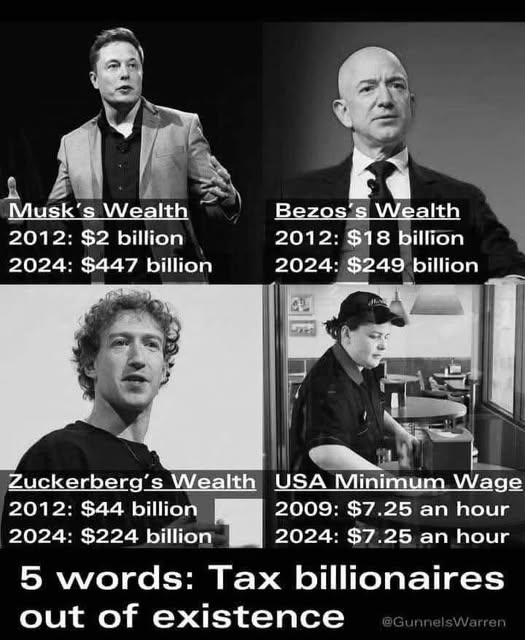
Nope! Trickle down is an idiocy. It doesn’t work. Just like ‘taxing billionaires out of existence’. It has been experimented, you know… It was called communism by those promoting this brilliant idea. So brilliant that it burnt down every society which had tried it. I lived under communist rule. I know. There isn’t much difference between all money being controlled by the state/government and too much money being controlled by a handful of billionaires! Meaningful decisions are still being made by a too small number of people…
Yes, taxes are useful. Besides gathering money to be used, by the government, for the common good. My point being that taxes are an expression of how a society sees money.
That’s what’s needed. Decision makers who do not put money over everything else! Any attempt to ‘tax billionaires out of existence’ is already an abuse of power. Doing it before the society changes its understanding of the matter would be worse than a crime. It would be a horrible mistake.
High marginal taxes accomplish two things. If no loopholes are allowed. Balance the budget and change the minds of the decision makers. ‘CEO’s’ as well as shareholders. Convince them to reinvest a bigger share of the profit. Which makes it possible for the company to become more efficient. Which makes it possible for the company to increase wages. Balancing the budget with money brought in by taxing the high earners makes it possible for the politicians to lower the taxes paid by the Regular Joes. Which would improve their status, their self esteem and their buying power!
Blaming a section of the society for something which needs to be dealt with in concert, by all the members of a society, is counterproductive. To say the least. It does nothing to solve the real problems and it deepens the already existing rifts.
Blaming the billionaires for what’s going on – for everybody being obsessed with money – is in no way different from blaming the immigrants for most of the people being unsure about tomorrow.
Billionaires, as well as the immigrants, should be ‘exploited’ rather than driven into disappearance. Each of them are very good at what each of them are doing. The difference between them consists in the fact that the billionaires set their own wages.
Wages, all wages, are paid by us. By the consumers. Hence it is us who should determine how much each people should get. We, not some of those getting our hard earned money! How are we going to accomplish that? Making sure that the market remains free. Functionally free as opposed to controlled by a small number of people. No matter where they come from. The Government, as in communism, or a collection of monopolies. As in oligarchic capitalism.
Celebratory meme posted by ecstatic Trump 47 supporter a few days after the inauguration.
True enough.
Only living in a world where everybody is scared… isn’t that much fun!
Not even for those who have managed to amass all the money in the market.
As somebody who has lived under both communism and not yet free market capitalism I must stress that there’s little difference between communism and monopolistic capitalism presented under the guise of democracy. Between a social order where all power – political, economic, social, you name it – is concentrated in the hands of a few self selected people pretending to protect the interests of the people. A social order described by those calling the shots as being a ‘popular democracy'(?!?). And a social order where all power – …. – is concentrated in the hands of the few people who have amassed all the riches in that particular society. And who, behind manipulated -and no longer liberal – democratic mechanisms pretend to protect the interests of the people.
The problem with both situations being the fact that a few people – no matter how capable and/or well intended, if that is the case – cannot manage, over a sizeable amount of time, such a complex thing as a society. Period.
Free market works for only as long as it remains free!
Which is the problem.
Before meddling with the free-market, we need to agree first about freedom. About what we mean when we think/speak about freedom.
Freedom for all versus freedom for only those who happen to fit a certain set of criteria. To be wealthy, in this case.
Functional freedom – as in the kind of freedom which preserves, which remains sustainable over the long run – versus ‘absolute’ freedom. The kind of freedom which leads to anarchy. Which anarchy, necessarily and very shortly, becomes a rigid hierarchy. Then ends up in shambles…
Free market works for only as long as it remains functionally free. Free enough to do its thing. To provide enough for enough of those contributing to the collective effort to make ends meet.
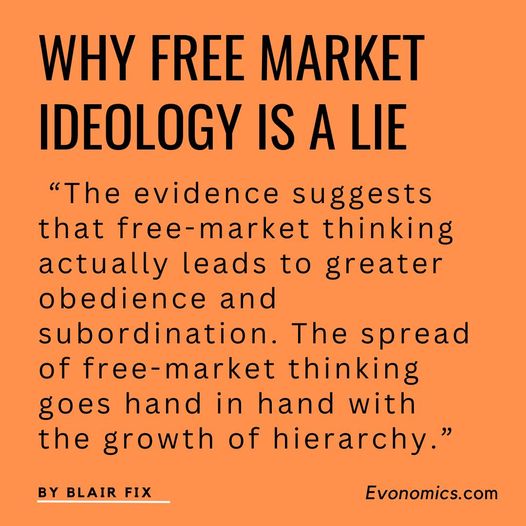
To understand what Blair Fix has to say, we need to identify the key words in his speech. “It appears” and “I argue”. In fact, he tries to convince us to see ‘the world’ as he sees it. He tries to convince us to be ‘on his side’.
He divides ‘the problem’ and then takes sides… which only contributes to the world/market losing its freedom.
As for what ‘evidence suggests’… It suggests two things. That yes, the ‘free market’ has, indeed, become an ideology. There are too many people who consider the market should be left to the mercy of the powerful. Who don’t understand how freedom actually works… The second thing being an evidence. Not a suggestion. All other markets but the free one work worse.
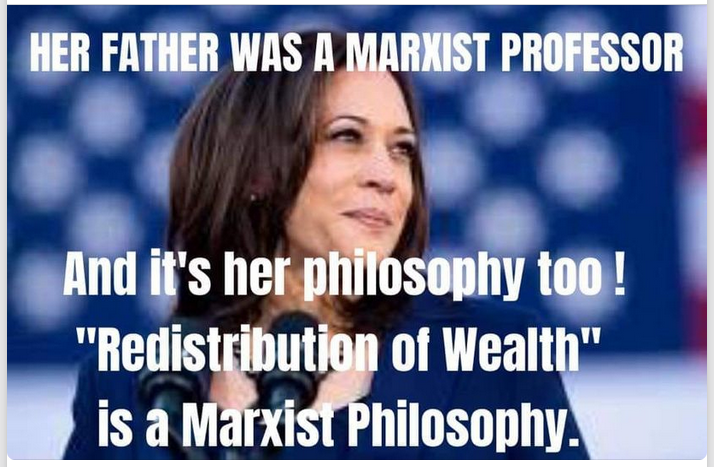
Redistribution of wealth is an anti-marxist technology.
Taxing the super-wealthy and redistributing the proceeds towards education, health care and infrastructure makes it possible for the middle class to survive.
Read what Marx had to say about things if you want to avoid the marxist abomination.
Marx’s idea of revolutionary progress was based on the notion that property, hence wealth, must be abolished. Abolished, altogether, and not redistributed!
‘Redistribution of wealth’ means everybody pulling their own weight/contributing their fair share instead of ‘the the already rich taking the lion’s share’.
Redistribution of wealth means preserving the concept of property/wealth and maintaining the functionality of the capitalist free-market.
About which individual are we talking about here? About me? The ONE above all? About us? The only ones who ‘belong’? About all individuals? Regardless of age, gender, ethnicity …
“On the other hand, the individualist or anti-collectivist can at the same time be an altruist…”
Sir Karl Raimund Popper had died in 1994. Long after all of the so called collectivist regimes of the XX-th century had shown their true colors. Long after all the self styled collectivist regimes had unveiled their murderous nature.
And murder, by definition, is the most individualistic attitude available to a human being.
Let me be absolutely clear. I’m talking about murder here. That thing perpetrated by an individual, alone or in cahoots with others, against other individual or individuals. Self defense – the minimal action meant to save one’s own life, which stops as soon as its goal has been fulfilled – has nothing to do with murder. Criminals can, indeed, try to camouflage murder as self defense but their actions are obvious for all level-headed observers.
My point being that individualism cannot be defined as being anti-collectivist. And what’s bothering me is the fact that Popper himself had fallen into this trap.
If I get this right, Popper’s main contribution to our understanding of the world is the notion of ‘falsifiability’. The idea that human knowledge – science – grows in fits and starts. That individuals notice things, formulate their observations as theories and put them forward for public examination. And that even the theories which hold water, for a while, will, by definition, be proven false – or at least incomplete – at some point in the future. The way I understand this process – I’m an engineer converted to sociology – is as a continuous dialogue between individuals and the community which nurtures them.
Just as you can’t have a working engine – I’m a mechanical engineer – without all the pieces fitted in the right places and without a tank full of fuel, you can’t have a ‘healthy’ collective without ‘established’ individuals. Symmetrically, no individual can survive – let alone thrive – alone. A baby needs to be fed and taught to walk/speak/think in order to become an individual. A conscious human being.
Collectives, currently known as nations, fare according to the opportunities enjoyed by the individuals comprising those collectives/nations. AND according to how each of the individuals understand to enjoy each of those opportunities. The members of the North Atlantic Treaty Organization – who treated their citizens far better than how the Soviet citizens used to be treated by their self styled collectivist leaders – have fared a lot better than the defunct Soviet Union. Democratic and free-market capitalist countries fare a lot better than those run in a more or less centrally planned manner by authoritarian regimes.
And the explanation is simple. Democracy and free market capitalism mean that many more individuals have many more opportunities to contribute to the well being and the ultimate survival of their community than what’s going on inside authoritarian regimes. Where the decision making is concentrated in a very few hands. Where most opportunity has been confiscated by a handful of self chosen few individuals. In fact, the democratic and free market capitalist countries are far more collectivist minded than the self-styled collectivist authoritarian regimes. Where only the high ranking officials count as individuals!
And no, Plato wasn’t exactly right either. His ideas haven’t reached us in their intended form… or it is us who can’t read them in an appropriate manner… “Plato suggests… that if you can’t sacrifice your self-interest for the sake of the whole, then you are a selfish person, and morally depraved.” ‘Suggests’ already comprises a healthy dose of individual latitude. A healthy dose of individual lee-way when it comes to interpreting each individual situation. Furthermore, this is rather a matter of how a collective deals with each individual situation than an individual being selfish or morally deprived.
All situations which determine the fate of a collective are experienced, interpreted and dealt with by individuals. No collective exists as a ‘unit’. Nor reacts as one, regardless of whatever efforts have been made, under whatever disguises, by ultimately individual dictators to implement such ‘unity’. Around the ‘individuality’ of the dictator…. And whenever the individual called to solve a particular situation considers his individuality as being superior to the fate of the collective… then that individual actually lights a fuse. Which might or might not detonate a charge. Which charge might or might not destroy much… but… The main problem here residing in the fact that many individuals haven’t figured out yet that their own individual fates are inexorably linked to that of the collective.
That if it’s not peer-reviewed, it’s not science! That being a bona fide individualist “does not mean (that the concerned individual is entitled) to take one’s own individuality particularly seriously, or to lay more stress (or even as much) on one’s own interests than on the interests of others.”
“It is not from the benevolence of the butcher, the brewer, or the baker, that we expect our dinner, but from their regard to their own interest. We address ourselves, not to their humanity but to their self-love, and never talk to them of our own necessities but of their advantages.“ Adam Smith, The Wealth of NATIONS, 1776
I’m sure you already know that Adam Smith didn’t invent capitalism. As Marx invented communism and Lenin invented bolshevism.
Adam Smith had done nothing more and nothing less but described what was going on around him. How a bunch of people acting according to their ‘moral sentiment’ took care of business. How individual needs – for meat, beer and bread – were met and how the wealth of nations was built in the process.
Do you notice any need being fulfilled, in earnest, in this, new, situation? OK, things were not that rosy in Smith’s times either. Most people had to work hard, a lot harder than today, to make ends meet. But since Smith and until some 40 years ago things went better. Year after year. When Smith was writing his books, Regular Joe-s used to live in crowded shacks, usually rented out from their employers. Nowadays, most of those in their 50-ies and 60-ies own the house they live in. Which house has nothing in common with the afore mentioned shack.
So, is this the new kind of progress? A looking back in anger kind of progress? Are you even aware of the huge number of people pondering whether capitalism is not as good as advertised – by those who have already enjoyed its spoils? For the simple reason that in the current (no longer) free (enough) market so many people can no longer enjoy the kind of economic well being their grand parents took for granted…
As someone who had experienced both communism and capitalism, the situation is clear.
Marxism still works… Marxism is a dogma. Despite everything pretended by marxists, marxism – as an ideology – is an article of faith. And as long as there are believers who continue to promote a faith, any faith, that faith continues to survive. To work… On the other hand, there is a non-ideological side of marxism. A pre-ideological component, if you will. The analysis made by Marx before reaching his conclusion. Before reaching the conclusion that communism is ‘the answer’… The analysis was correct. Furthermore, even some of his predictions had been right. Our current obsession, induced by Milton Friedman, with profit as the ultimate goal of human activity has led us into an impasse. But Marx’s solution – to a very accurately defined problem – was an abject failure. Communism was a failure. Each and every time! But marxism still works… We, some of us, continue to believe according to this ideology…
Man has a natural tendency to prey on other people. This being the reason why humans must be educated and for which we need a lot of coercive measures.
I strongly disagree. The first sentence is utterly wrong and the second is brazenly manipulative.
Something which can be educated isn’t ‘natural’. Not in the sense implied above! People can be educated to eat in a certain manner. As in having ‘table manners’. People can be educated about what to eat. And what to avoid eating. To avoid eating things which are both delicious and nourishing. People can be educated even about how much to eat! But you cannot educate anybody to stop eating!
What is truly natural about ‘Man’ – about all people, actually – is that they need to interact with other people. In order to become full fledged human beings, people need to live among other people.
What can be educated is behavior. How to interact with other people.
People can be educated to cooperate. Or people can be educated to gang up. And prey on those outside the gang.
Please note that those who gang up in order to prey on others do cooperate among themselves! Even if that cooperative behavior has a strong hierarchical nature.




 nicichiarasa