“Despite this advancing scientific knowledge,
there is much that remains unknown about both sleep
and dreams.
Even the most fundamental question
— why do we dream at all? —
is still subject to significant debate.”

Dreaming is normal and healthy, but frequent nightmares can interfere with sleep.

So.
We’ve figured out that dreams are something which happen inside our heads. When sleeping.
Then called them names. ‘Dreams’ if they were OK, ‘nightmares’ if not.
Interesting, isn’t it?
Then we have hallucinations. A sort of daydreaming – if you think of it – only less pleasant.

My point being that our consciousness – “our ability to observe ourselves observing” – opens up a new realm inside what we call ‘reality’.
That we live, in fact, inside a world of our own making.

‘But this is valid for all living things, right?’

In the sense that all living things collaborate – albeit involuntarily – towards the continuous reshaping of what we call ‘biosphere’… yes! Life does indeed reshape the portion of space/time where it happens.

The way I see it, life is responsible for the ‘second layer’ of what we call reality.
While we, the conscious observing cum living inhabitants, are responsible for the ‘third layer’ of what we call reality.

‘You keep saying “what we call reality”.
Would you care to elaborate?’

You see, we have developed two concepts.
‘God’ and ‘Reality’.
God is something which had suposedly made us. According to those who believe in God, we have been brought to life – along with the world we inhabit, in a voluntary manner, by the agent we call God.
On the other hand, reality – according to those who believe in ‘science’ – is the ‘place’ where we have happened to ‘evolve’.

God is something we are told about by others. Something the ‘worthy among us’ might experience first hand through ‘rapture’.
Those who believe in God consider that the original information about God had been delivered, through divine inspiration, to ‘prophets’. Or had been acquired one way or another by ‘elders’.
Those who believe in God consider that God – and his will – are inaccessible to humans. That we, ordinary human beings, are only meant to simply experience ‘God’s will’. And adapt our behaviour accordingly.

Reality is something we, the present ones, are told about by our predecessors. And something we experience through observation.
Those who believe in science consider that nobody – individually and collectively – will ever be able to know everything. Basically, those who believe in science are also convinced that reality is ultimately inaccessible to us.
Those who believe in science consider that it’s our job, as conscious human beings, to find out as much as we can about ‘reality’ and adapt our behaviour accordingly.

For somebody unwilling to take sides, there’s not much practical difference between the two sides mentioned above.
Both are states of mind. Convictions. Weltanschauungs which shape human action.
Furthermore, both mandate us to do the very same thing. Adapt our behavior to what we ‘see’!
Does it really matter whether what we ‘see’ was handed out to us by somebody or is the consequence of happenstance? Would our reaction be different? Why?

‘But God has handed out a series of commandments! For us to follow in order to be saved.
Science doesn’t provide any ‘spiritual guidance”!

I beg to differ.
The Bible – and all other sacred texts – have been written by people. Taught by people to other people.
Science – everything we know about things, including what we call ‘best practices’ – has been put together by people. And taught by people to other people.
Furthermore, technology – the manner in which we have put in practice what we know about the world, regardless of how we have acquired the information – has been put together by us. We’ve designed each and every tool we have used to transform our world into what it is today.
And it was still us who have use those tools according to our own goals.

So it is us, collectively, who are responsible for the world we live in.
For the dream we live.
And for the nightmares experienced by some of us.

Conserving the subjective self-perception

“Objective through shared subjectivity”

‘Popular belief’ posits that ‘objective’ is based on facts while ‘subjective’ is based on whim.
True enough but facts need to be identified as such first and then agreed upon before they become ‘facts’. Before they are recognized as facts by the interested parties. Before they become the foundation for objective knowledge.
On the other hand, ‘subjective’ is indeed personal. A personal ‘take’ on something which has happened inside the same reality where facts take place. In fact, all the facts we agree upon have started their lives as subjective impressions. Which had been shared with other people and eventually stated as facts after ‘negotiation’.
Furthermore, no matter how subjective a perception, all perceptions are perceived using the same senses. And ‘processed’ using the same brains. According to culturally accrued ‘habits’.
Even a hallucination will conserve some degree of normalcy. If of a visual nature, for example, the hallucinatory perception will be experimented and described in visual terms. Pondered upon and discussed with others using the same brain which usually deals with facts. Shared with others using language and evaluated according to ‘customs’.

Self-preservation

According to the Cambridge Dictionary, a rationalization is “an attempt to find reasons for behaviour, decisions, etc., especially your own“.

According to my research, all conscious agents will first attempt to arrange all information at their disposal in such a manner as to conserve the subjective impression they have already acquired about themselves.

Salvation

According to Merriam-Webster, salvation is “deliverance from the power and effects of sin
Having to do with religion, some people will say salvation is subjective by its very nature.
Being understood in the very same way across various cultures and religions, salvation becomes objective.
Not real in the materialistic sense of the word but real in the sense that belief in salvation has very real consequences. Real enough to become material. Set in stone!
Shared belief in Christian salvation has driven people to build churches while shared belief in Buddhist salvation has driven people to build monasteries. The fact that people involved in so different religions as Christianity and Buddhism share their faith in salvation makes salvation an objective ‘thing’.
Makes salvation something ‘natural’.

Self-actualization

According to Abraham Maslow, an American psychologist, for a person to be able to attempt self-actualization that person must have fulfilled all other needs they might have had.
Having fulfilled those ‘previous’ needs is no guarantee for self-actualization being a success, only a prerequisite.

Copernican Revolutions

In a sense, each Copernican revolution humankind has sailed through – of which there have been many – has been a self-actualization.
I’m going to mention three and wrap up this post.

Instrument and possession

Many animals – relatively speaking, are able to use tools. To purposefully alter pieces of matter in order to be more useful towards the intended goal. But nobody except us carry them around.
Furthermore, a lion will defend its pray. And its hunting ground. In a sense, a lion behaves as if it defends its possessions. But only us, humans, talk about possession.
It was us who have conceptualized possession. Who have instrumentalized the notion of property.
This has happened more or less simultaneously with the advent of organized agriculture. Which needs instruments and order. Tools to work the land and the expectation to be able to enjoy at least some of the end-results of your work.

Money and nation

Systematic agriculture has thoroughly transformed human society.
Or, more exactly, the humans who had invented systematic agriculture had to adapt themselves to the new reality brought upon their heads by their own invention.
The spoils of systematic agriculture – abundant food – have created vast opportunities. Some of the people involved in the process were ‘free to do other things but toiling the fields. Hence specialization of work and social division. ‘Professional people’, priests, soldiers.
The source of this new found abundance, and the spoils themselves, had to be protected. And organized…. a.k.a. taken advantage of! Hence ‘rulers’. Arable land had been taken into possession along with the people working the fields. Nation building had begun.
The hoarded produce could be traded. Hence they were. Along with the ‘things’ produced by the ‘professionals’ fed with the accumulated ‘excess’ food.
Trading would have been easier if money was available. Hence it was invented. And used. By traders as a tool for trading merchandise and by rulers as a tool for ruling ‘their’ nations. Which weren’t yet called as such. Only functioning as such…

Rights and reason

Systematic agriculture and trading had been the stepping stones for the advent of ‘industry’. For professional people producing things for sale.
Oekonomy – the art of making ends meet on a yearly bases, as understood by the Ancient Greeks – had become ‘the Economy’. The engine moving society along the passage of time. A process so complicated that a single agent was no longer able to control it. L’etat had become so complex that even Louis XIV could no longer claim it as his own. For the ‘system’ to maintain its ability to function, to go forward, individual agents had to be freed.
Hence the freedom of the market and the human rights.
Hence individual human beings indulging in the habit of thinking for themselves…

Salvation no longer came in an organized manner. According to rules.
To each their own. Reason had been freed once and for all.
Each of us has assumed the freedom to rationalize according to their own wish.
To their own purposes.

To which end?
Only history will tell…
But before proceeding we’d better remember Ernst Mayr’s words.
‘Evolution has nothing to do with the survival of the fittest.
There’s no such thing as ‘the fittest’! The fittest to what since everything changes all the time?!?
Evolution is about the demise of the unfit.’

Until now, evolution has been ‘blind’.
Increasingly, some have become cocky enough to consider they know better. To consider they know where they should lead ‘their subjects’. Lenin, Hitler and Stalin are but a short selection from a long list.
Those who have followed the advice and have facilitated the ‘pestilence’ put in practice by this kind of people are those who have forgotten the deeper meaning of “You must not make any idols. Don’t worship or serve idols of any kind, because I, the LORD, am your God”.

Which ‘God’ brings us back to where we started.
To ‘objective as something agreed upon by many subjective agents’.
You see, I quote the Bible and I mention God quite a lot. And still define myself as being ‘agnostic’.
The fact that I don’t know whether God had actually created the world doesn’t alter the fact that the Bible is a trove of knowledge. As for God’s very existence… things are complicated!
How do you determine whether something exists? You check for the consequences of its existence, right?
A table exists only if you can ‘touch’ it. Since you cannot touch something which doesn’t exist, the fact that you can touch it is a consequence of its existence.
Same with God. Irrespective whether it has actually created the world – or anything else, as a conscious agent – God does exist. People acting as if God was real – people’s faith in God – had and continue to have consequences.
People acting as if God was real have brought God to life. The God we know, talk about and have faith in…

My last affirmation is rather hard to swallow?
Then how about money?
What makes them so valuable? Except for our ‘faith’ in them? Except for our belief, our shared belief, in the ‘fact’ that we are able to get things by paying for them?
And how about ‘rights’?
Do we respect human rights because we believe in them? Or only because ‘that’s the law and there is no other alternative, at least in public’?

See what I mean?
We live in the reality of our own making. And we tinker with it incessantly.
Attempting to make it more and more comfortable. To us!
Each of us tries to make the world ‘a better place’. Each of us working for themselves, each of us according to their ‘own advice’.

Which brings us to ‘how things work’.

Time and time again, reality has told us that we cannot survive, let alone thrive, individually.
That everything we have done is the consequence of us working in concert.
It was our shared belief in ‘money’ which has given us capitalism. Economic effervescence and elevated life standards.
It was our shared belief in God which had convinced us that ‘we were brothers’. And, as brothers, that we should respect each-other. That we should respect each-other’s rights.

Now, that ‘God is dead’ and it has become obvious that ‘capitalism is no better than those who put it into practice’, we have arrived at an inflection point.
Are we able to preserve the true nature of the things which have brought us here?
Or are we going to transform them into idols?

If you don’t fight like hell, you’re not going to have a country anymore!
Donald J. Trump, President of the USA, January 6, 2021,
Save America March, Washington DC
“The J6 hostages, I call them.
Nobody has been treated ever in history
so badly as those people nobody’s ever been treated in our country.”

Donald J. Trump, GOP Presidential candidate, January 5, 2024, Iowa.

A group of Colorado voters contends that Section 3 of the
Fourteenth Amendment to the Constitution prohibits for-
mer President Donald J. Trump, who seeks the Presidential
nomination of the Republican Party in this year’s election,
from becoming President again. The Colorado Supreme
Court agreed with that contention. It ordered the Colorado
secretary of state to exclude the former President from the
Republican primary ballot in the State and to disregard any
write-in votes that Colorado voters might cast for him.
Former President Trump challenges that decision on sev-
eral grounds. Because the Constitution makes Congress,
rather than the States, responsible for enforcing Section 3
against federal officeholders and candidates, we reverse.

Read carefully, this means that the Supreme Court of the USA is telling the Colorado Supreme Court:
‘Stand down, this is a matter too important to be decided state by state! This has to be settled at the federal level’!
Nota Bene, the gist of the matter – was Trump involved in insurrection? – remains in limbo!
The Supreme Court says nothing which might enlighten us about this subject.

“In interpreting what is meant by “liberty,” the
Court must guard against the natural human tendency to confuse
what the Fourteenth Amendment protects with the Court’s own ardent
views about the liberty that Americans should enjoy. For this reason
the Court has been “reluctant” to recognize rights that are not men-
tioned in the Constitution. Collins v. Harker Heights, 503 U. S. 115, 125.
Guided by the history and tradition that map the essential compo-
nents of the Nation’s concept of ordered liberty, the Court finds the
Fourteenth Amendment clearly does not protect the right to an abor-
tion. Until the latter part of the 20th century, there was no support in
American law for a constitutional right to obtain an abortion. No state
constitutional provision had recognized such a right. Until a few years
before Roe, no federal or state court had recognized such a right. Nor
had any scholarly treatise. Indeed, abortion had long been a crime in
every single State. At common law, abortion was criminal in at least
some stages of pregnancy and was regarded as unlawful and could
have very serious consequences at all stages. American law followed
the common law until a wave of statutory restrictions in the 1800s ex-
panded criminal liability for abortions. By the time the Fourteenth
Amendment was adopted, three-quarters of the States had made abor-
tion a crime at any stage of pregnancy. This consensus endured until
the day Roe was decided. Roe either ignored or misstated this history,
and Casey declined to reconsider Roe’s faulty historical analysis.

The Constitution does not confer a right to abortion; Roe and Casey are overruled; and the authority to regulate abortion is returned to the people and their elected representatives.

Do I have to remind you that up to 1865 it was legal, in some US states, for people to own other people?
People could be lawfully owned as slaves…
And “the people and their elected representatives” were OK with that. In some states!
So OK that a war had to be won by those who were not OK with “elected representatives” having the power to determine whether people could be owned. Only after the conclusion of that war the 13th Amendment could be adopted!
Enshrining each individual’s freedom to steer their own fate, within the confines of the law!

Fast forward back to our days.

When “elected representatives” – at state level – have been given back the power to determine how wide is the lawful space inside which a woman can dispose of her own body.
When “elected representatives” – at the same state level – are denied the power to ascertain whether a president, after losing an election, has incited his supporters to storm the Capitol.

And who has done that?
Who’s been determining what “the people and their elected representatives” might do at which level?
A team of nine individuals named by various presidents and only vetted by the Senate? Who are judging according to their “own ardent views about the liberty that Americans should enjoy.“?!?

“Weird” is not enough to describe this!

I hated all the things I had toiled for under the sun,
because I must leave them to the one who comes after me.

Ecclesiastes 2:18

Our hunting/gathering ancestors had been very successful. So successful that hunting/gathering has survived to this day. Not only that most hunter/gatherers continue this lifestyle even when offered an alternative but a few ‘civilized’ persons have also decided to embrace this manner of ‘making ends meet’.
According to many sociologists, it was during this stage of development that humankind had ‘invented’ spirits and totems in their quest to make sense of the world.

Agriculture – the ability to grow/raise a far more predictable amount of food than that available to the hunter/gatherers – had been the first game-changer.
Specialization is natural. Individuals are different hence each of them is better at doing diverse things.
And this was valid from the very beginning. Some of the hunter/gatherers were better at knapping others at curing hides. But because food had to be gathered constantly, by essentially every member of the clan, the specialists didn’t have many opportunities to advance their craft.
Agriculture had changed all of that.

Work specialization had given birth to social division.
Tools had been transformed into weapons and used to defend stashed crops. This process had engendered ‘landlords’ and had transformed some of the peasants into soldiers. Temporarily at first and professionally later.
Meanwhile, the specialists could stop gathering/growing food and offer the results of their toil in exchange for whatever they needed.
Trade had appeared naturally and the notion of property had to be invented in order for things to remain orderly.
A new narrative was needed to provide meaning and social cohesion.
Productivity had shot up and societies had started to produce more than they needed for day to day life
‘Left over’ resources had started to be accumulated and then used to ‘make things’.

Among other things, accumulated ‘left over’ resources had allowed local ‘rulers’ to hire more soldiers and to enlarge their fiefdom.
To put more and more (social) distance between them and the ‘common people’. And to ‘hire’ ‘thinkers’ whose job was to make sense of what was going on.
Hence organized religion and, simultaneously, ‘science’.

At some point, technology – the practical side of science – had become sophisticated enough to have a huge impact on trade.
When people have enough ‘spare time’ in which to think about ‘meaning’ they also have enough time to look for and design easier methods for doing things. For achieving practical goals. To fabricate things, to transport them, to preserve food… That was how a new profession had been invented. The trader!

Who needed a specialized tool! Money.

Trading, more and more intense and reaching farther and farther away, had furthermore increased social productivity.
Having more diverse resources at their disposal meant that people had to learn more crafts. The longer and longer distances which had to be covered induced a new technological leap in this realm.
More and more things which had to be learned, understood and made sense of enticed the birth of ‘real’ science

Science, what we call ‘science’, has again played havoc with the established order of the world.
Not only that the innumerable new technological breakthroughs have vastly increased productivity, modern science has also proposed new meaning. A new narrative for making sense of the world.
An impersonal one. Devoid of any almighty and fully responsible agent.
Abruptly, people were left without any ‘origin’ on which to peg their understanding.

‘Man as a measure for all things’ had acquired a totally new meaning.
For those who could ‘afford’ it.

Acțiunea este făcută de subiectul gramatical
și tot el o suferă.

Naște monștri…

‘(conducerea) se interzice’…
„Mortul se transportă manual!”

Pe sine se…

Partea îngrijorătoare a întregii tărășenii este că genul ăsta de exprimare a devenit atât de uzual încât nu mai deranjează pe nimeni. Nu mai zgârie nici un timpan…
Da, limba este un organism viu. Care se mișcă în mod independent de voința individuală a celor care folosesc respectiva limbă.
Da, dar nu independent de voința colectivă a acelor oameni!
Poate să spună ce vrea ea academia care dezbate folosind o anumită limbă. Atâta vreme cât populația nu ‘pune botu’ ‘ la indicațiile respectivei academii… Și reciproc!
Degeaba protestează o academie. Dacă populația folosește limba într-un anumit fel, după o durată suficient de lungă de timp modalitatea respectivă va sfârși prin a fi adoptată și de ‘literați’!

Da, numai că fenomenul poate fi și analizat. Nu doar impus, refuzat, acceptat sau chiar toate la un loc.

Ei bine, genul ăsta de folosire a unei limbi – adică utilizarea ‘lemnoasă’ a modului lingvistic de exprimare – denotă o anumită detașare a clasei conducătoare de viața de zi cu zi. De viața de zi cu zi a oamenilor de rând.
Detașare care sugerează o viitoare instabilitate socială.
Tocmai pentru că detașarea de cotidian a conducătorilor denotă faptul că aceștia nu mai sunt la curent cu viața reală. Cu viața dusă de oamenii de rând. Cu viața dusă de către cei care se confruntă, zi după zi, cu consecințele deciziilor luate de către conducători.
Cu consecințele deciziilor luate de conducătorii detașati de realitate…

Și uite-așa ajunge conducerea să se ducă singură, pe sine, la groapă.

Cum era aia cu „Cronica unei morți anunțate”?

Nota bene!
Detașarea are loc din ambele direcții. Conducerii nu-i mai pasă de ce se întâmplă iar populimea nici nu mai este atentă la ce i se spune. Conducerea – mai ales zona intermediară, ‘cureaua de transmisie’ – nu-și mai asumă nici o răspundere iar oamenii de rând o mai bagă în seamă doar pentru a se păstra ‘în anonimat’.
Conducerea ‘intermediară’, lipsită de orice autonomie în urma centralizării excesive a puterii de decizie, își ascunde impotența în spatele limbii de lemn. Fenomen absolut echivalent cu modul în care oamenii de rând se fac nevăzuți printre faldurile realității de pe teren.
Și uite-așa dispar în ceață straturile societății atunci când oamenii nu se mai ascultă între ei.
Atunci când limbajul este folosit mai degrabă pentru a („se”?!?) ascunde decât pentru a spune lucrurilor pe nume!

“Why couldn’t we drive it out?”
“Because you have so little faith.
Truly I tell you, if you have faith as small as a mustard seed,
you can say to this mountain, ‘Move from here to there,’
and it will move.
Nothing will be impossible for you.”
Matthew 17:19-20

According Archimedes, an engineer, all you need is a long enough lever and a fulcrum. If you wish to move the world…
According to Jesus, a leader, all that his disciples need is faith. If and when they want their expressed wishes to come true.

We’ve been moving our world down the history lane for quite a while now.
2000 years, give or take a couple of centuries, since the two mentioned above have shared their apparently conflicting advice, we’ve arrived at an infliction point.

We’ve almost levered ourselves out of our history.
And replaced ‘us’ with ‘ME’.

Chimps have learned to use grass blades to fish ants. And sticks to spear bushbabies.

We, the smartest among apes, have learned to lever the walking stick into a club.
To whittle clubs into spears and then lever them into arrows.

Using tools we’ve levered ourselves from working beasts into humans.
Using weapons, some of us have levered themselves into leaders.

Using money, some of us have levered themselves – collectively – into relative abundance. Relative to others…
Using ‘borrowed’ money, a few of us have levered themselves into financial gurus. And others into homeless people. 1929-1933 and 2008 are but two of the more poignant examples.

Using printed information – a.k.a. books – we’ve levered ourselves out of ignorance.
Using widely disseminated and specially crafted information – a.k.a propaganda – some of us have levered themselves into temporarily powerful positions. At the expense of those gullible enough to swallow that poison and causing immense suffering to the bystanders who had the bad luck to be there.

Using automation we have levered skilled workforce into clerks.
Using procedures, we have levered clerks into pen-pushers who check for conformity instead of thinking by themselves.

Nota bene!

Neither of these is an argument against leverage!
After all, we live in the best world we’ve been able to build for ourselves…

The only thing we should pay attention to is the fact that our levers have become progressively powerful.
As in starkly more and more powerful. And not necessarily more powerful in a progressive way… On the contrary, more likely.

Our weapons have become so powerful that we are able to obliterate life on Earth. If enough ‘unstable persons’ among us will somehow end up controlling enough of those weapons…
Our single-mindedness regarding profit, levered by an intense Neo-liberal propaganda about money as a panacea, has dramatically changed everything. From the very geography of the Earth to the way we relate to the world.

Nowadays we have started to leverage our thinking.
Not for the first time, indeed, but with renewed intensity!

Writing has allowed us to divide a big problem into smaller problems. Each of those smaller problems was assigned to and eventually tackled by a specialist. Ultimately, it was the job of the ‘project manager’ to assemble the ‘solution’ by making ‘good use’ of the results provided by the specialists.

No longer.
Powerful enough computing and skillful code writing have been levered into Generative AI.
Very soon, ‘project managers’ will no longer need specialists. Only specialized generative AI apps.

Those apps will constitute Archimedes’ ‘long enough lever’.
The already existing automation will constitute the fulcrum.
The wishes of those happening to be able to use the apps and control the fulcrum will constitute the faith mentioned by Jesus.

Are we ready for this?

If ye continue in my word, then are ye my disciples indeed;
And ye shall know the truth, and the truth shall make you free.

John, 8:32

Bruno, Giordano Bruno, was speaking the truth.
Something we consider to be true…
Yet he ended his career as a definitely unfree person! At the hands of people who considered themselves to be disciples of Christ…

Something doesn’t add up!
Either at least some of the truth mentioned here isn’t actually true… or we’re dealing with altogether different truths!

The way I see it, Giordano Bruno had died because he was defending an absolute truth while his killers had never realized that the truth pronounced by Christ was relative.

Let me elaborate.

An absolute truth – there are many – is a piece of truth of the kind which will eventually trips over you.

‘Reckless driving will kill you’.
‘High water will knock down the levy’.
‘A red hot iron will brand a cow’.

Relative truth, which has many faces but is essentially one, depends on us.
According to Christ, those who follow his word – who remain his disciples – will know the truth. And will become free.

According to Christ, it is not possible for an individual to know the truth – nor become free – in an individual manner. To accomplish the feat, WE have to follow his word.

We have to ‘love’ each-other. To respect each-other!
To turn the other cheek…

For us to be able to get near the truth – near the many absolute truths that are there – we need to share whatever knowledge we have.
Keeping anything hidden from our brethren – not turning the other cheek for ‘inspection’ – means disrespect. Means distrust. Lack of love. Inability to be in communion with the rest. Incapacity – or unwillingness – to partake in the same piece of reality. To partake in the same piece of absolute truth.

This is why Christ, who was right, has been killed. By those who didn’t want to share freedom. Who wanted to keep freedom for their own use. Who wanted to restrict the freedom of others.
This is why Bruno, who was right, has been killed. By people who behaved exactly – and for the same reasons – like those who have killed Christ. Despite declaring themselves to be the disciples of Christ…

Truth and freedom are human concepts. Words.
Both need us, human action, to become reality.
Both need us, working in communion, to become practice!

Individual absolute truths are relative to us. Are relative to us noticing, formulating, sharing and validating each of them.
‘Relative truth’, the ‘only one’, is absolute. In the sense that the only absolute – and definitive – truth is the fact that we can learn, and become free, only in concert. Respectfully helping each-other.

Truth used to be based on reason.”
J.P.Moreland, Introduction to
Escape From Reason 2006
by Francis A. Schaeffer

Etymologically speaking, reason comes from ratio.
‘Reason’ in Latin but also having to do with ‘reckoning’.
With dividing the ‘big picture’ into easier to understandable slivers. Slivers meant to be analyzed and later assembled back into meaning. Into ‘truth’.

Currently we understand reason as “the intellectual faculty that adopts actions to ends“.

Now, which of the two reasons gives birth to the ‘genuine’ truth?

The analytical/synthetic one which attempts to develop reality into meaning or the one which defends and embellishes the already known truth? The revealed truth?

The whole thing depends on the “ends” of the reasoning agent?

Reason, hence truth, depends on the intention of the individual performing the act of reasoning?!?

Quite unreasonable, don’t you think?
Truth was supposed to be anchored in reality, right?!? Not on ‘intention’….

Truth as unhiddenness… is a concept developed by Heidegger.
Basically, this whole thing is about individuals being unable to discover nor formulate the ‘entire’ truth so a ‘bigger’ truth may be reached only through cooperation. Everybody ‘says’ – unhides – everything they know about a subject and that’s how the most complete truth available at that moment is ‘uncovered’.

‘But this means the Truth becomes fluid.
No longer ‘fixed’. Unreliable!’

I’m afraid you’re right!
Except for the ‘unreliable’ part.
As long as enough people do their part, and honestly speak up their minds, the most reliable truth knowable at any given moment will become apparent to everybody.
To everybody who cares to look for it!
To everybody who accepts that their reason, while imperfect, can and should contribute to the common effort to get closer to truth.
To everybody who accepts that other people’s reason, while imperfect, can and should be listened to in the common effort to get closer to truth.
To everybody who accepts to continue this effort knowing very well that no matter how hard they will try, people will never find the entire truth

The Supreme Court on Monday ruled that states cannot disqualify former President Donald Trump from the ballot for his role in the Jan. 6, 2021, attacks on the U.S. Capitol.

The Supreme Court on Friday eliminated the constitutional right to obtain an abortion, casting aside 49 years of precedent that began with Roe v. Wade.
the decision permits states to implement far more restrictive abortion laws

I’m not going to discuss any of these ‘calls’.
In a normal world, it doesn’t matter who makes a decision. At which level.

In the present world, which is far from normal, something jumps at any open minded observer.

‘States are good enough when it comes to setting rules about when a woman might have – or rather not – an abortion but they shouldn’t be allowed to decide, individually, whether a would-be president has been involved in insurrection.’

I agree with the legal minded among my readers that there are sound arguments, legal-wise, for each of those decisions. Unfortunately, most people are ‘legal-blind’. Instead of delving into the obscure paragraphs which shed light into the nook and crannies of any judicial sentence they prefer to decide based on what they see at the first glance.
And what’s staring at us is the fact that the President of the USA is elected state-side. Each state sends a number of people to Washington with a clear mandate about who should be the next POTUS. Which means that candidates need to ‘win’ more delegates, not necessarily more individual votes from the general public. States play a critical role in this process.
Equally staring at us is the fact that ‘individual rights’ are defined and upheld at the federal level. States no longer have anything to say about an individual right as soon as a particular ‘something’ is assumed – at the federal level – to pertain to the realm of the ‘individual human rights’.

Is it possible to see a new colour?
David Hume, 1739

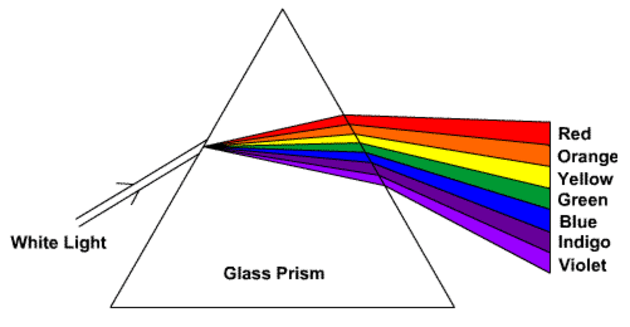
According to Newton, there’s no new colour to be seen.
The spectrum he had ‘split’ from what was called white light was continuous. And still is.
So, in order for us to see a new colour we should rename one of the already existing ones.

That’s according to the ‘light splitters’….

According to people who study vision – how humans see – “People can be made to see reddish green and yellowish blue—colors forbidden by theories of color perception.”

Oops!

There’s more to light than meets the eye… at the first glance, at least.
The way our brain works has something to do even with what we see of this world!
The good thing being the fact that once we understand how our brain works, we are capable of by-passing at least some of these limitations.

But what has any of these to do with ‘dimensions’?!?

I’ve argued in my previous post that having evolved as ‘runners’ we basically live in a 2.5 dimensional world. That we are biased against a proper perception of depth. And that we loath to go back and reconsider already entrenched convictions.

In this post I’ll go further and say that dimensions are tools.
Gimmicks we have invented to help us make sense of the world. And not only invented but fine tuned to fit our purposes.

We have invented length and breadth when we needed a way to impose taxes on arable land.
We have invented weight and volume when trading cereals and wine.
We have invented time when needing to pin point our position on a map while sailing around the world.
We have radically altered geometry when the old one was no longer useful.
We have even learned to adjust dimensions when speed had became fast enough to demand it.

Now, time is ripe for us to reconsider them altogether.
Opportunity, space and time.
We can make do with only three basic dimensions.