Archives For author
Celebratory meme posted by ecstatic Trump 47 supporter a few days after the inauguration.

True enough.

Only living in a world where everybody is scared… isn’t that much fun!

Not even for those who have managed to amass all the money in the market.

As somebody who has lived under both communism and not yet free market capitalism I must stress that there’s little difference between communism and monopolistic capitalism presented under the guise of democracy.
Between a social order where all power – political, economic, social, you name it – is concentrated in the hands of a few self selected people pretending to protect the interests of the people. A social order described by those calling the shots as being a ‘popular democracy'(?!?).
And a social order where all power – …. – is concentrated in the hands of the few people who have amassed all the riches in that particular society. And who, behind manipulated -and no longer liberal – democratic mechanisms pretend to protect the interests of the people.

The problem with both situations being the fact that a few people – no matter how capable and/or well intended, if that is the case – cannot manage, over a sizeable amount of time, such a complex thing as a society. Period.

And the LORD God said,
Behold, the man is become as one of Us,
to know good and evil;
and now, lest he put forth his hand,
and take also of the tree of life,
and eat, and live for ever.

“And the LORD God called unto Adam, and said unto him, Where art thou?

Adam called back and we all what happened next.

The serpent was cursed for his role, Eve was cursed for tempting Adam and Adam was cursed for….
In the end, all those involved – including the serpent, for whatever reason – were banished from the heaven. “Lest he put forth his hand…”

What are we to understand from all this?
That God, the omniscient and all powerful Father, was ‘evil’?
He must have known what was going to happen… he was omniscient, wasn’t he?

There are people who believe the Bible to be an accurate rendering of the past.
I happen to be one of them.
Only I don’t interpret what I read in the literal sense… the narrative is true, those things did happen, only not in the ‘real’ world. The Bible is not the story of flesh but a story of mind.

It is the story of what has happened in our minds. In our collective mind!

Genesis is the story of how we’ve grown conscious!
Starting from the sensations perceived during our interaction with the ‘real’ world – read ‘serpent’ – and using the evolutionary accrued ability to speak among ourselves – we’ve learned to identify ‘information’.
We, like all other living things, were already able to make the difference between good and ‘bad’. All living things ‘know’ what’s good for them and what to avoid. Or, at least, act as if…
We, like all other primates and along many other animals, were already adept at ‘reading minds’. Were already able to figure out intentions.
As conscious ‘human beings’ we have started to attribute intent! “To know good and EVIL”!

So evil is of a conscious nature, right?

‘How about ‘God’? Is it real?’

Sorry, I don’t have a reasonable answer for this question.
All I know is that the God so many of us believe in is nothing but a representation.
A figment of our collective imagination. And since we cannot imagine things but starting from the real world, there is a strong possibility that there is something, somewhere, which fits, however loosely, our concept. Our concept of a God…

Humberto Maturana, The origin and conservation of Self
https://constructivist.info/radical/pub/hvf/papers/maturana05selfconsciousness.html
Frans de Waal, Are we smart enough to know how smart animals are?
https://www.goodreads.com/book/show/30231743-are-we-smart-enough-to-know-how-smart-animals-are

We use words to build narratives.
Which, supposedly, help us in our quest for meaning.
Yet everything does nothing more than alleviate our fear.

At some point in my life, some 6 years after Ceausescu had been chased from his presidential palace, I discovered the Stock Exchange. I had read about it, was under the impression that I knew how it worked but never had the opportunity to trade on in. Living in a communist country prevents you from trading on the free market, you know.
To cut a long story short, I had a lot of beginner’s luck.
And I wanted more. So I started to learn about it. Fundamental analysis, technical analysis, accounting… investor’s psychology, decision making theory…

But it wasn’t enough.
So I went back to school. Sociology this time.
I was no longer trying to beat the market, I only wanted to understand what was going on.
Not only in the market but in our minds. By that time, I had already learned that investors were – and still are – torn apart by greed and fear.

So, what’s going on?
What are we doing here?

Being able to ‘see the difference’ is what makes us able to considerate.
The result of our considerations…

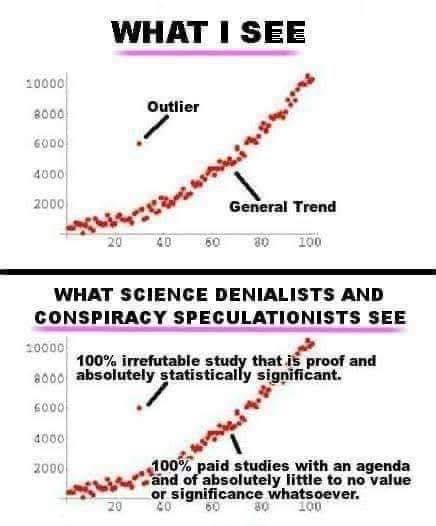
You don’t have to be a rocket scientist to spot the difference between a spot and a curve.
You don’t even need to be able to read…

Every adolescent steps out of the straight and narrow. Time and time again. And is told by his elders to toe the line. Until they learn that stepping back into the fold is easier than remaining an outlier for the rest of their natural life.
Only the fold is no longer were it used to be… It has reached its current position because those who had the guts to explore have done that for the rest of us. Experimented being outliers. So that we, all of us, did not have to experience every possibility before choosing where to go next. They, the outliers, found out what was ‘out there’ and told us.

I’ve already made a few considerations about the two pictures above. About some of the differences between the top and the bottom ones. I’ve left the main one for today’s post.

We do have a certain bias towards conformity. We do, socially and statistically speaking, tend to follow the trend. Like all other social animals.
After all, no society/herd can function – as a group, when all its members behave ‘outlierly’. So much outside the trend as to buck it.
The difference between the top and the bottom ‘graph-s’ being the attitude towards the situation.

The top one comes with the ‘normal’ bias. Each normal individual does have a certain ‘something’ against the ‘outlier’ situation and a certain affinity for the comfort of being trendy. But we have learned to respect the outliers, for as long as they don’t hurt us. For as long as they don’t rock the boat so much as to get us seasick.
The bottom graph states from the beginning that only the outlier opinion is valid. That no matter how many people continue to follow the trend, they are wrong. Even worse, they are insignificant. Hence disposable.

OK, there have been instances when the trend was leading in the wrong direction. Quite a few.
Yet people have somehow managed to survive. They stuck together, realized the outliers who kept warning them were right and followed them out of the dire situation they found themselves in.
But in each and every situation where an outlier had declared the rest of the ‘mob’ to be insignificant/disposable, and had enough traction to act upon their convictions, the situation had to become worse before people realized they had to change tack.

Before the people had realized they were following the wrong outlier!

Two things cannot exist
simultaneously
in the same place

Logic, ‘the correct way of thinking’, starts from the notion that no two things can exist, simultaneously, in the same ‘place’. Not even in our own head… Until they do, actually.

I’ll make a break here and tell you about Oscar Hoffman. A Romanian Teacher.
Who kept telling us, those who had the privilege to hear him teaching,
‘It’s not enough for a proposition to be valid from the logical point of view. It also has to make sense. Epistemologically speaking.’

The bottom part of the picture describes a stance which does make some epistemological sense and is seriously deficient when examined logically.
The top part is logically correct but also includes the meaning hidden in the bottom part.
Let me elaborate.

“100% irrefutable study that is proof and absolutely statistically significant.”
Absolute BS.
No scientific study has ever proved anything. Other than the facts examined confirm, or contradict, the hypothesis being tested during that study. Hence the hypothesis is allowed to stand, temporarily, as a theory or declared to be wrong.
A single study being claimed to be ‘absolutely statistically significant’ is so outrageous that it isn’t worth any comment.
“100% paid studies with an agenda and of little to no value or significance whatsoever”…
Nowadays 99.99% of the studies do involve money changing hands. Scientists have to eat and ‘money’ want to learn things. Hence ‘agendas’, on top of ‘money’.
‘Little to no value’ makes a lot less sense. If those studies yield results without any “value or significance whatsoever”, then why is any money involved and any time spent? To discuss about them, let alone to put them together….
To fit an agenda?
The scientists involved – all of them?!?, “100%” – are frauds and all those paying the hefty sums of money are suckers?
Then how can be explained the huge technological leap and the scientific breakthrough we currently witness?

‘Outlier’ versus ‘General trend’, is a far more ‘logically sound’. But also a lot more vague… The first proposition/picture, when examined with an open mind, does include everything claimed by the science deniers and the conspiracy speculationists. An outlier can be right, all change starts with one, and trends can be wrong. As all of them end up being…

So. What will it be?
Are we going to let ourselves be divided into warring camps?
Or understand ‘superposition’? Accept that having an agenda is not necessarily bad and that money is an excellent servant but a horrible master?
Or continue the current trend? Until we will have killed each-other along the line of divide et impera while repeating at nauseam ‘greed is good’?

De ce?!?

– Păi nu trebuie să mă descarc și eu?

Înțeleg foarte bine cum e asta cu ‘încărcatul’. Mai ales atunci când situația pare a fi nerezolvabilă. Fără ieșire…
Doar că plânsul, mai ales cel către cineva, nu rezolvă mare lucru! Doar scade puțin tensiunea. Presiunea din sufletul plângăciosului!
Are plânsul vreo influență asupra problemei care a generat tensiunea?

Doar dacă persoana căreia îi sunt adresate hohotele se apucă să rezolve problema…

Deci mesajul ar trebui adresat persoanei care este parte a conflictului!

Sau poate că plânsul este, de fapt, un strigăt de ajutor… Un mesaj adresat persoanei percepute ca fiind cea care poate rezolva problema, chiar daca nu este ea cea care a generat propblema!

Dar ce te faci cu plângăcioșii profesioniști? Cu cei care se plâng despre orice, din orice poziție?
Cu oamenii care nu se pot bucura de viață tocmai pentru că au ochi doar pentru ‘probleme’?
Cu oamenii care se plâng atât de mult încât cei din jurul lor nu mai știu când să-i ia în serios și când să ignore semnalele transmise?

Aici lucrurile se complică rău de tot. Mai ales atunci când sunt diferențe de opinii între cei care se plâng, în sufletul cărora apare și se acumulează tensiunea, și destinatarii mesajelor. Care văd lucrurile diferit și/sau care au găsit metode pentru a se debarasa de/ignora acea tensiune.

Până la urmă, fiecare situație trebuie analizată în mod individual. Nu există rețete.

Există totuși o experiență. Un set de întâmplări prin care am trecut fiecare dintre noi.
Experiența mea îmi sugerează că cel mai bine, pentru mine, este să încerc să rezolv problema. Singur sau împreună cu cine poate să mă ajute.
Dacă nu pot, atunci o ignor. Nu are rost să bag în seamă – adică să mă încarc cu – ceva ce nu poate fi rezolvat. Pun, în măsura în care sunt în stare, tensiunea la pământ. Fără ca ea să treacă prin corpul meu. Pentru că altfel n-am făcut nimic! Mă uzez degeaba și nimeni nu are nimic de câștigat din chestia asta.

– Și nu te plângi niciodată?

Când nu mai pot, plâng. Plâng în loc să mă plâng. Plânsul, de unul singur sau în compania cuiva, e o foarte bună metodă de a pune tensiunea la pământ. De a o descărca. De a o descărca fără a o arunca în cârca altcuiva…
Aici e marea diferență între a plânge și a te plânge.
Atunci când te plângi doar muți tensiunea aia dintr-un loc în altul. Mai bine o lași să se acumuleze în tine până când te mobilizează să faci ceva pe chestia aia!

Nota Bene.
A te plânge are foarte mult de a face cu modul în care pui problema. Este o mare diferență între „ajută-mă să fac ceva pe tema asta” și „vai, nu mai știu ce să mă fac cu chestia asta”. Cel puțin pentru unii oameni. Plângăcioșilor li se pare o metodă firească de adresare.
Care cică nu face altceva decât să sublinieze importanța problemei pentru cel care inițiază conversația.
Ceilalți găsesc modul acesta de adresare ca fiind extrem de neplăcut. De agresiv chiar.

O situație foarte greu de rezolvat apare atunci când un plângăcios reușește să agaseze un alt plângăcios. Niciunul dintre ei vrând să accepte că modul lor de a privi lumea, atenția lor pentru ‘detalii’, a fost ‘spațiul psihologic’ în interiorul căruia fiecare dintre ei și-a adus aportul la crearea tensiunii care băltește între ei.

Nota Bene 2.
Unii oameni se plâng, pe umerii unora care nu pot face nimic în situațiile respective, ca și cum ar face-o la ‘terapist’. Ca/în loc de o sesiune de psihoterapie.
Doar că de la un civil, oricât de binevoitor, nu vei primi mare lucru. Poate să-ți confirme că ai dreptate sau să-ți spună că te apropii de nebunie. Indiferent de nuanțele pe care civilul le va introduce în răspunsul său, plângăciosul este atât de pornit încât nu mai vede nuanțele. Odată pornit pe calea asta, plângăciosul mai vede doar în alb și negru. Cu mine sau împotriva mea.
Partea pe care am uitat să o mentionez este că de fiecare dată când te plângi îți accentuezi tendința plângăcioasă. Iar de fiecare dată când te plângi cu privire la ceva anume retrăiești experiența. Mai produci și mai acumulezi încă niște tensiune pe chestia aia!

Thou shalt not make unto thee
any graven image, or any likeness of any thing
that is in heaven above….

Exodus 20:4

“God is dead. God remains dead. And we have killed him. How shall we comfort ourselves, the murderers of all murderers? What was holiest and mightiest of all that the world has yet owned has bled to death under our knives: who will wipe this blood off us? What water is there for us to clean ourselves? What festivals of atonement, what sacred games shall we have to invent? Is not the greatness of this deed too great for us? Must we ourselves not become gods simply to appear worthy of it?”

And it thus becomes obvious that Nietzsche has been falsely accused. It wasn’t he who had murdered God! He was simply the first who had the guts to write His death certificate…

My point being that what we call ‘God’ is a man made image. A concept.
It doesn’t matter, for this analysis, whether there is an actual god or not. What we call God is nothing more than our image of one.

And it had been enough. For a while.
For as long as we have followed the rules we ourselves had established to guide our own behavior – as in written them down – the God we’d imagined worked as intended. ‘Religion’ did what it was supposed to do. People had a ‘spiritual environment’ in which they behaved both coherently and cohesively.
Coherently and cohesively enough to evolve from slaves – owned and/or owners – to equal rights owning/yielding citizens.
Coherently and cohesively enough to evolve from horse driven war chariots to the M1A3 Abrams tank.
Coherently and cohesively enough to ‘be fruitful and multiply’ to the tune of 8 billion. Give or take. Not all of them following ‘the rules’ but all of them benefiting from the results of those rules having been followed for a while.

Yet, when things were unfolding so smoothly, why have we given up following those rules?

Have we outgrown the need for a shepherdly Father? For a Ghost to frighten us unto doing the right thing?
Or have we become so infatuated with our own ability to think, to reason, that we have turned it into an idol? Against all odds…
Despite having been warned about it!

Pascal’s wager is about turning the tables on ‘God’.
The image we made for ourselves about God, the ‘Holy Gost who frightened us unto staying on the straight and narrow’, convinced us to behave in a constructive manner. Benefiting the entire community.
The argument made by Pascal was made to convince us, individually, that we – each of us – should believe in God for their own sake. For their own benefit!
Effectively transforming each individual belief into an idol… ‘Graven’ by each individual, upon their own soul, in the likeness of things in heaven, for their individual use… Transforming the community creating God into an individual tool designed and believed to ‘give’ each of us ‘everything’.
Individually. As opposed to making it possible for everybody to exist.

As Nietzsche observed, by making Pascal’s wager – by transforming faith into a rational thing – we have collectively killed God. The same God which has made us possible.
Against everything we have been warned about, by our wise ancestors, we have replaced God with ourselves. So that we “gain all”. Individually. Each of those who had made the rational decision…

I see this as expression of a mother’s love for her child
and not a statement that women are for breeding only.

Of course, you are completely correct,
but today people are amped up to find
something offensive everywhere.
Ridiculous.

In fact, this is way more than a mere expression of love.

There’s no other meaning of life but life itself.
Whatever meanings each of us might find do nothing but contribute to ‘life’.

And what else is life but a perpetual tomorrow?

“Intelligence is the ability to think, reason, and understand
instead of doing things automatically or by instinct.

Nerve cells, after all, do not have intelligence of their own.

Theoretically, we do have a certain understanding regarding the thing we call ‘intelligence’. After all, there are some dictionary entries discussing the matter.
But when it comes to measuring the said intelligence… nothing is straightforward anymore. So we still have a lot to learn about the thing. About our ability to understand, after all… About our ability to understand, period, including our own intelligence.

Click the picture above and read the article. It is interesting. The most interesting part being what it misses.

The first really intelligent computer application put together by man was the one who defeated Garry Kasparov.
Has anyone been invited to play chess by an application?
Is anybody aware of any chess or go application who had any initiative? Meaningful initiative? Other than making this or that move only AFTER a human had initiated the game?

What are we discussing here?
The intelligence level of any of the many, present or future, artificial intelligence applications or their ability to become aware? Aware of anything…

Furthermore, when we discuss whether AI, ANI, AGI or even ASI would erase humankind from the face of the Earth… nobody has yet mentioned us. After all, we are the ones building the applications. The computers on which we run the applications…
Instead of worrying whether any of the AI versions would do anything to us, we should worry about what some of us will do after they will have laid their hands on a really powerful AI application!

“There’s going to be things we do and the superintelligences just get fed up with the fact that we’re so incompetent and just replace us.”
Nearly 10 years ago, Elon Musk, founder of SpaceX and CEO of Tesla Motors, told American astrophysicist Neil deGrasse Tyson that he believes AI will domesticate humans like pets.
Hinton ventures that we’ll be kept in the same way we keep tigers around.
“I don’t see why they wouldn’t. But we’re not going to control things anymore,” he said.
 “

Isus zicea:
„Tată, iartă-i, căci nu știu ce fac!“.
Apoi au tras la sorți, ca să-și împartă hainele Lui între ei.

Sunt unii oameni care, poate din neștiință, îl ajută din răsputeri pe ucigă-l toaca să semene zâzanie.
Între credincioși, între credincioși și necrecredincioși, între necredincioși… Să semene cât mai multă zâzanie intre oameni!
Fără măcar să aibe habar despre argumentele pe care le invocă.
Singurul lucru pe care îl fac cu o oarecare măiestrie este să răstălmăcească. Învățăturile cărții, temerile oamenilor…
Dar, mă repet, fără să înțeleagă – cu adevărat, despre ce vorbesc.
Fără să înțeleagă că taie creanga de sub picioare. Și pe cea de sub picioarele lor!

„BLASFEMIE f. livr. 1) Cuvânt prin care se ultragiază o divinitate.”

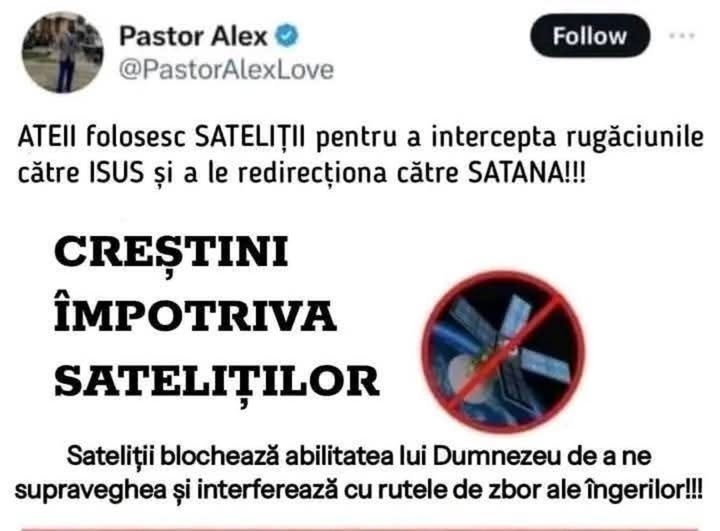
„Sateliții blochează abilitatea lui Dumnezeu de a ne supraveghea și interferează cu rutele de zbor ale îngerilor!!!” e o aberație mai mare decât creația. Decât creația lui Dumnezeu!
Și nu, spusele mele nu reprezintă vreo blasfemie. Eu nu sunt credincios!
Dar să fii creștin… și să pretinzi că îngerii au rute de zbor, rute care ar putea fi afectate de orbitele sateliților….

Iar să te pretinzi creștin și să spui că vre-una dintre abilitățile Dumnezeului pe care îl crezi/declari a fi atotputernic pot fi blocate de câteva ‘pietre aruncate pe cer’ de către niște bieți muritori este mai mult decât o blasfemie.
Este o aberație! O aberație descalificantă…