Archives for posts with tag: tradition

Behold, the man has become as one of Us,
to know good and evil.
And now,
lest he put forth his hand and take also of the tree of life,
and eat and live for ever:
Therefore the Lord God sent him forth from the garden of Eden,

to till the ground from whence he was taken.

Tradition is a collection of knowledge. Which has been agglutinating in time and is used as a ‘benchmark’ by the currently living keepers of the relevant tradition.
‘Relevant’ in the sense that not everything which is still remembered continues to be useful.

Functionally speaking, tradition is both a filter we use to interpret the reality and a guide we use when shaping future action. And we use it simply because the alternative would be to start from scratch whenever we see anything or have to do something. Like a child learning to walk and speak.
Like a child who keeps saying ‘what is this and why do I have to…’
We get many of those answers from the traditions passed over by our ancestors. Without these traditions we would be like a lonely child. A collective child who keeps asking for direction but who gets no answer. Because there’s no one around to answer…

Ideology is also a collection of knowledge. Which has been put together, edited or both at the same time by an ideologue. Or group of ideologues.
Psychologically speaking, ideology and tradition work in the same way. Both as a filter used when interpreting reality and as a guide for future action.

But there are some differences.

Tradition has been vetted by evolution.
Individual traditions have evolved themselves. No modern Jew would ever consider stoning to death “a woman who had been caught in adultery”. Even if this used to be the biblical standard punishment for such a transgression…
Some traditions have disappeared altogether. Because, at some point, they had ceased to be relevant. Their teachings were no longer helpful… At some point, those who were living in those traditions had understood, one way or another, that their particular tradition was suggesting an interpretation of reality which was … wrong! So wrong/useless that the entire tradition had to be abandoned. Like the Egyptian pyramids.
Other traditions are still alive today. Because at least parts of them continue to be relevant for those who keep them. “And God said, Let us make man in our image, after our likeness: and let them have dominion over the fish of the sea, and over the fowl of the air, and over the cattle, and over all the earth, and over every creeping thing that creepeth upon the earth”.

In fact, what we call ‘modern civilization’ is based entirely upon this particular piece of tradition.
We’ve built it together, as children of the same father. We’ve been building it under the authority of the said father, who had given us dominion over everything which was moving under the sun. And the fact that we considered ourselves to be the children of the same father – siblings, hence equals – has given birth to the very notion of human rights.

Ideology, on the other hand, is still fresh. Some of it might make it, some of it might break us.

The bible itself has been nothing more but a piece of ideology. When it was written…
The fact that those who had been inspired by the bible have survived, as a flock, for so long is a strong suggestion that the biblical tradition has been useful. That, overall, the suggestions derived by the ‘keepers’ from this particular tradition have helped them in their quest.

Other ideologies have been less successful…

Communism, for instance.
On the face of it, the communist ideology is a continuation of the christian tradition. People are to be considered equals, resources are to be shared among the members of the community… what more can you wish?
Well, it didn’t work out that way. It actually failed. Abysmally. I know, I’ve been there myself.

I’m not going to delve into why some ideologies work – and live to become traditions – while others fail.
I’m not God, I don’t know everything.
What is plainly visible, for those who want to see, is that authoritarianism – under any ideological pretext – is doomed to fail. This being the reason for which God – or the wise guy who wrote that passage – had banned Man from the garden of Eden. An immortal man would stick to his convictions until it would be too late. Until the heaven would had fallen upon his shoulders….

I cannot end this before sharing with you what prompted me to write it.
The goal of Hamas – ideologically shaped and ideologically imposed upon its followers, regardless of any of the circumstances – is to destroy the state of Israel and to replace it with an islamic state. Is there a ‘promise’ about how people will live once that islamic state would be imposed? Except that they will have to obey?
The goal stated by the communist ideology was equality! Not people’s happiness or anything like that. The way to obtain that goal was a continuous revolution. A sort of jihad, if you will…
Now look at what Hamas has accomplished. At what Marx’s communists had accomplished…

Choose wisely.
‘Cause each of us is born into a tradition. Into a particular tradition…
But ideology is something that each of us chooses. And can give up!

Yesterday you’ve been babbling about painting an elephant. One which was already present in the room. Doesn’t make that much sense, does it?

In my childhood there was a certain emperor. Who had been duped by a couple of crooks to wear a suit of clothes so special that they were in fact invisible. Hence the emperor walked around naked, convinced he was wearing the coolest set of rags available on this Earth. Pun intended, of course. I forgot to mention the price. Not only hefty but also recurrent. Each set of clothes, of in-existent clothes, could be worn only once. They were too fragile for ‘second helpings’. The courtiers kept congratulating the emperor for his beautiful attire so the scam went on for quite a while. Until he took to the streets of his capital city to show off his clothes to the ordinary people. And a child exclaimed: “Look. the emperor is naked”. And those present started to laugh.

Same thing here. Everybody senses that something’s amiss. Except for those who should know better. Who, for various reasons – I’ll get there, soon enough, don’t believe what they see. Or, more exactly, refuse to ‘go to the bottom of it’.

Back in the ‘good old days’, emperors had jesters. Courtiers who were allowed to speak the uncomfortable truth. Cloaked under a thick layer of funny words, true, but well worth saying.
This is what I mean when I ‘babble’ about ‘painting the elephant’.

I’ve already mentioned the story about the naked emperor. Now it’s time for that about the four blind men being led to learn about the elephant. One got to feel the hind legs, one the huge belly, the third got acquainted with the ears and the last with the tip of the elephant’s trunk. When later asked to share what they had learned, the first said the elephant was a pair of tall columns, the second said the elephant was a huge barrel, the third contradicted the first two maintaining that the elephant was a leathery curtain of sorts while the last was convinced that the elephant was a thick snake ending with a finger.

As I said before, ‘same thing here’. For ideological reasons, we consider some things and disconsider others. Furthermore, for psychological reasons, we tend to coalesce into ‘bubbles’. Those who consider the same things tend to stick together. And to disconsider those who consider other things.

I’m afraid this is too hard for me to follow. You first want to paint an elephant, then come up with a naked emperor and end up with parts of an elephant. Is there any elephant at all? Or all we have is a collection of disparate impressions? Man made illusions, vaguely resembling parts of an elephant and involving nakedness?

Well, you got the gist of it but you’re afraid to say it out loud.
The elephant is indeed of our own making.
An image. Not an illusion, mind you! Just an incomplete image of what’s going on around us.
Let me try to spell it differently.

The world was complicated to start with. Both wide and deep. Too wide and too deep for any of us to be able to comprehend it in earnest. But for most of our history, we didn’t have to. We used to live ‘locally’. Both geographically and ‘spiritually’. Each of us, individual human beings, belonged to a place. To a village and to a tradition. When one of us happened to move to another village, they, more or less naturally, translated their ‘spirit’ into the local tradition.
Nowadays, the world has become even more complicated. We made it even more complicated than it was at the beginning. We uncovered many of the previously unknown nooks and crannies. Building the illusion of knowledge in the process. Then we assumed tradition. Called it culture and made it our own. Took it with us where ever we went. Shared it with others and, sometimes, even imposed it – or parts of it, upon others.

The world itself is no longer straightforward. For us…
Our ancestors didn’t make any distinction between the physical world and the tradition which made sense of it. The world – ‘Cosmos’, as they used to call it, was whole. ‘Reality’ was made of ‘objects’, the names of those objects and the rules between them. The point being that our ancestors did not make any difference between an object, its name and its place in the order of things. Between the physical reality and tradition. Between the objects per se and the meaning – name and connecting ties, we’ve attached to each object.
Only after the Ancient Greeks had come up with the concept of “phusis” things were separated into natural and man-made. Into real and illusory…

That being the moment when the elephant had been born.
When we have started to steer our fate. Not to determine it – we’ll probably never be able to do this in a comprehensive manner, but to influence it.
Which influence has two dimensions. Size and … there’s no words for what I have to say right now. ‘Awareness of what’s going on’?!? Our ancestors did what they used to do because they had to do it and they did it as things were done at that time. We, on the other hand, get to choose among the many things which should be done and the manner in which we see fit to do it. Meanwhile, we entertain the illusion of doing all these things in a fully conscious manner.

A part of the elephant I have in mind consists of the fact that our consciousness is limited. But our illusion about our consciousness is bigger than the reality of the matter.
Another part of the elephant consists of the fact that more and more of us no longer consider advice. From those who entertain different opinions (illusions?!?) than us.

And why should I accept advice from somebody who promotes illusions?

I didn’t say you should accept advice from a peddler of illusions. From a con artist or from a snake-oil distributor.
What I said was ‘be careful, your own convictions are nothing but, ultimately, illusions. Man made illusions. Some of them, maybe, closer to reality than those entertained by other people. Meanwhile, others of your illusory convictions – most of them, probably, are more distanced from reality than those entertained by those who ‘control’/master each particular realm of ‘knowledge’.
This being the reason for which we go first to the doctor instead of raiding a pharmacy when our child gets sick.

I didn’t say you should accept advice from any peddler of illusions.
All I said was that we should pay more attention to what other people have to say. More considerate attention to what other people say, bearing in mind that our own convictions – about anything, are nothing but ultimately illusory.

It is up to us to decide how we put traditional precepts into practice!

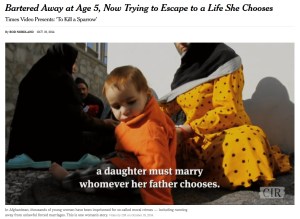
islamic law about marriage

And what is there to stop the father from accepting her choice except for his ego or self serving interests?

Click on the picture, watch the video and then tell me what ‘higher instance’ forced any of those people to do what they did, to make the choices they made..
All individuals featured in this video belong to the Afghan people and, presumably, to the Muslim faith. Yet their attitudes cover the entire spectrum. Don’t tell me there is no such thing as free will and individual responsibility.

What forced the father to give away his daughter as compensation for his son’s “sins”?
Peer pressure?!? (‘Relatives’ that may become belligerent if their demands are not met.)
But who are these ‘peers’ if not human beings themselves?

When are we going to understand that we can not quell yesterday’s conflict by inflicting fresh sufferance?
This just doesn’t work!