Archives for posts with tag: slavery

Things – every’thing’, actually – are/is relative.
Relative to the agent evaluating each of those things
.
Accordin’ to Einstein, that is.
He was the one who taught us to use whatever reference frame suits our needs.

Do you reckon anybody wasted any time or energy thinking about freedom before the advent of slavery?
Me neither.
Forget about the fact that, in those times, people didn’t have much time left for abstract thinking. Finding food and enjoying it with friends kind of drains your energy when you have to do it yourself… The point being that, in those times, everybody was free. Hence ‘had’ nothing to compare freedom with… No lack of freedom, no reason to speak/think about it.
No reason to notice the thing and no reason to coin the concept…

Hunter-gatherers have no use for ‘property’. Personal objects are just that and everything else either belongs to Mother Nature or to the entire group. And this goes without saying. Or thinking about it. People share everything as a matter of fact and common sense discourages the others to use anybody’s personal objects unless in an emergency.
Agriculture – either herding animals or growing crops – changed everything. Property, both as a concept and as an everyday manner of dealing with ‘things’, was invented and introduced in daily use. Productivity increased dramatically. Which made it possible for people to have ‘spare time’. For thinking.
And for planning…

‘The neighbors have better crops. Let’s go take some for us. And while we’re at it, let’s take some of their women too’.
The first slave was probably the first person to long for freedom…

‘Cheap’ slave work coupled with the increased social productivity induced by a markedly improved technology for obtaining food meant that some individuals could afford the luxury of thinking.
The Ancient Athenians had both slaves and philosophers. The slaves did whatever was needed to be done while some of the ‘beneficiaries’ had enough time, and energy, to let their minds ‘free’. To roam free in search for meaning.
To coin the concept and to explore freedom…

Relative “To whom”? To us!
We’re responsible for freedom and freedom is relative to us.
We have invented it. We’re the ones using it. In the sense that we’re the ones who need to notice that freer communities fare a lot better than the less free.

So freedom is relative both to those thinking about it and to each particular community.
To each particular community which puts freedom into practice!

We all know about it.
To the tune that none of us cares
anymore about what the rest of us think about it.

We’ve conditioned ourself to use a single perspective.
To measure with a single yard-stick.
To have but a single goal…


We have not yet been able to replace the founding illusion
The naturally born idol.
Our image of God…

Our hunting-gathering ancestors have become conscious, learned to speak, invented crafts. And painted numerous caves.
Life was nice in those days. A few hours spend foraging then you could do whatever you fancied. No point in gathering more food – it would have spoiled – and no point in making more tools than you could carry with you. So… lay back and enjoy.
The only problem with this was the fact that those people lived in a state of an extreme precarity. No provision could be made for tomorrow. Nobody ever knew what they were going to eat, if anything, the next day!

Hence they jumped at the first chance of agriculture. A far safer approach.

The problem with agriculture was that it had brought three things with it.

People were divided in three. Rulers, free people – men, usually and slaves.
It was far cheaper, and way more efficient, to use slaves instead of hiring free-people. They were spared for trading, fighting and other occupations which needed self esteem and a lot more personal autonomy than tilling.

Agriculture also brought about the need for protection. For an army.
Stashed produce, saved to be used during the entire year and sometimes beyond that, was liable to tempt some of the neighbors. Those who preferred to steal something rather than work for it.
The ‘protection force’ also came in handy when the slaves tried to leave their posts.

The third ‘thing’ was philosophy.
The society had enough spare resources to allow a few of its members to spend their time thinking. Instead of performing ‘menial’ tasks.

These thinkers have started to notice.
And continue to do so.
For as long as the thinkers concentrated their efforts towards the well being of the community and the community paid attention, things went well. Each generation fared better, on average and statistically speaking, than the previous ones.
Whenever things went astray – the thinkers started to ‘hallucinate’, the ‘public’ no long cared and/or both, things went the other way.

Until some 50 years ago, things were going in the right direction.
People were increasingly freer and fared increasingly better.
Since some 15 years before the communism had collapsed, things has started to sputter.

Stay tuned.

If you don’t fight like hell, you’re not going to have a country anymore!
Donald J. Trump, President of the USA, January 6, 2021,
Save America March, Washington DC
“The J6 hostages, I call them.
Nobody has been treated ever in history
so badly as those people nobody’s ever been treated in our country.”

Donald J. Trump, GOP Presidential candidate, January 5, 2024, Iowa.

A group of Colorado voters contends that Section 3 of the
Fourteenth Amendment to the Constitution prohibits for-
mer President Donald J. Trump, who seeks the Presidential
nomination of the Republican Party in this year’s election,
from becoming President again. The Colorado Supreme
Court agreed with that contention. It ordered the Colorado
secretary of state to exclude the former President from the
Republican primary ballot in the State and to disregard any
write-in votes that Colorado voters might cast for him.
Former President Trump challenges that decision on sev-
eral grounds. Because the Constitution makes Congress,
rather than the States, responsible for enforcing Section 3
against federal officeholders and candidates, we reverse.

Read carefully, this means that the Supreme Court of the USA is telling the Colorado Supreme Court:
‘Stand down, this is a matter too important to be decided state by state! This has to be settled at the federal level’!
Nota Bene, the gist of the matter – was Trump involved in insurrection? – remains in limbo!
The Supreme Court says nothing which might enlighten us about this subject.

“In interpreting what is meant by “liberty,” the
Court must guard against the natural human tendency to confuse
what the Fourteenth Amendment protects with the Court’s own ardent
views about the liberty that Americans should enjoy. For this reason
the Court has been “reluctant” to recognize rights that are not men-
tioned in the Constitution. Collins v. Harker Heights, 503 U. S. 115, 125.
Guided by the history and tradition that map the essential compo-
nents of the Nation’s concept of ordered liberty, the Court finds the
Fourteenth Amendment clearly does not protect the right to an abor-
tion. Until the latter part of the 20th century, there was no support in
American law for a constitutional right to obtain an abortion. No state
constitutional provision had recognized such a right. Until a few years
before Roe, no federal or state court had recognized such a right. Nor
had any scholarly treatise. Indeed, abortion had long been a crime in
every single State. At common law, abortion was criminal in at least
some stages of pregnancy and was regarded as unlawful and could
have very serious consequences at all stages. American law followed
the common law until a wave of statutory restrictions in the 1800s ex-
panded criminal liability for abortions. By the time the Fourteenth
Amendment was adopted, three-quarters of the States had made abor-
tion a crime at any stage of pregnancy. This consensus endured until
the day Roe was decided. Roe either ignored or misstated this history,
and Casey declined to reconsider Roe’s faulty historical analysis.

The Constitution does not confer a right to abortion; Roe and Casey are overruled; and the authority to regulate abortion is returned to the people and their elected representatives.

Do I have to remind you that up to 1865 it was legal, in some US states, for people to own other people?
People could be lawfully owned as slaves…
And “the people and their elected representatives” were OK with that. In some states!
So OK that a war had to be won by those who were not OK with “elected representatives” having the power to determine whether people could be owned. Only after the conclusion of that war the 13th Amendment could be adopted!
Enshrining each individual’s freedom to steer their own fate, within the confines of the law!

Fast forward back to our days.

When “elected representatives” – at state level – have been given back the power to determine how wide is the lawful space inside which a woman can dispose of her own body.
When “elected representatives” – at the same state level – are denied the power to ascertain whether a president, after losing an election, has incited his supporters to storm the Capitol.

And who has done that?
Who’s been determining what “the people and their elected representatives” might do at which level?
A team of nine individuals named by various presidents and only vetted by the Senate? Who are judging according to their “own ardent views about the liberty that Americans should enjoy.“?!?

“Weird” is not enough to describe this!

While everything mentioned above is absolutely true, we must also remember that it was the whites – who had first reached the ‘proper stage of development’, who had given up slavery and invented ‘human rights’.
On the other side, it is also true that the whites did reach the ‘proper stage of development’ by exploiting the rest of the world.
Only ‘this’ wasn’t invented by them! I don’t want to go into the finer details. All of you know, very well, what had really happened ‘on the ground’.

So.
What are we going to do next?

‘Delete’ everything the white people have contributed only because they have been the last to exploit the rest of the mankind?

Or accept the fact that evolution works in an oblique manner?

I keep hearing about this issue and I can’t stop wondering about how parallel to each other are those defending this idea with those denying its merits.

Pro:

-Robots are eating more and more jobs so more and more people will end up hungry.
-AI will make robots so productive that it will be far more efficient to use robots than human workers.
-A decent income is a human right.

Con:

-This is a socialist move, hence it will end up in failure – no other reason offered.

As it is obvious to all, both sides score big.

Yes, including ‘a decent income is a human right’ and ‘all socialist ideas end up in failure’.

Then what are they fighting each-other about?!?

Let me rephrase that.
WHY are they fighting, in the first place?

Because neither listen to what the other has to say… as simple as that…

Let me discuss some of the practicalities involved.

Robots eating up jobs and AI being able to continually increase financial efficiency are so evident that they do not deserve much consideration.

‘All socialist moves ended up in failure’.
We need to define socialism in order to make sense of this sentence.
Mainly because ‘socialism’ is one of the most abused words nowadays, on a par with liberalism. Sometimes they are even considered synonyms…
Well, ‘liberalism’ comes from liberty and  bona fide liberalism is concerned with individual freedom.
Socialism, on the other hand, comes from social. And is concerned with the the workings of the entire society.
The point being that there are two types of socialism. One which is ‘somewhat’ synonym with liberalism – the ‘reverse’ side of liberalism, actually, while the latter is the exact opposite.

I’m not making any sense?

Let me start from the other side.
All forms of socialism which have failed have been excessively centralized forms of government. And it was because of that excessive centralism that they had failed, not because of being ‘socialist’. The evident proof being that the same thing has happened with all right-wing dictatorships, which had used the very same excessively centralized decision making mechanism – the totalitarian government …

Which brings us back to the problem at hand.

For Universal Basic Income to work – or Guaranteed Basic Income, as some insist on calling it, it has to be financed.
Through taxes, right? Which means that those owning the robots would have to be somehow convinced to give up a huge proportion of their profits… Then why bother in the first place…? Why start any businesses, at all?
We’ll have the government run the whole show? Remember what history teaches us about centralized decision making?

So?!?

Well, not all is lost while there’s still hope!

Let me rearrange the arguments.

We not only live in an inherently limited space, with inherently limited resources, but we’ve also finally started to understand our predicament. Which calls for as much efficiency as possible.
Only for a different kind of efficiency than that we’ve accustomed ourselves to.

Until recently, we’ve been trying to get as much money under our belts as possible. Without much regard for anything else.
That’s why we’ve been cutting down secular forests, feeding almost all the fish we’ve been pulling from the oceans to the domestic animals we were raising for their meat, polluting our breathing air, selling our fellow humans which happened to had a different skin color than ours into slavery… As if there was no tomorrow…

Slowly, we’ve started to realize that this won’t work for very much longer.

That no matter whether we’re responsible for the global warming – or if it’s real at all, sooner or later we’ll exhaust the planet.
OK, it is highly plausible that we’ll discover/learn to use new classes of resources.
But this eventuality doesn’t constitute, in any way, a valid reason for us to continue squandering the meager resources we have at our disposal.

Hence the need for increased efficiency.

Only this has to be a different kind of efficiency. The kind that focuses on minimizing waste instead of maximizing profits. The kind that recycles because it makes obvious sense, not because it is cheaper.

Along the same path we’ll discover that it would make a lot of sense to help the less developed nations to catch up with the most advanced ones.
For starters, because the ‘advanced economies’ no longer need cheap workers. They use robots instead.
Secondly, because better living people tend to have less children than those struggling to survive. And we’ve already agreed about the planet being rather limited…

Nothing too fancy… until now, right?

Well, the next item will be trickier..

Remember that Ford had raised dramatically the wages he paid to his workers?
With tremendous results?

OK, his reasons were not the ones, generally but erroneously, attributed to him.
He didn’t do it to ‘encourage’ his workers to buy cars from him… or because of philanthropy…

Actually, it was the turnover of his staff.

At the time, workers could count on about $2.25 per day, for which they worked nine-hour shifts. It was pretty good money in those days, but the toll was too much for many to bear. Ford’s turnover rate was very high. In 1913, Ford hired more than 52,000 men to keep a workforce of only 14,000. New workers required a costly break-in period, making matters worse for the company. Also, some men simply walked away from the line to quit and look for a job elsewhere. Then the line stopped and production of cars halted. The increased cost and delayed production kept Ford from selling his cars at the low price he wanted. Drastic measures were necessary if he was to keep up this production.”

But, whatever Ford’s reasons were, the long term results have been abundantly clear.
Nowadays people who build cars are being paid well enough to afford buying the same kind of cars they are building. At least in the advanced economies…

What happened was that Ford, in order to keep the assembly line going, paid his workers as much as he afforded to. With spectacular results.
While nowadays most employers tend to ‘compensate’ their employees with as little as possible. Which makes perfect economic sense… doesn’t it?

The same economic sense which used to drive us into “cutting down secular forests, feeding almost all the fish we’ve been able to pull from the oceans to the domestic animals we were raising for their meat, polluting our breathing air, selling our fellow humans which happened to had a different skin color than ours into slavery… As if there was no tomorrow…”

See what I mean?
Instead of attempting to mandate a ‘Guaranteed Basic Income’, calculated by the central government and financed through forcefully levied taxes, how about hiring as many people as it would make sense, let them work as little days per week as they want and pay them as much as we can afford to instead of programmatically replacing as many of them with robots and paying the remaining ones as little as we possibly can?

OK, some of us won’t get as rich, as fast, as our grand-fathers did… So what? None of us can eat even close to what our grand-fathers used to… and food is a lot cheaper, anyway…

This is would be a considerably shorter way to get more people out of poverty than any scheme concocted by any government and it would have the same snow-ball effect as Ford’s wage increase had.

Economists describe this as Rostow’s ‘take off effect’.


For attaining adequate finance for take off it is necessary that:

(a) The community’s surplus over consumption does not flow into the hands of those who will utilize it by hoarding, luxury consumption or low productivity investment out-lays;

(b) Institution for providing cheap and adequate working capital be developed;

(c) One or more sectors of the economy must grow rapidly and the entrepreneurs in these sectors must plough back a substantial portion of their profits to productive investment; and

(d) Foreign capital can profitably be utilized for building up social and economic overheads.”


Obviously, any attempt to instate a guaranteed basic income, (except for those too young, too old or otherwise un-able to pull their weight, of course) would grind any ‘take-off’ to a stand-still.

And no, getting people out of poverty is not a valid goal, per se.
Poverty is a relative thing, which relies more  on feelings than on hard reality.
The real problem with poverty is that it reduces the ability of poor individuals to lead meaningful lives. Poor people are a lot less autonomous than self sufficient ones, meaning that decision making ability is impaired by the fact that they need to focus their attention on the short term time span.

This whole thing has long term consequences on societal level.

Remember what I said about centrally planned socialist countries constantly failing.
About all dictatorships eventually crumbling under their own weight, because of too much decision power being concentrated in too few hands?

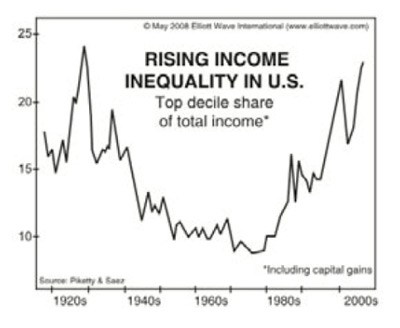
Excessive wealth polarization produces the same results. Economic decision becomes too concentrated, political decision follows through and…

What next?
The world has already experimented with communism. Didn’t work.
It also experienced two economic meltdowns, exactly when wealth polarization was at relative peaks.
income-inequality-08

When are we going to learn anything from what happens to us?
Why do we continue to waste the accumulated lessons collectively known as ‘history‘?