An open wound will be ‘colonized’ by various organisms. A mixture of water and flour will develop a ‘froth’. A naive person will be swindled.
A healthy immune system will, eventually, take care of the infection. Successfully or not… If in the hands of an experienced baker, the mixture of water and flour will – eventually – become the starting point for a delicious sour-bread loaf. The previously naive person, once swindled, might learn something from the experience.
Life is nothing but an added layer of opportunity. The pre-animated world is about strict rules. No variation, except for that brought about by happenstance.
Life is also about rules. But way laxer than those governing the pre-animated world. While the pre-animated world is about nothing more than mere existence, life is about surviving in the given conditions. About evolution. About change.
And here’s the catch. Pre-conscious change is also mainly about happenstance. Darwin’s evolution is driven by minute changes at the DNA level. Those which are helpful are perpetuated while those which are harmful either kill out-rightly the organism where they have appeared or restrict its ability to ‘give birth’. Nota bene. Darwin’s evolution was about “On the Origin of Species by Means of Natural Selection“ In his understanding, and in the real world, evolving – biology wise – is done by the species. Not by individual organisms!
Conscious change, on the other hand… is driven by individuals! Happenstance continues to be involved, heavily, but the main drive comes from ‘want’. From individuals willing/wishing to ‘make a difference’.
Is this a good or a bad thing?!? It is a fact. Neither necessarily good or bad. Just a fact. The outcome, evolution wise, depends on how the social organism – the cultural species – digests the experience.
For a while, I was convinced we were living in a virtual reality. In a reality of our own making. As I mentioned earlier, ‘vir‘ is a Latin word. “Man”. “Hero”. Hence ‘virtual’ literally means ‘man-made’. ‘Manufactured’.
Now I’ve realized we live inside an experiment. We are both the objects and the agents of the intersecting experiments currently active.
Socrates and Bertrand Russel, both, knew everything there was to be known in their respective times. Socrates and Bertrand Russel, both, had enough guts to acknowledge their doubts. To themselves and to the rest of us.
On the other hand, Russell presents us with a very interesting riddle. Is it possible for a naturally occurring thing to become a vice?
Humans, and their pets, also get fat. Humans – some of them and alone, this time – like to get ‘high’. Exclusively on naturally occurring substances, until recently.
Humans are the only animal species – known to ‘man’ – displaying a certain kind of consciousness. Self-awareness, as defined by Humberto Maturana. Also known as ‘Human Consciousness’.
So, consciousness drove us to become vicious? To eat too much? To drink alcohol? To use drugs? To introduce other animals to drugs? In the name of science…
The way I see this, consciousness didn’t drive us to become vicious. Only made it possible.
Being aware of ourselves – being able to observe ourselves ‘in the act’, according to Maturana – has added ‘purpose’ to the whole thing. Animals do experience pleasure. Pet your pet and then call me a liar. Animals have even learned from us to ask for pleasure. Many of our pets beg for food and to be petted. But most wild animals – with the exception of pentailed treeshrews, whatever they might be – shun alcohol. While capable of learning to ‘douse their angst’ from us. In captivity… Which makes us the only species which has learned to behave viciously on its own. By itself…
To over indulge on purpose. Do you have a better definition for vice?
Which brings us back to Russell’s “intellectual vice”.
Which intellectual vice does have two aspects. Overconfidence in one’s own intellectual prowess and over-reliance on other people’s expressed opinions, despite those opinions having a very slim chance of being true. The point being that the second aspect is a ‘simplification’ of the first one. The opinions believed despite being unrealistic do match the biases entertained by the believer. By the ‘vicious’ believer, albeit the second aspect is less vicious than the first one. Where the overconfident should have known better.
To over-think on purpose. To convince yourself of your own rectitude… on your own or with the help of others…
‘Self awareness’ is how we call our ability to observe ourselves while observing others. Humberto Maturana
First and foremost, existence is a concept. Something our forefathers had coined. A mental construct built by talking about it.
Nothing existed before we saw it AND talked about it!
Think about the stars nobody knew about until we used Hubble to peek into the history of the Universe.
Think about the stars which ‘sit’ there and no man will ever see. Or otherwise perceive. Think! Do they, the stars, actually exist?
In the sense that has their being been ‘measured’ into existence by a self aware observer? Has that observation been communicated by the observer to anybody else? Who had confirmed that that observation was anything more than a mere illusion?
You see, both actually – my rantings on your monitor – and figuratively, I don’t need to be told about the existence of the steps I have to climb up and down when I leave my bed each morning. On the other hand, I know that the Amazon exists because I’ve been told about it. Further more, I see for my self the steps in my house but I have a name for them – and I can write about them – because our forefathers had learned to speak. About the world they were discovering around themselves.
My point? We speak things into existence, not into being.
‘How about the things we talk about before we’ve ‘seen’ them? Neptune, the planet, had been ‘calculated’ before ‘seen’ and all mass manufactured things are first discussed and only then launched into production. Which was the exact moment when each of them had started to exist?’
Good question! I’m afraid I have no valid answer. This is a matter which will remain open for further debate! After all, how else to justify our existence? How else to find our own meaning? Other than by talking about it?
– How did you manage to mess things up so thoroughly? – By allowing too much coherence to slip away. After we – well, some of us, already had a fair understanding about how things worked. About how we got there in the first place. – Would you care to elaborate? – Things went on more or less linearly up to when we had learned to speak. That was when it had all started. When we had realized what a start was. And that was it. Speaking to each other allowed us to access the second level of consciousness. Self awareness. Speaking to ourselves – a.k.a. ‘thinking’, gave us the illusion of ‘knowing’. ‘Knowing’ led to ‘knowing better’ and ‘knowing better’ gave birth to arrogance. For a while, this process had been kept in check by the harsh reality. People, like all living organisms, have certain needs. Basic needs. Food, shelter… During most of our evolution, getting enough food and shelter consumed most of our resources. And time. Only a very small number of people had enough spare time. And energy left for thinking. And only a very small percentage of this already small number of people used their minds to think about anything else but how to preserve their privileged status. Which status was the source of their ‘spare time’ in the first time… Slowly but surely, those having something else in their minds besides their selfish self interest have come up with a thing called ‘technology’. By carefully, and considerately, watching those who worked, the selfish thinkers have noticed that from time to time and from craftsperson to craftperson there could be noticed small differences in how things were done. Hence the concept of ‘how things are done’. With the natural sequel of ‘let’s do things in a better way’. Technology made it possible for workers to be more productive. Communities as a whole became more productive. Hence increased the possibility for more people to have spare time for thinking. Some communities made good use of this new possibility while others failed to do so. Usually for reasons depending on the ‘general conditions’ and not at all imputable to the communities themselves. Unfortunately, technology also had two less fortunate consequences. By freeing more and more people from want, it also freed them from ‘religion’. Until that moment, people who were ‘excluded’ from society – who did not partake in ‘religion’, could not survive on their own for any significant length of time. After the advent of technology, reclusion no longer meant almost instant death. Technology also produced ‘hard science’. A corpus of knowledge about how nature works. Which knowledge can be summarized as a collection of natural laws. No longer depending as much on their contemporaries and cognizant of those natural laws, some of the thinkers – whose numbers had been constantly swelled by the continuously improved technology, have reached the conclusion that through thinking a human might, given enough time and resources, understand basically everything. Some of those had become dictators. Others had become consultants. Both categories extremely confident in their own knowledge. Arrogant, even. This is how we messed things up. This bad.
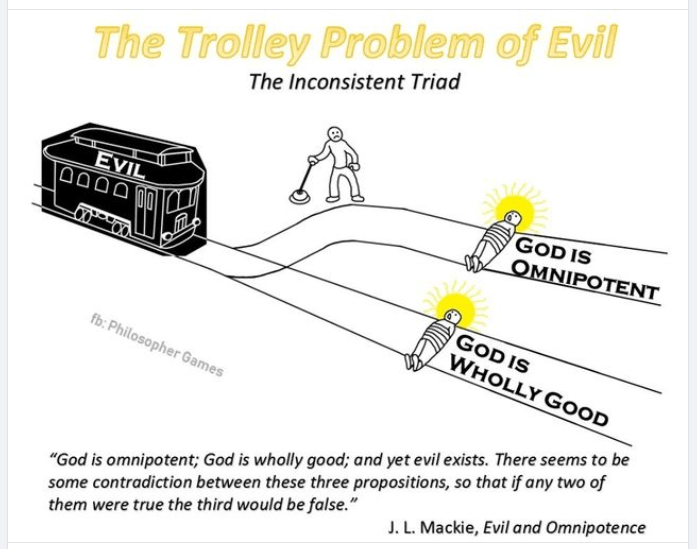
Who wrote the Bible? Who considers God to be both omnipotent and wholly good? Who had become human by learning ‘to tell good from evil’? Does evil even exist outside our minds? Is anything actually evil unless considered so by one of us?
And no, I’m not hair-splitting when speaking about the huge difference between bad and evil! An earthquake, for example, is bad for those affected. Yet no evil is involved here but for those who ‘question God’s actions’. An individual who tortures animals for fun is also bad. Arguably less so than a major earthquake… but for everybody in their right mind that person is undoubtedly evil!
‘What?!? “Ignorant of most things” yet still “knowing good and evil”?!?’
Yep!
A more relaxed reader of the Bible may notice that what’s written there recounts, symbolically, the becoming of Man. The foremost apes notice the difference between night and day. And name both. The difference between ocean and dry land. And name them both. Notice the stars above and the living things, plants and animals, with whom they share the place. And name them all. “Apes”, not ape, because nobody can learn to speak by oneself. Nor become self aware. As in ‘able to observe oneself while observing other things’. (Maturana, 2005)
That same relaxed reader may also notice that the very ‘fallen nature’ of Man stems from the ‘inconsistency’ noticed above.
We’re basically ignorant yet still able to call out evil!
Oops…
Humberto Maturana, “The origin and conservation of self consciousness…”, 2005, https://cepa.info/702
We learn about what we call reality by analyzing the information we acquire through our senses.
We. We, the human people. We, the conscious human people. We, because nobody has ever been able to become conscious – as in aware of their own self, by their own. Alone…
Learn. We are not the only ones who are able to learn. Our dogs learn our ways. And we continuously learn about more and more living organisms being able to learn. And to remember what they have learned. To fine tune their behavior according to the circumstances into which they happen to live.
What we call reality. First and fore-most, reality is a concept. We call it ‘reality’. And many other names… Believers call it ‘god’, scientists call it ‘physical world’ and the scientists who happen to believe are convinced that by studying the reality they will eventually divine the will of the Lord. The believers being convinced that whatever exists, is here because the Lord wished it into existence. So, basically, the main difference between the believers and the nonbelievers is the fact that the believers are convinced that the ‘out-there’, the ‘source of it all’, has a conscience of it’s own. A will of it’s own…
By analyzing. We have been able to build our conscience – our ability to ‘observe ourselves while observing other phenomena’ (Maturana, 2005), because we have a big enough brain, the ability to share complex and meaningful information using language and the ability to put in practice some of our wishes/thoughts through the use of our hands. At a certain point in its evolution, human conscience has become sophisticated enough to need explanations. It was no longer satisfied with mere ‘connections’ – If… then…, it had started to wonder about why-s. ‘Why does this happen as it does?’ ‘Will it happen again tomorrow?’ Using our by then already established ability to speak up their minds, our ancestors shared among themselves these ‘anxieties’. Discussed them around the fire-place. Started to analyze. The reality. What they perceived to be real. The ‘thing’ which continuously generates the circumstances in which we – all of us, have to make do.
Information. In order to analyze, the analyst – each and everyone of us, has to separate the meaningful information from the surrounding noise. In order to do that, we have started by coining the very concept of (useful/meaningful) information. As being different from ‘noise’. The difference consisting, obviously, in us being able to find its use and/or pinpoint its meaning.
We acquire. Information is acquired on an individual basis. For an ‘event’ to become information, it has to be ‘noticed’ by an individual. It has not only to be sensed but also identified as useful/meaningful. Different from ‘noise’. Which process of identification implying methods which had been agreed upon by the members of the community. Music would be a good example of how various groups of people make the difference between sublime/abhorrent and white-noise. While ‘use of language’ is a very poignant example of how people can both share information and mislead one-another.
Senses. Everything that we know, had entered our mind through our senses. Before setting it aside as information or discard it as noise, we have to get in contact with it as a sensation. Or as a thought. A conjecture. A few pieces of information which put together have given birth, inside our individual mind, to new information. To ‘something else’ which passes the threshold into being information. At least according to our own mind…
Which transforms our minds into our famous sixth sense. In the sense that our individual minds are capable of building ‘sensations’ on their own. Starting from information that has already been stashed in our memory. Which brings us to the third reality.
We have – in the sense that we have agreed upon its existence, the surrounding reality. The things we – as in most of us, consider to be real. The mountains we climb, the air we breathe, the pebbles which happen to sneak into our shoes. The reality which is being studied by science. The reality to which we have access through our senses. Our minds and our sense enhancers – scientific instruments, included.
We also have the ‘out-there’. The things we know we’ll never be able to grasp. During our lives! The things our followers might be able to figure out…
And each of us has their own reality. Individually built even if ‘carved’ from the same (type of) material as the reality shared by the rest of us. Individually built even if using more or less the same (culturally accrued) methods. Individually built even if neither of us is alone.
H.M. Romesin, 2005, The origin and conservation of self‐consciousness: Reflections on four questions by Heinz von Foerster
A planned after-thought. Rumsfeld is both wrong and right. There are unknown unknowns but they are no longer unknown since we speak about them… Which actually proofs the limits of our languaging. The imprecision of the manner in which we gather, share and analyze information.
We know that smoking is bad for us yet we continue to smoke.
Because too many of us are convinced that each of us, in particular, will be fine. That things are not that bad. Well, maybe for those who had bad luck. Or something…
You see, I’ve reached the conclusion that an individual’s conscience is more preoccupied with it’s own survival than with the ‘well being’ of it’s “host”. The conscience itself comes first, in its own ‘eyes’.
“What?!?”
Do you have a better explanation for why so many of us continue to smoke? To do drugs? To drink/eat too much? To… – feel free to fill in your favorite aberration! Your own method of self-destruction.
Please don’t quote any study about how powerful addictions are. For each of those there are many studies proving how powerful our minds are when they become determined enough.
How fast things happen after our knowledge about something becomes a belief. A belief in something…
Let me put it the other way around.
Did you get the anti-Covid jab? Why? You haven’t made up your mind yet? Because you are not yet convinced? You’re not going to? No matter what? Because you don’t believe in vaccines?
See what I mean?
The world is awash in information. All of us are exposed to more or less the same knowledge. All of us know that a considerable number of people – the vast majority, actually, are convinced about the roundness of the Earth. Yet there still is a very vocal group of Flat-Earthers. Of people acting as if they actually believe that the Earth is Flat. All of us have been told that smoking can cause cancer. And other diseases. Yet some of us continue to act as if they actually believe that nothing of that sort might happen to them.
Mind you, there is nothing inherently bad in this! On the contrary. If people would have believed everything they had ever been told… at one time… the Earth would have remained flat, all witches would have been burned – or drowned, all ‘Jews’ would have been killed – many centuries ago…
The point of this post is to underscore the importance of self. The huge responsibility placed upon our individual shoulders by the fact that we are the ones called to choose what to believe.
Yes, we are indeed inundated with ‘data’. From the day we are born to the day when our conscience goes dark. Yes, some minds are sharper than others. Some of us are better at spinning thoughts than the rest of us. Some of us are indeed better at making sense of the information which happens to cross their paths. And some of us are better at influencing others. At shining ‘light’ on ‘things’ in a manner which makes the message they want to convey more palatable for their intended targets.
Yet all this ‘trivia’ doesn’t change the reality. We are the ones who make decisions. We are the ones who choose what to believe. We are the ones who shape our fate.
By choosing our faith! By convincing ourselves that some things are worth doing and that some should be left undone.
LE If this is of any help, for any of you, I still smoke a few cigarettes each week. And continue to drink. Alcohol. I’m not perfect either!
One-Time
Monthly
Yearly
Make a one-time donation
Make a monthly donation
Make a yearly donation
Choose an amount
$5.00
$15.00
$100.00
$5.00
$15.00
$100.00
$5.00
$15.00
$100.00
Or enter a custom amount
$
As much as I love writing, I do have to eat. And to provide for my family. Earning money takes time. If you’d like me to write more, and on a more regular basis, hit the button. Your contribution will be appreciated! Another very efficient way to help would be to share my posts.
As much as I love writing, I do have to eat. And to provide for my family. Earning money takes time. If you’d like me to write more, and on a more regular basis, hit the button. Your contribution will be appreciated!
As much as I love writing, I do have to eat. And to provide for my family. Earning money takes time. If you’d like me to write more, and on a more regular basis, hit the button. Your contribution will be appreciated!
‘Exploring what?!? We don’t know yet how conscience came to be, nor how it works, and you want to explore its limits? What are you talking about?’
First of all, Humberto Maturana has proposed a very astute explanation about how our conscience has evolved into what it is today. After our brains had happened to ‘accrue’ enough computing power, our ability to speak among ourselves had created the condition for us to cooperate towards the development of ‘self-awareness’. Towards our learned ability to ‘observe ourselves in the act of observing‘.
‘OK, I can accept that. But we still don’t know exactly how it works. How the brain ‘exsudes’ consciousness!’
Well… do you know exactly how a computer works? Or how your car transforms fuel into energy and transports you to work and back? Does your lack of detailed understanding prevent you from using a computer? Or from driving a car?
Does your lack of detailed knowledge about how things work prevent you from understanding – and accepting, the fact that the things you use have limits? That you cannot ‘overstretch’ any of them?
‘?!?… It’s my mind you’re talking about, dude! What do you want to say? That my ability to understand things and to act as a rational human being is limited?!?’
Yep! You got it perfectly. In one go…
If you want to read some more about your limits, please help me to overcome mine:
One-Time
Monthly
Yearly
Make a one-time donation
Make a monthly donation
Make a yearly donation
Choose an amount
$5.00
$15.00
$100.00
$5.00
$15.00
$100.00
$5.00
$15.00
$100.00
Or enter a custom amount
$
As much as I love writing, I do have to eat. And to provide for my family. Earning money takes time. If you’d like me to write more, and on a more regular basis, hit the button. Your contribution will be appreciated! Another very efficient way to help would be to share my posts.
As much as I love writing, I do have to eat. And to provide for my family. Earning money takes time. If you’d like me to write more, and on a more regular basis, hit the button. Your contribution will be appreciated!
As much as I love writing, I do have to eat. And to provide for my family. Earning money takes time. If you’d like me to write more, and on a more regular basis, hit the button. Your contribution will be appreciated!
Weapons are nothing but repurposed tools. Sometimes ‘enhanced’ to fit the new goal.
Clubs had started as fruit harvesting utensils, then used for hunting purposes and eventually for bashing in the heads of those who had slept with the missus when the wielders weren’t looking. And so on…
As a tool, an implement is used to ‘put things together’. As a weapon, the same (kind of) implement is used to ‘set things apart’. An axe can be used to split wood in order to build a fire or to ‘split’ furniture during a fit of rage. Generally speaking, a tool is used towards the ultimate goal of adding to/fine tuning a structure while a weapon is used to destroy/disable something which is meant to remain so.
Our ability to communicate was ‘the’ tool which actually transformed us into what we are today. Humans. At least according to Humberto Maturana. His theory maintains that we’ve become self-aware social individuals through what he calls languaging. In a nut-shell, he says that we’ve become humans – self conscious apes, by continuously expressing our thoughts towards the other members of the community. Hence simultaneously building an ‘agora’ and ‘walling in’ individual private spaces.
Yet the same ability to communicate can be used also as a weapon. Instead of being used by individuals to mutually groom themselves, and ultimately adding to the overall resilience of the community, ‘weaponized’ communication is used to ‘downgrade’ susceptible individuals. To lower the ability of certain individuals to contribute to the community to which they belong, to lower the ability of entire communities to hold together… or both at the same time.
History suggests that, in the longer run, democracy – as a manner of decision making, increases the survivability of the communities which use it. Simply by pooling the decision making resources of the entire community instead of relying on the mental prowess – and good will, of a single authoritarian leader. Only for democracy to be fully functional, the individual members of the community have to be able to share, in earnest, their thoughts. This is why Freedom of Speech has been enshrined in the First Amendment. That’s why whenever the public discourse becomes increasingly dominated by ‘fake-news’ things start to go south.
That is why whenever people allow themselves to be split into warring parties – with no real communication between the sides except for the misinformation hurled across the divide, both sides eventually end up wondering at the destruction they had allowed the ‘communication warriors’ to inflict upon them.
We need to remain ‘consistent’. Each of our individual consciences needs to remain in ‘one piece’. To preserve its self-esteem.
Hence our tendency to rationalize away our mistakes. Our past decisions which had been proven to be less than optimal.
Hence our tendency to uphold our already ‘adopted’ beliefs. To discard any new information which contradicts our past conclusions.
The process of ‘selection and discarding’ followed by a robust ‘defensive’ rationalization is almost instinctive. In no way completely conscious.
No one in their right mind can pretend that someone defending their smoking habit is fully aware of what’s going on inside their heads. That rationalizing away the higher probability of a smoker to develop a cancer is behaving in a fully reasonable manner.
Unfortunately, rationalizing away bad habits is the smallest manifestation of bias. A more important, and malignant one, is the tendency to impose upon others our own conclusions. To force others to give up smoking because we’ve reached the conclusion that smoking is bad for us. To interpret other people smoking – wherever nobody else is affected by the smoke, as a slap in our faces. As an insult to our intelligence. How does that guy dare to act contrary to what I believe to be proper behavior?



 nicichiarasa