Archives for posts with tag: Rules

“WE ARE GOING TO CONTINUE TO FOCUS ON SOLVING PROBLEMS
FOR HARDWORKING AMERICAN TAXPAYERS”

LEADER JEFFRIES

(You might want to read my previous post before this one.
If you haven’t already done that, of course…)

Democrit’s atoms come with a clear cut set of rules. ‘Trapping’ them into a very predictable ‘future’. ‘If conditions are such and such, each of them atoms will do this and that’.
Furthermore, and as far as we know, that set of clear cut rules is valid everywhere. Was since the start of time and will remain valid for as long as the world will remain ‘as such’.
Our current understanding of the world – leaving aside various religiously motivated cosmogonies – actually depends on that set of clear cut rules being consistent over space and time.

At some point in time, and space, another set of rules had appeared. Even if we weren’t there to notice the event… Meaning that that appearance was a natural occurrence. We don’t yet know how that happened – not exactly, any-way – but we are satisfied that the first set of rules didn’t have to be broken in order for the second to appear. We consider that no miracle was necessary for life to happen. That happenstance and the first set of rules are a sufficient explanation.

This second set of rules is somewhat laxer than the first one.
It still traps those who have to obey it into a certain behavior but those respecting it enjoy a way wider ‘lee-way’ than Democrit’s atoms. The second set of rules makes it possible for evolution to happen.

While the individuals involved – atoms in the first case and individual living organisms in the second – don’t have any say in the matter, the first set of rules is consistent in space and time while the second one depends on the specifics of each region of the space and evolves in time.
Still trapped, but differently. The limitations pertaining to the first set of rules are drastic – life needs a very ‘narrow’ ‘window of opportunity’ in order to remain viable – yet the second set of rules ‘enshrines’ a certain amount of ‘individual freedom’. In the sense that individual living organisms do have a certain say when it comes to their own survival while the individual species have the ability to adapt to whatever changes happen where they have to survive.

Very recently – in the cosmological time-frame – yet another set of rules. Opening yet another space/place. Consciousness.
Not unlike a Matryoshka…, the first set of rules ‘opens’ the space where everything happens. Exists, but somehow ‘insulated’ when it comes to the passage of time.
The second set of rules opens a ‘narrower’ space. Narrower in the sense that life needs a very ‘narrow’ set of temperature, atmospheric pressure and the presence of certain substances. But a lot wider in the sense that the individuals involved have a certain autonomy and a certain sensitivity in the passage of time.
The third set of rules, the one opening up the space we call ‘consciousness’ is ‘written on the go’.

It does have a certain consistency.
For the simple reason that it is ‘written’ by statistically similar ‘authors’.
Take language, for example. One of the sub-sets belonging to the third set. It is shared solely by members of a single species, wielding more or less similar brains. OK, different languages have appeared in different geo-historical conditions but every human being who happens to be alive is potentially able to learn any of the languages ever spoken on Earth…
This third set of rules is usually referred to as ‘culture’. In the wider sense of the word. Information which is passed from one generation to the next one. Information which, shared among the members of the living generation, makes them conscious human beings.

I know, this is a startling manner of looking at things.
Please allow me to shed some light on the matter from another angle.
We have – we have noticed, more exactly – a ‘First Set of Rules’. FSR, let’s call it. Ingrained into the building blocks of the ‘real world’. Which rules will, hopefully, remain as they are for the entire foreseeable future… otherwise life, as we know it, will cease to exist in a jiffy.
We have also noticed, while attempting to understand ‘life’, a SSR. Second Set of Rules. Describing/making possible what we call life. Which life is, by nature/definition an evolving process. Hence the rules themselves not only allow a certain lee-way but also are bound to be rewritten whenever possible. Whenever the ‘altered version’ doesn’t jeopardize the survival of the individual harboring that version.
And whenever the accumulated alterations happen to be beneficial … a new rule is in place. Or a new species, according to the biologists.
The TSR is a work in process. A lot more so than the SSR. In the sense that each individual ‘rule’ – piece of information added to the corpus of work usually known as culture – has been put there teleologically. On purpose. Never fully aware of all the implications but always as the consequence of a conscious act.

This being the moment when I remind you that this blog is about “exploring the consequences of our limited conscience”.

https://books.google.ro/books/about/What_Evolution_Is.html?id=i8jx-ZyRRkkC&redir_esc=y

https://constructivist.info/1/3/091 regarding self awareness/consciousness

“All governments suffer a recurring problem:
Power attracts pathological personalities.
It is not that power corrupts but that it is magnetic to the corruptible.”

Frank Herbert, Chapterhouse: Dune

Some people are convinced that all they have to do is to follow the rules.
Other people are convinced that freedom – their freedom, in particular – is the most important thing.

Apparently, these two convictions are incompatible.

Which is not true.

Those convinced that following the rules is the only way to ‘get there’ – wherever that might be – forget one thing. Two things, actually…
That no journey starts until the traveler makes the first step. And decides where they want to go…
Those convinced that freedom is the only important thing forget one thing. One thing only.
That whenever the traveler breaks a rule… there will be consequences!

The fact of the matter being that freedom is a human achievement.
Achieved during the long journey towards the future.
Achieved as a consequence of the process through which we have learned about rules.

‘Rules’ is our definition of ‘possible’. Defines a space where things can happen. As long as the pertinent rules are being observed, of course.

At first glance, flying is possible. For birds…
After learning the pertinent rules – and mastering certain skills – we have learned to fly. But we can continue to fly for only as long as we keep observing the pertinent rules!

At first glance, walking a rope strung between Manhattan’s Twin Towers was impossible.
Not for Philippe Petit. He had the skills and he was crazy enough. He even didn’t ask for permission… Click on the picture and read ‘all about it’. My point being that he remained alive because he had observed the laws of physics. All of them! And because the human laws he had trespassed didn’t involve the capital punishment…

I believe you already understand what I want to convey.
Have a nice week-end.

People are promised:

Do ‘this’ and you’ll be happy.
Follow these rules and you’ll reach ‘nirvana’.

Some of us heed to this advice.
Only to discover that the only happiness they reach following this path is that produced by a dutifully fulfilled task.
That of following rules…

The catch being that following rules – the right ones, is required but never enough.
Following rules – the right ones, again – is helpful towards survival. Nothing more.

Drive safely and you’re more likely to get there.

Where?

That’s up to you.
There’s no rule about that!

Let me put this another way.

Nobody can survive alone.
Not for a considerable amount of time, anyway.

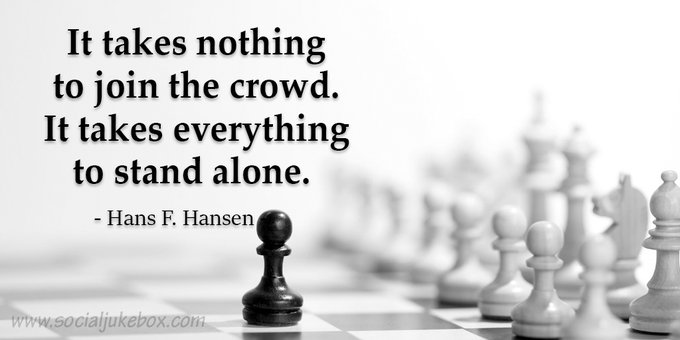
“It takes nothing to join the crowd”.
To join, maybe… but if you choose to remain, you must ‘follow the rules’.

So yes, it takes everything to stand alone… Your very life!
And the ‘membership price’ is your ‘absolute’ freedom…

Hard to make up your mind, eh?
Then let me raise up a few points.

I started this argument by mentioning that nobody can live alone. Not for long and not very comfortably. No matter how hard you may prepare yourself.
Don’t kid yourself. All those hermits and preppers you hear about – on ‘social media’!, are able to do that because of modern technology. Which technology has been developed by somebody else…
On the other hand, most individuals are able to survive, alone or in small groups, while jumping from ‘one boat to another’. Think emigration, for instance. Or ‘acculturation’.

But no crowd will ever survive its members leaving in droves!

One-Time
Monthly
Yearly

Make a one-time donation

Make a monthly donation

Make a yearly donation

Choose an amount

$5.00
$15.00
$100.00
$5.00
$15.00
$100.00
$5.00
$15.00
$100.00

Or enter a custom amount

$

As much as I love writing, I do have to eat.
And to provide for my family.
Earning money takes time.
If you’d like me to write more, and on a more regular basis, hit the button.
Your contribution will be appreciated!
Another very efficient way to help would be to share my posts.

As much as I love writing, I do have to eat.
And to provide for my family.
Earning money takes time.
If you’d like me to write more, and on a more regular basis, hit the button.
Your contribution will be appreciated!

As much as I love writing, I do have to eat.
And to provide for my family.
Earning money takes time.
If you’d like me to write more, and on a more regular basis, hit the button.
Your contribution will be appreciated!

DonateDonate monthlyDonate yearly

‘For things to work as intended, there must be a rule’.

Errr…

‘For things to work, there must be at least some consistency involved’.

This is a far better starting point!

An example would be fine?

Then imagine an Earth where the gravitational field was haphazard. In space and time. Where two lumps of dirt, a k a mountains, sometimes pulled at each other while some other times pushed. With no rules involved whatsoever.
Or where sometimes wood needed oxygen to burn while some other times – or in some other places, the presence of nitrogen was enough for wood to burst into flames.
Need some more? Then how about a place where dogs breed with cows. And also with butterflies. Only not always. And not in a constant manner.

Have you stopped laughing?
Well, this was how our ancestors imagined the Earth.
Sometimes after a mutation had provided them with the most powerful brain ever, our forefathers had learned to speak. To ‘trade’ information. Soon after they has started to develop something Humberto Maturana called ‘the ability of an observer to observe themselves while making observations’. ‘Self awareness’ for short. Or ‘conscience’ in everyday parlance.

Imagine a self-aware observer watching the sun go down. A rather smart one. One with a vivid enough imagination to ask ‘what if the sun will not come up tomorrow morning’…
Stonehenge has suddenly acquired a new meaning, right?

That was why God had so much traction. Simply because it gave sense to everything. It lend meaning to everything under the sun. And beyond!

In time, under God’s protection, we invented science. And, slowly but surely, we’ve started apportioning meaning ourselves.
Meaning we’ve started to take for granted.
Meaning which no longer depended on any third party!

Only we’ve gradually forgotten what science is really about.

Why we had developed it in the first place.

We had forgotten that science is wrong by definition.
That, by following this path, we’ll be forever able to find new meaning but that we’ll never be able to find ‘the’ meaning.

And now, that we’ve ‘killed’ God – as no longer necessary, we rely solely on the meaning we’ve already affixed to the things we already know.
To the things we consider to know… conveniently forgetting what science taught us….

Faced with unforeseen crises – unforeseen, not unforeseeable, we are left powerless.
Having taken so much for granted – our knowledge about the world and our ability to overcome everything the nature throws at us, above all, we find ourselves bereaved of our erstwhile powers.

Are we going to rediscover intellectual humility? And the ability to take advice? From the most unlikely teacher?

Or else?

SARS-CoV 2 lock-downs have intensified the already heated discussion about ‘rights’. About “our rights”. Which have to be defended “at all costs”.

The way I see it, rights can be evaluated from two directions.
As ‘gifts’. Either gifted to us by ‘higher authorities’ or conquered for us by our ancestors.
Or as ‘procedures’. Elaborated in time by society and coined into law by our wise predecessors. Who had duly noticed that societies which respect certain rights work way better than those who don’t.

After all, societies are nothing but meta-organisms. Which, like all other organisms, function for only as long as the components interact according to certain, and very specific, rules. The ‘better’ the rules, the better the organism works.

In this sense, ‘rights’ are the code we use when interacting among ourselves. The rules we use when cooperating towards the well being of the society.

You don’t care about the society? Only about ‘your rights’?

OK, but if the society, as a whole, doesn’t work properly, who’s going to respect ‘your rights’?
Who’s going to help you when a bully will try to snatch ‘your rights’ away from you?
And bullies trying to separate you from ‘your rights’ are the most certain occurrence whenever societies cease to function properly.
Whenever the individual members of a society no longer respect each-other enough to collectively uphold their rights. Their rights.

Our rights.

There’s a lot of dry wood in the forests around us. It stays there for a while. Only from time to time something happens that starts a fire.

Fill a room with a mixture of oxygen and hydrogen – at ‘room temperature’, and nothing happens. Strike a match and… you get a big noise and a little water. Don’t try this at home, you won’t live to tell the story. The noise is really big.

White phosphorus has to be kept under water. Whenever it gets in contact with humid air at a temperature above 30 degrees Celsius it starts to burn. And it cannot be extinguished in any other way than by submerging the whole thing under water.

Put a TNT stick (make sure it isn’t dynamite) into fire and it will simply burn. Fuse it properly and it will detonate whenever you ‘tell’ it to.

Let’s consider life now.

All the chemical elements, and a huge number of the organic molecules, which are the building blocks of any living organism have been around for eons while ‘life’ is a relatively recent occurrence.

Males and females – both animals and plants, roam around freely. Yet no offspring appears before something happens between a male and a female. This – the need for something to occur outside the individual organism, is valid also for bacteria – they need certain conditions to multiply, and viruses – which need the assistance of other, suitable, organisms.

Whenever conditions are right enough, sooner or later ‘life’ will surely appear. Or so it has happened all over our Earth. Till now, at least.

Whenever a living organism follows it’s normal set of instructions – its DNA remains fully functional, everything goes ‘as advertised’. If, by any reason, enough DNA is damaged beyond repair, the hell breaks loose. Being diagnosed with Cancer is enough to blow up even the most stable mind.

I’ve kept the most striking similitude for the last.
Both combustion and life continue only as long as certain conditions are met. Both need enough oxygen and fuel/nutrition.

There are also two big differences between them. One regarding ‘time’ – the successions of ‘moves’ which constitute the processes, and the other regarding ‘space’.

Combustion follows a set of pre-existing rules.  The chemical composition of the combustible might change the ignition temperature but that’s all it can do. Or it may add – as it’s the case for explosives, the possibility of detonation. But, again, both combustion and detonation follow a set of rules which are valid ‘across the board’. For all combustible and explosive substances.

On it’s turn, life follows two broad sets of rules. It has to obey all those which govern chemistry and physics – read combustion and detonation, and, on top of that, it has it’s own set of detailed instructions. Which vary from species to species.

I’ve left for the end the difference regarding ‘space’ because this one is very simple.

‘Combustion’ will extend all over the place where combustible is ‘continuous’, in a single ‘event’, while ‘life’ is, by definition, about finite organisms which multiply to make ‘good use’ of the available resources.
This being the reason for which combustion stops whenever the combustible available in an enclosed place is exhausted while life can resist a certain period of ‘famine’.

According to Humberto Maturana, what we call consciousness – our ability to ‘observe ourselves observing‘, is the result of what sociologists would call a ‘cultural process’.
Meaning that consciousness has been developed in time – as is millennia, and is constantly shaped through daily interactions between us.

I don’t intend to discuss its genesis now, I’m just gonna point to one of its many consequences. Our need to explain everything.

We’ve developed our consciousness by talking to each-other. If we are to accept Maturana’s theory – of course, which I do.
At some point in time, during this process, there must have been an ‘aha’ moment.
Or, more precisely, a ‘what if’ moment.

Until then, everything was ‘natural’. Sun up, sun down, birth, death… and everything in between.
While learning to ‘observe ourselves observing’ one of our ancestors must have noticed that we make a lot of decisions. Unconsciously – until that moment, of course, but, nevertheless, still momentous. To ‘flee or fight’, which fig tree to climb, which cave to use tonight, which pelt to skin, which flint to flake…

The very next moment our ancestor must have asked their-self:

What if the Sun doesn’t get up next morning? Will I wake up from sleep tomorrow?
Who decides these things?
Are there only rules – like ‘every time you touch a flame you get burned’ and ‘ice is always cold’ or on top of the rules there is somebody who calls the shots? As in ‘decides whether this time the lion will attack on sight or it will let this one go’?

And we’ve tried to explain away our fears ever since…
By determining which are the pertinent ‘natural rules’, by placing the responsibility on somebody else’s shoulder – read ‘God’, or both at the same time. Again, I’m not going to develop this subject either, I’ll just remember you that Buddhism – for example, doesn’t reject older creeds. The Japanese, for instance, follow both Buddhist precepts and Shintoist traditions. Also, many Christians entertain a lot of local and not so local superstitions. Like never start walking with the left foot or having a very strong ‘respect’ for the third number after 10.

Let me make a short recap.
We taught ourselves to speak, we talked to each other until we developed something called consciousness to such a level that we’ve started to ask ourselves existential questions and then we came up with more or less credible scenarios meant to allay our fears.

‘OK, … and your point is?’

Don’t be so ‘surprised’ when somebody ‘irrationally’ defends their own ‘story’. ‘Their story’ encompasses their world. That’s where they had been living, together with everybody they used to know/consider their kin.
Don’t attempt to force your story upon them. Let aside that you might be wrong yourself… any attempt to forcefully impose a narrative upon somebody else is nothing but “rape”. Don’t do it unless you are prepared to get raped yourself.
And keep in mind that it’s not ‘their story’ that harms you but ‘their actions’.

No story has ever harmed anyone. For any story to have consequences, people must act upon it. According to how they have chosen to relate to the it.  That’s where we can see eye to eye, regardless of the stories each of us keep dear.
Are we ready to accept that we might be wrong? That our story might be incomplete? That our explanation of the world might need some adjustments?

Are we ready to understand that enlarging our explanation to encompass others will actually increase our own ability to survive?
Or are we going to defend ‘our’ version, no matter what?

Are we going to keep looking for explanations or to become the subject of yet another one?

Natural‘, ‘Artificial‘ and ‘Synthetic‘.

In my last post, I was arguing that rules are made by us, humans.
In an attempt to make some sense of the seemingly chaotic environment in and of which we’ve become aware at some point in our evolution.

So.

The ‘natural‘ rules are those which have only been ‘identified’ by us.

‘Two swords don’t fit, simultaneously, in the same scabbard’.
‘Light travels in a straight line’.
‘There’s no smoke without a fire’.
‘Magnets either attract or reject other magnets’.
‘For as long as the temperature of a gas contained in an enclosure remains constant, the product obtained by multiplying the volume of the gas by the pressure exercised by that gas on the walls of the enclosure does not change’ – Boyle’s Law.
‘Things fall down, unless…’
‘Two objects attract each-other with a force directly proportional with the added masses of the two objects and inversely proportional with the distance between the geometric centers of the same objects’. Newton.
‘The principle of mass conservation’.
‘E=M*C2’
I’ll come back later.
For the moment, I’ll just observe that ‘natural’ laws are, simply put, an enumeration of what we consider to have understood of what’s going on around us. Our take on the natural world.

Artificial‘ rules are decisions we had to make in order to improve our chances of survival. Decisions we had been forced to make at one point and which made so much sense that they had been perpetuated. Habits we’ve somehow acquired and which had proven themselves so useful that we impose them on our beloved children.
‘Drive on one side only’.
‘Wash your hands before dinner’.
‘Thou shalt not kill…’

Synthetic‘ rules are those we’ve made ‘out of the blue’.
How to play backgammon, for instance.
How to evaluate a moving picture… or an evening dress.


Things interact according to their nature.
Mass generates gravitational pull, electric charge produces electrostatic forces, a moving electric charge gives birth to a magnetic field… hydrogen is ‘infatuated’ with chlorine, white phosphorus is so keen to combine itself with oxygen that it actually behaves indecently if not ‘modestly’ hidden in water… sex is the driving force which sets the animal world in motion… while survival instinct, however powerful, is, sometimes, overcome by altruism.

Meanwhile rules are just a figment of human awareness interacting with observable interaction between things.

And no, the ‘simple’ ability to learn is not sufficient, by itself, to generate rules. The rats in Rat Park were quick to figure out how to get a ‘fix’ of morphine but that didn’t mean they had ‘discovered’ any rule…
For that to happen, the ‘ruler’ needs to be able to watch from ‘above’. From ‘outside’ the interaction.

And this is why we find it easier to study other persons. Preferably strangers. ‘The doctor who treats himself has a fool for a patient’. Simply because our ability to watch ourselves from outside – and to compartmentalize knowledge, is real but severely limited.

Yet, limited as it is, it’s powerful enough to help us generate rules.