Archives for posts with tag: responsibility

And the Truth shall set you free.

Heidegger, the philosopher, has an interesting take on this ‘truth’ thing.
Nobody does, and never will, know everything about anything. Lest of all about ‘everything’. Hence nobody has access to a ‘true’ piece of knowledge.
Furthermore, ‘truth’ is about communication. About a message. An expressed piece of knowledge. And since there is no language precise enough to allow a communicator to cram into a message all they want to express… nor precise enough to allow a ‘reader’ to figure out everything the communicator had attempted to express…
Which drives Heidegger to posit that truth depends on intent. On a communicator sharing honestly everything they know about a subject. On a communicator allowing the receiver of the message to reach their own conclusion.

I ended my previous post by mentioning the ‘fairy tales’ our ancestors have spun in order to ease their ‘passage into the great unknown’. Thus making their lives bearable. Enjoyable, even.
In those times, ‘the truth’ – the unconcealed truth, in Heidegger’s terms – was that nothing made sense. That life itself was a meaningless joke. As a Romanian saying goes, ‘life resembles a hair from the private parts of the body. Short and full of shit…’
I’m not going to make a historical inventory of the various fairy tales the humankind has used to lullaby itself into accepting life as it used to be. Enough to say that they, the fairy tales, did the trick. Helped us reach the present stage.

I’m going to make a break here.
And notice that any, or even all, of those fairy tales might, eventually, be proven as being true. No matter how improbable this might be. I’m not an atheist. I just don’t know whether a god, or more, do exist.
What I do know is that, by their own admission, all of those stories have been spun by people.
Each of those stories is about what the original ‘spinner’ saw fit to communicate on the subject.
And the better stories, those who made more sense in the particular circumstances where they had survived, made it up to the present.
Helped the respective believers to survive. Helped some of them to thrive, even.

Now, today, we need to make up our minds.
Accept that our consciences are works in progress.
That consciousness is a space caught up in an accelerating evolution. A cauldron of sorts.
That each of those ‘fairy tales’ was useful in its own time. That the need to mitigate our cognitive dissonances continues to exist.
That we’re responsible for our future. Nothing new here.
And that there’s no one to save us. Not now. Or after we will have fucked up everything.


The ‘Truth’ being that ‘Give me Liberty or give me Death’ was a very effective call at arms.
On the face of it, on the ‘logical front’, it doesn’t make much sense.
‘Death’ was, and continues to be, inexorable. Why, for the sake of ‘liberty’, jeopardize the few precious moments left to be experienced as a living creature? Specially when, according to the lore considered valid when Patrick Henry had uttered the words, a second life was going to open just ‘after’…
‘The Devil is in the details’!
The belief in the ‘after-world’ works both ways. It encourages the freedom-fighters to take risks – believing they will get their reward ‘afterwards’ – and encourages the prudent to endure. Believing that they will get also get their reward ‘afterwards’.

Now, that I’ve ‘spilled it out’, I must confess that I’ve successfully convinced myself.
I’ve rationalized, according to my standards, my belief that it’s our responsibility.
To understand and accept that we’re responsible for the consequences we’re leaving for those coming after us.
I don’t know what we should do. I’m no prophet.
But I do know what we shouldn’t.
You do too!


God blessed them and said to them:
“Be fruitful and increase in number; fill the earth and subdue it.
Rule over the fish in the sea and the birds in the sky
and over every living creature that moves on the ground.”
Genesis 1:28

Engineers are trained to think first. And ‘shoot’ only after they have figured out what was going on. What was going to happen as a consequence of their enacted decision…
Handymen, the hard working people who actually prevent the ‘wheels’ from halting screechingly, are trained – self trained, mostly – to repeat what has worked in the past.

Both engineers and handymen are convinced that they know better. That each of their Weltanschauungs are more appropriate.
Both are right.
The distance between them can be construed as (one of) the depths we need to fathom. If we wish to understand ‘reality’…

An engineer myself, MSc level, I had my midlife crises rather early. Went back to school. BA in Sociology. Trying to understand ‘decision making’. Figure out what reality really is…
How to make a wise decision if you don’t know what’s going on?!?

Almost 20 years later – and a few entries in my blog – I found out that I was not alone. That more than a century ago, another guy – a former mathematician, had already broken the ‘glass-ceiling’.
While ‘process philosophy‘ is as old as philosophy itself – traceable back to Heraclitus, Panta Rhei – it was Alfred N. Whitehead who had introduced enough epistemological order into the matter to make it a ‘real’ issue.

What’s the meaning of all this?
Why haven’t we changed tack since Whitehead gave us such a powerful heads-up?
Why most of us continue as ‘handymen’?!?

Process philosophy, as I understand it – with my engineering mind, is mostly about responsibility.
Marx’s was about ‘taking charge’. Shoot first, ask questions later – if ever, was how communism had been translated into reality. Like all other dictatorial processes…
Whitehead’s – if I read him correctly – is about understanding responsibility. Not about ‘merely’ assuming it but about accepting it. About accepting the fact that it will be us – or our children – at the receiving end of the processes we initiate.

‘Uncomfortable position’ is a very lame expression for feeling alone. When trying to decide ‘what next’…
‘Maybe we should just proceed as we used to?’

‘Universe’ has no meaning. Other than what we assign to be its meaning…

‘Universe’ is a word we use to encompass everything around us. Whether we know of it or not. Whether we understand (of) it or not.

From ‘where’/’when’ we are in/attempt to perceive this huge environment, things look like ‘this’.
Depending of the wavelength of the light we use to ‘reinterpret’ the picture…
Nota bene, the colours were assigned by a computer app, starting from a series of ‘black&white’ images shot using filters which select short intervals of light-wavelength.

By sheer change, life appeared on Earth. And on who knows, if ever, how many other planets.
Evolution, an impersonal process, playing the odds in the current setting, had engendered the set of circumstances into which we happened to ‘burst’ into existence.

We, for better or for worse, have shaped the planet into what it has become.

Regardless of what each of us believes, religiously speaking, it doesn’t actually matter whether a god did or didn’t do anything. Since each and every religion currently biasing human thinking on Earth speaks about individual responsibility – hence freedom, for you can’t have individual responsibility without freedom – it actually doesn’t matter whether any of the teachings we refer speak about have been induced by an outside agent or have been produced ‘in house’.
Since each of us is individually responsible for our thoughts/actions – hence ‘free’ – then the meaning we assign to the object of our judgement, the ‘Universe’, belongs to us. To each and to all of us.

‘God save us!’

But since we’re ‘free’, we must save ourselves.

And since nobody can be free on their own – freedom has been defined by ‘us’ and put in practice collectively – saving ourselves will be a collective effort.
Or else.

Nota bene!
We are a ‘collection’/community of individual human beings.
We either ‘save’ ourselves maintaining what makes us human – our distinct individual individualities – or we become a hive. Of something else but ‘human’.
Of what we currently understand as being ‘human’…

Holidays are very good opportunities to reconsider,
And to learn new things.

These days I learned that while having nothing makes you feel ‘uncomfortable’, having too much can be very limiting.

If you have just enough, you can go forward. Explore new venues. Learn new things.
Enjoy life!

If you have too much, you spend too much time and energy protecting what you already have. Trying to get more…
The venues open for you to explore are suddenly reduced to one! Only one… You become the guardian of your fortune!
Can you enjoy such a life?
Are you sure? Have you examined the alternatives? In earnest?

‘Are you implying that all wealthy people are unhappy?
Unable to enjoy their lives?!?’

On the contrary, my dear Watson!
I’m only saying that being wealthy is complicated.
“Just enough” is a matter of individual ability to cope.
That enjoying wealth needs a lot of skill.
And that being wealthy comes with a lot of responsibility!
Towards yourself in the first place!

And towards your kids, family and the rest of the gang…

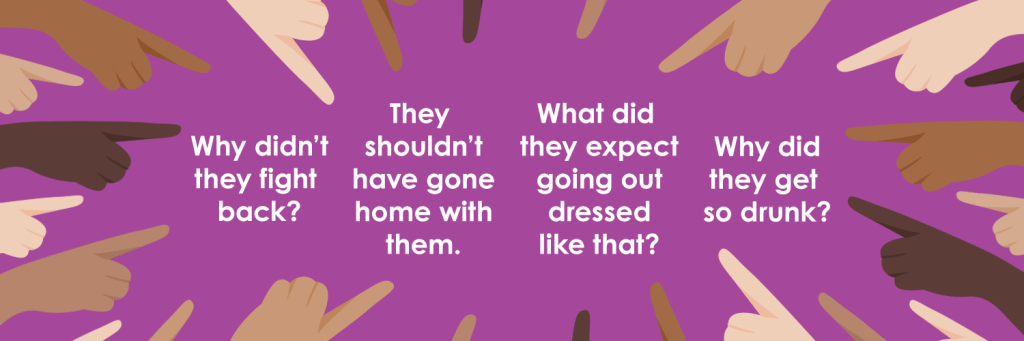
Whether it’s in day to day conversation or in the media, a common response to disclosures or mentions of sexual assault is a phenomenon called victim blaming. The term might be unfamiliar, but what it looks like in practice is all too familiar. It’s questioning people who experience violence — especially sexual violence — about their actions, and what they could have done to prevent it, or worse, invite it. It’s pointing out supposed weaknesses or differences in a person that could have made them a target. In general, it’s the common tendency for people to look for the cause of violence as something the person who experienced harm did or didn’t do to prevent it.”

Victim blaming is a fact.
As in ‘exists even if it doesn’t make much sense’. As in ‘still exists despite our intense efforts to make it disappear.’

Shouldn’t we try to understand it? Before blaming those who blame the victims?

What’s going on is that our minds are biased.
And one of the two most powerful biases is our need to make sense of the word. We actually need to perceive the world as being rational. We need to have causes, to identify causes, for everything which happens around us.
The other one being our need for relevance. We not only need to make sense of the world, we also need to control it. Hence we do our best to understand the world as controllable. Controllable by us! By us, the purveyors of the explanations. By us, those who understand it as a rational succession of causes and effects.

Let involve ourselves in a small thought experiment.

We’ve just had a few drinks. Not enough to get stoned but each of us is a little ‘merrier’ than usual. A tad dis-inhibited.
In this condition, one of us has sex with an under-age person and the other has a car accident.

In which of these two cases, ‘being under influence’ would be seen as a mitigating circumstance?
Why?

See what I mean?

Socially, it is unacceptable to DUI. Because you are far more likely to cause an accident.
Socially, it is more than acceptable to have a couple of drinks at a party. Because you are going to be a far more ‘pleasant’ person that way. Well, most of us are…

It’s actually reasonable to expect a driver to be sober and a party-goer to be ‘tipsy’-ish.
Simply because it’s a lot more unnatural to drive than to have social intercourse. Hence we need a lot more ‘self-control’ when driving than when talking to someone. Even if that person is very attractive.
We, statistically speaking, have a gut feeling which tells us it’s harder to drive than to behave. Hence the biases.

‘OK, but has any of this anything to do with victim blaming?!?’

Victim blaming is the ‘easy way out’ for both would-be victims and would-be aggressors.

Remember what I said about our need to make sense of the world as a controllable environment?
As a place where we, each of us, is in charge? With the known – and already agreed upon, limitations…

For those who see themselves as potential victims, doing the ‘right thing’ – or not doing the wrong one, is something which puts us in a safe place. We’ve done everything (in our power) so we’re safe. Or as safe as we could be… If we become a victim even after we’ve done everything in our power to avoid it, then it’s exclusively the fault of the aggressor. There was nothing more we could have done to avoid it. Hence there’s no self-guilt falling on our own shoulders.
And if we have reached ‘this’ conclusion – that ‘this’ is the right behavior, then each of the ‘trespassers’ do nothing but ‘contradict’ our ‘good judgement’. Hence our ‘need’ to ‘educate’ them.

For those of us who conceivably might become or had ever been – directly or indirectly, as in ‘one of our relatives had done it and we didn’t see it coming’, – an aggressor, the logic follows the same path. The victim should have taken every precaution, we are naturally ‘limited’ individuals who cannot ‘resist’ when ‘pushed over certain limits’.

‘OK, and your point is?
That it’s OK to blame the victim?!?’

Let me bring your attention back to the title.

‘Causing’ circumstances.

Who transforms a certain set of circumstances into a cause?
Who sees a certain set of circumstances as an opportunity to do something or as an opportunity to do the very opposite? Or to simply stay put?
To directly cave in to something which ‘might’ be seen as a provocation or to ask for permission first? And to accept ‘no’ for an answer, in no matter what circumstances …

Who bears the responsibility for choosing one way or another?

Blame is something which is attributed while responsibility is something which is assumed.

Let’s return to rape.
The recurring question here being:

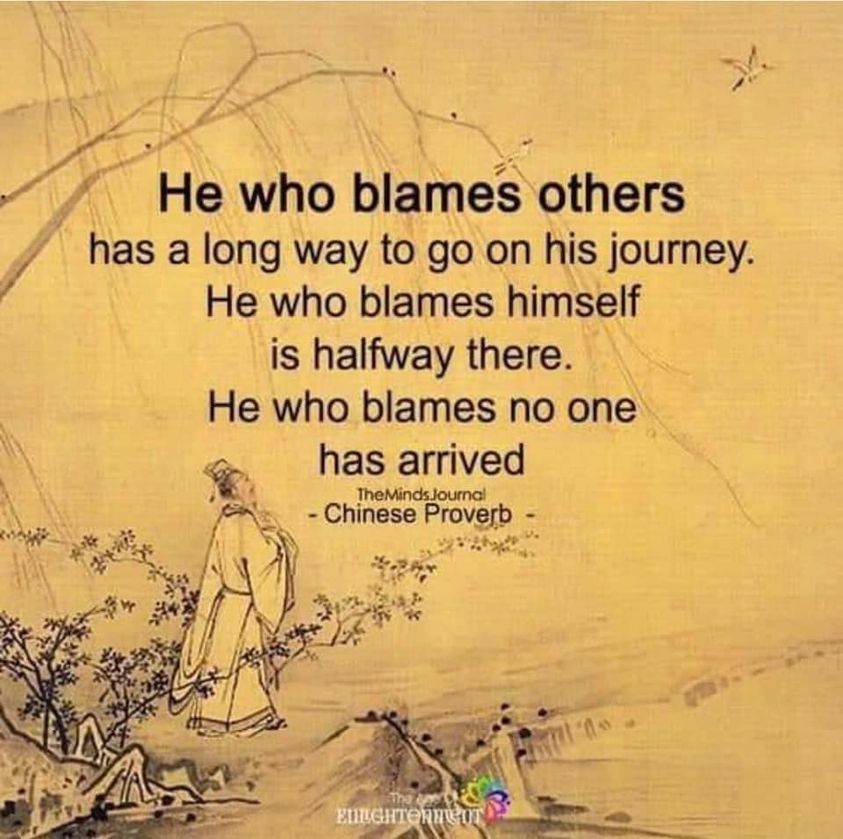
As stated by the Chinese proverb above, victim blaming will get us nowhere. For as long as we’ll ‘blame first, ask questions later’ we’ll never understand what’s going on. Remain stuck in ‘status quo’.
Where some of the victims will feel entitled to say:

Can you blame them?
Should we blame them? After all, the broadness of the accusation ultimately reduces it to a shot in the foot…
But haven’t we agreed earlier that blame will not move us forward? No matter how we feel about the whole thing?

How about ‘manning’ up?
How about each of us, men and women, assuming responsibility? Each their own!

Why?!?
Simply because it is us who have to deal with the consequences!
We, the women who get raped.
We, the fathers, brothers, partners, sons, friends, etc. of the raped women.
And we, the mothers of the raped women.

We, all of us, have ‘condoned’ a society where male children are taught to be assertive. Chivalrous, maybe, but, certainly, assertive.
And, simultaneously, a society where female children are taught to behave nicely and to refrain from becoming a ‘nuisance’.
These are, roughly, the gender roles our society – read ‘we, the parents’, continue to imprint upon the young generation. The Dolce and Gabbana advertisement above being only one of the myriad examples which illustrates this fact.

What next?

In the name of ‘playing it safe’ are we going to presume that each male (?!?) is a potential rapist?
And take the ‘necessary’ precautions?


Ooops!
How is a potential victim going to protect herself against a (close) acquaintance?
What kind of clothing are they supposed to wear and what kind of a behavior should they adopt in order to avoid being raped by a “current or former spouse, boyfriend or girlfriend (?!?)”

OK, let’s consider we’re done with the ‘blame-game’.
Let’s play ‘responsibly’ now. Who should assume it?

We! As in ‘All of us’.
For the simple reason that it will always be us who will ‘foot the bill’. Have to deal with the consequences!

From having to overcome the experience of being raped to helping towards healing the wounds to actually bearing the costs – not only the financial ones, of so many people being hurt.

We, the parents, need to educate our children in such a way as to understand that rape – in any shape, way or form, is unacceptable.
We, both men and women, need to educate ourselves about what to do when in ‘dire straits’. How to avoid ‘dangerous situations’ – from not going to ‘sleazy’ bars to not taking our dates to ‘unsafe’ places.
We, all of us, need to educate ourselves towards openness. Towards coming forward when something like this happens. Towards helping those who suffer it. As in being an ‘active’ participant instead of pretending nothing happened.
And, last but not least, we – all of us, need to learn how to overcome this.
And how to help the victims to overcome their tragic experiences.

Change can either be inflicted upon you or effected by you.

‘Change’ as in ‘something you need to overcome if you are to survive’.

We, humans, are the first to be in this situation. The rest – from the humble sub-atomic particles to our cousins, the great apes, experience change only as being inflicted upon them.

Gravity pulls together a huge cloud of gas and dust until it becomes hot enough for the fusion reaction to transform it into a star.
A supernova becomes so hot that gravity can no longer keep it together. It explodes and releases the heavier elements needed for planet building.
As it cools down, the second generation nebula is again pulled together by gravity.
A smaller star appears, this time ‘entouraged’ by planets.
On one of those planets, conditions are ripe for life to appear.
Wind and frost erode the mountains. Water carries the debris into ravines. Micro-organisms transform the debris into soil.
Vegetation – starting with the blue-green ‘algae’, which are actually cyanobacteria, have transformed the atmosphere into what it is today.
Animals have evolved into their present state by eating plants – at first, and then each-other.
Fungi have added their contribution towards what we witness/enjoy today by digesting whatever they ‘perceive’ as being ‘food’.

All of the above mentioned ‘change’ has been ‘inflicted’ upon those who bore it, by the ‘changing factors’, according to ‘natural laws’ implicit to the nature of the ‘changing factors’.
Gravity pulls because…
The blowing wind and the freezing frost who had broken down mountains did change the face of the Earth because it was in their nature to do what they did.
Plants, animals and fungi, together, have transformed the planet into what it is today as a consequence of each of the species doing what it was natural for it to do in order to survive. None of the species, nor any of the individual members of those species, had ever done anything ‘on purpose’!

Until we, the ‘naked apes’, have become ‘conscious human beings’.

We continue to have a lot of change inflicted upon us, of course.
Inflicted by factors outside our species – the current Covid pandemic, for instance, or by ‘agents’ amongst us. The first example which comes to my mind being the plane high-jacked by Lukashenko – the ‘last European dictator’, because he wanted to arrest a dissident journalist who happened to be inside.

The post continues after this message:

One-Time
Monthly
Yearly

Make a one-time donation

Make a monthly donation

Make a yearly donation

Choose an amount

$5.00
$15.00
$100.00
$5.00
$15.00
$100.00
$5.00
$15.00
$100.00

Or enter a custom amount

$

As much as I love writing, I do have to eat.
And to provide for my family.
Earning money takes time.
If you’d like me to write more, and on a more regular basis, hit the button.
Your contribution will be appreciated!
Another very efficient way to help would be to share my posts.

As much as I love writing, I do have to eat.
And to provide for my family.
Earning money takes time.
If you’d like me to write more, and on a more regular basis, hit the button.
Your contribution will be appreciated!

As much as I love writing, I do have to eat.
And to provide for my family.
Earning money takes time.
If you’d like me to write more, and on a more regular basis, hit the button.
Your contribution will be appreciated!

DonateDonate monthlyDonate yearly

My point being that we’re the first who effect change. Who do it ‘on purpose’.
Which very ‘purpose’ makes us responsible for the outcomes of our actions.
For no other reason than the fact that it will be us who will suffer the consequences of our own ‘edeavours’!

It’s our consciousness which instills purpose into our actions.
Then our very same consciousness should better become responsible towards the consequences engendered by our purposeful actions.
For no other reason but the simple fact that it’s our own survival at stake here!

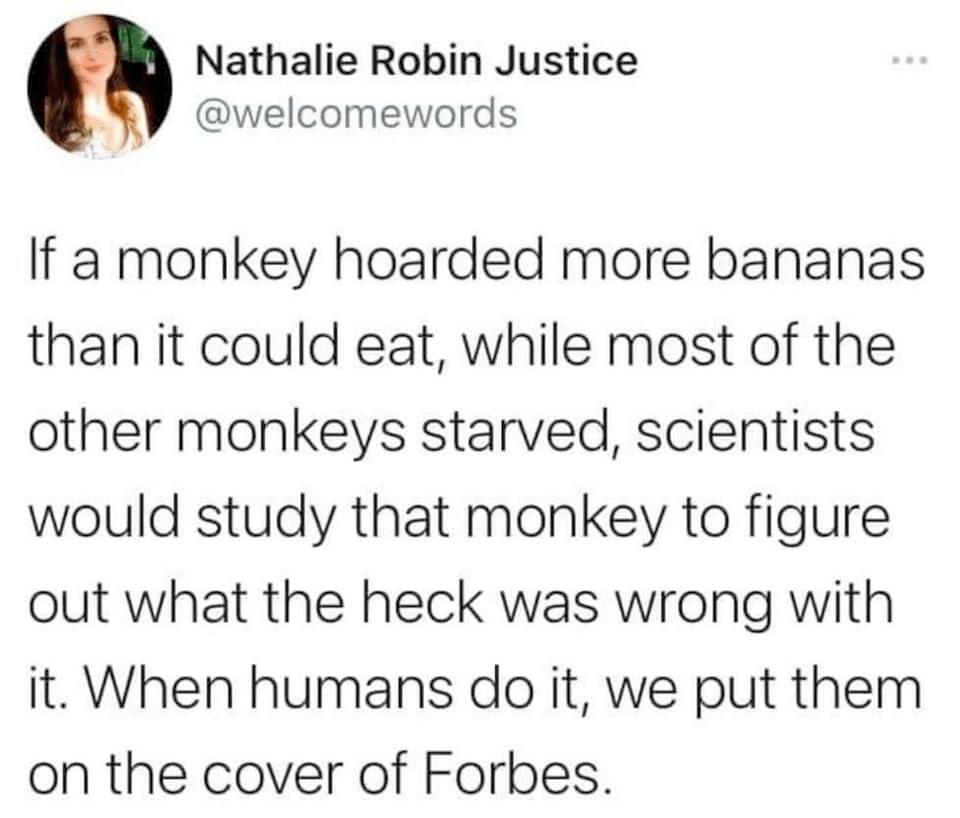
Well… Money doesn’t get spoiled as easily as bananas do…

On further consideration, money can be understood as a tool with many uses.
Hoarding, for instance. Bananas, among other things …

And, as with all other tools, the responsibility for its use falls squarely on the user, not on on the tool itself.
Tinkering with the tool won’t change that, ever.

My point being that monkeys would also hoard bananas if bananas were hoard-able.
There’s nothing wrong with that. For as long as the hoard is meant to feed the hoarder till the next crop, of course.

Hoarding is bad only when done for its own sake.

And this is something for philosophers to study, not for scientists.
The teachings of the Chicago School of Economics had been very scientific yet following them was what brought us where we are now. Into a very uncomfortable cul-de-sac…

Blindly following them… mislead precisely because of their scientific nature!

“Why should the European taxpayers bail out the profligate Greeks?”

That’s the mantra I’ve been hearing for some time now, even though a way bigger, and darker, cloud slowly builds up on the other side of the world.

As almost all mantras there is a small nugget of truth in here, even if things are not at all as some want us to believe. wrote this almost prophetic article for Reuters, more than two years ago.

So?

First of all I’d like to quote the definition proposed by Investopedia.com for ‘moral hazard’:

“The risk that a party to a transaction has not entered into the contract in good faith, has provided misleading information about its assets, liabilities or credit capacity, or has an incentive to take unusual risks in a desperate attempt to earn a profit before the contract settles.
Moral hazard can be present any time two parties come into agreement with one another. Each party in a contract may have the opportunity to gain from acting contrary to the principles laid out by the agreement…..
.
.
.
Moral hazard can be somewhat reduced by the placing of responsibilities on both parties of a contract….”

The way I understand this definition is that it is the job of both parties who enter into a contract to perform every diligence they see fit before committing to that contract  and to assume the responsibility afterwards.
Let’s see if this definition sheds any light on today’s subject.
The Western World tends to act as if all countries were functioning as communities. If we don’t like what Putin does in Ukraine we impose sanctions that hurt the entire Russia in the hope that people will do something about the situation. That tactic works very rarely – see what happens in N. Korea and in Iran. Even more, sometimes it even backfires. Look at how popular Putin has become after the sanctions have been put in place.
Coming back to Greece we have become fed up with the shenanigans of the Greek politicians – right, left and middle – and now we insist on harsh ‘austerity measures’ in the hope that the Greek voters will somehow find among themselves an honest knight in a shinning armor that will appear from somewhere and teach them to pay their taxes – and by doing so they’ll dully repay the entire debt that has accrued over the time.
After all it’s their responsibility, isn’t it?
It was them, the Greek voters, that have elected the corrupt politicians in the first place. It was them, the Greek voters, that didn’t do anything when they noticed that their Government was corrupt. Even more, some of the ordinary Greeks must have helped the corrupt politicians – nobody can be corrupt by it’s own, somebody must be at the other side of the deal. On top of that dodging taxes was, and still is, a national sport in Greece – well, that’s actually a rational thing to do: ‘who in it’s right mind would willingly pay his taxes, knowing that most of the money would be squandered away’?
Does that mean that the Greeks should be made to reimburse, in integrum, what their creditors demand of them?
OK, lets forget for one moment that this not possible and that if Greece defaults not only the Greek people will have to endure harsh conditions for a while but also the creditors will loose a considerable amount of what they are due.
Let’s presume that a completely different Tsipras somehow convinces the Greek people to accept pension cuts, tax hikes and, lo and behold, to pay their taxes in an honest way.

Then we’ll still have a fine example of ‘moral hazard’.
We have just established that in a democracy the voters have the final responsibility for the actions of those elected/hired into meaningful positions.
And what did the elected officials, from Brussels as well as those from the rest of the EU capitals? Turned a blind eye when Greek politicians ‘cooked the books’ before Greece was admitted into the EU and, after that, into the Euro zone? Then, when the private banks that had unwisely extended credit to the profligate Greeks had troubles recouping their money, the same elected officials said nothing while Jean Claude Trichet, the then president of the ECB, helped transfer the entire burden – mind you, no ‘haircuts’, unto the ‘wider’ shoulders of the European tax-payer? Who said absolutely nothing!
Only now some of the elected politicians, afraid that their constituents might finally protest, have started to notice the irresponsible attitude of Greece, to demand harsh austerity measures and to refuse even the idea of any debt relief.
So how come we can speak of moral hazard when we describe what the Greeks (governments, tax dodgers and general public) did but never mention in this context the lack of financial responsibility displayed by the investment bankers that helped the Greek governments cover up their shenanigans, the European officials who turned a blind eye to what was going on and the wide European public who didn’t care about what was done with their money by those hired to take good care of the European finances?
What is going to happen from now on?
Before trying to gouge that we need to understand what sets Greece apart from the countries that have dragged themselves out of the worst phases of the latest crises – Ireland, Spain and Portugal: Greece is a country deeply divided by rampart corruption.
In most of Europe corruption is a cancer that reaches across the entire social organism, in Greece it divides the population in two almost equal parts: those who work for or do business with the Government and all the rest.
The situation is made worse by the fact that Greece has become independent rather lately, specially compared with the Western Europe. Furthermore, the process was a lengthy one, it started in 1821 and ended right after WWI, only to recommence during WWII. Add to that the long list of authoritarian leaders and you’ll understand the deep mistrust between the people and the Government – which is not at all ‘their’, despite Greece calling itself a democracy. I have a distinct impression that even those who work for or do business with the Government doesn’t really trust it – they know too much about what is going on there. Small wonder, in these conditions, that dodging taxes is a national sport…
What we have now is, on one side, some European leaders who were elected on a conservative/popular ticked and who have already introduced some austerity at home and, on the other side, a leader who has promised to end austerity.
For these people to reach an agreement both sides have to admit failure: the European leaders must accept the past errors and take responsibility for them and Tsipras must convince his constituents that they need to change their attitude. Completely.
Does any of this have any chance to come true?

Image


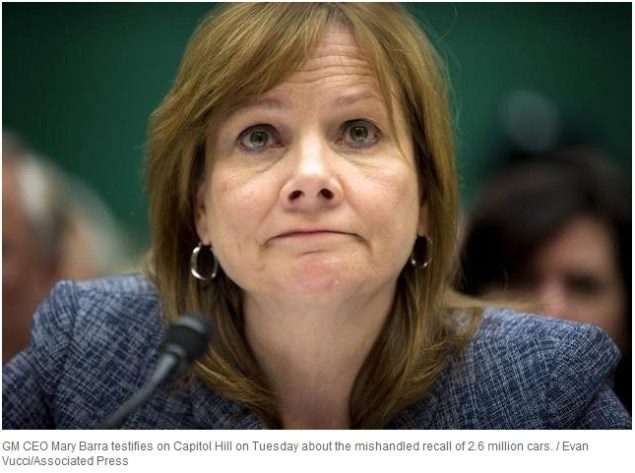
“During the hearing, a lawmaker read out an internal company e-mail saying that a 90-cent per-piece increase that would have fixed the flawed part wasn’t justified by the offsetting 10 cents to 15 cents in warranty savings. Barra, 52, said the GM she inherited three months ago would never condone executives opposing fixes that might have saved lives because they’re too expensive.”

We all know were the ‘cost culture’ has taken the ‘old’ GM: into the ground.
I’ll be blunt on this one. In fact it is not about minimizing the costs. That is not only rational but also natural. The real problems arise from ‘maximizing profits’, sometimes at “all costs”. Non financial costs that is. I.e. lives. Human lives in this case.

And this will keep on happening until we’ll finally understand that profits are good – inexorable even – but only as long they are an indicator for being on the right track towards long time survival (sustainable growth if you want to call it that way).

Allowing for the customers to get killed just for the sake of some pennies shaved from the costs is an extreme but compelling symptom of the present confusion. Short time profits, made at the expense of the customers, can be extremely dangerous.

Eventually they’ll kill the business itself, not just the customers.

PS Click on the highlighted quote, or here, and read the entire Bloomberg article. It’s worth it.