Archives for posts with tag: prohibition

Make
America
Lonely
Again
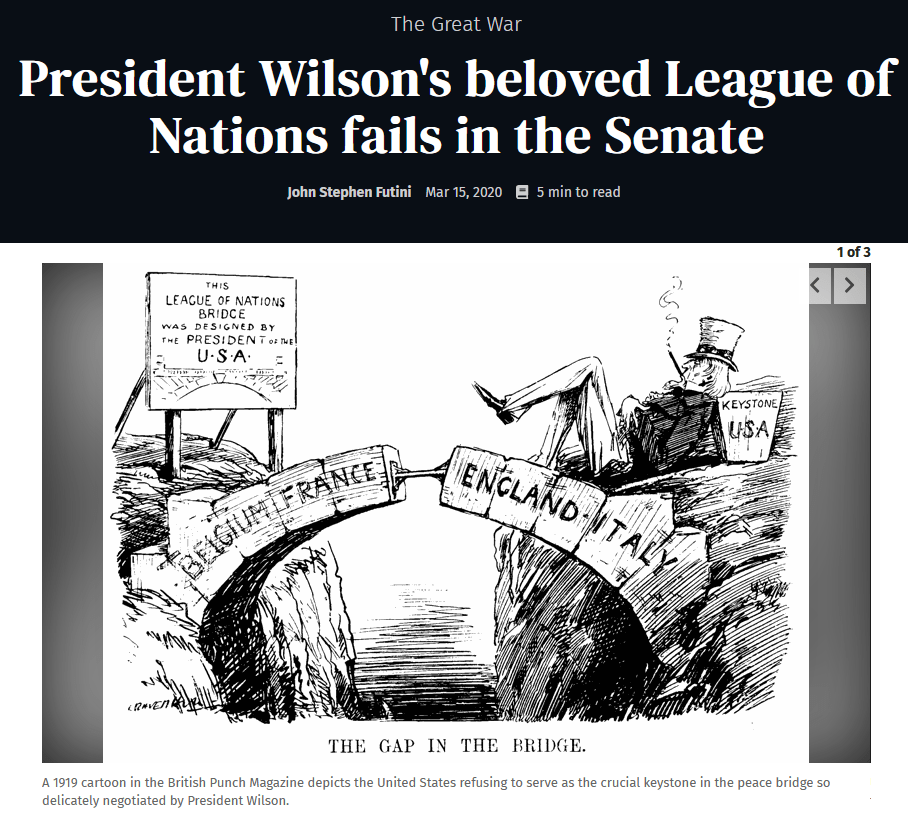
What happened next?
The Roaring 20s, Prohibition – and the advent of the Mob, the Great Depression, WWII.
In the rest of the world?
The Great Depression, Fascism, WWII.

Could America have made a difference? As an ‘insider’ rather than as a peeping Tom?

“The United States never joined the League. Most historians hold that the League operated much less effectively without U.S. participation than it would have otherwise. However, even while rejecting membership, the Republican Presidents of the period, and their foreign policy architects, agreed with many of its goals. To the extent that Congress allowed, the Harding, Coolidge, and Hoover administrations associated the United States with League efforts on several issues. Constant suspicion in Congress, however, that steady U.S. cooperation with the League would lead to de facto membership prevented a close relationship between Washington and Geneva. Additionally, growing disillusionment with the Treaty of Versailles diminished support for the League in the United States and the international community. Wilson’s insistence that the Covenant be linked to the Treaty was a blunder; over time, the Treaty was discredited as unenforceable, short-sighted, or too extreme in its provisions, and the League’s failure either to enforce or revise it only reinforced U.S. congressional opposition to working with the League under any circumstances. However, the coming of World War II once again demonstrated the need for an effective international organization to mediate disputes, and the United States public and the Roosevelt administration supported and became founding members of the new United Nations.”

https://history.state.gov/milestones/1914-1920/league

Was the World a better place after WWII? Was America happier? Inside rather than outside?

There’s a seemingly unending debate about what “my liberty ends where yours begins” really means.

The initial saying was a little longer, Your right to swing your arm leaves off where my right not to have my nose struck begins.”, and had been coined during the disputes between those who tried to impose the Prohibition and those who opposed it.

In that context, it made sense.
‘How close to my house – a teetotaler, should you be allowed to open a bar and why should I be able to tell you what to drink/serve in your house.’

In a wider setting – individual rights, for instance … not so much!

‘Your right to swing your arm leaves off where my right not to have my nose struck begins’ only if at least one of the following is true:
– My arms are as long as yours AND I’m willing/able to defend my nose.
– You are a civilized person.
– We, the entire community, have reached the conclusion that we are better off, together, if we observe – and enforce, this rule.

The first sentence describes a situation of generalized conflict. Not necessarily ‘hot’ but, nevertheless, always ‘waiting to happen’.
In the second situation, ‘one side’ depends, decisively, on the ‘other side’ behaving ‘properly’. Nice and commendable but what happens when one of them goes berserk?
The third describes the de facto functioning of any civilized nation. Which nation, any nation, is composed of individual people. ‘Endowed’ with ‘free will’ and not always ‘well behaved’.

Hence the danger of narrowly defining freedom as a collection of individual spaces where each of us might do as they please – as long as the consequences of their actions remain inside that space.
Which spaces would have to be constantly defended.
Or could be extended, whenever any of the neighbors wasn’t on the lookout.

How about ‘our mutually respected individual liberty is the well deserved consequence of our collective effort to enlarge OUR freedom’?