Archives for posts with tag: power

And what’s in it for us, ordinary people?”
My 90 years old father, commenting the news just running on TV

Nothing but what we can make of it.

The Earth was circling the Sun since the very beginning. Way before Bruno ‘discovered’ the phenomenon. Again…
The egg was sending ‘chemical signals’ since … who knows when. We, all of us, have been born without any knowledge on this matter.

Giordano Bruno was burnt at the stake.
He wasn’t the only one to face the consequences of his discovery. The lives of everybody else have been changed by his discovery. And the way we understand the world!
Sooner or later, somebody will find a way to use the information about ‘how the egg works’. To make some money out of it, to help people… or even to make an ‘ideological point’. “Yet another male dominated fantasy about the creation of life…”

So, Giordano Bruno was burnt at the stake as a consequence of his discovery?!?

Nope!
Bruno was burnt at the stake as a consequence of what we, the people, have made of his work.
Well, not exactly us but our ancestors. And not exactly we, the ordinary people, as the ‘bright minds of the day’. They had to be bright since ‘they’ were the ones running the show, right?!?

OK, so ‘those who know how to weave a story are those who order around those who know the facts’.
According to Yuval Noah Harari.
And, again, what’s in it for us?

Nothing but what we can make of it.

For as long as we’ll continue to chase power, ‘political power’, things will continue as they were.
As we’ve conditioned ourselves to expect them to be.

But, hopefully, when the next Giordano Bruno will tell us things can be spun the other way around, we’ll know better than to burn him at the stake. Alive. Again!

Power can be exercised in many ways!
The more sustainable of which being in favor of the general public.
‘For the long term benefit of the self aware social organism’ instead of ‘for how the public has been led to believe by the spin doctors’.

When will we be able to figure this out?
When those who know how things work will spill the beans out-front instead of choosing whose arse to lick.
After all, the egg encourages the most suitable sperm, not the most enchanting one…
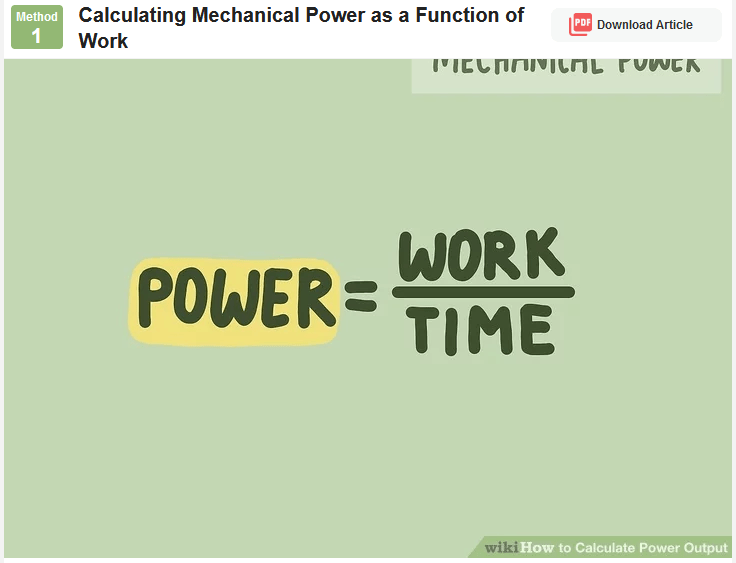
An amount of interaction expressed in the considered amount of time.

Where ever there is power, there is also resistance.
Michel Foucault in the footsteps of Isaac Newton

Michel Foucault used to be a post-Marxist philosopher and sociologist.
As the rest of the Marxists, two of his main subjects were Power and the individual’s (philosopher) duty to put their own convictions into practice. To make a difference, preferably ‘against’ the establishment.

From a Darwinian point of view, Foucault’s insistence that we shouldn’t restrict ourselves to the ‘straight and narrow’ makes perfect sense. The ability to change along with the changes in the environment is paramount to survival. Furthermore, the ability to induce change is paramount to what we call ‘progress’.

On the other hand, life itself demands that we, successive generations of individuals belonging to different evolving species, need to retain a certain congruence.
Succeeding generations share the genetic information needed to preserve the nature of the species.
Species living together evolve in such a manner as to maintain the viability of ‘their’ ecosystem. Or else…

The ‘law of the jungle’ is nothing more than something we believe to have noticed. And then convinced ourselves that we were right when we have formulated our observation in the current form. “The law of the jungle…

“Power” is but a word.
And words have the nasty habit of cloaking more than one meanings. Well, most of them…

“Power” means many.
From a ‘certain amount of work divided by the time in which that work had been performed’ to ‘the influence somebody has over the people happening to live in the vicinity.
And also something very pervasive yet seldom noticed.

Something which ‘permeates everything and “makes us what we are”‘.

Contradictory?
A tool, teleologically yielded by agents, or a fixture of the ‘environment’?
Both a the same time!
Imagine a group of people cavorting in a pool. Each of them using water to splash the others.
Or two ‘teams’ of angry men fighting near a river and using stones retrieved from the riverbed to crack each-others’ skulls.

‘A fixture of the environment’ identified as such and used by agents as a tool with which to further their goals.

Knowledge is power and power creates knowledge...
Both Bacon/Hobbes and Foucault have been right.
By identifying new and increasingly powerful instruments people have transformed knowledge into power while by putting power to work, the powerful have generated new meaning and driven things towards where they wanted them to be.

Having been able to draw from more accrued knowledge (a.k.a. culture) than Hobbes. Foucault is marginally ‘even more right’ than his predecessors.

“People know what they do;
frequently they know why they do what they do;
but what they don’t know is what what they do does.”

This being the explanation for all ‘social arrangements’ where power has been concentrated in a too small number of hands/heads having eventually failed.

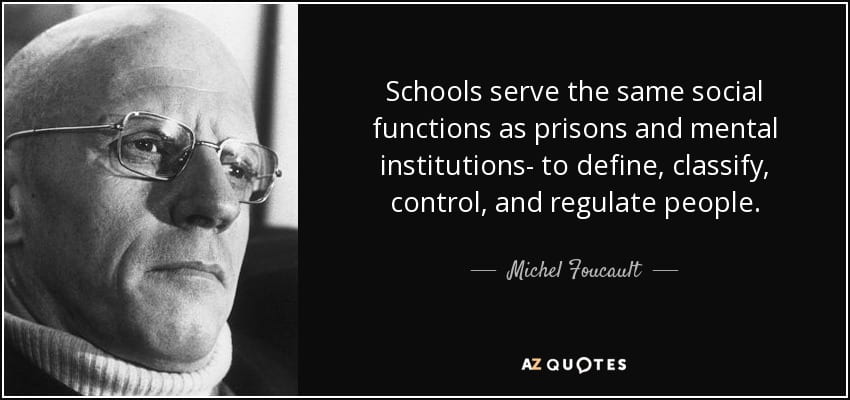
A society where schools and prisons are hard to tell apart – or perceived as such by those who have to spend time in any of them – is sooner rather than later going to reconsider it’s ‘knowledge’ regarding ‘power’. Or else…

“statuuntque latiores terminos scientiae Dei quam potestatis,
vel potius ejus partis potestatis Dei (nam et ipsa scientia potestas est)
qua scit, quam ejus qua movet et agit:
ut praesciat quaedam otiose, quae non praedestinet et praeordinet”

Francis Bacon, 1597
“and they set wider limits for the knowledge of God than for power,
or rather for that part of God’s power (for knowledge itself is power)
by which he knows, than that by which he moves and acts”
Google Translate

scientia potentia est
Thomas Hobbes, 1668

E=mc2
Einstein, 1905

In fact, power produces; it produces reality;
it produces domains of objects and rituals of truth.
Michel Foucault, 1991

“They” – as in ‘the knowing people’ – ‘set the limits for the knowledge of God’.
Then it was ‘they’ who had the real power over (their) God…

A little later, another thinker simplified the whole thing into ‘knowledge is power’.

Which, already collective, state of mind morphed into the socio-cultural environment into which Einstein was able to notice that E=mc2. That apparently different things can morph one into the other, given the right circumstances.

Which brings us to Foucault noticing that power produces reality. Including knowledge…

But is there a real difference between ‘power produces reality’ and ‘they set different limits for God’s knowledge than for God’s power’?
In fact, there is.

According to Foucault power is exercised directly.
According to Bacon, people exercise power by ‘fine tuning’ their ultimate tool. Their God. Which god, like all others, acts like an agent. Its powers might be limited – it is able to do/know only as much as those who have faith in it believe it to be able to know/do – but inside those limits it is as free as each of those who believe in it.

And the difference is huge.
As soon as Nietzsche had noticed that ‘God was dead’, ‘reality’ had shattered.
While God was alive, power created one reality. Also known as “God”.
As soon as there was no more God to mediate between reality and those gathering knowledge about it and exercising power while recreating it… reality became many!

And not only many versions of reality are competing for our attention, each of these realities are farther and farther away for the ‘hard’ one. The one harboring Einstein.

“People know what they do; frequently they know why they do what they do; but what they don’t know is what what they do does.”

Michel Foucault, Madness and Civilization:

War is over when the goals have been achieved, not when the enemy had been destroyed.
While sometimes you have to utterly obliterate the enemy in order to achieve your goals, this is not always necessarily true.


Hari Bucur-Marcu

This makes a lot of sense, right?

Yeah, sort of…

The problem with this approach being that this understanding degrades war to a simple instrument.

Something used by a decision maker towards the achievement of certain ‘goals’.

The problem with this approach being that it obliterates the decision power of all other people involved in it. Of everybody else but of those calling the shots. Pun intended!

All analysts commenting Putin’s ‘special military operation’ babble on about Putin’s goals.
‘Ukraine will never be able to crush Russia, militarily, so we need to understand what’s going on in Putin’s mind.
In order to be able to ‘bribe’ him into ending the war. Or to black mail him. Only we need to understand first what will constitute a too big of a price for him to pay.’

On the other hand, Putin seems to be thinking along the same lines.
‘I need to preserve my position. MY power. Ukraine is a bad example for the Russian people. They have shifted their ‘allegiance’ and want to build a real democracy. I cannot allow this to happen, otherwise I’ll be next.
Now, how much pain do I have to inflict in order to achieve my goal? Directly, upon the Ukrainians and indirectly, upon the rest of the world?’

Meanwhile, the rest of those involved in this situation bear the brunt of the war. Directly and indirectly.

Some of them understand what’s going on and some don’t.

My point being that not all instruments are born equal.
While all are nothing but mere ‘sticks’ in the hands of the agents wielding them, choosing to use a certain instrument among the available alternatives speaks volumes about the agent making the choice.

What are we, reasonable creatures, to understand when an agent chooses an instrument which debases all other creatures to the role of ‘kill or be killed’?
For whatever reason and under whatever pretext?
Is that agent ever going to stop? To stop setting ‘goals’, further and further away?

Specially after having the ‘first installment’ safely tucked under the belt…

Where conditions had been ripe:

The market had become free.
Free for more and more people to search for new ways to meet their needs.
This freedom had allowed the market to become efficient enough for more and more people to be able to satisfy some of their wishes, on top of most of their needs.

Agora had become free.
So free that politicians had to solve more and more of the real problems encountered by the society at large.
Life had become so free that states had become prosperous.

And more and more of the people were happy!

Now, the market is so free that more and more people have started to search for ‘really’ new ways to meet their wishes. Eventually, they came to be known as ‘financial engineers’. The market is no longer the place where people meet to satisfy their needs but the place where some of them accrue huge sums of money while more and more of the rest find it harder and harder to survive.

The Agora is also at its freest.
‘Political marketeers’ have taken over from the ‘the old school’ – and ‘real’ politics have been replaced with ‘give the people what they want’. Political life is no longer about solving problems. It has become a relentless quest for power.
Keeping things ‘afloat’ is no longer THE goal, only a cost.

Is this sustainable?

One-Time
Monthly
Yearly

Make a one-time donation

Make a monthly donation

Make a yearly donation

Choose an amount

$5.00
$15.00
$100.00
$5.00
$15.00
$100.00
$5.00
$15.00
$100.00

Or enter a custom amount

$

As much as I love writing, I do have to eat.
And to provide for my family.
Earning money takes time.
If you’d like me to write more, and on a more regular basis, hit the button.
Your contribution will be appreciated!
Another very efficient way to help would be to share my posts.

As much as I love writing, I do have to eat.
And to provide for my family.
Earning money takes time.
If you’d like me to write more, and on a more regular basis, hit the button.
Your contribution will be appreciated!

As much as I love writing, I do have to eat.
And to provide for my family.
Earning money takes time.
If you’d like me to write more, and on a more regular basis, hit the button.
Your contribution will be appreciated!

DonateDonate monthlyDonate yearly

And no, this is no joke! Alas…

Populism is scientific because its ‘adepts’ have a very rational behavior and use scientific tools to increase the appeal of their public messages.
And, on the other hand, populism is scientific because its advent is perfectly explainable given what we currently know. About our society, about our brains, about our psychology….

Let me start from the beginning.
In Thomas Kuhn’s terms, the last 60 or so years have witnessed a tremendous paradigm shift.
Science has replaced religion as the main paradigm and ‘religion’ has been demoted to  ‘religions’.

Science becoming the main paradigm means that we have grown confident about our knowledge. We might be aware that we don’t know everything yet but we continue to believe that we’re able to learn everything. That if we are diligent enough we’ll sometimes be able to look under every rock that is.
This attitude has led us to search for ‘perfection’. ‘Efficiency’ has displaced ‘redemption’. We have ceased our quest for salvation and are now obsessed with ‘buy low, sell high’. In other words, ‘make the most of it but strain yourself as little as possible’.

Which makes a lot of sense, doesn’t it?

A lot of sense… mainly when you no longer perceive the guy next to you as being a full-fledged member of your community. Your religious community, that is. Of your church.

You see, ever since Emil Durkheim, the sociologists have been aware that religion was not so much a story about the making of the world as a ‘common ground’. The ‘common core’ shared by the members of a given community. Which ‘common core’ makes it possible for those who share it to have respect. For themselves and for the other faithful members of the community. By sharing that common core, the individuals find their bearings in the ‘wide, wide world’ and, thus, know how to behave relative to their ‘neighbors’. With enough mutual respect among the individual members that the community is able to function. To survive, that is.

We no longer have that kind of community.
Our primary allegiance is no longer towards ‘church’. Most of us consider themselves primarily as members of a nation – something governed more by formal laws than by public sentiment, and only secondarily – if at all, as members of a ‘religious’ community.

Now, putting two and two together, it’s very simple to understand that in the given circumstances ‘populism’ was inevitable, right?

Too many of the would be leaders have no qualms about how they get what they want.
Power.
‘Buy low, sell high’ is the current mantra, remember? Accepted by all of us. Buyers, sellers, by-standards…
Too many members of the general public are willing to accept promises which are in line with their own expectations, even if those promises being put in practice means a lot of misery for OTHERS. Who cares about those others, anyway? They are not members of OUR ‘church’!

I’ll let you decide how sustainable is such a situation. I was going to use ‘community’ instead of ‘situation’ but it would have been horribly wrong. We no longer live in communities. We only happen to live in the same place.

For how long?

As in mob rule?

A British historian that went by the name of Lord Acton observed more than a hundred years ago that
“All power tends to corrupt; absolute power corrupts absolutely.”

Judging by what historians keep writing and the politicians keep ignoring this observation tends to be pertinent.
Click on the highlighted quote to see some of his arguments in Ben Morrell’s interpretation.

Somewhat unhappy with this vision, a sci fi writer, Frank Herbert, contradicted the historian:
“Power attracts pathological personalities. It is not that power corrupts but that it is magnetic to the corruptible. Such people have a tendency to become drunk on violence, a condition to which they are quickly addicted.”

In fact it’s more like a completion than a contradiction but I’ll have to leave it at that because both are dead now and way past such mundane preoccupations.

Recently, things having not been properly set yet, a team of Swiss scientists lead by John Antonakis decided to sink their teeth in the matter. They gathered a group of people, ‘measured’ all sides of their personalities – including their honesty – and then involved them in a game of ‘lets play dictator’.
“The findings showed that those who measured as less honest exhibited more corrupt behaviour, at least initially; however, over time, even those who initially scored high on honesty were not shielded from the corruptive effects of power.”

OK, so Acton was right altogether, ‘power’ does corrupt. The problem is that Antonakis never tried to verify Herbert’s hypothesis. If he was right then the honest people stand no chance at becoming powerful enough to become corrupted because the already corruptible are fighting dirty to get on top, something the more honest would not do, at least not from the very beginning. Seen this way the very competition for power selects the people who get on top based on how corruptible they are.

Luckily things are not that simple. Really smart guys, no matter how corruptible, figure it out – sooner rather than later, that by ‘stealing’ too much/misbehaving really bad  they destroy the entire structure upon which their very existence, let alone power, depends.

So how come really bad dictators do come into existence?
From Lenin to Hitler, from Ceausescu to Pol Pot and nowadays from Putin to al-Baghdadi.

Here Antonakis’ findings fit in perfectly.
Participants “were given complete control over deciding pay-outs to themselves and their followers. The leaders had the choice of making prosocial or antisocial decisions, the latter of which resulted in reduced total pay-outs to the group but increased the leader’s own earnings.”

The key concept here is ‘complete control’. In fact this ‘dictator game’ is no game at all. It’s nothing but a solitaire. It has rules, certainly, but it’s up to the ‘player’ himself to decide whether to respect them or not. If the rest of the people concerned – those who suffer the consequences of the ‘game’, have no say in what is going on then they don’t count. And are not able to help, either. The final outcome will depend exclusively on the honesty of the ‘player’. And we haven’t, as yet, made any mention about skills…

Besides the very important insight Antonakis also offers us a valuable piece of advice:
” “We think that strong governance mechanisms and strong institutions are the key to keeping leaders in check,” concludes Antonakis. “Organisations should limit how much leaders can drink from the seductive chalice of power.” “

It’s a very good starting point. Add to it a renewed insistence on initial honesty – it helps, just as the study showed, coupled with intense surveillance and continuous feed back from the stakeholders and things might improve dramatically.

After all ‘governance mechanisms’, ‘strong institutions’ and ‘organizations’ are nothing but words. Powerful and meaningful words indeed but ‘words’ cannot do anything by themselves. They have first to be pronounced by pertinent persons and then diligently put into practice.

And this would mean that ‘power’ won’t belong to anyone in particular, not even to ‘the people’.

Keep tuned for the difference between real democracy and ‘mob rule’.

I’ve just sent a comment to the guy who posted this: 

http://qz.com/87795/free-information-as-great-as-it-sounds-will-enslave-us-all/

“Those with the best computers can simply calculate wealth and power away from ordinary people.”

First of all you seem to equate power with wealth. It may not always be the case. Power, in order to be effective, must be acquiesced.
Wealth can be of two kinds: hoarded resources, say wheat, which must be guarded and preserved or ‘cash’. The first kind is valuable only as long as somebody else needs it while the second … is valuable only as long somebody trusts the entity that coined the ‘paper’ in which the said wealth is expressed.
There also exists an intermediary kind of wealth, stock or financial papers – futures, options and the like – they are also valuable only as long this papers are ‘enforcible’.
In fewer words power and wealth are relative to what people involved think/understand/feel about what is going on.

https://nicichiarasa.wordpress.com/2013/06/14/life-versus-profits-by-joseph-e-stiglitz/

As to ‘free information’… In the natural world everything has a price and is scarce. One has to ‘work’ in order to get food, build a shelter and keep warm. Even breathing takes some effort. By contrast information comes for free: you get your ADN and your initial education shoved on you from your parents (they even don’t care to ask for your consent about this) and from there on you get bombarded by free information: you see, hear, taste, smell and feel without any effort. Only modern man understood that there is something to be gained from controlling information and invented tuition, copy-rights, patents…”