So, when Popper doesn’t tolerate intolerance, he is being mean?
Intolerance is something no one should tolerate.
From where I’m looking, intolerance is like a pebble in your shoe. You may walk for a while, without removing the pebble, but the damage will be there. For certain.
And if you persevere, the damage will be permanent.
Your question is a tricky one. Popper is not necessarily mean when refusing to tolerate intolerance. He would have been mean only if he used unkind words when trying to convince the intolerant to change their hearts.
Aaron Mostofsky, the guy pictured above, “has worked as an assistant architect in New York“. Which means he must have at least some idea about the ‘art of the Italian Renaissance’, right? And now I wonder. His ressentiment had been seeded in his soul during college? Earlier?
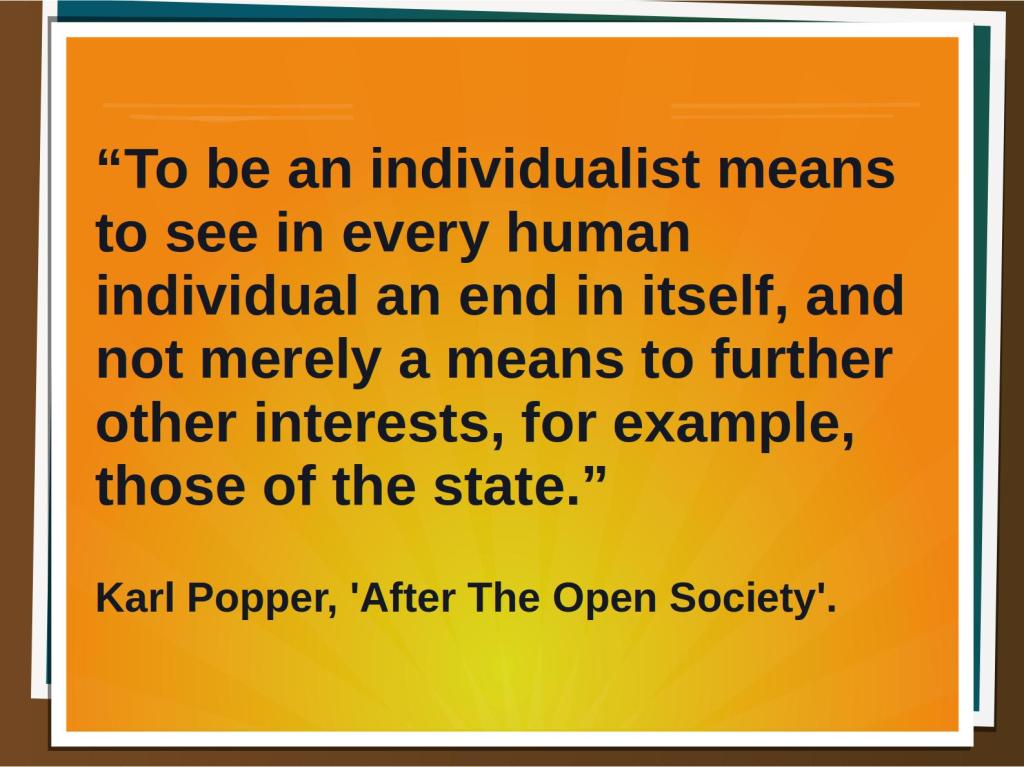
Popper, Karl Raymund, had witnessed the entire XX-the century. Both WWs and their aftermath. The advent of the USSR, that of the III-rd Reich and that of the Red China. And the defeat of the imperialistic Japan. Him insisting that collectivism – as put in practice by the fascists and by the communists – leads to a very dark cul-de-sac is spot on and perfectly aligned with what history teaches us. But who has enough time to read nowadays … we glance at the internet, catch a meme … interpret it according to our own weltanschauung… and then storm the Capitol! Because the individual is above the state. “An end in itself”…
The teachers/parents should have done a better job? At explaining what Popper had in mind? At teaching the next generation that you don’t ransack the Capitol whenever you don’t like the outcome of an election?
“Doubt everything” instead of ‘trust the scientist until proven wrong’. ‘Illiberal democracy’, whatever that might mean… “Abolish capitalism”. As if there was any viable alternative!
Survival of the fittest?!? No, only the demise of the unfit! Ernst Mayr, What Evolution Is?
An end in itself…
For whom? For the concerned individual? For the philosopher pondering the concept? For the ideologue promoting the idea?
And who determines ‘the interests of the state’?!?
“Plato suggests, and all later collectivists followed him in this point, that if you cannot sacrifice your self-interest for the sake of the whole, then you are a selfish person, and morally depraved.”
Since there’s no better judge for ‘sustainability’ than mere history, let’s ‘look back’.
Whenever the powerful of the day considered that everything belonged to them, and that the collective wasn’t worth any consideration, that ‘arrangement’ soon ended in chaos. From Alexander the Great to Saddam Hussein. Hitler, Stalin, Ceausescu… Whenever the meek had accepted everything which came from ‘above’, very soon the ‘arrangement’ also ended in chaos. The Khmer Rouge experiment, the Chinese Cultural Revolution, communism being instated in the Eastern Europe by the Soviets…
As a rule of thumb, individuals can exist only as members of a collective. None of us can birth itself (?!?) None of us can educate itself ON ITS OWN. OK, one might teach itself to read. And then devour a whole library. But for that to happen, somebody else must have invented the letters first! None of us can develop into a conscious human being without living with other human beings.
Furthermore, the same rule of thumb states that collectives which value their individuals, all of them, fare a lot better than the highly ‘hierarchical’ ones. In this sense, Popper was right. ‘Individualistic’ societies – the collectives which ‘see individuals as ends to themselves’ – fare better than the collectives which allow, for a while, their temporal leaders to lure them into obedience.
About which individual are we talking about here? About me? The ONE above all? About us? The only ones who ‘belong’? About all individuals? Regardless of age, gender, ethnicity …
“On the other hand, the individualist or anti-collectivist can at the same time be an altruist…”
Sir Karl Raimund Popper had died in 1994. Long after all of the so called collectivist regimes of the XX-th century had shown their true colors. Long after all the self styled collectivist regimes had unveiled their murderous nature.
And murder, by definition, is the most individualistic attitude available to a human being.
Let me be absolutely clear. I’m talking about murder here. That thing perpetrated by an individual, alone or in cahoots with others, against other individual or individuals. Self defense – the minimal action meant to save one’s own life, which stops as soon as its goal has been fulfilled – has nothing to do with murder. Criminals can, indeed, try to camouflage murder as self defense but their actions are obvious for all level-headed observers.
My point being that individualism cannot be defined as being anti-collectivist. And what’s bothering me is the fact that Popper himself had fallen into this trap.
If I get this right, Popper’s main contribution to our understanding of the world is the notion of ‘falsifiability’. The idea that human knowledge – science – grows in fits and starts. That individuals notice things, formulate their observations as theories and put them forward for public examination. And that even the theories which hold water, for a while, will, by definition, be proven false – or at least incomplete – at some point in the future. The way I understand this process – I’m an engineer converted to sociology – is as a continuous dialogue between individuals and the community which nurtures them.
Just as you can’t have a working engine – I’m a mechanical engineer – without all the pieces fitted in the right places and without a tank full of fuel, you can’t have a ‘healthy’ collective without ‘established’ individuals. Symmetrically, no individual can survive – let alone thrive – alone. A baby needs to be fed and taught to walk/speak/think in order to become an individual. A conscious human being.
Collectives, currently known as nations, fare according to the opportunities enjoyed by the individuals comprising those collectives/nations. AND according to how each of the individuals understand to enjoy each of those opportunities. The members of the North Atlantic Treaty Organization – who treated their citizens far better than how the Soviet citizens used to be treated by their self styled collectivist leaders – have fared a lot better than the defunct Soviet Union. Democratic and free-market capitalist countries fare a lot better than those run in a more or less centrally planned manner by authoritarian regimes.
And the explanation is simple. Democracy and free market capitalism mean that many more individuals have many more opportunities to contribute to the well being and the ultimate survival of their community than what’s going on inside authoritarian regimes. Where the decision making is concentrated in a very few hands. Where most opportunity has been confiscated by a handful of self chosen few individuals. In fact, the democratic and free market capitalist countries are far more collectivist minded than the self-styled collectivist authoritarian regimes. Where only the high ranking officials count as individuals!
And no, Plato wasn’t exactly right either. His ideas haven’t reached us in their intended form… or it is us who can’t read them in an appropriate manner… “Plato suggests… that if you can’t sacrifice your self-interest for the sake of the whole, then you are a selfish person, and morally depraved.” ‘Suggests’ already comprises a healthy dose of individual latitude. A healthy dose of individual lee-way when it comes to interpreting each individual situation. Furthermore, this is rather a matter of how a collective deals with each individual situation than an individual being selfish or morally deprived.
All situations which determine the fate of a collective are experienced, interpreted and dealt with by individuals. No collective exists as a ‘unit’. Nor reacts as one, regardless of whatever efforts have been made, under whatever disguises, by ultimately individual dictators to implement such ‘unity’. Around the ‘individuality’ of the dictator…. And whenever the individual called to solve a particular situation considers his individuality as being superior to the fate of the collective… then that individual actually lights a fuse. Which might or might not detonate a charge. Which charge might or might not destroy much… but… The main problem here residing in the fact that many individuals haven’t figured out yet that their own individual fates are inexorably linked to that of the collective.
That if it’s not peer-reviewed, it’s not science! That being a bona fide individualist “does not mean (that the concerned individual is entitled) to take one’s own individuality particularly seriously, or to lay more stress (or even as much) on one’s own interests than on the interests of others.”
The first reaction, for the ‘average person’, is to ‘love’ this post.
The ‘normal’ reaction, for the ‘fact-checkers’ among us, is to ask ourselves:
Is this actually true?
Heidegger has something really interesting to say about the subject. I’m gonna put it succinctly and bluntly.
None of us knows everything about anything. Not even about the most trivial thing. Because the very nature of our knowledge and of our manner of expressing it – language, none of us is able to ‘put together’ even the simplest ‘absolute’ truth.
Hence, according to Heidegger, we have as many truths as there are people interested on the subject.
‘Then the African Proverb is a ‘lie’?’
Nope.
The African Proverb pictured above is a meta-truth. Heidegger’s truths, as well as those discussed by Popper, all converge towards the ‘absolute’ one. As each of the ‘people interested on the subject’ dig deeper, each of them gets closer to the kernel. Probably none of them will ever get exactly ‘there’ but their respective positions will become ever closer.
Meanwhile, there’s nothing like a ‘meta-lie’. As we had ‘truth’ and ‘meta-truth’. A lie, any lie, is also a meta-truth.
We know – we are under the impression, more exactly, that we’ll never reach ‘the absolute truth’. About any subject, let alone the ‘absolute-absolute’ one. But we can conceive that there is one. Somewhere. At least about individual points of interest.
Do we even have the concept of an absolute lie? What would that be? How could that even be expressed?
This being the reason for some of us being able to come up with so ‘plausible’ lies. They put so much truth into their words that it becomes harder and harder for us to notice that the ‘proposed conclusion’ is misleading.
That, in fact, they are lying through their teeth.
Karl Popper had described science as a (virtual) place where things happen like this:
Some guy has an inkling. Studies it and gathers a lot of information on the subject. Based on that information, develops a hypothesis. Then attempts to prove it. After being satisfied with how much proof they had found, the hypothesis is declared a theory. And published as such. Along with all pertinent evidence. For all those interested to see.
So that all those interested to be able to replicate the experience. To be able to retrace the proving process. To certify its validity.
And for all those interested to be able to find any proof to the contrary! So that, as soon as that proof had been found – and declared acceptable, the theory to be considered false. Or, at least, incomplete.
The first example which comes to my mind being that the simple existence of Einstein’s Relativity had proven that Newton’s Physics was incomplete….
Fast forward to our days. To our raging Covid-19 pandemic.
When vaccines are already available and where there are people who refuse to be vaccinated.
The vaccine was supposed to protect us. From becoming infected. From needing to go to the hospital. From dying. From ending up suffocating alone…
But people continue be infected. Even after receiving the vaccine. People continue to be admitted to the hospital. And people continue to die. Even after receiving the vaccine.
Wouldn’t all these evidence strongly suggest, scientifically speaking, that the vaccine is useless? ‘Useless’, to say the least?
Wouldn’t it be actually rational to frame the situation in these terms?
Well, according to Popper’s reasoning, the first vaccinated individual becoming ill had been ample enough proof of the fact that the vaccine was not 100 % foolproof. That it isn’t fail-proof! The first vaccinated individual being admitted to the hospital had been ample enough proof that the vaccine is no absolute shield against any of us who has been infected will ever have to go to the hospital. The first vaccinated person who had died with Covid-19 had been ample enough proof that the vaccine will not protect all of us from dying after becoming infected with this virus.
And the fact that so many of us continue to refuse to be vaccinated is ample proof of the fact that reasonable should trump rational. Yet it still doesn’t…. Of the fact that too many of us continue to consider that their short term/self serving interests are more important than other people’s lives. And of the fact that too many of us continue to ignore how vaccines work.
The key aspect here being the last! People continue to ignore how vaccines work simply because of the huge amount of disinformation which is being peddled on the internet right now. It’s not the ‘refuseniks’ who put their short term/self serving interests in front and above the lives of innocent people! It’s those who have initiated, and continue to drive, the fake-news process who will be eventually determined as having been the root-cause of the excess mortality we’re currently experiencing.
When? Hopefully, after a reasonable amount of time. If enough of us start behaving rationally… In a comprehensively rational manner…
Being an engineer, I’m gonna present you with a more straight-forward version than the philosophical one.
For something to be real, it has to have consequences.
‘But…?!?’
No buts! The only thing which classifies something as being real or not is our consciousness. Without it, without our consciousness, the something we’re talking about now – reality itself, would cease to be ‘real’. Without us pondering about it, ‘reality’ would continue to exist, of course! Only it would no longer bear a name… Without us being concerned enough about it, it would ‘disappear’ from our ‘radar’.
‘Yes, but … you just said that something becomes real as soon as it has consequences! We encounter ‘real’ things in each and every moment of our existence. We need air to breathe, water to drink… food to eat. And a solid earth to walk on…’
True enough. Only for all these things to become ‘real’, we first need to notice them!
See how ironic things are? In retrospect, electrons are real. Despite the fact that none of us can actually see them. Or otherwise ‘feel’ them. In any way, shape or form! But until we had gathered enough evidence about their existence…
And now, that our discussion has reached this subject – evidence, I feel the need to mention the fact that Earth is not yet round ‘enough’. That there still are some people actually believing in the notion of the Flat Earth.
‘Are you implying that the Earth might be Flat?!?’
Excellent question, thank you very much! (If I may say something like that myself. Please excuse my boastfulness!)
You see, we are dealing here with two things. Two very different things.
The roundness of the Earth. Which seems to be real. The ‘Flat Earth’. Which is certainly real.
The roundness of the Earth belongs to the realm of science. Which is ‘wrong by definition‘. At least according to Popper… In the sense that the Earth will continue to remain round only till somebody will prove it to be different. Which had happened already… In ‘reality’, the Earth resembles a potato more than anything else! On the famous ‘other side’, the ‘Flat Earth Theory’ belongs to the realm of belief. Which is also real. Not in the ‘direct’ sense – a concept which describes a real ‘reality’, only in the sense that it has certain consequences.
‘The Flat Earth has consequences?!? You admit that the concept – ‘the Flat Earth’, describes something which doesn’t exist yet you pretend that it has consequences?’
Yep!
Can you deny the reality of this whole thing? Six hundred and twenty million hits? In less than point 8 seconds? Can you pretend these are not ‘real consequences’? Can you imagine, for instance, how much energy is spent only to preserve this amount of raw information in the ‘cloud’. How much ‘space’? How much bandwidth is used to transport this ‘fake-ness’ across the ‘globe’!
‘And where does this whole thing lead us? What about the Flat Earth? Is it still a fake?’
Yeah. I’m actually tempted to say ‘obviously’! On the other hand… it’s hard to deny how ‘real’ the whole thing is…
“How absurd to imagine that something we can make could actually deliver us from problems we could not free ourselves from!” Dr. Allen Ross, Dead Idols or the Living God
According to Abraham Maslow, people’s lives are ‘staged’. During the first four, each individual ‘must’ – ‘inside’ whatever circumstances Mother Luck had granted them, provide for their ‘needs’. Only after they had reached the fifth stage, individuals have the opportunity – but no ‘obligation’ other than that each of them impose upon themselves, to ‘reinvent’ their own personae. Maslow had used ‘self-actualization’ to describe the process.
In religious terms, the whole thing is known as ‘coming to peace with oneself’.
No more ‘absurdity’ here! There’s so much each of us can do in order to move ‘forward’…
‘And where is this famous ‘forward’?!? How are we, individually and/or collectively, to determine which is the ‘good’ direction?!?’
Is our ‘imagination’ good enough to come up with a solution for the “problems we could not free ourselves from”?
Is ‘induction’ a comprehensive enough solution? Or ‘too much of a good thing’ will never fail to become ‘bad for you’?
Confused?
Let me put it another way.
‘One size fits all’. How many times have you been really satisfied by such a ‘solution’? Do you really think an ‘idol’ fashioned by a carpenter – by the most talented carpenter, even, will ever satisfy the needs of at least one blacksmith?
‘But how about the idols fashioned by Plato’s king-priests?’
To answer this question – this excellent question, if I may say so myself, we must turn back to Dr. Allen Ross’ Dead Idols. To the difference between the Dead Idols and the Living God, to be more precise.
‘Criterion for what?’
If you pay close enough attention to what’s written above, you’ll notice that not passing the falsifiability test doesn’t mean than an assertion is false! Far from it, actually! Not passing the falsifiability test – ‘if a claim is compatible with all and any states of affairs’, only means that that claim is both ‘true’ and unscientific! Simultaneously true and not scientific!
‘And what has any of these to do with God?!? With the Living God or with any of the Dead Idols humankind has built for itself? And later discarded?’
I’m afraid you’ll have to come back for the answers. Or, to put it differently, I’ll gladly welcome you back!









 nicichiarasa