Archives for posts with tag: Mutual Respect

Iliescu despre Nastase

Nu scapam de umbra lui nici macar acum.

Adevarul, trist, este ca inca ii domina pe urmasii sai politici.
Ponta declara ca Nastase a fost condamnat ‘politic’ iar Basescu se plange cui sta sa il asculte ca ‘daca ajung astia sa controleze justitia lupta impotriva coruptiei va fi oprita.’

Ce spune Iliescu pe chestia asta?
“Nu este, cred, o legătură, o conexiune directă între factorii politici şi justiţie, dar este schimbarea de judecată din partea oamenilor.”

Vedeti vreo diferanta intre ce a spus el si declaratiile celorlalti doi? N-a sustinut ca NU este nici o legatura ci doar ca nu o vede el… n-a spus ca Nastase ar fi nevinovat ci doar ca este vorba despre ‘schimbarea de judecata din partea oamenilor’… Sa nu uitam ca mai demult Iliescu i-a atras atentia lui Nastase ca ar trebui ‘sa se apropie mai mult de oameni’ si sa nu mai fie atat de arogant.
Poate ca n-a folosit exact aceste cuvinte dar mesajul era clar…si atunci si acum. In plus nici un om politic cu scaun la cap nu va recunoaste vreodata ca in tara sa, pretins democratica, exista procese politice sau vreo factiune politica care vrea sa utilizeze justitia intr-un fel sau altul. E descalificant, atat pentru tara cat si pentru el ca om politic. Daca tot esti acolo fa ceva sa dregi situatia, nu te plange in stanga si-n dreapta, ca d-aia te-au ales oamenii. Sa faci nu sa te plangi sau sa arati cu degetul. Pentru asta ii avem pe ziaristi, politicienii sunt pentru altceva.

Cu alte cuvinte Iliescu a ramas unul dintre putinii profesionisti din politica romaneasca iar faptul ca stie sa spuna adevaruri in asa fel incat sa nu te poti supara pe el este o dovada in acest sens. In plus, modul in care il caracterizeaza pe Nastase este genial: “Mi se pare că a căzut la mijloc un om care are şi meritele lui în toată dezvoltarea societăţii româneşti.” Ce recunoastere mai clara vreti ca in afara de merite mai sunt si altele….dar poti sa te superi pe el pentru cum a spus-o?

Si asa ajungem la ce ma doare cu adevarat pe mine.

Suntem in situatia de acum si pentru ca Iliescu, profesionistul in ale politicii Ion Iliescu, nu a stiut, nu a putut sau nu a vrut sa foloseasca prilejul pe care l-a avut in 1990.

Lumea se uita la el ca la salvatorul natiei, exact asa cum se uita acum la Ponta.
Iliescu tocmai ‘ne salvase’ de Ceausescu, Ponta ne-a promis ca ne scapa de Basescu.

Iar noi i-am ascultat si le-am dat increderea noastra.
FSN-ul a luat 66% in 1990, USL-ul 60% in 2012.
Si ei ce-au facut?
Ilescu a chemat minerii iar Ponta a incheiat un pact de neagresiune cu Basescu.
Ce a iesit din vizita minerilor stim cu totii. Rezultatele pactului cu Basescu apar si ele, unul cate unul.

OK si noi ce avem de invatat din asta?
Sa-i ascultam pe ai batrini si sa intelegem odata ca:
– La pomul laudat nu te duci cu sacul.
– Nu pune toate ouale ( 😀 ) intr-un singur cos.
– Nu e prost cine cere ci acela care da.

Adica nu ajunge ca cineva sa aiba capacitatea si ocazia sa faca ceva bun, omul acela mai trebuie sa fie si impins de la spate. Altfel tot ce ii trece lui prin cap va face.
Sperantele alea ca sa gasim ‘un om cinstit, drept si cu dragoste de popor, un adevarat barbat de stat cum au fost…si pe el sa-l punem in fruntea statului’ (iar noi sa ne culcam pe o ureche) sunt complet nerealiste. Am actionat, ca natie, dupa principiul asta aproape intreaga noastra istorie iar rezultatele se vad.

Ce-ar fi sa schimbam un pic macazul?
In primul rand sa mergem la vot. Daca nu ne plac candidatii, nu-i nimic, punem mai multe stampile si anulam buletinul de vot dar transmitem un mesaj extrem de puternic: ‘aveti grija ce faceti, suntem cu ochii pe voi!’. Absenta de la vot transmite intr-adevar ca ne e scarba de ce se intampla dar si ca nu ne pasa suficient de tare incat sa facem ceva. Iar daca tot nu ne pasa ‘ei’ de ce sa ne bage in seama?
Cand se anunta rezultele sa facem bine sa le citim cu atentie. Cati dintre noi stim cine ne reprezinta in Parlament? Dar in consiliile locale? Cati dintre noi am trimis vre-o scrisoare, vre-un mail catre vre-unii dintre ‘alesii nostri’? Pai daca noi nu le spunem direct ei de unde sa stie ce vrem de la ei? Cele cateva mii de oameni care mai ies din cand in cand pe strada nu sunt suficienti, politicienii se pot amagi cu gandul ca ‘lasa-i, sunt o minoritate, niste golani’! Ia sa se trezeasca ei cu cu mesaje din toate toate zonele tarii, din partea cat mai multor paturi sociale, avand ca obiect cat mai multe subiecte de interes…
“Bai, astia s-au trezit la viata, nu mai merge sa-i prostim in fata…”

Ne-am trezit oare cu adevarat?
Sa reuseasca oare CRBL ce n-au reusit, de fapt, Morometii?

PS.
Sunt sigur ca se va gasi cineva sa ma intrebe ‘bine dar Antonescu n-are si el o vina in toata chestia asta?’
In primul rand ca eu nu caut vinovati ci explicatii si eventuale solutii.
In al doilea rand din cate stiu eu Antonescu nu a fost de acord cu ‘pactul’. Constitutia ar fi fost suficienta.

Geoana a pierdut alegerile nu doar pentru ca s-a dus in vizita la Vantu ci si pentru ca n-a stiut sa gestioneze situatia creata de vizita lui acolo, oricum inoportuna.

Hai baietii, inca se mai poate numai ca trebuie sa ne hotaram o data ce vrem si apoi sa ne exprimam clar pozitia!

Image

” “Fiat justitia ruat caelum” is a Latin legal phrase which means “let justice be done though the heavens fall.” It signifies the belief that justice must be realized regardless of the consequences.”

Really?
Since when (rational) human beings do something (willingly and knowingly) without being interested in the outcome of their actions?

Let’s find a better interpretation!

I’ll start with Humboldt’s observation that the inner workings of a language are in strong connection with the way the native users of that language relate themselves to the world at large, observation that was later developed into the Sapir-Whorf hypothesis. I find this important because it perfectly explains the fact that a translation will hardly ever be as explicit as the original, precisely because the interpreter needs to translate both the meaning of the text and the frame-mind of the writer.

Back to the Latin phrase.
The Romans were warriors, not literates, so they favored direct talk even if it was sometimes so direct as to become a puzzle. After all they were familiar with their own way of talking!
Take for instance ‘Ubi bene, ibi patria!’
Apparently it’s an immigrant’s motto: “Where there is good (prosperity), there is my fatherland (country), Wherever I prosper, there is my fatherland.”
Now what if there is a lot more to it?
Let’s remember first that the Romans, like the early Americans, were not immigrants but colonists. Quite a difference between these two notions, isn’t it?
So what if ‘Ubi bene, ibi patria’ has a slighter different meaning than the generally accepted one, like ‘if we arrived this far let’s make this place our home’? As in ‘if we’re stuck here at least let’s make this place comfortable’!

I think you already have a fair idea about what I’m trying to suggest but I’d like to explore the concept of ‘justice’ before going any further.
The English term “Justice” is related to two Latin words:
– “Jus” = 1. Law; 2. Right
 “Justitia”= 1. Equity, 2. Justice
In these conditions it is safe to say that ‘justice’ is not only about the rule of law but also about the congruence between the behavior of an individual and his social status. Simply by having said that I got a lot nearer to ‘why on Earth do we care so much about justice?’.

Without justice the social fabric, the spider’s net that keeps us from wandering aimlessly through time, would simply disappear. Direct interactions between (no longer human) individuals would be governed exclusively by brute force and indirect relations would no longer exist.

And this was common knowledge since the dawn of time. Shortly after learning how to speak people have started to teach their children: “Don’t do unto others what you don’t want others to do unto you”. And one of the reasons people invented writing was for them to be able to pass that rule over and over across generations.

About the same time justice started to be ‘administered’. People no longer relied solely on their muscles to defend themselves, if they felt they had been mistreated they could raise the problem before the common gathering of the tribe or before the ruler of the place. And both of these instances would take swift action since none of them had any interest in things escalating any further, friends or relatives of those involved to take sides and the situation to degenerate into open conflict between sections of the community.

In order for a ‘sentence’ to be effective it has to be both just (according to the rules) and pertinent (according to the reality).
In practical terms before punishing somebody for stealing you need to have in place a rule stating clearly what constitutes an ‘act of stealing’, the penalty for purporting such an act, to have sufficient proof that the act has been committed and by whom; otherwise the whole enterprise would defeat its purpose since it would be perceived as arbitrary: a proof that the rule of law no longer operates, the new rule is ‘free for all’ and that individuals are no longer members of a society but hapless constituents of a mob.

I find it extremely significant that some of the most democratic nations had, for long periods of time and quite a few of them still have it, something called ‘judgement by peers’. This way not only the accused doesn’t find himself at the mercy of the ruler of the land, or one of its ‘henchmen’, but also the general public is assured that no monkey business is taking place during the final stage of the judicial process. (NB, judges might have had their powers ‘vested in them by God’ but they were, and still are, vetted by those in power at a given moment).

But the main difference between a jury trial and a bench trial is that while jurors receive strict orders from the judge that they have to be convinced ‘beyond any reasonable doubt’ before passing a ‘guilty’ decision, it is in the very nature of a judge’s job to interpret the law. And it is here where ‘fiat justitia, ruat caelum’ comes into play.
The classic ‘translation’ of this is that “justice must be realized regardless of the consequences” and this interpretation may ‘help’ a judge to pass a verdict one way or another just because he, personally, is ‘satisfied’ with the evidence presented to him and he feels that he has reached the just decision.
Maybe a more useful interpretation would be ‘be careful when dispensing justice otherwise the heavens will fall upon your head’.
Not in the mundane sense that you, personally, would have to suffer the consequences of your decisions but that you, the judge, have contributed – by twisting the due course of justice – to the weakening of the entire society. And by doing so you have brought great danger upon us all.

PS.

Here is another thing about ‘justice’ that is not exactly as conventional wisdom has it.
The blindfold that sometimes adorns the representations of Lady Justice is not so much a symbol of its impartiality and more a sign that she is going to (or at least should) ignore the ‘bribes’ being offered to her.

I, personally, prefer a ‘justice’ that is fully aware of what is going around her so that she might have as much pertinent information as possible at her disposal when reaching a decision.

Fiat justitia, ruat caelum insemna mult mai mult decat “faca-se dreptate chiar daca ar fi sa se prabuseasca cerul” (condamna-l cu orice pret daca il crezi vinovat).

Bunicii nostri romani erau mai degraba razboinici. Scrijeleau cuvintele cu varful sabiei, nu le mangaiau cu varful vreunei pene. Spusele lor erau mai mult avertismente si mai putin indemnuri metafizice.
Erau mult mai interesati de amanuntele practice ale guvernarii imperiului decat de aspectele morale ale justitiei abstracte.

Si pentru ca toate astea trebuiau sa se termine cu o interpretare alternativa a maximei din titlu….

“Ai grija! Daca dreptatea din care te impartasesti nu este cu adevarat justa, mai devreme sau mai tarziu cerul de de-asupra capului iti va cadea de sub picioare”!

Image

Please read first Mr. Binswanger’s article by clicking on the picture and only then proceed to my humble comments.

Even though I’ve been disappointed by Obama I don’t think yours is the right way out the current mess.
While you are right when claiming that the regulatory/welfare state is part of the problem I strongly oppose your solution: wholesale dismantlement.
The point of contention between us is the Sherman Antitrust Act of 1890.
You are right when you say that ultimately the free market will take care of everything – eventually even the ‘too big to fail’ will ‘eat the dust’, no matter what – my only problem is why allow them to grow so big as to put all of us in jeopardy when they fail/fall?
So how about putting the Sherman Antitrust Law to its intended use, to protect the freedom of the market from any entity, public or private, gaining any degree of control over the economic agents? (Here is a lot to be discussed, what I mean is that the state should only be able to restrict economic agents from acts that would harm the others – including from getting control over a market – and not to tell any of them what to do)
How about putting the entire state back to its intended use, a regulatory tool for making sure that the table stays level?
Right now it is anything but that but, I repeat, dismantling it altogether would not bring in freedom. It will bring very shortly a long period of dictatorship punctured by brief but very intense episodes of anarchy. Some like to call them revolutions …
In fact there is no difference between a state run monopoly and a private one, both fail eventually. And this is what Sherman had in mind, back in 1890.

I found the following joke in my inbox:

“A guy, just after making love to a woman, jumps up from the bed, grabs a small notebook and jots something in it.
– Why are you acting like a dick? You could have waited until I had left before adding me to your trophy list!
– I’m not adding you up on any list, I’m striking you out!”

Now this has left me thinking: He struck her out because he didn’t want to see her again in his life or because she was topping the ’10 things I want to do before I die’ list?

Image

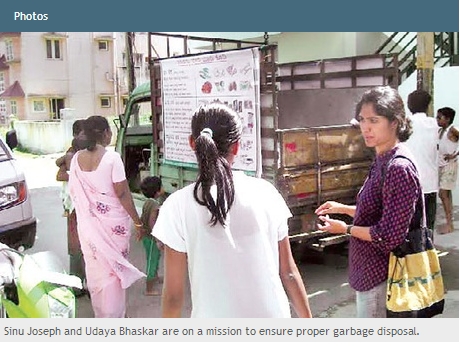
http://www.newindianexpress.com/cities/bangalore/Chasing-the-Evasive-Muck/2013/12/24/article1961626.ece

This is the most effective way to introduce something new to people.
Preaching isn’t enough, there are a lot of small hurdles that need to be removed before change will actually be implemented.
Enlisting the help of those involved insures that the new thing is OK with them – otherwise you wouldn’t be able to convince them – and that they understand what it’s going on!

Have you considered ‘being friends with your neighbors to such a degree that you may count on their help’ as being part of an adequate preparation for what ever we may have to confront in the future?

Image

M-a intrebat cineva ce cred despre articolul asta:

“Nouă personalităţi răspund pe ce se întemeiază credinţa lor: De ce cred în Dumnezeu”

Dupa ce am citit (doar) “Omul fara rost” am raspuns repezit:

“Icoana de pe peretele clasei nu este un indemn catre narcomanie sau orice altceva (din ‘clasa’ celor evocate de Dan C. Mihailescu) ci este unul catre conformism.

Si exact asta este motivul pentru care am intrat, cu totii, in criza in care suntem de vreo 50-60 de ani: am ascultat prea tare de altii si am imprumutat prea disciplinati modelele care ne-au fost propuse.
E adevarat ca dezvoltarea la care a ajuns spatiul cultural din care facem parte (cel ‘vest european’) are foarte mult de a face cu faptul ca am fost crestini numai ca noi oamenii am dat nastere crestinismului nu invers.
Cu alte cuvinte noi am dezvoltat crestinismul, noi l-am creat pe Dumnezeu (tocmai pentru ca avem credinta – “Nu M-ai cauta daca nu M-ai fi gasit!”) si nu invers.
Distanta care a aparut acum intre oameni si Dumnezeu nu se datoreaza faptului ca Dumnezeu ar fi facut ceva rau (nici nu poate, el este insasi ‘firea’ – tot ce exista – asa ca daca ar face ceva rau ar fi ca si cum si-ar trage un glont in picior.) Se datoreaza faptului ca unii smecheri incearca sa profite de credinta oamenilor. Prea mult preoti catolici isi bat joc de copii. Ortodocsii construiesc prea multe biserici monumentale si prea putine azile de batrani. Prea multi protestanti se straduie sa invete pe unii cum sa-i urasca pe altii (legile anti-homosexuali din Uganda se pare ca sunt opera unor evanghelisti americani) in loc sa-i indemne sa depaseasca diferentele dintre ei. Prea multe ulemale indeamna la varianta exterioara, violenta a jihadului.
In realitate oamenii nu se indeparteaza de Dumnezeu. Se indeparteaza de chipul pe care i l-au cioplit smecherii astia si ii cauta adevarata fata, cea care se arata fiecaruia dintre noi in particular si nu atunci cand batem matanii in fata bisericii ca Iliescu sau ca Bush dupa ce s-a ‘nascut a doua oara’. Sau ca sa ma intorc la Mihailescu oamenii merg “prin păduri, pe vârfuri de munte, prin livezi, podgorii, fâneţe, ori în largul mării” tocmai pentru ca acolo gasesc o fata a lui Dumnezeu mult mai sincera decat cele zugravite prin unele ‘altare’ sau zbierate prin difuzoare de unii predicatori!”
Abia dupa aceea am citit si restul articolului. Merita. Pe mine m-au interesat mai ales cele spuse de Radu Gologan. Pe urma am mai citit odata si predica parintelui Galeriu.

Image

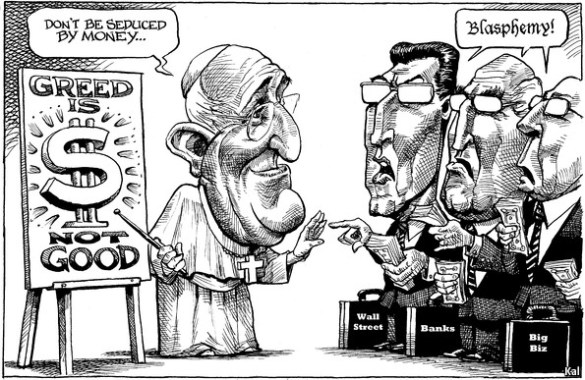
Yesterday I shared this picture on FB.

One of my friends asked me:
“How do you define “greed”. In the movie “Wall Street” Michael Douglas has this great speech saying that “greed is good” meaning that passion for things in life is good. Where is the line between greed and passion? Does that line look differently depending on where you are in the deal chain?”

This was my answer:
“This one is simple.
If you are willing to do your best in order to get something then you’re passionate ABOUT that something.
If you are ready to ‘step on corpses’ to reach your goal then you are ‘greedy’ FOR that something.”

Another friend commented:
“Well I have a problem with this; the Catholic church is one of, if not the richest organization in the world, how does the pope plan on distributing the assets? The church generally asks for 10% of your income to be ‘donated’; not mandatory but one of the heftiest taxes around. Practice what you preach.”

Me again:
“It seems that Romanians have already solved this conundrum.
We have a saying that goes like this: “Do what the priest says, not what he does!” ”

Thank you guys!

Ca tot ‘sarbatorim’ trezirea din 1989…

In postarea trecuta am adus vorba despre Sven Hassel.
Cei mai tineri dintre noi s-ar putea sa nici nu fi auzit despre el. A fost un soldat din armata germana care a reusit sa supravietuiasca razboiului – si l-a facut pe tot, din ’39 pana in ’45 – iar apoi a povestit ce i s-a intamplat.

In ’40 a dezertat. A fost condamnat la puscarie iar dupa cateva luni a fost transferat intr-un regiment disciplinar. Ca atare a mai facut un stagiu de instructie. Numai ca de data asta ‘instructia’ avea mai degraba de a face cu ‘reeducarea’ (vezi ‘Fenomenul Pitesti’) decat cu antrenamentul specific militar. Intr-una din cartile lui povesteste ca ‘instructia’ asta cuprindea si momente in care trebuiau sa se prezinte la o ‘inspectie de front’ (unde pentru o pata de noroi pe uniforma primeau pedepse crunte) la o jumatate de ora dupa ce se intorsesera din cite un mars de doua zile prin noroaie. Singura solutie era sa intre sub dus cu uniforma si tot echipamentul pe ei si sa spele tot acolo, pe loc. E de presupus ca apa de la dus era daca nu calda atunci macar incropita, altfel nu ar fi avut nici o sansa…

Ei bine, in primele 3 sau 4 saptamani de armata acolo unde si cand am fost eu incorporat nu a curs apa aproape de loc. Nici rece si cu atat mai putin cea calda. Si mi-am “satisfacut stagiul militar” in mijlocul unui municipiu – Focsani – din Romania anului 1981 si nu undeva in Germania anului 1940…

Pana la urma asta a fost motivul pentru care au cazut regimurile comuniste. Nu comunismul nu ‘a cazut’ inca, mai sunt nostalnici care mai cred ca utopia asta ar fi putut fi pusa in practica, dar despre asta mai tarziu!

Regimurile comuniste au cazut pentru ca asa ceva nu putea functiona!

It’s the economy, stupid!