Archives for posts with tag: Marx

‘Revolution’ might be sexy and hype but our lives are shaped by counter-revolution.
Ilie Badescu, PhD

Marx, Karl Marx, is considered the quintessential revolutionary philosopher.

Ilie Badescu – a Romanian Professor of Sociology, proud of his reactionary convictions – makes a very poignant argument. ‘We live in counter-revolutionary times. Almost always. After each revolution, whatever was changed during the upheaval has been mitigated by the survivors to fit with the existing circumstances.’

The Communists are distinguished from the other working-class parties by this only:
1. In the national struggles of the proletarians of the different countries, they point out and bring to the front the common interests of the entire proletariat, independently of all nationality.

2. In the various stages of development which the struggle of the working class against the bourgeoisie has to pass through, they always and everywhere represent the interests of the movement as a whole. The Communists, therefore, are on the one hand, practically, the most advanced and resolute section of the working-class parties of every country, that section which pushes forward all others; on the other hand, theoretically, they have over the great mass of the proletariat the advantage of clearly understanding the line of march, the conditions, and the ultimate general results of the proletarian movement.
The immediate aim of the Communists is the same as that of all other proletarian parties: formation of the proletariat into a class, overthrow of the bourgeois supremacy, conquest of political power by the proletariat.
The theoretical conclusions of the Communists are in no way based on ideas or principles that have been invented, or discovered, by this or that would-be universal reformer.
They merely express, in general terms, actual relations springing from an existing class struggle, from a historical movement going on under our very eyes. The abolition of existing property relations is not at all a distinctive feature of communism.

The Communist Manifesto

Karl Marx and Friedrich Engels wrote this in the first half of the XIX-th century. During quite revolutionary times… Or rather?!?

‘The communist ideas have not been invented or discovered by this or that would-be universal reformer’…

Those familiar with the history of communism know – or should – that both Marx and Engels had been born and raised in Prussia. At that time, until 1848, Prussia was run as an absolute monarchy.
Engels came from a wealthy merchant family who owned textile factories in both Barmen, Prussia, and Salford, England.
Marx was born into a well off family. His father, Heinrich, owned a number of vineyards and was an attorney. Eventually, after an engagement spanning 7 years, Marx married the educated daughter of a liberal aristocrat, but not before befriending his future father-in-law.

Neither had any blue-collar experience. Yet they co-authored the Communist Manifesto…

“How is capitalism better than socialism and communism?”

First of all, capitalism, socialism and communism are four different things.
Socialism, per se, is two things.
Funny, right?

There is the democratic socialism. A social arrangement where ‘nobody is left behind’ and where the economy is run according to capitalist principles.
And there is the ‘stepping stone’ socialism. The ‘prep class’ a Marxist society was supposed to graduate from before acceding to communism. In fact, the former USSR – as well as all the other former ‘communist’ countries had never reached that stage. Stepping stone socialism is something nobody has yet been able to graduate from.

‘Stepping stone’ socialism and communism are bad. For the simple reason that both are authoritarian regimes. Run by a small group of people according to their own whims. Pretending to mind the best interests of the entire people but, in reality and like all other dictatorships, minding exclusively their own businesses.

Capitalism? Nazi Germany was capitalist. Not good. Because it was Nazi…

‘Capitalism’, the entire gamut covered by the blanket term, is neither good nor bad. People collaborating using capitalist principles can reach for the stars – literally – while people obsessed with amassing money will, eventually, end up in a cul de sac. Remember what happened in 2008?
Free market capitalism, run by a democratic society, makes wonders. The USA until 2008, Canada, Australia, New Zealand, Japan and South Korea after they had regained their freedom, W. Europe. Great Britain.
The problem with free-market capitalism being the freedom of the market. In order to make wonders, the market must remain functionally free. Free from obsessions, free from monopolies, free from political heavy handed interventions. And equipped with a sturdy social safety net. The US used to have one. W. Germany also. Unfortunately, that kind of capitalism is very hard to find nowadays… Too many oligopolies have cornered too much of the former free market and too many safety nets have been transformed into pampering devices for dependent people. Some of whom are already rich!

We’re currently experiencing a tug-of-war.
Frustrated people have been harnessed to pull in diametrically opposed directions.
Some have somehow been convinced that the free market should be allowed to become a MMA cage. A no holds barred free for all fighting place. And what if the whole thing will eventually be dominated by your local bully? We’ll deal with that if/when it will happen.
Others have been duped to believe that capitalism is bad. That usury is not an abuse but the defining characteristic of capitalism. Hence a compelling reason for capitalism to be rejected lot, stock and barrel!

OK, for the sake of the argument, let’s look for a replacement. A replacement for Adam Smith’s capitalism.

Let me remind you that bona fide socialism relies on redistributing wealth created using capitalist principles.
That stepping stone socialism is a mockery. An undercover capitalism where all significant property is owned by the state. Where all decisions are made by the government. By the revolutionary government which pretends to know better, as advertised by Marx. Karl, not Groucho.
And that ‘real communism’ is nothing more than a thought experiment! Wouldn’t it be nice if? Yes, it might have been nice if the practical aspects of the whole thing didn’t prevent those who have tried it from reaching their goals.

Redistribution of wealth is an anti-marxist technology.

Taxing the super-wealthy and redistributing the proceeds towards education, health care and infrastructure makes it possible for the middle class to survive.

Otherwise, the marxist prophecy will come true.

No sooner is the exploitation of the labourer by the manufacturer, so far, at an end, that he receives his wages in cash, than he is set upon by the other portions of the bourgeoisie, the landlord, the shopkeeper, the pawnbroker, etc.
The lower strata of the middle class — the small tradespeople, shopkeepers, and retired tradesmen generally, the handicraftsmen and peasants — all these sink gradually into the proletariat, partly because their diminutive capital does not suffice for the scale on which Modern Industry is carried on, and is swamped in the competition with the large capitalists, partly because their specialised skill is rendered worthless by new methods of production. Thus the proletariat is recruited from all classes of the population.

Read what Marx had to say about things if you want to avoid the marxist abomination.

Marx’s idea of revolutionary progress was based on the notion that property, hence wealth, must be abolished. Abolished, altogether, and not redistributed!

‘Redistribution of wealth’ means everybody pulling their own weight/contributing their fair share instead of ‘the the already rich taking the lion’s share’.

Redistribution of wealth means preserving the concept of property/wealth and maintaining the functionality of the capitalist free-market.

“Until philosophers rule as kings or those who are now called kings and leading men
genuinely and adequately philosophize,

that is, until political power and philosophy entirely coincide…
cities will have no rest from evils…
there can be no happiness, either public or private, in any other city.”

Plato, circa 375 BC

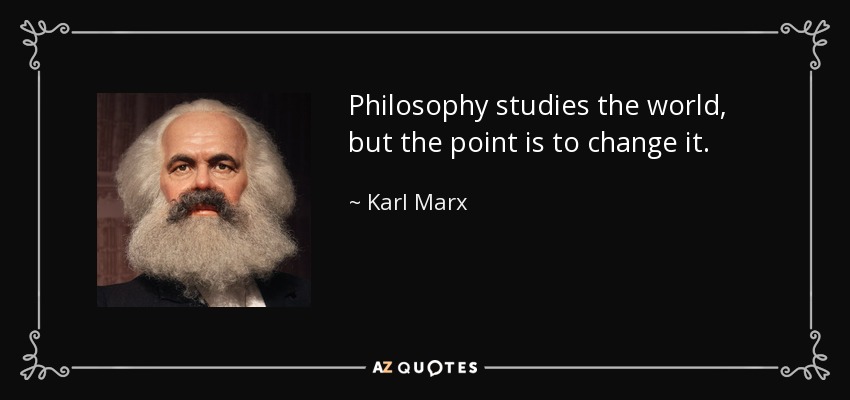
The philosophers have only interpreted the world, in various ways.
The point, however, is to change it.

Marx,1845

“God is dead. God remains dead. And we have killed him.
How shall we comfort ourselves, the murderers of all murderers?
What was holiest and mightiest of all that the world has yet owned has bled to death under our knives: who will wipe this blood off us?

Nieztsche, 1882

The Social Responsibility of Business Is to Increase Its Profits
Milton Friedman, 1970

“Real life, says Heidegger, happens when beings become ‘unhidden’,
when we help bring things out of their hiding places
and step out of our own along with them, into the light of being itself.
It happens in rare moments when we see links between
‘beings themselves, the human world, the work of God.’
It can only occur, he says, when you’re disturbed by a sense that real life is elsewhere.”

Peter Holm Jensen, 2023

Wood is the raw material we use to make timber. And paper.
Steel is the raw material we fashion into tools. And weapons.
Words are the raw material we shape into ideas.

We use timber to build houses.
Paper to print poetry.
Tools to transform nature into civilization.
Ideas to make sense of the world we live in. And of ourselves.

When angry, we burn houses. Print lies. Transform tools into weapons and use them to destroy.
When angry, we no longer see eye to eye about meaning.

Almost two and a half millennia back, Plato told us us that “until political power and philosophy entirely coincide…
We had chosen, while ‘angry’, to interpret Plato’s warning as being a ‘blue print’. A ‘boiler plate’ for ‘how to breed appropriate rulers’. https://www.britannica.com/topic/philosopher-king.

Karl Marx, while terribly angry – and not without reason, had chosen to put in practice, tentatively, the generally accepted version of Plato’s work.
The Communists, therefore, are on the one hand, practically, the most advanced and resolute section of the working-class parties of every country, that section which pushes forward all others; on the other hand, theoretically, they have over the great mass of the proletariat the advantage of clearly understanding the line of march, the conditions, and the ultimate general results of the proletarian movement.“.

Nietzsche confessed, publicly, “God is dead. God remains dead. And we have killed him“.
We have chosen to place the onus on him. As if it had been he who killed God. Alone…

Friedman – Milton Friedman the economist, not a word-smith nor a philosopher – had formalized the public opinion prevalent during his ‘tenure’. That corporations should stick to what they were good at – producing things in an efficient manner, hence being profitable – and leave social intervention to those concerned with solving that line of specific problems.
NB. I’m not suggesting Friedman was right. More about ‘being right’ in a short while. I’m only stating that both Friedman’s sycophants and detractors – including me – have been near-sighted.

Heidegger was the guy who brought back into discussion the notion of Aletheia. “the presocratic way to truth, as unconcealment.
Truth as the the ‘politically’ sanctioned expression of reality. “until political power and philosophy entirely coincide…

In a sense, we’ve spent the last two and a half millennia updating Plato’s to Heidegger’s wording of how to make sense of truth.
We haven’t been able to come up, yet, with a convincing version because we’ve chosen to ‘ignore’ Buddha’s “truth that misery originates within the craving for pleasure“. That ‘misery’ originates from our ‘rational’ desire for ‘being right‘.

That misery originates from us being angry, collectively, for not being able to reach ‘the truth’ individually.
That misery originates from each of us, individually, craving to be ‘right’. Each on our own…

The Buddha taught that nothing is permanent and that everything is impermanent.
Therefore, people should avoid getting attached to things as eventually everything will change.
People suffer when they crave and when they get attached to people and objects.

Being right, individually, is both incomplete – as Heidegger pointed out – and temporary. According to both Siddhartha Gautama and Karl Popper.
Being angry about not being right is not helpful. On the contrary…
It compels us to defend our version of truth and it blinds us towards all others. Regardless of how they complement ours.
Renders us incapable to politically sanction a comprehensive version of truth. Renders us incapable to build Aletheia.

The Polish state broadcaster on Saturday suspended
a television journalist who, during the Olympic Games opening ceremony,
reacted to a performance of John Lennon’s “Imagine” by saying it was a “vision of communism.”

Communism is perfect!
Communism is the perfect lie…

Communism was ‘invented’ by Marx and proposed as the only solution to a real problem.

The problem with communism as a practical solution is that it cannot be put into practice!

Humans, both at individual and social level, need freedom.
Without individual and social freedom, individuals regress to an animalic state and societies fail. Abysmally!

According to Marx, communism was the only solution for what he had perceived as a problem.
According to Marx, when a critical mass of people belonging to the middle class will become destitute, they will accept to be led out of their predicament by ‘the communists’. But since the rest of the society continues to enjoy their perks or to ignore the dangers ‘lurking in the future’, in order to achieve their goal – communism for everybody, including for the unwilling, the communists will have to institute the socialist dictatorship. As a transition phase to communism. A phase in which the unwilling will be convinced.
According to history, no dictatorship – including the socialist – has ever survived. Has ever achieved its goal.

Communism, at least for now, is unattainable. For the simple reason that humankind has not yet learned how to survive dictatorship. How to live without freedom.

On the other hand, communism is very alluring.
For the idealists amongst us…
Communism is a very suitable subject for dreaming. A very nice thing to have, albeit impossible to achieve…

Since the idealists are hard to convince, let me speak to the practical minded amongst you.
John Lennon invited us to dream. To dream a world with ‘no possessions’ and with ‘no need for greed or hunger’. What’s not to like in this dream, except for the fact that it can’t be put in practice?
Hunger is natural. Why eat if not hungry?!?
Greed is also natural.
Who doesn’t like/want more of what they consider to be pleasant?!? The wise amongst us?
How do we become wise? As wise as each of us is able to become…
By interacting with others? By learning from them? And from the consequences of those interactions?

Property – possessions – is a tool.
A tool society uses to make order. If each of us knows what they are able to use for what purpose things go smooth. There’s no need for outside intervention. Granted, this is valid for only as long as each – well, at least most – members of the society have enough to eat, where to sleep and what to protect their backs with.
Without the order construed by the society, collectively, using the tool known as ‘property’, how are the people going to cooperate?!? To interact? To learn, even…

How about we wake up?
Sleep is essential and dreaming a normal part of it.
But we also need some wake up time!
Pun intended…

What are the errors of Marxism?

Marxism is an ideology.
Ideologies don’t have errors, they are thought templates used to evaluate a certain situation and to determine what to do next. Ideologies are tools.
They can be used properly or improperly.
Sometimes, the best use for certain tools is to be left alone. Particularly when you understand they are useless. If you understand they are useless…
Hence it’s not Marxism which is full of errors, it’s the Marxists who are barking up the wrong tree.

If you really need to put your finger on something, if you need to point out a culprit, I give you Marx.
Yes, Karl Marx is your man.
His analysis was brilliant. His diagnostic was spot on.
Finally, in times when the class struggle nears the decisive hour, the progress of dissolution going on within the ruling class, in fact within the whole range of old society, assumes such a violent, glaring character, that a small section of the ruling class cuts itself adrift, and joins the revolutionary class, the class that holds the future in its hands. Just as, therefore, at an earlier period, a section of the nobility went over to the bourgeoisie, so now a portion of the bourgeoisie goes over to the proletariat, and in particular, a portion of the bourgeois ideologists, who have raised themselves to the level of comprehending theoretically the historical movement as a whole.
His cure – the mandate he gave to the “bourgeois ideologists who have raised themselves to the level of comprehending theoretically the historical movement as a whole”, and whom he called “communists” – was abysmal.

Which tells us Marx’s brilliant analysis wasn’t deep enough. He had noticed a series of facts but he had failed to notice the bigger picture. He had failed to see that all authoritarian regimes had failed. Under their own weight. Inevitably. And he had failed to notice that all democratic regimes had survived, and thrived, for as long as they had managed to preserve their democratic nature.

Hence the Marxist cure, communism, was stillborn.
A tool to be left alone.
The attempt to impose yet another authoritarian regime – with no matter how generous intentions – after the overwhelming experience of all other authoritarian regimes failing abysmally, is nothing but the compelling proof of social and historical blindness.

And why start this post by quoting Marx himself?
Because that quote is more than enough. More than enough proof for Marx being a bully.
It’s OK to ‘change the world’ if you own it. If it was yours…
But bearing in mind that there are other people living in the same world… wouldn’t it be nice to ask their opinion about the whole thing? About the changes you want to make? Which changes will dramatically affect the world they live in?!?
They are simpletons? Whose opinions are worthless? Because you said so yourself?

“The lower middle class, the small manufacturer, the shopkeeper, the artisan, the peasant, all these fight against the bourgeoisie, to save from extinction their existence as fractions of the middle class. They are therefore not revolutionary, but conservative. Nay more, they are reactionary, for they try to roll back the wheel of history. If by chance, they are revolutionary, they are only so in view of their impending transfer into the proletariat; they thus defend not their present, but their future interests, they desert their own standpoint to place themselves at that of the proletariat.

The “dangerous class”, [lumpenproletariat] the social scum, that passively rotting mass thrown off by the lowest layers of the old society, may, here and there, be swept into the movement by a proletarian revolution; its conditions of life, however, prepare it far more for the part of a bribed tool of reactionary intrigue.”

As I just said.
Bullly!!!

Tough times create tough men. Tough men create easy times.
Easy times create weak men. Weak men create tough times.

American proverb
Wealth lasts only for three generations: one to make it, one to keep it, one to squander it
Chinese proverb
If you raise your children, you get to spoil your grandchildren.
If you spoil your children, you get to raise your grandchildren.

Popular word of mouth

There’s no denying that, on average, each generation fares better than its predecessor.

Then why some people end up worse than their parents?
Is it a social thing?
Is it in their upbringing?
Is it the consequence of bad personal choices?

The easy way out would be to consider that legislation, material status, the culture one was born into and even the upbringing offered by the parents are nothing but circumstances. And, ultimately, it’s the individual who makes the call. And bears the consequences…
But the above mentioned individual doesn’t rise from and into a complete void… so I need to go deeper!

An equally true but somewhat more useful observation would be that we’re dealing here with something more important than mere wealth.

‘There’s no such thing! Nothing is more important than Wealth!’

Yeah, right… Individual people keep squandering the personal wealth accumulated by their forefathers, the humankind keeps going forward and you tell me personal wealth is the most important thing here…

But you do make a good point. Your insistence, obsessive even, about wealth being the crux of everything is very relevant.
Since I agree with you that wealth is important, indeed, then maybe it’s the ‘insistence’ which is causing the problem…

First of all, allow me to make a simple distinction.

There is wealth – structured opportunity, I’ll discuss this notion in another post, and there is personal wealth. Opportunity which belongs to somebody.
When an individual squanders the wealth inherited from their parents – or even that which they had managed to put together themselves, the wealth itself – the accrued opportunity – doesn’t disappear from the face of the earth. It just passes from one hand to another. Most of it, anyway. For the simple reason that most of today’s wealth is expressed in money. Which is fungible.

‘OK. So individual people squandering their inherited wealth do not represent such a big problem. The total wealth already present ‘on the face of the Earth’ remains (more or less) the same, no matter who owns it. And since new wealth is created everyday, the humankind, on aggregate, goes forward.’

That’s how things used to be. That’s how things had evolved for the last ten millennia or so. Ever since our forefathers had invented agriculture. Agriculture and money… Land and money cannot be destroyed. Buildings and almost everything else which carries value can. Be destroyed. Land and money also, actually, but it’s a lot harder to do it.

But there’s a catch here.

For wealth to do its trick – to function as an opportunity, people have to have access to it.
That’s why, for example, people do not keep their money under the mattress. When deposited in a bank, money will end up being used. The bank will lend them to somebody who needs it and that somebody will put that money to work, In no matter what shape or form. Kept under a mattress, money becomes mostly useless. At least for the time being…
And this is where ‘insistence’ – our obsessive insistence – that money is the only worthwhile goal for any respectable person becomes counterproductive.

‘Are you a communist?!?’

On the contrary, my dear Watson!

In fact, Marx had been just as infatuated with money as Milton Friedman was going to be a century later. With more or less similar results…
Friedman taught us that greed is good. Profit uber alles. That getting money trumps everything else. That getting money is not only good for the individual itself but also commendable. That everybody should make it their goal to become rich!
Marx, on the other hand – please remember that the ‘other’ hand is nothing but similar to its twin – advocated for all wealth to be stripped from its rightful owners.
See what I mean? Both Marx and Friedman had been thinking only about ownership. Who owns that wealth!

On average, we deal with the same situation.
According to Friedman – pushing his advice to the very limit, there’s no problem if someone owns all the money in the world. If it so happened, so be it.
According to Marx, nobody should own anything.
On average, the wealth corresponding to each living human in both situations would be the same.

We already know the consequences of Marx’s teachings. When all the wealth present in one country is managed by a very small number of people, the whole situation goes south. Fast. Very fast!
We also know what happens when the market is cornered. Becomes suffocated by a monopoly. The whole situation goes south. That’s why we cherish the freedom of the market!

Doesn’t make much sense?
To insist that the market must be free and simultaneously maintain that ‘greed is good’?

Yep! My point exactly…

The vaunted human capacity for reason may have more to do with winning arguments than with thinking straight.
Illustration by Gérard DuBois
Why Facts Don’t Change Our Minds
New discoveries about the human mind show the limitations of reason.
By Elizabeth Kolbert February 19, 2017
https://www.newyorker.com/contributors/elizabeth-kolbert

For some reason, there still exists a considerable number of people not yet convinced that what had been experienced in the Soviet Union was “a true socialist/communist form of government”

The sad reality is that the Russian Revolution did establish a true socialist form of government!
As per Marx’s teachings.
The communists had been in charge of things, and the things failed to become better.
In fact, they had become worse.
Eventually, the Soviet Union – along with all other socialist attempts, had crumbled under their own weight.

Those who want to find better alternatives to democratic capitalism – good luck with that – need to find another word but socialism to describe their goal.
Or wait a few generations before attempting to give it a new meaning. The current one had been wasted by the likes of Marx, Lenin, Stalin, Mao, Kim, Ceausescu…

People who have never experienced communism speak freely about it.
Some are frightened by it – as they should be, while others are looking forward to it.

People who have no real idea about what fascism/nazism was about speak freely about it.
Some are frightened by it – as they should be, while others are looking forward to it.

While there is a consensus about communism being a ‘far left position’, fascism is usually – but not unanimously, considered to be ‘far right’. Some even speak about a ‘third position‘, whatever that might mean.


The way I see it, what we have experienced as fascism is what Marx had in mind when he wrote the Communist Manifesto.
According to Marx, at some point in what he hailed as ‘the future’, the middle class was going to become poorer and poorer. All the wealth generated by the capitalist economy and governed by the increasingly imperialist/monopolist states was going to be herded into fewer and fewer hands.

As a consequence, once impoverished, people until then belonging to the middle class were supposed to realize they had been duped and let themselves be led – out of misery – by the communists. ‘The most advanced and resolute section of the working-class parties of every country …’

What Marx was prophesying had soon enough come to be. The post WWI German and Italian peoples had lost their hopes and allowed themselves to be led by those who pretended to put ‘the best interests of the people’ above everything else.

Same thing happens whenever a crises is deep enough to impoverish a significant number of people. Who loose their hopes and allow callous political operators to advance closer and closer to power.

What we have experienced as ‘communism’ was a Leninist short-cut.
In Marx’s view, communism was going to happen after economically advanced societies had reached a certain pinnacle.
Lenin – and Mao, had introduced ‘socialism’ and ‘popular democracy’ as intermediary stages between their underdeveloped societies and what Marx had in mind.

So no, there is no such thing as a ‘third position’. We have democracy – where left and right cooperate towards the common good, and authoritarianism.
While democracy is clear and transparent, authoritarianism hides its true nature under a chameleonic cloak. Painted, by the spin doctors who run the show, in whatever hue happens to be more attractive to the masses which are about to be fooled.

Afterthought. I googled ‘third position’ and found out that:

“In the last few years of the 20th Century, according to an article by Chip Berlet, a new form of fascism emerged in a period of resurgent neo-fascism. Called the Third Position, it seeks to overthrow existing governments and replace them with monocultural nation states built around the idea of supremacist racial nationalism and/or supremacist religious nationalism.”

Footnotes:


https://www.marxists.org/archive/marx/works/download/pdf/Manifesto.pdf

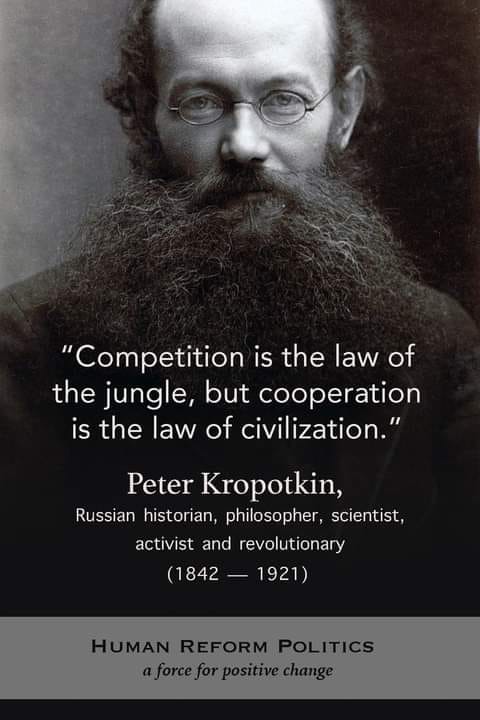
The Bolshevik Revolution had nothing to do with cooperation. Nor with civilization.
It was nothing but the famished underdog eating the bloated plutocrat.
The ensuing indigestion lasted for almost a century and resulted in a huge number of people suffering from ideological food-poisoning. Too many of the poisoned ending up dead…

Yet here we are. Again!
Trying to sort out a re-heated dish.
Which had already been proved to be unpalatable!

No wonder ‘gaslighting’ had been determined to be ‘word of the year’…

As for Kropotkin… he was a true revolutionary!
He was gaslighting his audience before the term had even been coined…

‘Jungle’ – or ‘bush’, is where evolution takes place.
Some of us might see it as a venue for cut-throat competition but it’s nothing but the opposite of it.
The fact that some of us misperceive the jungle doesn’t change the evidence.
In nature, death doesn’t happen at the whim of someone.
A lion kills only when hungry. And chooses to hunt the already weak. Leaving the rest of the herd in a better situation.

The kind of cooperation designed by Marx and put in practice by Kropotkin – the communist ‘civilization’, is the epitome of stagnation. When humans are no longer free to fine-tune competition with cooperation – and are forced to cooperate as they are told to from above, things end up in chaos.

All revolutions – 1789, 1917, 1989, have proven – time and time again, that things cannot be sustainably maintained as the rulers consider to be appropriate. That no matter how skillful the ‘designers’ consider themselves to be, society is a too complex thing for a small gang of however powerful people to be able to ‘keep afloat’.
This being the point where Marx, along with all other ideologues, had gotten it completely wrong.

The Communists, therefore, are on the one hand, practically, the most advanced and resolute section of the working-class parties of every country, that section which pushes forward all others; on the other hand, theoretically, they have over the great mass of the proletariat the advantage of clearly understanding the line of march, the conditions, and the ultimate general results of the proletarian movement.

According to Marx, it’s enough for a bunch of people to pretend they have a ‘theoretically clearer understanding of the line of march’!
In fact, this is the sole argument made by Marx when explaining why the communists were entitled to lead the proletariat.
‘Because they knew better!’

Well, we know, now, what it means to be led by people who pretend to be above all others!
By people who pretend to be better than the rest…