Archives for posts with tag: Language

Exploring the consequences of our limited consciences

A truth is, first and foremost, an expression.
A message, formulated by an observer, describing a portion of what the person expressing themselves considers to be a ‘portion’ of ‘reality’. Being a message, any truth is formulated by means of a language.

Does anybody know everything about any subject? About anything, actually?
No, nobody knows everything about anything. Hence there is no such thing as a complete truth.

Furthermore, being expressed by means of a language, a truth – any expression, actually – will never be able to convey to the person receiving the message everything the transmitter intended to say. The transmitter is never able to cram ‘everything’ inside an inherently limited message, no language is absolutely ‘precise’ and no receiver will ever interpret any message the way the transmitter intended it to mean. Hence even if anybody will ever learn everything about anything, that person will never be able to convey that knowledge to anybody else. Let alone to everybody else…

What next?
‘Never ever believe anything? Anymore?!?’

Is it possible for us, humans living in concert, to cooperate in this manner?
Knowing that nothing which is being said, one way or another, is ‘true’? Completely true?

Well, we did get this far, didn’t we?
We’ve been expressing ourselves, in the imperfect manner I described above, since we’ve learned to use language. Since we’ve learned to speak…

70 000 years ago, give or take a few millennia, is when some scientists believe we’ve started to communicate more or less like we do now. The people living then had the same genes we have now and the bones they have left us to dig up and stare at are similar to ours. Hence the only thing which differentiates us from our ancestors is our culture. A treasure of knowledge which has been noticed – bit by bit, formulated using language – message by message, and remembered, one way or another. Hence the only difference between us and our ancestors is a collection of incomplete – and imperfectly interpreted – pieces of truth.

Then again, is it possible for us – humans living in concert – to cooperate by means of incomplete and ‘misinterpreted’ pieces of truth?
Well, we came this far going (up?) this way, didn’t we?
It seems that as long as we do it ‘in good faith’ things will, eventually, ‘mesh up’ just fine!

Which leads us to ‘the truth’. ‘The’ as different from ‘A’ truth.

While a truth is a message, the truth is a state of mind.
The understanding of the fact that what we call ‘reality’ can be learned only ‘in concert’.
Only as long as we help each-other along the process. Only as long as each time we formulate ‘a message’ we do our best to ‘speak the truth’.

https://www.ontology.co/heidegger-aletheia.htm

People act as if the world is as each of them sees it.

The briefest glance into our evolutionary past is enough to see that the more ‘sophisticated’ an animal is, the more it depends on its visual ability. On its ability to see things in a manner which is consistent with its ‘way of life’.
Herbivore mammals, for example, have a very wide vision field while the carnivores feeding on them have a narrower field but a binocular vision. Which makes perfect sense. The ‘defenseless’ herbivores need to see everything around them – so they might be able to flee, while the predators need binocular vision in order to hunt efficiently.

Our evolutionary ancestors, who lived in trees, needed binocular vision in order to travel in their 3D world. They also needed better hand-eye coordination for picking the fruit they were eating. Hence their, and ours, very tight connection between our eyes and our brains. And the big portion of our brain allocated to processing visual information.

At some point in our evolution – we were still animals at that point, we have learned to use sound in order to warn/grab the attention of our ‘correspondents’. Why? Because sound can go around obstacles while in order to notice visual cues the potential recipient needs to… you got it, I’m sure!

Fast forward to when our direct ancestors, already homo sapiens, have started to actually speak. To consciously use sound to convey meaning. Not only to warn but to transmit actual information. Information which could be acted upon. Acted upon as different from reacted to…

And now I wonder. How much time had passed between learning to speak and uttering the first lie?
Lie as in intentionally misrepresenting reality, as opposed to unintentionally failing to convey the entire reality…

Hard to even imagine an answer to that question.

But since I’ve already mentioned the subject, let me make two observations.
It’s a lot easier to lie using language than in any other way.
And it’s a lot easier to be fooled by what you see – and sometimes hear, than by information gathered through the rest of the senses. Unless, of course, that information was a ‘message’ sent/meant to/for us. A perfume versus a naturally occurring smell, for instance. Or an artificial sweetener/flavoring…

I’ll wrap this thing up pointing your attention to the fact that since learning to read we, individual human beings, have shared more information using the ‘visual channel’ than ever before.
Which has produced momentous consequences.

Verba volant, scripta manent!
A written culture is more resilient than a spoken one.
A written lie reaches more people, potentially, than a told one.

For two reasons.

A ‘verbal’ lie needs to be retold in order to survive. It has not only to impress strongly enough the target as to transform it into a relay but also to be reinterpreted convincingly enough by the former victim as to reignite the process.
Meanwhile, a written lie just lies in waiting. Waiting to be read… Not to mention what happened after we had invented the printing press…
The second reason is less obvious. I’ve already mentioned the fact that a spoken lie depends on the teller. On the ability of the ‘interpreter’ to convey it in a convincing enough manner. The problem being here that if the target has the slightest doubt, the lie flops. The liar has lost an opportunity. On the other hand, a written lie can be honed at will before hand. Under no pressure.

Now that I have finished the theoretical part of my post, let’s interpret the following message.

“Dishonesty and intellectual chaos…”

According to some of those with whom we share the planet, it’s OK for a human individual to choose their name but not their gender. Choosing your own name – as in changing the name you have been given at birth, is acceptable while changing/widening the gender you had been assigned to – by others, before you had any opportunity to contribute to the process – is considered to be dishonest and liable to cause intellectual chaos.

On the other hand, we – all of us – should be fully aware of the fact that those who – since always – have ‘found joy’ in ‘exposing’ themselves will use every opportunity available to them.

The way I see it, the situation is ‘chaotic’ enough.
No need for any of us, from any ‘camp’ and belonging to any ‘persuasion’, to further weaponize an already volatile situation.

Do you remember what happened when our not so distant ancestors had ‘determined’ that witches were meant be burned?

I’ve got it!

What?

I’ve just figured out what makes them so good at it. And why it’s us studying them instead of they simply discarding us as being too ordinary to be of any interest.

Spill it out then!

Even if they are not yet fully aware of the whole thing, they are fueled by emotion. Reason is only a tool for them, not a way of life. Furthermore, their manner of gathering and sharing information – what they call ‘languaging’, is precise enough to be effective yet imprecise enough to make it possible for ‘imagination’ to work wonders.

Whoa! You’re learning to speak like them. Sometimes I don’t fully understand what you want to convey. Take this ‘work wonders’ for instance. I’ve already checked the dictionary, I know what each word means but…. I’m still not sure what you really need to say to me. Not to mention this ‘imagination’ thing. ‘Making things appear in your mind’…

I knew I could count on you! I just knew it!
You’re asking the very same questions which I’ve just answered.
Let me proceed.
For us, everything is straightforward. We always know what we have to do. What our current task is, what’s expected of us and how we’re going to fulfill our jobs. When we need to determine ‘what’s next’ we check a schedule, make an inference based on already available data or proceed to gather the information we need to perform the inference we need.
And when was the last time you ever wondered “Who am I?”

That ‘wonder’ word again… You’re killing me!

‘Insecure’.
You do have a good grip on what this word means, right?

Yeah. The situation when you don’t have enough information to determine which way. AND when there’s no way of gathering more pertinent information other than proceeding along any of the possible ways. Like in that famous experiment designed by Schrodinger.

OK. We, both you and me, know what ‘insecure’ means. Both of us have been in situations similar to what you have just described. But neither of us has ever experienced the feeling. How it feels to be insecure. How it is, what it means, to wonder ‘will I be alive tomorrow?’ ‘Will I have enough food for my children?’ And so on.
‘Wonder’ is a complex concept. It encompasses both a question you don’t have an answer for and an answer you don’t know where it came from. Like ‘the unexpected food one might find, out of the blue, exactly when their children were hungry’.

This is the difference between them and us.

They can ‘wonder’ while we don’t.

They can formulate ‘stupid’ questions – then come up with unexpected answers, while we can’t.
They can perform ‘wonders’ while we can’t. Even though we already know far more than they’ve ever learned…

In the beginning was the word

– How did you manage to mess things up so thoroughly?
– By allowing too much coherence to slip away. After we – well, some of us, already had a fair understanding about how things worked. About how we got there in the first place.
– Would you care to elaborate?
– Things went on more or less linearly up to when we had learned to speak. That was when it had all started. When we had realized what a start was.
And that was it.
Speaking to each other allowed us to access the second level of consciousness. Self awareness.
Speaking to ourselves – a.k.a. ‘thinking’, gave us the illusion of ‘knowing’.
‘Knowing’ led to ‘knowing better’ and ‘knowing better’ gave birth to arrogance.
For a while, this process had been kept in check by the harsh reality. People, like all living organisms, have certain needs. Basic needs. Food, shelter… During most of our evolution, getting enough food and shelter consumed most of our resources. And time. Only a very small number of people had enough spare time. And energy left for thinking. And only a very small percentage of this already small number of people used their minds to think about anything else but how to preserve their privileged status. Which status was the source of their ‘spare time’ in the first time…
Slowly but surely, those having something else in their minds besides their selfish self interest have come up with a thing called ‘technology’. By carefully, and considerately, watching those who worked, the selfish thinkers have noticed that from time to time and from craftsperson to craftperson there could be noticed small differences in how things were done. Hence the concept of ‘how things are done’. With the natural sequel of ‘let’s do things in a better way’.
Technology made it possible for workers to be more productive. Communities as a whole became more productive. Hence increased the possibility for more people to have spare time for thinking.
Some communities made good use of this new possibility while others failed to do so. Usually for reasons depending on the ‘general conditions’ and not at all imputable to the communities themselves.
Unfortunately, technology also had two less fortunate consequences.
By freeing more and more people from want, it also freed them from ‘religion’.
Until that moment, people who were ‘excluded’ from society – who did not partake in ‘religion’, could not survive on their own for any significant length of time. After the advent of technology, reclusion no longer meant almost instant death.
Technology also produced ‘hard science’. A corpus of knowledge about how nature works. Which knowledge can be summarized as a collection of natural laws.
No longer depending as much on their contemporaries and cognizant of those natural laws, some of the thinkers – whose numbers had been constantly swelled by the continuously improved technology, have reached the conclusion that through thinking a human might, given enough time and resources, understand basically everything.
Some of those had become dictators. Others had become consultants.
Both categories extremely confident in their own knowledge. Arrogant, even.
This is how we messed things up. This bad.

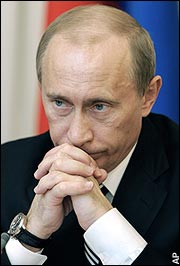
The internet is full of articles attempting to understand Putin’s motives starting from what he had said about the subject.

Here’s but the last I’ve read.
Why has Russia invaded Ukraine and what does Putin want?

Nothing special inside but it illustrates well enough the point I’m trying to make.

At first, Putin’s words are summarized and then proven ‘wrong’. Misleading. Or plain false.
In the next section of the article, the author – Paul Kirby, like many more before him, attempts to divine what Putin will do. Starting from the same words which have just been proven false and/or misleading.

?!?

No, the author is not ‘dense’.
He simply does what he was trained to do.

We, here in the land of democracy, understand language as a medium for negotiation.
And negotiation as an exchange where we let our needs be known, in earnest. As an exchange where we ‘trade’ information with the goal of finding the best mutually acceptable solution for whatever problem we attempt to solve.
In this sense, a negotiation is a form of cooperation. And compromise is something which both sides find beneficial.

For people conversant in ‘dictatorian’, ‘compromise’ is something to be shoved down the throat of the weaker side. The bigger the power differential, the harder to swallow becomes the ‘compromise’.

Doesn’t make much sense?
To us, democrats?
Because we know that shoving things down the throat of now weaker people doesn’t work on the longer time frame?

‘Assuming’ is the worst thing a negotiator may make.

We keep assuming that dictators are rational. Even worse, that they follow the same ‘ratio’ as we do.
That we – as in we and them, see the same world and have ‘slightly’ different goals.
And express those different goals in the same manner. Using the same kind of language.

We are wrong.

We, the democratically minded, are trained – conditioned is a truer word, to consider ‘the other’ as being equivalent to us.
At least some of the others, but that’s another discussion.
We actually ‘know’, in our bones, that we cannot ‘do’ anything by ourselves. That we exist only in cooperation with those around us. That everything we have ever accomplished was the result of a common effort.

People conditioned in dictatorial regimes see things rather differently.
They don’t cooperate, they just obey.
Their existence does not stem from the common effort but from following orders.
Language is not at all a medium where information is being passed between equivalent agents but a two way conduit. Orders are flowing from top to bottom and acknowledgments crawl from bottom to the top.

‘And what about ‘information’?!?
How does it travel among those people?’

Piecemeal.
Exclusively on a ‘need to know’ basis.
Nobody ‘volunteers’ any information unless expressly asked about it by a superior.

This is why dictatorships end up crumbling under their own weight.

That’s why we don’t understand, for real, what Putin attempts to communicate.
That’s why he is extremely annoyed right know.

Putin no longer understands what’s going on.
Let aside the fact that nobody around him dares to volunteer any information – which would be contrary to what Putin wants to hear.
My point being that Putin had been accustomed to having his way.

I’m not going to enumerate all the things he had done. Things we should have reacted against…
As in ‘reacted’, not meowed meekly.
As a consequence, he had grown accustomed to shoving things down our throats…

Suddenly, we have stopped swallowing!
Without giving him a ‘reasonable’ reason…
A reason he could understand!

Do you remember what I’ve told you?
A few moments ago? That dictators don’t care about those who are weaker? Nor about the long term consequences of their decisions?
That dictators are concerned exclusively with their own survival?

Savvy?

SPOKEN

According to Britannica.com, language is “a system of conventional spoken, manual, or written symbols by means of which human beings, as members of a social group and participants in its culture, express themselves. The functions of language include communication, the expression of identity, play, imaginative expression, and emotional release.

Since we’re already dealing in conventions, I’m going to ask you to consider this:
How about we redefine language as ‘any manner in which information is transported across space and or time between two entities which have the possibility to interpret, act and or otherwise intervene on/influence the message, the situation described by the message or both at the same time’?

You’ll surely notice that the second definition is more inclusive that the first, of course. And you’ll also notice the differences. Which aren’t that dramatic, after-all…

– ‘Conventional’…
‘Classic’ languages – English, Chinese, French, Urdu, German,  etc., are more the result of ‘natural evolution’ than of any ‘straightforward’ convention… while Esperanto, the most conventional of the spoken languages, didn’t make it too far.
In this sense, the ‘natural’ languages – those which have evolved ‘on their own’, without any intentional intervention from those who use it, are not that far away from the ‘classic’ languages. Birds have ‘vocal’ manners of sending distress and ‘sexual’ signals; monkeys and apes also; even social insects, ants and bees, dispose of an entire array of chemicals, sounds and gestures used to convey freshly gathered information from one individual to another.

– ‘by means of which human beings, as members of a social group and participants in its culture, express themselves’.
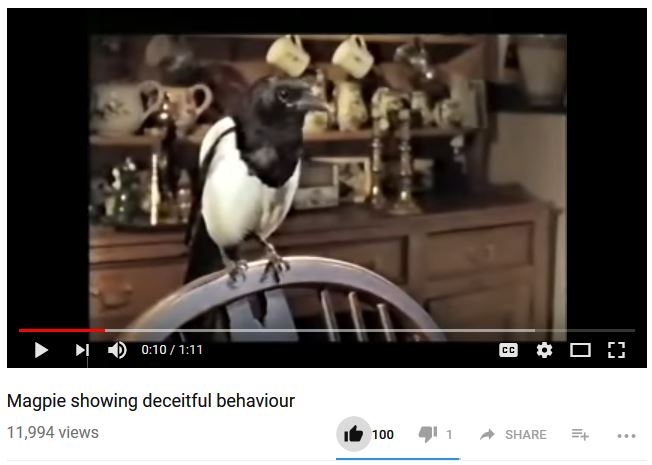
Really? What’s all this brouhaha about ‘expressing one’s self’? A call for help, ‘expressed’ in any way, shape or form, remains a call for help… regardless of the manner in which it has been expressed. Articulated language, Morse code, sign language or a simple sob. Same thing is valid for a warning call. Most of the times, the caller does it ‘instinctively’ and not to gain any ‘social points’ by ‘expressing’ their care for the rest of the ‘cultural community’ ‘conversant’ in the language used to make the call. The magpie in the video above is one of the exceptions, not the rule. Otherwise, the whole signaling ‘industry’ would have been abandoned long ago… due to the very evolutionary forces which have made language what it is today.
Don't cry wolf

– ‘The functions of language include…”
Isn’t this funny?!? ‘The functions of language include…’ How about ‘some of functions we, users of language, have been able to identify are… “.
Or even ‘some of the uses we’ve been able to put language to are …’?

Quite a lot of confusion… isn’t it?

But language was supposed to make things clearer, not muddier… right?

Tell that to those dogs… the ones sent chasing ghosts by the fake distress calls ‘jokingly’ (?!?) emitted by the magpie in the video at the top of my post…

So…

– ‘Spoken’ language.
Or should I call it ‘extemporaneous’? The way I see it, most ‘spoken’ language is uttered on the spur of the moment… or used to be, anyway.
Nowadays, spoken words can be carefully prepared long time in advance… even made to ‘faithfully’ mimic an impromptu message…

– ‘Written’ language.
While ‘spoken’ messages’ have been used, extemporaneously, for a huge amount of time – and not only by humans, as I mentioned earlier, ‘writing’ has been a late invention. Ours.
Or, at least, this is how we like to believe…
The most important characteristic of ‘written’ – as opposed to ‘spoken’, being ‘verba volant, scripta manent’. ‘Spoken words fly away, written words remain’!
The earliest scripts, both cuneiform and hieroglyphic, were used to ‘transport’ information through time. At first, to conserve data rather than what we currently call ‘complex information’. Inventory and ‘identity’ rather than information which may – or even has to, be interpreted in order to make sense. The early cuneiform clay tablets contained ‘cargo manifests’ and only later some of them had been used to ‘conserve’ the Story of Gilgamesh.

– ‘Operational’ language.
Aren’t you tired of that magpie yet?
Have you even watched the video?
Did you notice how the dogs reacted to the fake distress calls? For the umpteenth time, probably…
For the purposes of the present post, it doesn’t matter whether the magpie actively/conscientiously makes fun of the dogs or just acts out of some sort of an instinctive boredom… something akin to the bright spots we sometimes see when ‘confronted’ by a pitch-black environment. It also doesn’t matter whether the dogs are actually fooled every-time they go out to chase the invented fox or they do it because they experience the same kind of boredom like the one which ‘fuels’ the magpie.
For me, all that counts is the consistent manner in which the target reacts to the message transported through the use of this particular kind of language. It is this kind of consistency which determines the ‘operational’ nature of certain languages.

And now, let’s get to the ‘fun’ part.

The calls emitted by the magpie can be construed as being ‘spoken’, right?
They are of a ‘vocal’ nature, are fleeing by definition – unless someone records them using some artificial devices… yet they are also ‘operational’… since the dogs faithfully execute what they are ‘told’ to do…
Now, if we think of it, most natural languages are ‘operational’ indeed.
Ants and bees use them to direct ‘practical’ action, not to ‘express themselves’…
Calls used by most animals relate to avoiding danger, signaling food or ‘expressing’ sexual ‘desire’… and have little or no connection with anything else.
In this respect, the magpie is an exception, not the rule. And even here, the message is ‘formulated’ ‘operationally’. Simply because magpies don’t ‘know’ any other kinds (uses) of language.

We, humans, have bucked the trend only in the sense that we’ve developed kinds of languages lax enough to allow ‘thinking’.

I’m sure that all of you have noticed that when considering the pros and the cons to something you think using a language, right?
A language ‘lax’ enough to accommodate ‘what if’!

Something which doesn’t ‘fit’ in the ‘language’ used by most nursing babies to ask for more milk…

Language is the tool we use when we consciously transmit, receive or glean information.

While the ‘transmitting&receiving’ part is rather simple, ‘consciously and ‘glean’ might need some explaining.

You’ve all heard about ‘body language’.

Actors use it consciously to convey emotion and sometimes even meaning while profilers use it to glean information unconsciously distributed by their marks.

Artists use specific ‘modes of expression’ – language, actually – to convey emotion/subliminal meaning to sometimes unsuspecting audiences.

Skillful ‘communicators’ have learned how to chisel a message – using most common words, printed or spoken – to obtain ‘maximum impact’.

By now I’m sure you’ve already gleaned what I meant by “‘consciously’ and ‘glean'”.
Contrary to popular belief, only one half of those ‘immersed’ in communication need to be conscious of what is going on in order for language to be in use.

Actors can influence their audience without the audience being privy to acting tools.
All of us freely distribute a lot of information about ourselves – through walking, eating, manner of speaking, etc., etc. – which can be ‘deciphered’ with ease by those knowledgeable in this trade.
All of us are inundated by all kinds of advertisement – commercial, political, religious, you name it – but very few of us are aware of the full picture which is being played for us.

In a sense, those of us who can sense anything are like any device connected to the internet.

If it’s connected, it can be hacked‘.

But nothing’s as bad as it seems.
Devices can be plugged off or fire-walled while we can stop watching crap.
And, of course, we can put our brains to work, in earnest, before buying into anything which is hurled towards us.

First and foremost language is perceived as a communication medium.

As such it needs clarity and consistency, otherwise information could not have been reliably exchanged and or preserved through its use.

But language is used for many other purposes than for simply ‘translating’ raw data. Where to find a certain object or how to execute a certain task.
We use it to convey sentiment – the way we are affected by the raw data that has become known to us, and to communicate our particular understanding of things. Our point of view about what has happened around us.
Furthermore we use it to convince people. To do things or to accept our points of view.

All these different uses involve a considerable amount of negotiation.

Regarding immediate goals – the things we are negotiating about, but also some that is taking place ‘under the table’ and involves the continuous fine tuning of the instruments used during the negotiating process. The words themselves.

These negotiation instruments – the language itself, in fact, have to be constantly re-calibrated for two rather obvious reasons.
For starters, the reality around us – and our understanding of it – is changing constantly.
Secondly, every negotiation involves a degree of ‘shade’. In fact that ‘shade’ is exactly the space where ‘change’ happens, where the positions of the two negotiators overlap and where the two can swap ideas.
If words would be rigidly precise than we’d have to invent new ones every time reality changes, no matter how minutely. Also whenever our understanding about things deepens, no matter how shallowly.
Simultaneously, too much ‘linguistic precision’ would kill not only poetry and our ability to convey our real feelings to other human beings but would also gravely impair our ability to influence each-other. Could you imagine how our life would be if a polite intervention would sound exactly like an SMS message of if a marriage proposal would be similar a requisition order?

More about how the linguistically mediated interplay between us has brought about our own self-awareness can be found here:

Humberto Maturana, The Origin and Conservation of Self-consciousness.

More than five years ago a friend introduced me to the work of Humberto Maturana.
I was instantly hooked.
Only I’m not that interested in how consciousness appeared to be as I am in the consequences of us being conscient.

“The argument unfolds as follows: physicists have no problem accepting that certain fundamental aspects of reality – such as space, mass, or electrical charge – just do exist. They can’t be explained as being the result of anything else. Explanations have to stop somewhere. The panpsychist hunch is that consciousness could be like that, too – and that if it is, there is no particular reason to assume that it only occurs in certain kinds of matter.”

This excerpt perfect illustrates what I have in mind.

First thing after becoming conscious – ‘aware of his own awareness’ in Maturana’s terms – man realized how fragile he is.  The best way to assuage that feeling was to find an explanation and a purpose for the whole situation. That’s when our immortal soul came to be. Created by God or simply invented by us, it doesn’t make any practical difference.
In time, as rational knowledge constructed wider and wider inroads into the unknown and currently offers scientific explanations for almost everything, the Creator God became less and less necessary. But ‘soul’ survived and now accompanies our still smart and yet unfulfilled desire to understand the origin of our consciousness. And now that we are no longer satisfied with the ‘divine origin’ of anything but not yet ready to accept that we might indeed be something special – fright again, being special implies extreme fragility/responsibility for one’s own fate – we are constantly searching for a new way to connect our nature/fate to the rest of the known Universe.

Hence the advent of ‘panpsyhism’. Which is not such a new idea as it would seem at first glance. The Buddhist notion of successive reincarnation has been around for more than two millennia.

How about accepting what Maturana teaches us – that consciousness of self is something we have continuously improved by using it synergistically with language and all these could take place simply because of the increased processing power that was accidentally bestowed, evolutionary speaking, upon our brains – and move on? If a better explanation will ever dawn upon us – by feat, by chance or even by divine intervention – we can always come back and reconsider – this is how science works, right?
Remaining stuck in this so called ‘Hard Problem’ – what is the direct link between our anatomy/brain physiology and our thoughts? – won’t take us anywhere, for sure.

http://www.theguardian.com/science/2015/jan/21/-sp-why-cant-worlds-greatest-minds-solve-mystery-consciousness

http://www.univie.ac.at/constructivism/pub/hvf/papers/maturana05selfconsciousness.html