Archives for posts with tag: Democracy

What are electron spins:
Electrons are able to spin on an axis, like how the earth rotates on an axis, but much faster. Electrons can spin in either a clock-wise or counter-clock-wise direction. The spin on an electron is described by the spin quantum number (ms). The value of ms can be either +12 or -12. The +12 is called spin-up and denoted by a ↑, where the -12 is called spin-down and represented by ↓. Sometimes the spin of electrons will be described as angular momentum.
Each orbital of an atom can be occupied by up to two electrons. The two electrons will have opposite spins. This phenomenon was first described in the Pauli exclusion principle which states that each electron in an atom is described by a unique set of quantum numbers, including ms.”

Political spin, in politics, the attempt to control or influence communication in order to deliver one’s preferred message.
Spin is a pejorative term often used in the context of public relations practitioners and political communicators. It is used to refer to the sophisticated selling of a specific message that is heavily biased in favour of one’s own position and that employs maximum management of the media with the intention of maintaining or exerting control over the situation, often implying deception or manipulation.

Electrons ‘work’ in certain ways. Science has recently figured out some of those ways.
The point being that electrons keep to themselves. One spins in its direction, the other spins in the opposite direction and no more than two electrons fit in the same ‘orbital’.

People’s minds also work in ‘certain’ ways.
Not as ‘rigidly’ as the electrons but still ‘useful’ for those who know how to exploit this phenomenon.

By constantly pestering people with certain messages, you get to convince at least some of them.
You get to divide them into (political) camps.
You get them to fight among themselves instead of cooperating.
You get to lead them into battle.
And after the battle has been won, by no matter which side, you get to lead the winning party. At least for a while, but that is another subject.

And all lies, aka as ‘half truths’/alternative facts, start from something real.
Capitalism, for as long as the people remain awake, works. As advertised.
Socialism, on the other hand, doesn’t. It had failed, abysmally, whenever and wherever it had been experimented.

But there’s a caveat.

‘Capitalism’ is a rather clear-cut concept. Property belongs mainly to the individuals and individuals trust each-other enough to do business among themselves. Usually – but not always – capitalism is associated with ‘free market’ and democracy. With freedom to act – inside the confines of the law – and freedom to speak up.
I’ll say this again! For as long as the people remain awake, the market continues to be free and democracy still functions, capitalism works. Sustainably. But only for as long as the people remain awake…

‘Socialism’ is rather vague. From ‘public’ (instead of private) property associated with central planning of the entire society to softer versions which sometimes pay lip service to democracy. The central idea of ‘socialism’ being that society comes first and the individual is only a cog.
Who wants to be a cog? Those who see no alternative… Those who, once in a certain set of circumstances and exposed to a certain propaganda, succumb to the Sirens’ song.

The point being that in order to impose ‘socialism’ to a society you need to lure (enough of) the people into an ‘altered state of consciousness’. To make them believe a certain set of rules. To make them behave according to that set of rules.

The interesting part, as usual, comes at the end.
There is a ‘social arrangement’ where property remains private but where the people behave in a ‘certain’ manner. As if they have been made to believe a ‘certain’ – as in ‘forcefully unified’ – set of rules.

That social arrangement is just as fragile as ‘socialism’.
Again like socialism, it has already been experimented.
Both had failed. Abysmally. History is our witness.

The ‘other’ always failing social arrangement is usually called ‘fascism’.
In Germany, it has been known under the name of ‘NAZIonal socialismus’.

About which individual are we talking about here?
About me? The ONE above all?
About us? The only ones who ‘belong’?
About all individuals? Regardless of age, gender, ethnicity …

“Plato suggests, and all later collectivists followed him in this point, that if you cannot sacrifice your self-interest for the sake of the whole, then you are a selfish person, and morally depraved.
But this is not so, as glance at our little table may show. Collectivism is not opposed to egoism, nor is it identical with altruism or unselfishness. A collectivist can be a group-egoist. He can selfishly defend the interest of his own group, in contradistinction to all other groups. Collective egoism or group egoism (e.g. national egoism or class egoism) is a very common thing. That such a thing exists shows clearly enough that collectivism as such is not opposed to selfishness.
On the other hand, the individualist or anti-collectivist can at the same time be an altruist. He can be ready to make sacrifices in order to help other individuals. (….) To be an individualist means to see in every human individual an end in itself, and not merely a means to further other interests, for example, those of the state. It does not mean to take one’s own individuality particularly seriously, or to lay more stress (or even as much) on one’s own interests than on the interests of others.”
Karl Popper, ‘After The Open Society’, Chapter 7.”

“On the other hand, the individualist or anti-collectivist can at the same time be an altruist…”

Sir Karl Raimund Popper had died in 1994.
Long after all of the so called collectivist regimes of the XX-th century had shown their true colors.
Long after all the self styled collectivist regimes had unveiled their murderous nature.

And murder, by definition, is the most individualistic attitude available to a human being.

Let me be absolutely clear.
I’m talking about murder here.
That thing perpetrated by an individual, alone or in cahoots with others, against other individual or individuals.
Self defense – the minimal action meant to save one’s own life, which stops as soon as its goal has been fulfilled – has nothing to do with murder. Criminals can, indeed, try to camouflage murder as self defense but their actions are obvious for all level-headed observers.

My point being that individualism cannot be defined as being anti-collectivist.
And what’s bothering me is the fact that Popper himself had fallen into this trap.

If I get this right, Popper’s main contribution to our understanding of the world is the notion of ‘falsifiability’. The idea that human knowledge – science – grows in fits and starts.
That individuals notice things, formulate their observations as theories and put them forward for public examination.
And that even the theories which hold water, for a while, will, by definition, be proven false – or at least incomplete – at some point in the future.
The way I understand this process – I’m an engineer converted to sociology – is as a continuous dialogue between individuals and the community which nurtures them.

Just as you can’t have a working engine – I’m a mechanical engineer – without all the pieces fitted in the right places and without a tank full of fuel, you can’t have a ‘healthy’ collective without ‘established’ individuals.
Symmetrically, no individual can survive – let alone thrive – alone. A baby needs to be fed and taught to walk/speak/think in order to become an individual. A conscious human being.

Collectives, currently known as nations, fare according to the opportunities enjoyed by the individuals comprising those collectives/nations. AND according to how each of the individuals understand to enjoy each of those opportunities.
The members of the North Atlantic Treaty Organization – who treated their citizens far better than how the Soviet citizens used to be treated by their self styled collectivist leaders – have fared a lot better than the defunct Soviet Union. Democratic and free-market capitalist countries fare a lot better than those run in a more or less centrally planned manner by authoritarian regimes.

And the explanation is simple. Democracy and free market capitalism mean that many more individuals have many more opportunities to contribute to the well being and the ultimate survival of their community than what’s going on inside authoritarian regimes. Where the decision making is concentrated in a very few hands. Where most opportunity has been confiscated by a handful of self chosen few individuals.
In fact, the democratic and free market capitalist countries are far more collectivist minded than the self-styled collectivist authoritarian regimes. Where only the high ranking officials count as individuals!

And no, Plato wasn’t exactly right either. His ideas haven’t reached us in their intended form… or it is us who can’t read them in an appropriate manner…
“Plato suggests… that if you can’t sacrifice your self-interest for the sake of the whole, then you are a selfish person, and morally depraved.”
‘Suggests’ already comprises a healthy dose of individual latitude. A healthy dose of individual lee-way when it comes to interpreting each individual situation. Furthermore, this is rather a matter of how a collective deals with each individual situation than an individual being selfish or morally deprived.

All situations which determine the fate of a collective are experienced, interpreted and dealt with by individuals. No collective exists as a ‘unit’. Nor reacts as one, regardless of whatever efforts have been made, under whatever disguises, by ultimately individual dictators to implement such ‘unity’. Around the ‘individuality’ of the dictator….
And whenever the individual called to solve a particular situation considers his individuality as being superior to the fate of the collective… then that individual actually lights a fuse. Which might or might not detonate a charge. Which charge might or might not destroy much… but…
The main problem here residing in the fact that many individuals haven’t figured out yet that their own individual fates are inexorably linked to that of the collective.

That if it’s not peer-reviewed, it’s not science!
That being a bona fide individualist “does not mean (that the concerned individual is entitled) to take one’s own individuality particularly seriously, or to lay more stress (or even as much) on one’s own interests than on the interests of others.”

What are the errors of Marxism?

Marxism is an ideology.
Ideologies don’t have errors, they are thought templates used to evaluate a certain situation and to determine what to do next. Ideologies are tools.
They can be used properly or improperly.
Sometimes, the best use for certain tools is to be left alone. Particularly when you understand they are useless. If you understand they are useless…
Hence it’s not Marxism which is full of errors, it’s the Marxists who are barking up the wrong tree.

If you really need to put your finger on something, if you need to point out a culprit, I give you Marx.
Yes, Karl Marx is your man.
His analysis was brilliant. His diagnostic was spot on.
Finally, in times when the class struggle nears the decisive hour, the progress of dissolution going on within the ruling class, in fact within the whole range of old society, assumes such a violent, glaring character, that a small section of the ruling class cuts itself adrift, and joins the revolutionary class, the class that holds the future in its hands. Just as, therefore, at an earlier period, a section of the nobility went over to the bourgeoisie, so now a portion of the bourgeoisie goes over to the proletariat, and in particular, a portion of the bourgeois ideologists, who have raised themselves to the level of comprehending theoretically the historical movement as a whole.
His cure – the mandate he gave to the “bourgeois ideologists who have raised themselves to the level of comprehending theoretically the historical movement as a whole”, and whom he called “communists” – was abysmal.

Which tells us Marx’s brilliant analysis wasn’t deep enough. He had noticed a series of facts but he had failed to notice the bigger picture. He had failed to see that all authoritarian regimes had failed. Under their own weight. Inevitably. And he had failed to notice that all democratic regimes had survived, and thrived, for as long as they had managed to preserve their democratic nature.

Hence the Marxist cure, communism, was stillborn.
A tool to be left alone.
The attempt to impose yet another authoritarian regime – with no matter how generous intentions – after the overwhelming experience of all other authoritarian regimes failing abysmally, is nothing but the compelling proof of social and historical blindness.

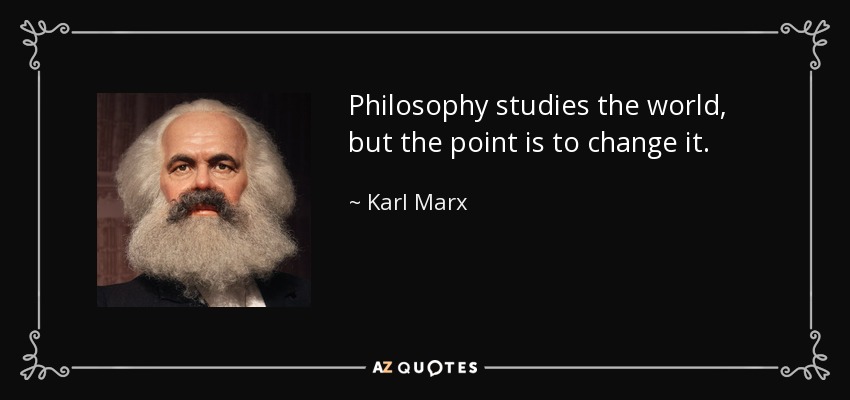
And why start this post by quoting Marx himself?
Because that quote is more than enough. More than enough proof for Marx being a bully.
It’s OK to ‘change the world’ if you own it. If it was yours…
But bearing in mind that there are other people living in the same world… wouldn’t it be nice to ask their opinion about the whole thing? About the changes you want to make? Which changes will dramatically affect the world they live in?!?
They are simpletons? Whose opinions are worthless? Because you said so yourself?

“The lower middle class, the small manufacturer, the shopkeeper, the artisan, the peasant, all these fight against the bourgeoisie, to save from extinction their existence as fractions of the middle class. They are therefore not revolutionary, but conservative. Nay more, they are reactionary, for they try to roll back the wheel of history. If by chance, they are revolutionary, they are only so in view of their impending transfer into the proletariat; they thus defend not their present, but their future interests, they desert their own standpoint to place themselves at that of the proletariat.

The “dangerous class”, [lumpenproletariat] the social scum, that passively rotting mass thrown off by the lowest layers of the old society, may, here and there, be swept into the movement by a proletarian revolution; its conditions of life, however, prepare it far more for the part of a bribed tool of reactionary intrigue.”

As I just said.
Bullly!!!

Not even on paper!

If you read carefully Marx’s communist manifesto, you’ll realize that it doesn’t. Work. Not even on paper!
According to Marx, communism will come to be when enough people formerly belonging to the middle class will have become poor. As a consequence of their wealth having been siphoned away from them.
Becoming poor will make those former middle class people open to communist ideas. And will convince them to follow the already ‘enlightened communists’ into revolution.
For a while – again, according to Marx, the society will have to be led by the successful revolutionaries. In a dictatorial manner, because not all people will have risen to the communists’ level of understanding.
So. ‘Communism’ will be instated by some disgruntled people using dictatorial methods.
How auspicious is this?
Let me go even further.

Why were those people disgruntled in the first place?
Because capitalism!
Not so fast. The Adam Smith kind of capitalism worked just fine. Only after it had been warped by greed it had started to sputter. Specially after Milton Freedman had enshrined greed…
This being the moment when I need to remind you that Adam Smith’s first book on this subject was “The Theory of Moral Sentiments”…

‘Those’ people had become disgruntled after too many in that society had been convinced, at least for a while, that ‘greed was good’. And what was Marx’s proposed solution for that disgruntlement?
That all ‘means of production’ – meaning all property/wealth, to be taken away from individual people. And entrusted to ‘the people’.
Since ‘the people’ were going to be led by the “communists”, in practice the communist revolution meant that all wealth was going to be confiscated from those who happened to own it and entrusted to a very small number of people. Who happened to own the secular power in that moment. As the main consequence of the communist revolution. Apud Karl Marx’s Communist Manifesto…

Let me revisit now Milton Friedman’s words.
‘Greed is good’.
According to this line of thinking, wealth becoming as concentrated as possible is a good thing. Since greed is already good, concentrated wealth is but a logical consequence…

Then Marx’s Communist Manifesto was nothing but an avant-la-lettre short-cut for an easier implementation of Milton Friedman’s greed hailing ideology!

See what I mean?

Karl Marx communism did not and cannot work.
Because it leads into a vicious circle.
It creates a monopolistic situation which cannot be avoided. Time and time again, history has proven that ‘this time is different’ is nothing but wishful thinking. Whenever too much decision power is concentrated in a too small number of hands, the situation becomes untenable. The more concentrated the decision power, the faster – and more dramatic – the eventual collapse.

How about a ‘different’ kind of communism?
The only sustainable kind of anything – ‘social arrangements’ included, had been ‘natural’. Had appeared in an evolutionary manner.
In contrast, all revolutionary developments have produced counter-revolutions. In many instances even more destructive than the revolutions themselves.
What will come after democratic capitalism? I don’t know!
But it better be better than what we have now.

And come in quietly!

Otherwise…

How about a return to bona fide democratic capitalism?
To Adam Smith’s kind of capitalism?
The one whose entrepreneurs used to put ‘moral sentiments’ above greed!

Wishful thinking?
Maybe!
But is there any other way to achieve anything? Other than to start by wishing that something?
And since Smith’s brand of capitalism did work, communism always failed and a viable alternative has yet to appear…

7 years after the accord had been signed, and never implemented, Putin had ordered his army to invade, again, Ukraine.
Using Lukashenko’s Belarus as a springboard.

As of now, all five people who had signed the accord had failed. In more ways than one.
None of their stated goals have been achieved.
The three democratically elected leaders had failed in the sense that they had not been able to prevent the escalation of the conflict.
The two dictators have not, as of yet, been able to fulfill their ‘promises’.

For almost a year now, Ukraine had been able to defend itself against the Russian aggression. In the first days of the ‘special operation’, Ukraine had managed to do this alone! Only after the initial surprise had given birth to hope, the ‘west’ had started to send in meaningful assistance.
Which strongly suggests that a people which is in control of its own fate – as in ‘democratically decides its own future’ – has a greater ability to fight than a people sent to the battle field at the whims of a dictator.

One by one, the democratically elected signatories of the Minsk agreement had been replaced. One way or another, all of them peaceful. Not necessarily as a consequence of this particular failure but, nevertheless, they are no longer able to make any other hugely significant mistake.
The two dictators continue to dictate. To make mistakes and to defend their previous mistakes. To cause misery.

Looking at the whole thing from a distance, the situation is simple.

All governments suffer a recurring problem: Power attracts pathological personalities. It is not that power corrupts but that it is magnetic to the corruptible.

Frank Herbert

Unfortunately, things are even worse. Not only that power is magnetic to the corruptible but also most ‘ordinary’ people tend to have a hard time acknowledging mistake.
Once committed, even by the most incorruptible person, a mistake gets a life of its own. And works hard at convincing the perpetrator to ‘hide’ it. Hence to commit even worse mistakes.

Now, why is power magnetic for the corruptible?
Because power makes it possible for the ‘agent’ to ‘hide’ a lot of mistakes!

The way I see it, people have a knack for learning on the run.
The shape of the learning curve and the duration of the process depends on the particulars of each situation but all people eventually get there. Those who survive to that point, of course…

What’s to be learned from all this?

The obvious, my dear Watson!

All those five powerful agents in the picture above have failed.
Yet the French and the Germans fare a lot better than the Russians and the Belorussians while the Ukrainians fight better than the Russians.

What’s the main difference between those two ‘sides’?

Those who fare better change their leaders more easily and more often?
Before their mistakes pile up? And become ‘too big to fail’?

‘Most people confuse liberty and democracy. They are not the same.’

Liberty and democracy are not the same indeed.

Like my left hand is not the same with my right one.

But I need both in order to lead what I consider to be a normal life.

Most people – specially if they get help, can survive without a hand. Or without either liberty or democracy.

But without both… without both hands or without both liberty and democracy… I’d be at somebody else’s mercy!

‘What?!?
What kind of liberty is there under communist rule???’

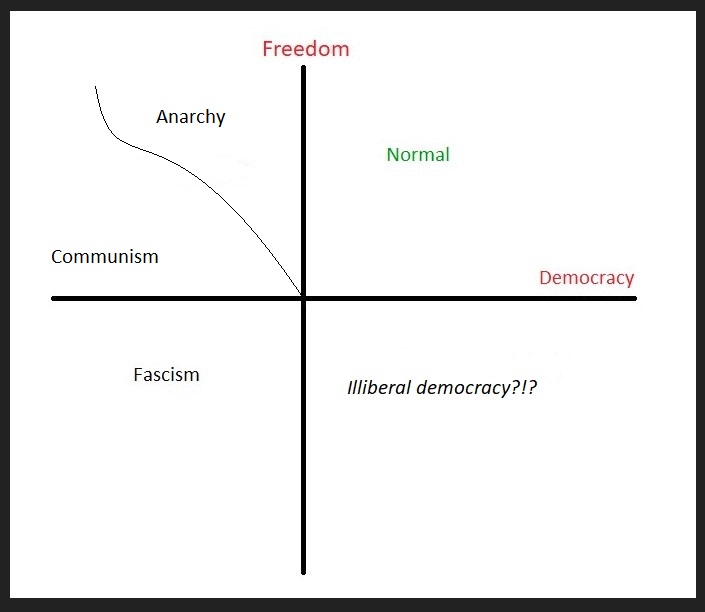
You see, liberty has two ‘faces’. Two dimensions.
Three, actually, but I’ll be talking about only two of them in this post.

There is the ‘inner liberty’ and there is the ‘socially sanctioned liberty’.

Liberty itself is a human concept.
We have noticed something, wondered about it, named it and then attempted to understand it.
This was, and continues to be, a collective effort.

In some places ‘liberty’ had appeared ‘naturally’.
There was enough liberty naturally sloshing around, hence the circumstances were right for those who had happened to live there at the right time to notice it. Furthermore, the conditions had been right again for the entire community to be able to agree among themselves about the concept and about how to use it/put in practice their new intellectual achievement.

Other places have not been so lucky.
They had been close enough, geographically and socio-historically, to notice the ‘birth of liberty’ but their specific conditions were not ‘right enough’. Many people living there coveted liberty but the local conditions made it impossible for liberty to take hold.
In these places ‘inner liberty’ – individually assumed freedom, can be found a lo more easily than presumed by those unfamiliar with the local realities.

Yet other places had it even worse.
Initially on the path towards liberty – and democracy, they have somehow stumbled.
For whatever causes – internal and/or external, something went wrong. People became disappointed enough to give up not only democracy but also liberty. Including their own, individual inner freedom.

A somewhat intermediary situation constitutes the third abnormal quadrant.
The people involved have given up their liberty – partially, but those running the show continue to use (‘pretendingly’) democracy as a window dressing to hide their true intentions.

The last hundred years or so have been extremely relevant in this matter.
All communist regimes had fallen. Under their own weight.
Most fascist/nazi regimes are no longer with us. Had been so ‘arrogant’ – read self destructive, that their neighbors had to do something about them. Had created so much disruption around them that those whose very existence was endangered had been forced to spring into action.
‘Illiberal democracy’ is a rather new ‘development’. Would be fascist/nazi dictators don’t have all circumstances aligned to make their final move so they have to make do with what there is at their disposal. The local population is ‘despondent’ enough to pay attention to their arguments but not desperate enough to follow them into the ‘unknown’. Hence this oxymoronic abomination.

‘Illiberal democracy’…
On the other hand, the spin doctors promoting illiberal democracies hope to be able to reap the benefits of democracy – the population being ‘rather favorably disposed’ towards the government while having to pay less ‘lip service’ to individual human rights.
A balancing act, with no safety net, which is alluring to those reckless enough to attempt it but which will end up badly. Sooner rather than later.

But the most interesting ‘combination’ – for me, at least, is Anarchy.
In the sense that those who ‘swallow’ the lure are self delusional.
They have somehow convinced themselves that their, own, liberty somehow trumps the liberty of everybody else. They feel so strong, so immune to any outside influence, that they would willingly accept to live in a no rule environment. Without understanding that ‘no rule’ means ‘no holds barred’.
They actually don’t realize that unfettered liberty actually means ‘Each of us free against all others’.
This being the reason for which Anarchy, as a political arrangement, has never survived for long enough to be noticed. Except as a transitory phase.

Can we do without it?
And if not, how much of it?

– If ‘no government’, then who would pay for the army we need to defend ourselves?

Ooops… you’ve just answered the ‘why does Russia ‘encourage’ the trolls who push ludicrous libertarian ideas’ question. Which trolls attempt to achieve two things at once. Weaken the concept of free government and give libertarian-ism a bad rep. Transforming libertarian-ism into yet another form of extremism.

Let’s get serious and try to find an answer to ‘why, and how much of it, do we need government?’

The boring one would be: ‘Whenever one government falls, another one takes over. The interregnum is always bad so… let’s get used to it’.

‘Getting used to it’ works only for very short expanses of time. Left on its own, all ‘government’ becomes sloppy. So sloppy that it soon becomes such a burden that even the most ‘used to it’ lose their patience.
Government, all of them, need to be kept on a tight leash. Otherwise it will soon cease to perform as intended.

– But if you have to keep it on a tight leash, why bother with any in the first place?
Can’t we do without such a bothersome pet?
What’s the point of the whole thing, anyway?

Instinctively, we’re against ‘government’ for two reasons.
It costs us a lot and it used to represent the interests of the ruler.

Until 10 000 or so years ago, we didn’t need ‘government’.
People were living more or less like the modern day Sun People still do. In the Kalahari desert… small bands roam the place, living of the land. The bands are small – so that they might find sustenance, they don’t have any ‘private’ property to protect, hence they don’t need government. Neither did our ancestors.

As soon as people ‘invented’ agriculture – raising ‘tame’ animals at first and working the land soon after, things had changed dramatically.
The advent of agriculture brought two things. An increased productivity and private property.
Soil has not been born equal. Both pastures and arable land can be good, passable or bad. People wish to have the best. Those who already have it are willing to defend it and those who don’t are willing to steal it.
Increased productivity means that those who produce are able to hire people to protect their ‘means of production’. Their property. As a consequence of fighting for it, some people accumulate more and more of it.
More and more ‘means of productions’ – property, means an ever increasing need for ‘management’ and an ever increasing need for ‘protection’. Soon you have a very ‘wealthy’ owner – the lord of the place, call it what you like or use the name given to him by his subjects, the people who perform the day to day management of the ‘whole-sale property’ and those who protect it from ‘marauders’. Both the ‘managers’ – read ‘government’, and the ‘protectors’ – read ‘army’, used to be under the direct supervision of the local lord.
For a while – for as long as the lord kept everything in balance, everybody was happy. The ‘peasants’ were happy because thy were safe, the ‘managers’ were happy because the wise lord used to appreciate their work and ‘compensated’ them accordingly, the ‘protectors’ were happy because they were well fed and taken care of. According to this article, the great Egyptian had been built by willing people, not by slaves.
https://www.harvardmagazine.com/2003/07/who-built-the-pyramids-html
But soon enough, the lord had become estranged from his people. Government had become an instrument used to extract more and more wealth from the peasants while the army was used to protect the government against the people and, whenever possible, to increase the property of the ruling lord by stealing some from the neighboring ‘lords’. The ’empire’ was born.

But this development could take place only in certain circumstances. Where those below the ruling lord had nothing more to do than to obey. Where the best subject was the disciplined one. Where autonomous thinking and imagination were frown upon by the ruler. Where one mind was enough.
Whenever the ‘environment’ mandated the individuals to remain relatively autonomous, proto-democratic forms of self government had been experimented. From the nomadic pastoralists of the Central Asia to the sailing communities in Ancient Greece and Medieval Scandinavia. Those driving herds or sailing ships need to be a lot more independent-minded that those who just tile the earth. No offense intended here! Simple observation will notice that where the geography of the place had allowed it, somebody had ‘built’ an empire. The Nile Valley, the Middle East, the Russian plain, China, Mexico…
Where ever the geography of the place was fragmented enough by sail-able sea, proto-democratic forms of self-management had been developed. The sailing Ancient Athens versus the land-locked Sparta, Medieval Scandinavia versus Medieval France…

Fast forward to present day.
When we have two forms of government.
The more or less democratic ones. Those under whose ‘guidance’ discussions like the present one can happen.
And the more or less authoritarian ones. Which actively discourage autonomous thinking.

Mind you, there are no ‘perfect’ governments.
There’s no perfectly democratic arrangement anywhere on Earth. Because we are imperfect human beings.
And there’s no ‘perfect’ authoritarian government. Because no government can survive for long if it attempts to centralize the decision power. The closer a government gets to being perfectly authoritarian, the smaller is the crisis needed to topple it. Unless it is supported from the out-side but that’s another topic.

So. It is fairly simple to understand how authoritarian governments fail. Too much ‘stiffness’ makes it impossible for authoritarian governments to evolve. To find solutions for whatever challenges pop up constantly.

But what can go wrong with the collective forms of self-rule? With the participative forms of social self management? Otherwise known as democracies?
Lack of enough popular involvement. Due to a sense of apparent safety, initially. And to a feeling of apparent impotence, soon after.
Lack of enough fore-sight. Those who should know better become distracted, for whatever reasons.
Too much opportunism. More and more of the ‘insiders’ use ‘the power of the government’ to fulfill their own, private, goals instead of making sure that ‘government’ works properly.

And what does that mean?

A government works properly when the community which self manages itself using that particular (form of democratic) government survives in the long run.
When those momentarily working inside the government make things happen for the community at large.
When people, both inside and outside the government, follow, in spirit, Kennedy’s words.

Am I being naive?
Maybe… But wouldn’t it be a nice thing to have?
A nice thing to chase, anyway?

And what better way to chase ‘it’ than voting for people who at least pretend to be honest? Who at least make the ‘right’ noises? Whom we can hold accountable whenever they break their promises?
Instead of voting for those who promise barrels and barrels of ‘pork‘?
https://grammarist.com/idiom/pork-barrel/

Ideological pork or hands-on pork, I don’t know which is worse…

Some say that history repeats itself until we figure out what it meant in the first place.
Others maintain that history’s first ‘helping’ comes as a tragedy while the second becomes a farce.

Well, I’m afraid things are a little more complicated.

For starters, history doesn’t do anything.
History is nothing but a string of events. Considered noteworthy and written down by some of those who have survived the above mentioned events.
NB, ‘winning’ is not necessary. Being able to survive – and to write, of course, is!

It is us who consider some of the events we have witnessed – or read about, to be noteworthy.
It is us who attempt to draw meaning from what we ‘hear about’.
It is us who are arrogant enough to believe we have learned anything.

Which brings me to the next step.

We live in a huge reality.
But see only a small portion of it. Understand even less than that.
But consider ourselves rational human beings. We are convinced that what we do – the decisions we reach and then put in practice, are based on reason. And good will!!!

Day to day practice tells us that individuals make mistakes.
I’ll leave ‘alone’ the actual ‘criminals’, I’m going to consider – for the scope of this post, that all of us act in good faith, all of the time.
Hence we need a mechanism to cope with the ‘honest mistakes’ made by every one of us.
No matter how low or how high in the ‘pecking order’.
No matter how feeble or how powerfull each of us is.
How much decision power each of us musters at any one moment.

We need a ‘procedure’, an ‘opening’, for each of us who sees something going amiss to be able to tell the others that ‘the emperor is naked’.

That’s what ‘democracy’ is for.

But there’s a caveat here.

Like history, democracy is a human concept. A man-made ‘tool’!

Each of the individual members of the group using this tool is ‘limited’. Has a limited knowledge and a limited ‘processing power’. By definition… Otherwise, democracy wouldn’t have been necessary in the first place. If at least one of the individuals involved would have been omniscient, they would have – somehow, climbed to the pinnacle of the hierarchy.
The fact that all imperia – all ‘arrangements’ where one individual garners a lot of power over a complex system comprising of many other people, have inevitably collapsed is a very powerful empirical proof for my assertion.
Further more, the number of individuals involved in any democratic arrangement is also limited. Also by definition. There’s no place on Earth – there are no humans living someplace else, for an infinite number of people. Hence even the ‘aggregate understanding of things’ any democracy might reach is also limited. Fallible, that is.

Thus even democracies need to follow rules. They just cannot ‘vote’ whatever their members wish to happen…

The first rule, of course, being you should not vote ‘against’ the rules of nature. You cannot, for instance, abolish Newton’s gravity by voting it ‘unlawful’…
The second rule being that the individuals comprising the democratic arrangement have be convinced that each of them is equivalent. Not equal, that’s impossible, but ‘equivalent’. That each of them should be able to vote, that each of them should have only one vote and that each of them should have the opportunity to voice their concerns. In a nutshell, that all of them have equal rights and that nobody – no individual or a smaller number of people than the entire ‘congregation’, has the right to tell anybody else what to do. Or what to refrain themselves from doing.

Now, that I have reached this point, let me go back to history.

The first ‘democratic arrangement’ known to us was the Ancient Athens.
It had evolved, for while, as an increasingly democratic form of government. During this time, the city’s fortune and influence in the region had grown almost constantly until Pericles had ‘bent’ the democratic principles so that he could yield more influence. Almost two centuries of democratic ebbing on and off followed until Philip II of Macedonia had taken over entirely. As a consequence, Athens’ influence had waned and then disappeared entirely.
The second one had dawned in Scandinavia, during the Viking era.
That democratic seed had, in time, spread in Europe, America and, gradually, in many other countries.

In the US, for example, at first only the white men were involved in the democratic process. They were the ones who voted and who were elected into office. Gradually, the democratic ‘rights’ had been extended to the female portion of the society and to the ‘members of the other races’. These successive ‘extensions’ had been parts of the general improvement of the society as a whole. During this period – not necessarily due to but certainly simultaneously with, the entire population lived better and longer lives while the country as a whole had become more and more powerful. The energy and potential of the population – of an ever increasing proportion of the population, had been put to better and better uses.

Simultaneously, individuals – an ever increasing proportion of the individual members of the society, with the criteria of sex, gender and race gradually losing the previously held power of discrimination, had enjoyed more and more power. More and more autonomy to determine their own fate.

Which brings us to the current developments in the US.

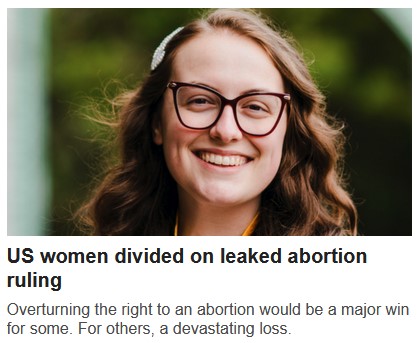
Some people, far from a majority of “The People”, would like to see the ‘other end’ of Roe v Wade.
‘These’ people seem to have somehow convinced a majority of the Justices sitting in the Supreme Court not only to hear their plea but also to ‘consider it in a favorable manner’.

In other words, a very small number of people – five out of nine, are going to restrict a previously granted right which had been enjoyed for almost 50 years by more than half of the American Population.

‘You have got it completely wrong!
Scotus isn’t going to prohibit abortion. Only the states can do that!’

Do you remember what the Civil War had been fought over?
Basically, the Confederates were claiming that individual states had the right to determine which people were to be considered ‘free’ while the ‘others’ kept maintaining that all people, regardless of their skin color, were free. That individual freedom was something which had to be determined at federal level, not by each ‘individual’ state.
Nowadays we have the very same thing. Some states claim it’s their ‘right’ to tell ‘their’ women whether, and in which circumstances, they may – or not, have an abortion.

Not a very ‘appealing’ proposition.
It opens the door for individual states claiming more and more ‘rights’ over their ‘specific subjects’.

The absolutely baffling thing about this whole development is the fact that those who want Roe v Wade to be repelled claim they do this in order to enhance individual rights (to live). I can understand that. I even sympathize with them. Ending a life, even that of an embryo, is not something to be treated easily.

But for a minority to impose their point of view – no matter how sound it might appear to some of us, to a majority… that cannot be, either, taken lightly.

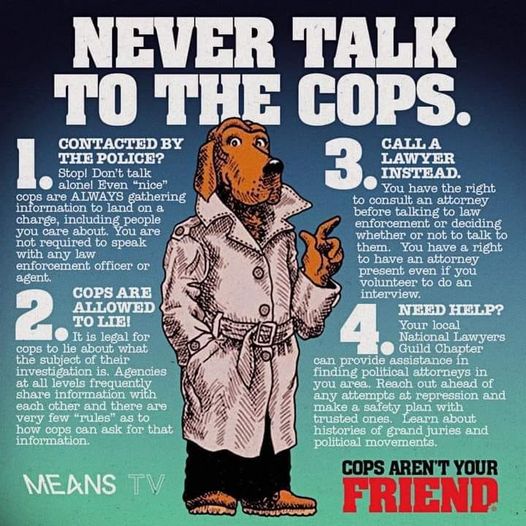
Just came across this meme.

It was shared on a FB-wall and somebody had commented that “Institutionally they are not your friends.”

My ‘jerked’ comment was:

“Institutionally, cops should be your ‘last resort’ friends.

The fact that too many of them are not, and the fact that too many of us consider them, as a category, to be unfriendly, is proof of how dysfunctional our society has become.

Cops used to be ‘unfriendly’ when I grew up. In communist Romania. When the cops were used, by the communist state, to preserve their power. The communist power over the entire society.

In the free countries of today, the cops are the sole barrier separating our persona and private property from the hands of the criminals.

Without their presence…

Or, putting it the other way around, we have but the cops we deserve. Train and motivate them properly and you’ll have good cops!”

At a second glance, I had an inkling.
Is it possible for the whole thing to be nothing more than a ‘marketing campaign’? Organized by the only people interested in increasing litigation?

Interested in altering the relative stability of our political establishment?

The police, by properly performing their duties – the world over, not only in the communist countries, contribute to the political stability of those respective countries.
For the police to properly perform their duties, there must to exist a proper trust between the general population and the police itself. The population must see the police as their friends of last resort while the police must see the general public as both their employer and their responsibility.
The population must be open in their relationship with the police while the police must treat respectfully every individual, including the suspects and the convicts.

In the communist regime I grew up, the police couldn’t fulfill its duties. Exactly between there was a ‘trust’ barrier between the general public and the police. Between the oppressed and the armed hand of the oppressor.
The communist regime I grew up under, in Romania, had eventually collapsed.
Exactly because of the malignant mistrust between the general public – The People, and the government. The police being nothing but a portion of the government itself.

Who is interested in the collapse of the democratic regimes?
Who is mostly interested in wedging apart the government from The People?

This is a stub.

‘This time is different’. https://www.economist.com/media/pdf/this-time-is-different-reinhart-e.pdf

History teaches us that each and every empire has collapsed. Usually under it’s own weight. Pareto has given us a valid explanation – each structure which doesn’t have to ‘refresh’ itself tends to become clogged with self serving individuals, near-sighted enough to ‘forget’ that none of them (none of us, actually) is able to survive ‘outside’. Yet each ’emperor’ allows themselves to believe that this time is different. I’m better than all my predecessors. And their followers allow this to happen, just as Pareto had taught us.

‘They is a rational operator hence they must have a reasonable objective’.
That’s how people raised/educated in a reasonable environment think/interpret the actions of other people.
This being the reason for democratically groomed leaders having such a hard time when they need to understand how dictators operate. This being the reason for democratically groomed political operators having such a hard time when it comes to identify skillful would be dictators.

https://www.journalofdemocracy.org/articles/russias-road-to-autocracy/