I argued in my previous post that corruption is akin to decay. Going forward, evolutionary speaking, we need to figure out what’s driving it. It’s ‘raison d’etre’.
Decay, also known as decomposition, re-allocates resources. Frees resources. Resources previously used in an currently ‘dead process’. Building blocks currently stuck in a corpse. Waiting to be freed, in order to participate in the next living process. Corruption does more or less the same thing. Only less naturally. Way less naturally, sometimes bordering malignancy…
I mentioned corruption taking place in two environments. In a closed, abandoned, fridge – in an authoritarian environment, or in an open forest. A free society. In the fridge, corruption begets ‘hairy’, aberrant, ‘things’ while in an open society corruption plays a more nuanced role.
‘Intensity’ wise, at the individual level, there is ‘grass-roots’ corruption – like tipping your restaurant server or your hairdresser – and white-collar corruption. Which culminates in ‘pork-barrel’ politics.
‘Consequence’ wise, at the social level, grass-roots corruption sets the stage for the white-collar variety. ‘Educates’ people. Accustoms individuals exposed to it with the phenomenon. White-collar corruption weakens the entire society. Prepares it for take-over. Softens it for ‘revolution’. Not very different from an insidious rot weakening a seemingly strong tree before it is knocked over by wind.
Historically speaking – as in looking back in time – it’s easy to notice that corruption weakens both kind of societies. Open as well as the authoritarian ones. The difference being that it works in opposite ways!
Corruption frees, eventually, those living in authoritarian societies. The same process weakens the open, democratic, societies which allow it to grow malignantly.
Let’s remember. Hitler’s Germany was defeated not only by the valor of those resisting its aggression but also by its inability to adapt. By its absolute corruption. USSR collapsed, under it’s own weight, like all other empires. The British one included. No authoritarian regime had ever survived for the long run. Each change of dynasty was, in reality, the advent of a new authoritarian regime. People had no alternative in those times. On the other hand, no democratic regime had ever collapsed as long as it had managed to preserve its democratic character. What had happened in Eastern Europe after communism had caved in is ample proof for my thesis.
Some ten years ago – 2015, October 30 – a fire broke out in a Bucharest night-club. 64 people died on the spot, including 4 members of the band. “The day we give is the day we die” was one of the tunes Goodbye to Gravity played that night.
The inquiry had determined that corruption was the main cause for what had happened. Safety certificates issued outside any norms, dysfunctional health care, unresponsive authorities… Massive popular protest forced the prime-minister to resign. Things are better now, in Romania, but only slightly. Too slightly…
I forcefully disagree. Corruption, like decay, is a natural thing.
Let me put it in a different perspective. Decay may happen in an abandoned fridge. A closed space in which all kind of ‘unnatural things’ will happen if left unattended. Decay naturally takes place in a forest. Where ‘no longer living’ organisms ‘turn back to dust’.
A fridge – which is a dead thing, specially when abandoned – is incapable of managing anything. Including a process of decaying. A forest – which is a meta-living organism, if you’ll allow this expression – thrives as long as natural processes can take place. Decaying being one of the most important ones.
Same thing goes for societies. Open societies – the ones known as democracies – are no more and no less ‘corrupt’ than the closed ones. The ones usually known as autocracies. In the sense that those in powerful positions are equally tempted by corruption. Equally tempted to misuse their power… The difference being that the open societies deal with corruption in an open manner. Above the board. In public. In a court of law. While autocracies deal with the corrupt people only when the autocrat allows it. Only when the autocrat feels that a particular act of corruption is detrimental for his own well being…
So. Every time an open society exposes an act of corruption, that society becomes stronger. While autocratic regimes are corrupt from top to bottom. By definition. Very much similar to an abandoned fridge brimming with ‘hairy’ things.
Consequences. We are the consequences of the decisions we take. Of the choices we make.
As biological organisms, our fate, both individually and as a species, depends on whether circumstances remain habitable. Whether we can continue to live.
As rational humans, our individual destinies depend on luck, genes and on our ability to make good decisions.
‘Good’ decisions! The tricky part being that nobody knows in advance the consequences of our decisions… whether a decision we consider to be good – when we take it – will remain so after its consequences will have been evaluated. After enough time will have passed for the full gamut of consequences to unfold…
To make things easier, humanity has developed ‘culture’. Layered information which has morphed into ‘Weltanshauung’. Experience distilled into knowledge and accrued in time. Advice we no longer need to ask, only to remember. When in a hurry, we do as we always used to. Back to the tried and tested.
But there’s a small problem here. The cultural norms might have been ‘tried and tested’, hence ‘right’, but are we applying the appropriate norm in the given circumstances? Have we interpreted whatever information we have in the right way?
Ukraine is at war. Resisting aggression against all odds. Despite some of those in power attempting to access ‘undeserved rewards’. Unfortunately, war profiteering and corruption are as old as civilization…
“Earlier this week, NABU (National Anti-Corruption Bureau of Ukraine) and SAPO (Specialized Anti-Corruption Prosecutor’s Office) said top company officials demanded illicit commissions of 10-15% from contractors. The corruption allegations center on contracts linked to Energoatom, which provides most of Ukraine’s electricity. According to investigators, an organized criminal group laundered the funds through an office in central Kyiv linked to the family of former lawmaker and suspected traitor Andriy Derkach. Among those named in the case was then-Energy Minister and later Justice Minister Herman Halushchenko.” https://www.kyivpost.com/post/64185
How do we choose to evaluate the current development?
As yet another step in the right direction? A country at war cleaning up its act?
Or…
Further more, what will we choose to DO?… after we will have chosen an interpretation to fit our ‘general disposition’… ’cause, unfortunately again, this is how we tend to evaluate things! Specially when we’re not diligent enough. Allow our ‘general disposition’ to take over and permit our reason to cowardly back off …
Help Ukraine to defend itself? And the rest of Europe? Freedom in general! Or give up? On Ukraine, on cultural norms which seemed set in stone until not so long ago…
When I was six, my father took me to a German kinder-garden.
He was learning German, at 35, and thought I should start earlier. In the end, I didn’t exactly learn the language but during the process I met a lot of nice German speaking people.
At 16 I read
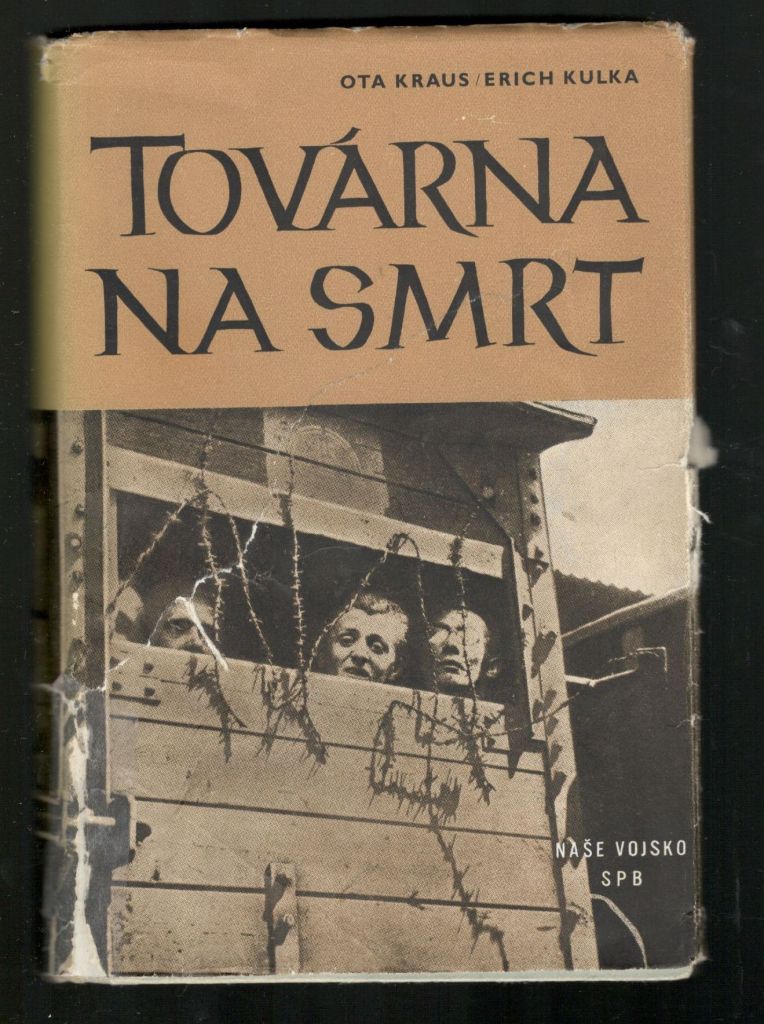
The Death Factory, a book about the Auschwitz concentration camp
Well, actually it was translated in Romanian but the original cover is far more suggestive for non-Romanians.
That was when I learned to distinguish between a people as a whole and the atrocities committed by a minority.
As I grew up, under communist rule, I noticed the ‘little compromises’ my parents had to make in order to provide a better life for me. The small bribes offered whenever ‘necessary’, not speaking up their minds in ‘official settings’, allowing stupid, but powerful, individuals to boss them around… As a young adult, I understood how those small compromises, made by almost all of us, added up and eventually caused the entire regime to collapse. Eaten up, from inside, by institutionalized corruption.
As a no longer young adult, after the regime change, I noticed that ‘compromise’ was so entrenched in our habit that it had been carried over into the new regime. As if the new found liberty had been interpreted as the freedom to accept ‘un-earned benefits’ from whoever offered them. In exchange for things which were not ours to give… The same was happening in other ex-communist countries. The closer to Moscow, the more intense the phenomenon.
That was when I learned to dissociate corruption from any particular political regimen.
Soon after that I learned the international dimension of the whole thing.
That was when I learned that democracy alone is not enough to cure corruption. That democracy can also be eaten from the inside by this worm. If ‘the people’ do not pay enough attention!
This morning, on top of the already ‘normal’ news from the Ukrainian front, I learned that
That was when I understood that ‘what goes around, comes around’ is driven by our bad choices. By our unwillingness to make good what we have already learned from past mistakes.
Should have learned from past mistakes…
Really guys? The Red Army had spilled its blood to free the people herded to be killed at Auschwitz and a survivor from Auschwitz is killed by a Russian bomb attempting to ‘denazify’ Ukraine?!? Which Ukraine wanted nothing but to join the EU and NATO? But couldn’t! Crimea was occupied while Donetsk and Luhansk have rebelled against the central government… and NATO – like all other clear headed alliances do not admit new members which are already involved in ‘border disputes’.
So. Putin, spooked by a NATO who doesn’t dare to violate the ‘founding act’ – not even after Russia had occupied Crimea, orders the Russian Army to demilitarize and denazify a country whose independence and integrity was guaranteed by the Budapest Memorandum.
And, caught in the middle, a man whose life had been saved – some 75 years ago, by the Red Army ends up being killed by the Russian one…
Simply because we didn’t pay attention. And allowed what went around to come back!
Boris Romantschenko of Ukraine, along with five other former prisoners, renews the oath of Buchenwald, from April 19, 1945, at the Buchenwald Concentration Camp Memorial, in Weimar, Germany, April 12, 2015. Picture taken April 12, 2015. Michael Reichel – Buchenwald and Mittelbau-Dora Memorials Foundation/Handout via REUTERS/File Photo
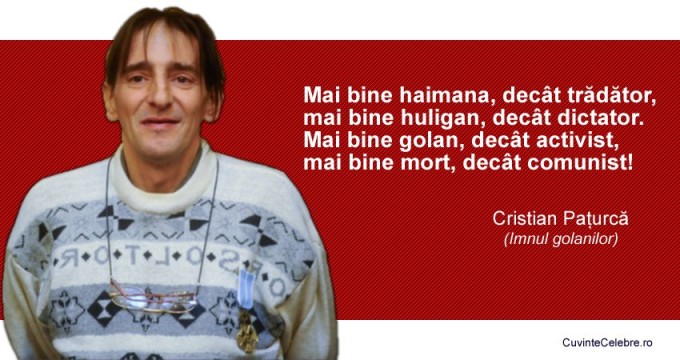
This was one of the favorite slogans shouted by the anti-communist protesters in Romania’s ‘Piata Universitatii‘. And the anthem used by those who opposed the regime which had ‘confiscated’ the political power after 1990.
The only problem with this notion being that it doesn’t make much sense. Not on the ‘face of it’. Not in any rational way…
You see, most individuals would choose life against any other ‘alternatives’. When ‘the going gets tough’ most of us would accept almost any compromise in order to stay alive.
I’m not offering any examples. Use your own ‘imagination’.
Let me explain what ‘being a communist’ meant in Romania during Ceausescu’s rule.
First of all, in 1989 the ‘party’ was 4 million strong. 18% of the population were ‘proud’ carriers of the red membership card! Were all of them ‘die hard’ communists? Not at all! Most of them had accepted to become members simply because they had no other alternative. Without the party’s ‘approval stamp’ one could not ‘accrue’ any significance. Nada! Nothing! Could not get any promotion. Get an education higher than the equivalent of a college degree. Go visit a foreign country – not even a communist one! Nor could you move out from your parents home! Not easily, anyway. To be granted your own apartment, you had to submit an application to the relevant authority. Which application had to ‘checked’ by the relevant party official if you were to have any chance of success. Which ‘relevant party official’ was way more likely to approve your application if you were already a ‘member’. And so on.
Then why would anyone refuse to become a member?!?
Thirty years later, I finally figured out the real meaning of the whole concept. For you to get the whole picture, I must introduce you to a few more verses.
“Bum better than traitor Hooligan better than dictator ‘Good for nothing’ better than activist And dead better than a communist!”
By now, I’m sure most of you already had your Eureka moment.
‘Better to be dead than an ‘active’ communist’!
You don’t know what ‘activist’ exactly meant in communist Romania?
For starters, a ‘regular’ communist was just a ‘member’. You did have some ‘potential perks’ but you had to ask for them. And you were never sure your wishes were going to come true. The activists, on the other hand, were paid for their efforts. Their ‘well compensated’ job was to put in practice whatever the party had decided. What the brass had decided, actually… To convince the regular members – and, through them, the rest of the population, that whatever the brass had decided was ‘in the people’s best interest’! And to inform the higher-ups about the real situation ‘in the field’.
In a nutshell, it was the party activist’s job to keep the party together!
‘OK, to keep the party together… that makes sense… but … whose interests were promoted by the almighty party? And why had the whole thing collapsed like a house of cards?’
Let me answer your second question first. The whole thing had collapsed like a house of cards because there was no other alternative.
Because there was no alternative to ‘the’ party!
Because those at the top had drifted away from reality. Because those at the top had been driven away from reality by those below them. Who had been acting in a rational manner! Who in their right mind would contradict a powerful figure?!? Specially when there’s no alternative? When you, the ‘middle man’ see no way out? What alternative do you have but to become an yes-man? Who utters only what the higher-ups want to hear and keeps mum about everything else?
See what I mean? Do you finally understand Frank Herbert’s message? Do you still wonder why all authoritarian regimes eventually succumbs, being eaten from inside out by corruption?
‘Now you’ve lost me! Are you implying that by actively promoting ideas, and acting as a back-bone for a political party, one becomes an ‘accomplice’? An enabler?!?’
Well, let me answer your first question now! ‘Whose interests were promoted by the almighty party?’
On the face of it, the main ‘beneficiary’ was ‘the people’. Practically… the people had become ‘hungry’. ‘Hungry’ enough to applaud when the dictator had been assassinated on Christmas Night in 1989 …
You see, every established system tends to put its own survival before anything else. Every individual member of the system wants to conserve its position. Which is a reasonable thing. The problem with ‘single’ parties being what I’ve mentioned above. The party slowly drifts away from reality for the simple reason that there’s no competition to keep them ‘moored’. ‘No real alternative in sight’ allows any ‘single system’ to construe their own ‘alternative’ reality. Made of “alternative facts”.
So! You may promote whatever ideas you want. How ever actively you want to do it. Be the back-bone of any political party – or any other organization, you see fit.
But don’t be surprised that if you promote the ‘flat Earth alternative‘ you’ll eventually fall over.
‘Things are not at all what they ‘really’ are but only what they seem to be.’
Confusing?
What we have here is the intersection between ‘reality’ – a.k.a. ‘absolute’ truth, and knowledge – a.k.a. logos or relative truth.
‘Things’, ‘existence’ and ‘reality’ are concepts. Developed by us, conscious people, through the use of ‘logos’ and starting from two implicit premises. That there must be something outside our consciousness – both the individual and collective ones. And that our perceptions do have at least some correspondence in that ‘outside’.
By adding layers and layers of logos, collectively known as ‘culture’, upon our initial perceptions we’ve actually built an alternative reality. The one we call ‘civilization’.
The ‘thing’ being that this second reality is just as ‘outside’ our grasp as the original one was. And continues to be. Because of our own consciousness, which both separates and connects us to ‘reality’.
What we are left with are our ‘perceptions’. And with our understanding, for those who had reached it, that ‘perceptions’ are ‘real’ only in the sense that they do correspond to some segments of ‘reality’ but they are not necessarily similar to them.
Our concepts, not matter how gingerly refined and thoroughly revised, are only representations of ‘reality’. ‘Real’, in their own right: developing them produced, and continues to, its own set of consequences – a.k.a. ‘civilization’. The downside being that some of those concepts have begotten rather unpleasant consequences.
‘Moral depravation’, ‘pollution’, ‘corruption’…
It doesn’t really matter how many of these consequences are the result of ‘direct’ action or unintended spin offs.
What matters is that we have to understand there will always be a distance between what we believe at some point and the object of our belief. That that distance may have enormous consequences. And that our only chance to avoid those consequences is transparency.
Heidegger was speaking about ‘unhiddenness’. The limited nature of both our consciousness and rationality produces the distance between our concepts and their ‘real’ correspondents. Only by openly, and respectfully, sharing what we know about ‘things’ we’ll be able to shorten that distance. Otherwise, the limited nature of the reality we live in – the planet itself, will no longer be able to accommodate the hiatus between our concepts and the only reality we have at our disposal.
Every 25 years or so Romania startles the rest of the world.
In 1989 we had to pass through the bloodiest Revolution in the Eastern Block in order to get rid of the most unreasonable communist dictator in Europe, bar Stalin of course.
In 2015 we had to be awaken by a disastrous fire in a night club to oust a prime minister who is currently under investigation for alleged corruption.
What’s going on here?
Some history first.
For the last 2000 years the Carpathian mountains have been the first obstacle that had to be negotiated by the migratory peoples that came to Europe from the depth of Asia.
Since for the first 1000 years on the plains where now lie Northern Poland and Northern Germany there was nothing to be plundered while the Northern shores of the Sea of Marmara were harboring a very rich city – Byzantium – most of those tribes transformed the area between the Carpathians and the Black Sea into a sort of highway. That’s why whatever forms of political structures the local population – the proto-Romanians – were trying to set had very short lives. They usually were fleeting fiefdoms run by chieftains from the migratory tribes whose authority survived only till the next, and more powerful, tribe arrived in the region.
After the huge Russian plains have been somewhat stabilized by the establishment of the Crimean Khanate the situation became even more complicated. The area was a battle ground for Bulgarians, Turks, Tartars, Hungarians and later Austrians and Russians. Besides the constant political instability this situation included the fact that very seldom the people who were in charge with running the place had a strong connection with the people they were leading. If any at all.
This had very insidious consequences, the most important being a huge distrust of authority. The present days libertarians would argue that this is a good thing… Well, think again.
If the people do not, not at all that is, trust those who happen to be in power and those in power do not care at all about those under their patronage you have the ‘perfect’ set of circumstances for the onset of an all pervasive corruption.
During the last five centuries the Western Europe has slowly evolved from Feudalism – the rule of he who happened to be powerful enough, tamed by some traditions inspired by religion, to what is now known as ‘The Rule of Law’. Meanwhile, in the European provinces occupied by the Ottoman Empire people lived in an almost schizophrenic manner. They passionately hated their rulers – and did their best to cheat them when ever they could, while developing a very strong respect for traditions, the only thing that kept the people together.
By the way, this is also the explanation for what has happened in the former Yugoslavia, where strong ethnic and religious allegiances were played upon by callous political adventurers.
This constant distrust/disdain between the rulers/administration and the general public has only deepened during the Soviet imposed communist rule and produced a real chasm between these two social strata. And it’s exactly this divide that is the reason for which all dictatorial regimes fail abysmally, sooner or later.
A convincing explanation for this was provided, long ago, by Pareto: ‘whenever the circulation of the elites (social mobility) is hindered, the society where this is happening is in great danger’.
Another way of explaining the unfailing demise of any dictatorship is corruption. When ever the rulers do not care about anything else but their very short term interests and the ruled do their best to cheat the system the corruption becomes so pervasive as to clog the entire social mechanism.
If left to itself this cancer can lead to implosion. The Roman Empire, for instance, didn’t fell because it was mortally wounded by the barbarous migrant tribes. It had became so weak because of wide spread corruption as to allow the barbarians to provide him with the fatal blow… Just consider what Caligula used to do for fun… The Soviet Empire did almost the same thing.
Now that I’ve reached this point I’ll have to remind you that corruption does not always have to be about money but covers all instances when people misuse, intentionally, their power.
You see, people make mistakes.
There is no way of avoiding this.
And the main difference between a corrupt society and one which is more or less ‘normal’ is that in a normal society he who notices a mistake has at his disposal enough means to report that mistake to the relevant authorities while having a decent chance to survive the attempts of the ‘perpetrator’ to ‘cover his tracks’.
The fire that started the current uprising in Romania was nothing but the final straw that broke the camel’s back. People have witnessed, individually, so many instances of corruption that had become fed up with it. But each of them wasn’t quite sure about what the guy next door was going to say/do about it. Meanwhile the authorities were more a part of the problem than providing a solution.
When this tragedy struck a lot of people have finally understood that this has to stop. And took their grief to the street.
People glimpse fragments from the surrounding reality and then use their newly found understanding to gradually change it.
They do this in three, successive, steps.
The first has a lot to do with happenstance – the right man at the right place, the second involves a lot of ‘due diligence’ and the third depends very much on how those who end up in command of the new understating relate to the rest of the people.
Sometimes some of the people who ‘happen’ to ‘stumble’ on new information/experience something really new feel the urge to communicate to others what has happened to them.
Usually the information gleaned/sentiments experienced during this first step are so new that there are no socially sanctioned symbols that can represent them faithfully so the individual trying to communicate the entire experience has to find a novel way to make it understandable for those around him. This is art.
The second step has less to do with actual discovery and is more about systematization of information already at our disposal. Something like charting a newly discovered territory. Even if we have to adapt our existing tools to the new task – some of them had been discovered during the first step but that means they are already here when we start the second one, here the job to be done is more about reason than inspiration. This is science.
And now, that new information is available – even before it was widely disseminated – people start to use it. Some of it is used straight away/as it is/honestly while some other is used to keep ‘the others’ in the dark or to alter their perceptions in order to fit the goals of the ‘user’/’entrepreneur’/spin doctor.
Usually this last way of using newly found understanding has perverse consequences. The ‘user’ becomes arrogant and starts to believe he has somehow become a (demi)God while the people kept in the dark/unwittingly exploited sooner or later become aware of what is going on – and sometimes express that in artistic ways.
At some point the equilibrium is regained, either through a a series of oscillations that ’embrace’ it – a revolution – or through small steps in the right direction – evolution.
(Usually, as the distance between a given state of facts and the perceived point of equilibrium becomes wider then people gradually loose hope in evolution and start to consider more revolutionary methods.)
I don’t think the American Dream is in anyway toxic.
The real problem arises from what those who have fulfilled their dreams choose to do afterwards…
It’s one thing that if from some point on the ‘winners’ start helping others to fulfill their dreams and quite another if they keep fulfilling (gorging on) they own dream long past the ‘waking hour’…
Most probably Michael Clark is right, things started to go South from the moment the American Dream had been corrupted from ‘I dream to make it out’ to ‘I’ll stop at nothing in my quest to the top and nothing else matters’.
And no, I’m no fan of Big government.
If the urge to help doesn’t come from within it doesn’t help any if an outside agent keeps pestering you. It doesn’t matter who is ‘number one’, private or government, it’s the very fact that we, as a species, still have the obsession to reach that position that’s dragging us down.
Bill Gates disapproves of Thomas Piketty’s method of leveling the play-field – levying a capital tax – and proposes a different tack: a progressive tax on consumption.
While I agree with both Gates and Piketty that extreme economic imbalances are bad for the society I profoundly disagree with both about how we should deal with them.
First things first. Extreme economic imbalances being bad has nothing to do with morals and very little to the fact that the poor feel bad when exposed to the excesses of the ‘filthy rich’.
They are bad simply because the dirt poor cannot express their creative potential and because the rich end up concentrating too much of the decision power. The society as a whole – including the super rich – looses, specially on the long run.
Taking the decision power from the hands of the super rich and giving it to the governments, through increased taxation, would only complicate matters. Not to mention the byzantine mechanism needed to enforce Bill Gates’ consumption tax.
Encouraging the rich to donate more would somewhat alleviate the problem but not much since until the money were distributed, if ever, the decision power would still remain too concentrated for our own collective good.
How about those same very rich people, now that enough of them have understood the perils associated with extreme economic imbalances, simply setting an example and start calculating wages using a completely different principle than is used today?
What if instead of ‘as low as the market allows’ they would ‘compensate’ their employees, all of them, as generously as their businesses can reasonably afford to? Somewhat in line with what Ford did back at the start of the XX-Th century, with more than excellent results for both sides? And does again now!
And how about the same rich and powerful individuals using their ‘political muscle’ and insisting on better governance? After all if their businesses and trust funds would have been run as most governments are run today they would have gone under a very long time ago…
And then, after the governments would have been ‘fixed’, and tax money not wasted anymore, how about the very same 1% start paying in earnest their ‘normal’ taxes, like the rest of us?






 nicichiarasa