Archives for posts with tag: collectivism

“If you’re an academic (like me),
Epstein has a particularly uncomfortable example
of how people in a perfectly comfortable profession like mine
can be happy and yet still itch with ressentiment about others
whose talents seem more valued than our own.
“Why does some ignorant lawyer have enough money to buy a villa in Tuscany
when one knows so much more about the art of the Italian Renaissance?
What kind of society permits this state of things to exist?
A seriously unjust one, that’s what kind.””
Our worst enemy..., Tom Nichols

Aaron Mostofsky, the guy pictured above, “has worked as an assistant architect in New York“.
Which means he must have at least some idea about the ‘art of the Italian Renaissance’, right?
And now I wonder. His ressentiment had been seeded in his soul during college? Earlier?

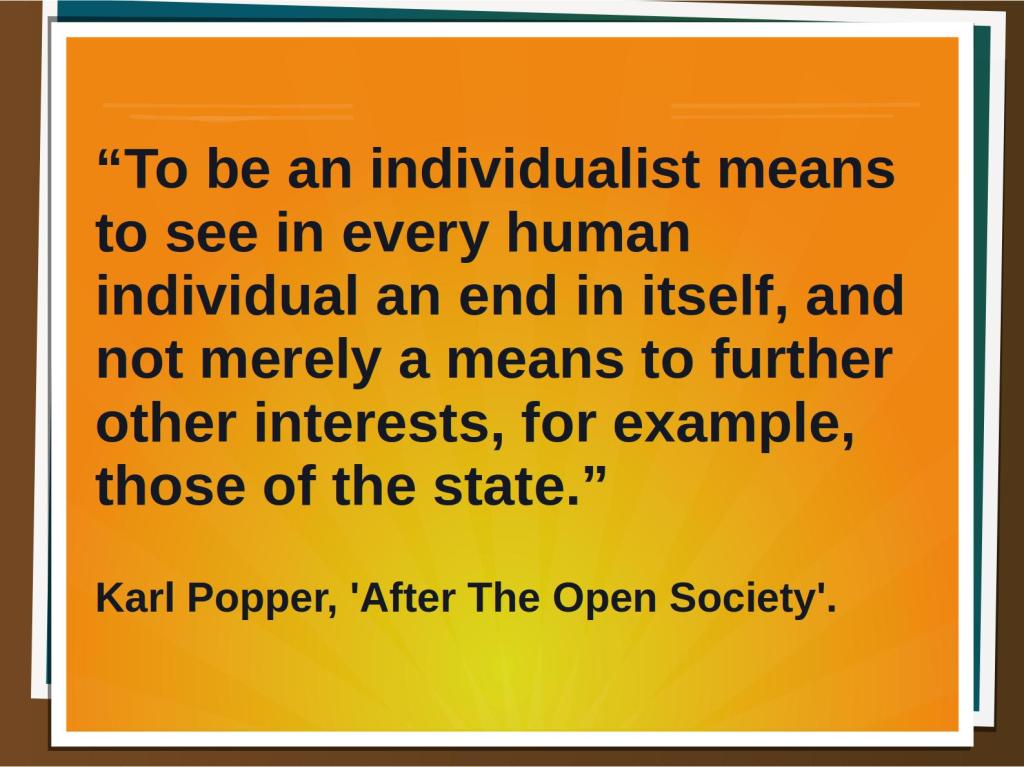
Popper, Karl Raymund, had witnessed the entire XX-the century. Both WWs and their aftermath. The advent of the USSR, that of the III-rd Reich and that of the Red China. And the defeat of the imperialistic Japan. Him insisting that collectivism – as put in practice by the fascists and by the communists – leads to a very dark cul-de-sac is spot on and perfectly aligned with what history teaches us.
But who has enough time to read nowadays … we glance at the internet, catch a meme … interpret it according to our own weltanschauung… and then storm the Capitol!
Because the individual is above the state. “An end in itself”…

The teachers/parents should have done a better job? At explaining what Popper had in mind? At teaching the next generation that you don’t ransack the Capitol whenever you don’t like the outcome of an election?

Which teachers?
Which parents?

WE?!?

https://www.amazon.com/Our-Own-Worst-Enemy-Democracy/dp/0197518877

https://www.routledge.com/After-The-Open-Society-Selected-Social-and-Political-Writings/Popper-Turner-Shearmur/p/book/9780415610230

Survival of the fittest?!?
No, only the demise of the unfit!

Ernst Mayr, What Evolution Is?

An end in itself…

For whom? For the concerned individual?
For the philosopher pondering the concept?
For the ideologue promoting the idea?

And who determines ‘the interests of the state’?!?

“Plato suggests, and all later collectivists followed him in this point, that if you cannot sacrifice your self-interest for the sake of the whole, then you are a selfish person, and morally depraved.”

Since there’s no better judge for ‘sustainability’ than mere history, let’s ‘look back’.

Whenever the powerful of the day considered that everything belonged to them, and that the collective wasn’t worth any consideration, that ‘arrangement’ soon ended in chaos. From Alexander the Great to Saddam Hussein. Hitler, Stalin, Ceausescu…
Whenever the meek had accepted everything which came from ‘above’, very soon the ‘arrangement’ also ended in chaos. The Khmer Rouge experiment, the Chinese Cultural Revolution, communism being instated in the Eastern Europe by the Soviets…

As a rule of thumb, individuals can exist only as members of a collective.
None of us can birth itself (?!?)
None of us can educate itself ON ITS OWN. OK, one might teach itself to read. And then devour a whole library. But for that to happen, somebody else must have invented the letters first!
None of us can develop into a conscious human being without living with other human beings.

Furthermore, the same rule of thumb states that collectives which value their individuals, all of them, fare a lot better than the highly ‘hierarchical’ ones.
In this sense, Popper was right. ‘Individualistic’ societies – the collectives which ‘see individuals as ends to themselves’ – fare better than the collectives which allow, for a while, their temporal leaders to lure them into obedience.

Attempting to value individualism over collectivism is similar to trying to establish which came first, the chicken or the egg.

Having experienced both – collectivism and individualism put in practice as political principles, I have noticed that neither extreme is capable of working in a sustainable manner.

Communist regimes had fallen one after another.
Fascist regimes did the very same thing.
Pirate republics could never resist for long.

Coming back to what is happening in the US, I’m afraid very few people are aware of how much collective thinking had been embedded in the American Psyche. The good kind of collective thinking…
Americans go to church. A place where you go to to be together, not alone.
Americans used to help each-other. Charity used to be a big thing. Slowly, it had become a dirty word.
And so on.

Individuals can not exist on their own. They need each other to survive. And to thrive.
Collectives can not last for long unless the individuals who constitute them do respect each-other. Help each-other maintain and develop their individuality.

As simple as that.

And why are we still trying to solve this riddle?

‘Cause this is indeed a riddle…

Remember those metaphorical stories whose heroes end up having to find the answer to one in order to save themselves/the day?
Like Sophocles’ “What walks on four feet in the morning, two in the afternoon and three at night?”

A riddle, of course, being a question which cannot be answered until the individuals attempting to solve it stick their heads out of the box into which the riddle had been framed.

So. Individualism? Collectivism?

Having grown up under communist rule – supposedly the most collectivist social arrangement to date, I can testify that there is no such thing as collectivism without individualism nor individualism without collectivism.

Libertarians’ mantra is that socialism/communism – and even liberalism, as Americans understand it, is a form of collectivism. And, of course, that collectivism is bad for you.
Socialists, on the other hand, maintain that the current situation – which is seen as being bad, is the consequence of the growingly extreme individualism which plagues modern societies.

Interestingly enough, both sides are simultaneously right.
Communism is indeed bad for you and the bad aspects of today’s society are a consequence of callous selfishness.

On the other hand, all communist societies are composed of a huge mass of obedient subjects AND a small number of individual, and very individualistic, leaders.
Similarly, all developed capitalist societies – including those sporting huge discrepancies between the shrinking number of haves and the growing number of utterly destitutes, have reached the current level of sophistication because most of their members continue to share the belief that ‘all men have been created equal and that all of them have certain, nonnegotiable, rights: Life, Liberty and the Pursuit of Happiness’.

“Share the belief…”
But wasn’t this the very definition of collectivism?
A social arrangement where the most important possession belongs to THE public?
Was there anything more consequential for what is currently known as the ‘Euro-Atlantic’ civilization than this shared belief? Other peoples have been in possession of way more abundant natural resources. Had reached ‘astronomical’ levels of civilization way before we were even able to wipe our noses… And yet…

Haven’t we, individual thinkers, figured out yet that unless we agree on ‘the basics’, we’ll be easy prey for the callous ‘snake oil merchantmen’ who have no qualms to use collectivist slogans to pitch some of us against the others?

Haven’t we figured out, yet, that there is no ‘political collectivism’ without fear? All collectivist social arrangements, both socialist and fascist/nazist, have been built using fear/contempt (of the other) to cement ‘the people’ into believing the lies proffered by false prophets. Lenin, Mussolini, Stalin, Hitler, Mao… Lies proffered by callously individualistic political agents… bent on satisfying their own domineering instincts and making ‘good use’ of pre-existing conditions.

Haven’t we figured out yet that individualism, the tame version developed along with the good aspects of the Western Civilization, is, by nature, the very beneficial consequence of the mutual respect which (still) exists among the members of our societies?

So, to answer the riddle, we need to understand that there is no real conflict between bona fide individualism and bona fide collectivism.
Just as there is no conflict between two perpendicular lines.

Since, by trade, I’m a mechanical engineer, I’ll use a very practical metaphor to illustrate this idea.
Consider a pressurized Oxygen tank. The more pressure inside, the more Oxygen you can store in it. The more useful the tank. Only if you ramp up the pressure too much, you end up with an explosion.
In this situation, you might consider ‘pressure’ to be in conflict with the ‘walls of the tank’, right?
Wrong. The conflict is only in your mind. Pressure is simply perpendicular to those walls. The more pressure those walls can withstand, the more useful that tank is for you.

But it’s your responsibility to determine the thickness and resilience of those walls. It’s your responsibility to choose how much to ramp up the pressure.
For the very simple reason that that tank is yours.
It is you who will suffer the consequences.