The things we believe are what we have in common with those who promote them.
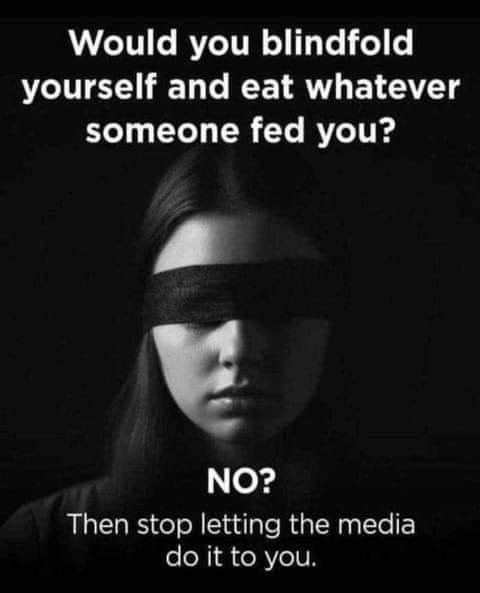
Well, nobody ‘blindly’ beliefs anything published in the media! We use our cognitive biases in order to do that.
The media publishes the things we like to hear. To sell advertising space, to please their sponsors… While those who actually do this, the journalists, appease their consciences with ‘we have to give them what they want’. ‘Cause we actually do ‘buy’ their stuff…
And we believe the things we read in the kind of press we ‘buy’ because we no longer bother to keep in check our cognitive biases!
Who has anything to gain? From this vicious circle spinning faster and faster?
Nobody, really! But we all have something to lose.
Everything, actually!
When was the last time you met a dead person who regretted anything?
According to Schoppenhauer’s take on the matter, we make sense of the world by carefully (?) ruminating the “pictures in our head”. The information which has already reached our ‘inner forum’. Which means that we should be very careful when letting something ‘in’! When reading a text, for example…
‘You should follow science, not scientists. Because scientists can be sold.’
Logically speaking, the phrase makes a lot of sense. Right?
Practically… not so much.
Do we learn everything about medicine before taking the pill prescribed by the doctor? Simply because the doctor might have been sold to the big pharma? Do we learn everything about microwaves before using a microwave oven? Simply because the physicist who had invented the thing might have been sold to the makers of household appliances? Do we stop using planes because they are used to spray our skies?
Literary speaking, what do you make of “scientists can be sold to the highest bidder”?!? Sold by whom? How can anybody sell a scientist? I might understand the notion of a scientist being bought… of a scientist selling his soul, his scientific soul, to the highest bidder… but selling one… Is there a market for scientists?
only because it happens to resonate with something you are already inclined to believe.
The first ‘virtual’ tool invented by Man, language made it possible for humans to become conscious. By sharing information among them, individual human beings learned to speak to themselves. To think. To evaluate their activity. To evaluate themselves. Their own selves. Speaking to each-other, people have developed self-awareness.
The process is a work in progress.
Words are ‘stamps’. Images. ‘Commodified snapshots’ of the thing we call reality.
Which reality is simultaneously a word and the place we live in.
A word/concept into which – like in all other words – we’ve crammed everything we know about the thing itself. Which everything is nowhere near enough to actually cover the entire thing.
Reality, the word, covers everything we know about the thing but the thing itself, the thing we call reality, is far wider/deeper than that.
Hence the problem we’re stuck with.
We instinctively consider that words are apt representations for the things we attempt to describe using those words. Which, most of the time, isn’t exactly true. We – most of us, most of the time – consider that those of us we talk to understand the words we share in the same way we understand them. Which is never the case!
I’ve been watching this, on and off, for three days now. And I still can’t make up my mind. Whom to admire more.
The one who performs what he believes to be normal. And somehow manages to include, into that normalcy, the negative feedback he is been dished out by the most powerful agent in his world. Or the other one. Who pursues his side of normal. Who finds in him to investigate when he realizes the two normals don’t fit. And the courage to make amends.
Thank you Elvis Naçi for this conundrum. I’m a better person now. Now that I’ve stated my impotence.
Regardless of our individual beliefs, it would be rather naive to consider there’s nothing but the here and now. Internet wisdom
What have you done since graduating into awareness?
Worrying about tomorrow?
Welcome to being a human. And how do you assuage your fear?
Put your faith into an exterior agent? Trust your fellow humans to bail you out if necessary? Make sure you’ll never depend on anybody else but you?
Each of these three strategies presumes differently about what happens outside yourself.
The more responsibility you transfer to the outside agent – currently known as God in certain circles – the more serene your life. You don’t have to change anything except putting your faith in the outside agent of your choice. If that works for you. Only by transferring the ultimate responsibility to ‘the outside’, no matter how hard you continue to do whatever you were doing before the epiphany, you embrace the fact that your fate is determined outside of you. If you expect your mates to do ‘the right’ thing, you must prime them first. You have to behave in a manner conducive to ‘community’. You and those around you. The community itself has to behave as a community. To make sure you’ll never depend on anybody else, you need to know everything that might happen to you. In fact, you have to know everything.
Each of these three strategies, or any combination thereof, mandates that there are things happening beyond here and now. Beyond what each of us might know and control.
Some people argue that ‘truth lies somewhere in between’ while others maintain that ‘truth is where it is, not somewhere in the middle’.
Well, both sides are right.
Truth is, indeed, “where it is”. The problem being that ‘that place’ is ‘out there’. Not necessarily ‘out of reach’ but definitely out of anybody’s realm. Hence finding ‘that place’ needs a collective effort. In this sense, the truth is, indeed, somewhere ‘in the middle’. In the middle of our converging efforts, if our efforts are honestly targeted.
On the other hand, truth is not ‘somewhere in the middle’. In the sense that truth is not something we can negotiate. We can indeed pursue truth individually but we cannot negotiate the results.
We can settle for a less than perfect truth, if we’re not able to reach ‘the absolute’, but it must be a workable version, not a lukewarm mean. The result of our quest, even if ‘only for a while’, must serve the goal we’ve been trying to reach! If we settle for something only because that something titillates the ego of the majority amongst us… then our efforts have been wasted!
Allow me to conclude that the truth is not somewhere between us but above us. It makes a lot of sense to thread carefully when trying to reach it – lest we stumble during our quest – but we nevertheless need to broaden our perspective. Lest the truth remains hanging just outside of where we’re looking for it.
For ‘man made’ things to happen – for anybody to do anything – three requirements must be met first. ‘Circumstances’, ‘determination’ and ‘opportunity’.
To serve a meal, the chef needs ingredients and tools, willingness to do it and a hungry client. To engage in an act of terrorism, the terrorist needs a certain set of circumstances, the ‘determination’ to do ‘it’ and a ‘trigger’.
Is it far-fetched to compare these two things? Feeding people and killing them?
From a ‘deterministic’ point of view, there’s no difference between deciding to serve a bowl of pasta and deciding to deliver a bomb. The consequences are, obviously, completely different. Supporting life versus taking it away.
There are more differences. Nobody has yet seriously considered banning restaurants and everybody hates terrorism. When subjected to acts of terrorism! Otherwise…
Meanwhile, PKK continues to remain a terrorist organization!
So… Just as food tastes vary enormously, so does various people’s interpretations on what constitutes a terrorist act. The first constant being the fact that food sustains life while terror tends to make it difficult. And the second one being the fact that both restaurants and terrorist acts are community based phenomena.
A restaurant depends on the people who deliver the goods, on those who operate it and on the paying customers who keep the business afloat. A terrorist depends on those who help and facilitate. And a terrorist depends on the rest of the community turning a blind eye towards what’s going on. For no matter what reasons! Until they realize how foolish they have been…
‘But who is a terrorist?’
That’s a very good question! There are up to three types of ‘associates’ in any act of terrorism. The ‘direct operator’, the ‘first hand facilitators’ and the ‘people behind’. While it is quite simple to understand the roles played by the ‘direct operators’ and by the ‘first hand facilitators’, things become murkier when it comes to the ‘people behind’. For some – including for me, the current Iranian leadership are among the ‘people behind’ the Hamas terrorist organization. But what about those who, willingly or unwittingly, make it so that whole communities become ‘restless’? Restless enough to generate terrorists and careless enough to turn a blind eye towards terrorist acts being prepared in their midst?
My point being that just as nobody becomes a celebrity chef overnight, it’s almost inconceivable that anybody might engage in major acts of terrorism without being helped by some and noticed by many. And just as a chef has to be talented to become noticed, a ‘direct operator’ needs to be in a ‘particular’ state of mind in order to operate. But just as an untalented cook is, eventually, ‘set aside’ by a run of the mill community, a willing ‘direct operator’ ends up, literally, being embraced by a ‘triggered’ community. Or is eventually ‘sent away’ by a normal one. By a properly functioning society!
Just before starting this post, I heard somebody commenting on Antonio Guterres’s words: ‘Even if he will not have to resign, he won’t get another mandate’… Now, as a coda, I feel the need to share that comment with you.
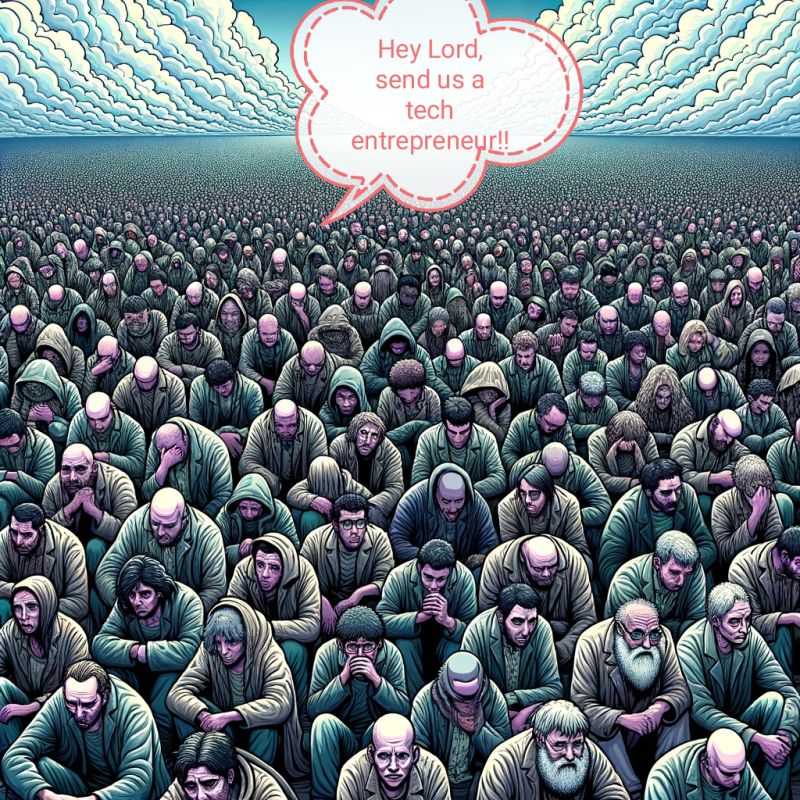
Taking and managing risk is also an acquired skill. Like riding a bike or swimming in the sea. Only nowadays the key word is safety. Safety, not safety net. We are taught to avoid risk, at all costs, instead of how to lend a helping hand towards the fallen ones. This is why we pay lip service to entrepreneurship but despise failure… as if it were possible to have one without the other.







 nicichiarasa