Archives for category: Politically induced fragility

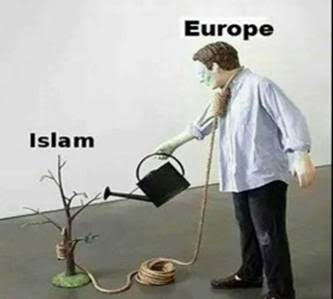
Islam Europe

I’ve just found this cartoon in my e-mail.
It was captioned: “The Winning cartoon in an organized competition.”

I instantly remembered some very wise words I’ve read long time ago:

Do not be deceived: God cannot be mocked. A man reaps what he sows.
Whoever sows to please their flesh, from the flesh will reap destruction; whoever sows to please the Spirit, from the Spirit will reap eternal life.
Let us not become weary in doing good, for at the proper time we will reap a harvest if we do not give up.
Therefore, as we have opportunity, let us do good to all people, especially to those who belong to the family of believers.”

“Beware! Whoever is cruel and hard on a non-Muslim minority, or curtails their rights, or burdens them with more than they can bear, or takes anything from them against their free will, I (Prophet Muhammad) will complain against that person on the Day of Judgment.”

All religious teachings, all of them, maintain that ‘a man reaps what he sows’. It doesn’t really matter if the ‘result’ will come as a sentence delivered by a divine judge or if it will be just another bead in the string representing the life story of an individual.
I, for one, don’t see much difference between ‘fate’ and ‘karma’.

Then how come we keep acting as if we’ve never been warned?

“In my two visits to Auschwitz, the Nazi concentration camp in Poland, I learned that holocausts and genocides do not occur in a vacuum. Rather, there is almost always a vicious campaign of incitement directed against the target group preceding them. What is troubling today, with the recent uptick in anti-Semitic and Islamophobic incidents worldwide, is that extremists and zealots are not the only ones inciting their followers. In a number of Arab countries, Muslim children are taught ideas that distort the true meaning of the Quran and hadith too.”

o-gay-prophet-570

Love, more powerful than hate.

scalia1

It is very rarely that I agree in full with something that I happen to stumble upon over the Internet.

And it’s no wonder that Scalia was absolutely right on the subject.
He had lived for so long in the shadow of the Constitution that at some point it must have downed on him.
The constitution, just as any other legal document, is nothing more, and nothing less, than what we make of it.

After all it was us, citizens, who wrote it in the first place.
Then amended it as we saw fit.
And are now interpreting it. To fit our own purposes, of course.

We don’t seem to agree much, lately, about those very purposes?
So we came up with diverging interpretations of what’s written in the Constitution?

Then the problem is with us, not with the Constitution.

Using it as a weapon, or adjusting it to fit the short term goals of whomever happens to be in power momentarily, won’t solve anything. Actually it will only make things worse.

It depends on the meanings we attach to these two concepts.

Yanis Varoufakis, Greece’s ex finance minister, is convinced that ‘Capitalism will eat democracy – unless we speak up.

Since he has some experience in this matter I’ll follow his line of thinking – for a while.

His point being that you can have successful capitalism in undemocratic societies – like Singapore and China – and that effective power has slowly shifted from the political sphere of the society to the economic one – which is undemocratic by definition.

Can’t say he’s entirely wrong, can we?

But we can say he’s somewhat confused…
So, he mentions Lee Kuan Yew’s Singapore and China as capitalistic success stories and then says that  the political sphere is gradually falling  under the yoke of the economic one… Well, last time I looked, in China the state was still in full control of everything that moved and the state was firmly in the hands of the politicians. Same thing was happenning during Yew’s tenure as Singapore’s good willed dictator.

Unfortunately there is some truth in his words when we look at what’s going on on the both sides of the Atlantic and that’s why I’m going to examine whether we have the same kind of capitalism in both situations.

By Google-ing the word I got two definitions for the concept.

The first definition that was offered by the search engine came from Oxford Dictionaries, “An economic and political system in which a country’s trade and industry are controlled by private owners for profit, rather than by the state” and the second one came from Merriam Webster: capitalism is “an economic system characterized by private or corporate ownership of capital goods, by investments that are determined by private decision, and by prices, production, and the distribution of goods that are determined mainly by competition in a free market“.

Putting them together we have private ownership, private decision, free market and profit as a goal.

Are these enough to describe a reasonably well functioning economic system?
I’m afraid not.

Let me give you some examples.
The French state has a controlling interest in Renault and the land of Bavaria quite a sizeable one in VW. Renault is in good shape and VW was too, until very recently. So private ownership is not an absolute necessity.
In the US we had quite an interesting situation. Two out of the three big car manufacturers  had to be bailed out by the state. All three were privately owned so we must look somewhere else: the Ford family still has a powerful word in the management of the single one which didn’t had to be bailed out. In Europe the best run auto company seems to be BMW – again controlled by a single family, the Quandt’s. It seems that it helps a lot if those who call the shots have a long time interest in the well being of the company versus the situation in which the top management has (short time) profit as the single/obsessive target.
Coming back to Renault and VW, they can be compared to Singapore, China and, maybe, Spain. Singapore was able to develop a ‘capitalistic’ economy despite it being an authoritarian society simply because Lee Kuan Yew was a very special kind of ‘dictator’ – one that not only cared sincerely for the greater good of his people but also didn’t loose his head during his long stage at the helm. A similar thing happened in Spain – Franco was the sole dictator who had made preparations for a democratic evolution after his demise, while China had to wait for another good-willed dictator to grab the power – Deng Xiao Ping – before it could steer towards the present course. No other authoritarian regimes but these two have ever managed to replicate this feat – we still have to wait a little before pronouncing Vietnam as the third, and very few other publicly owned companies fare so good as Renault does.

So, we have rather strong evidence suggesting that ‘skin in the game‘ trumps blind insistence on short time profit and that a free, democratic, society offers greater chances for economic development than a authoritarian one. In fact the politicians that need periodic confirmation from the people they govern do have some skin in the game while the authoritarians are in a position that is somehow equivalent to that of the CEO’s of the huge corporations whose stock owners are so disspersed that practically don’t count much – the members of the board practically slap each-other on the back and are able to do practically what they want with the companies. Look what happened at GM, Chrysler and, for example, ENRON.

But how free should be that society in order for capitalism to thrive?

Could it be so free that a guy could come from the street and claim your house as being his own? No?

So we need a free but orderly society. One where private property changes hands only when its owner says so – or has previously entered into a contract which stipulates that in certain conditions that transfer has to take place.

Meaning that in order to have a functioning capitalist society we need not only private ownership but also private owners who have enough trust in each other to start making business together.

You see, the feudal lords of the Dark Ages did have a lot of private property but capitalism couldn’t take hold in earnest as long as the (absolute) monarch could strip a man of his property and give it to somebody else. They couldn’t enter into (longish time) contracts because the era was dominated by huge uncertainties regarding various aspects of the social and economic life.

In fact it is exactly this well tempered freedom that is the crux of functional capitalism. Enough freedom so that everybody could feel confident that he is his own master but tempered by rules enforced in a pwerfully enough manner to give everybody sufficient trust that most contracts will be executed faithfully.

In this sense for capitalism to work properly we need to have a market that is free in more dimensions that one.

It has to be free from political intrusion in the sense that the government should leave it alone as a rule of thumb but also that the same government should keep it free from becoming cornered by a single group of interests.
In fact there is no difference from a market that is run by a governmental agency or by a monopolistic corporation – no matter if the latter is private. As soon as decision making becomes concentrated in too few hands mistakes starts happening. And their effect accumulate until the system finally collapse. Or is dismantled by some ‘exasperated’ more powerful agency – as Standard Oil and  ‘Ma Bell’ were dismantled by the US government. Which, by doing so, created the premises for  the huge development of those two respective markets – oil and communications.

Only this freedom of the markets can seldom be preserved by an authoritarian regime. Yew’s Singapore and contemporary China are exceptions, not the rule. Most authoritarian regimes cannot resist temptation and start meddling in the economic life of their countries. By doing so, they introduce a lot of ‘noise’ into the system. Eventually, this noise drowns the useful signals and ‘blinds’ the decision makers.

Same thing happens – and here Varoufakis has a valid point – when economic agents become so powerful that they can dominate the policy makers. The politicians can no longer preserve a balanced stance towards the economy and give in to ‘special interests’. This way the markets loose their freedom, with all the malign consequences that come with this situation. Among them, the lack of trust that slowly creeps in the souls of those who have to do business in the no longer free markets. Which lack of trust is very bad for all those involved.

And another thing about which Varoufakis is absolutely right. A lot of money are not being moved through the ‘front doors’. Not that they are not invested at all but because they are kept somewhat hidden they do not contribute as much to the well being of the world economy as they could/should.

2.1 $ trillion have been accumulated, as of  October 2015, in off shore accounts by the top 500 American companies in order to avoid taxes and
Between $21 an $32 trillion have been hiding in 2012 in various offshore jurisdictions.

Why is that? Simply because those who are called to decide about these money do not ‘trust’ that by bringing these money home and by investing them there, after paying the taxes, will be able to generate profits equivalent to those produced by leaving them off shore?

So what should we do? Tell them ‘democratically’, by electing somebody who is crazy enough to implement such a measure, to bring them home? Or even  confiscate them, one way or another?

I’m afraid that here I part again ways with Mr. Varoufakis. And with Aristotle: the way I see it democracy is not ‘the constitution in which the free and the poor, being in majority, control government‘. That would be ‘mob rule’.
A truly democratic process starts before the vote. When every stakeholder can make its point known to those who are going to cast a ballot so they’ll be able to do that having a reasonably clear understanding about what’s going on.

Frankly I’d rather rephrase Varoufakis’ message. ‘Corporatism has a tendency to disembowel democracy and transform it into ‘mob rule’ – the situation where the poor are no longer that free simply because they are convinced through ‘unholy’ methods to vote one way or another.

What can be done? Explain, loud and clear, that if jobs disappear the same thing will happen with the aggregate demand?
Explain that by giving their workers as little money as they can in reality the results are way worse than if the wages were as high as the companies could afford?
Ford didn’t give his workers more money because he loved them but simply because he had understood that in the long run he would be better off himself by doing this, you know!

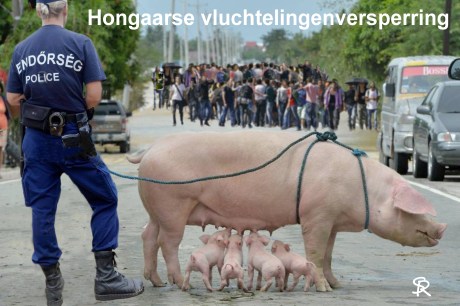
vluchtelingen-wegversperring

‘Hungarian self-defense’


… must we sink in our own, self induced, decrepitude before we’ll be able to notice the stink we, ourselves, have draped around us?

Before figuring out that it’s us who are ultimately responsible for our own fate?

Before figuring out that by allowing this kind of crap to be traded above our heads, and sometimes even by helping to its distribution, we soil the most precious of our ‘belongings’ – our souls?

This image has probably been ‘Photoshopped’ by somebody.
I’m not going to discuss that person’s motives here. We live in a free world and everybody should be able to express his/her feelings.

What I find extremely interesting – and dangerous – is the fact that this picture has been so widely circulated over the internet that it ended up in my mail. A short Google search confirmed that it comes from somewhere in Holland only the guy who sent it to me, horripilated, lives in Canada…

So, what’s the use for us to clamor virtuously about human rights and then make fun, shamelessly, of people who find themselves in a horrible situation?

And, please, do not make any mistake!
I’m not speaking exclusively about the refugees here.

Some of the manifestly dissatisfied Europeans who are protesting these days are not as much against the refugees themselves as they are against the hapless manner in which the European bureaucracy has been (mis) managing so many things recently.

Just as some of the political leaders who are lambasting the European Commission on this subject are not interested in improving the European Community but in ‘scoring swag’ with the disillusioned (and somewhat naive) electorate.

We need to break this vicious circle!

I published yesterday a post on this subject. In Romanian.

Today I stumbled upon another article which uses almost the very same manipulative tools. In English this time.

legal public urination

“Of all the things one could think of that New York City needs more of, public urination doesn’t immediately come to mind. But New York’s City Council, which is so far left it almost collides with the right, is about to make it happen thanks to it’s Speaker, a Puerto Rican nationalist who supports terrorists and rejects the Pledge of Allegiance.”

 Now can someone explain to me how can decriminalizing something be interpreted as an encouragement towards that something?
And what’s the use of making it a crime to urinate or to drink in public? A crime? Something that will be written into your rap sheet and follow you all your life?
Let’s imagine for a moment that you are a 19 year old who had one too many beers. And had to take a leak. A cop happens to be in the area. Now tell me what are the chances that he’ll look the other way if you’re white? And if you’re black?
Do you understand, at least now, what the ‘liberal official who sponsored this change’ meant by ‘helping the minorities reach their full potential’?
Who’s going to give a real chance to a ‘minority’ with a criminal record? Who has the time to check that his only crime was ‘public urination’? Or that he had a beer in front of his porch? Not exactly in front of his porch, because he used to live in a ‘public housing facility’ but you get the general idea…
Reality check no 1.
How about providing some places where people can relieve themselves? Porta-johns for instance? Or functional public rest-rooms in all New York subway stations?
Now I’m wondering what the author meant by “But New York’s City Council, which is so far left it almost collides with the right, is about to make it happen thanks to it’s Speaker, a Puerto Rican nationalist who supports terrorists and rejects the Pledge of Allegiance.“?
What has the Pledge of Allegiance have to do with anything? What’s the relevance of the Speaker’s ethnicity, beyond the fact that belonging to a minority increased her awareness of the way the minorities are treated by some of the law enforcement officers?
And how come a ‘supporter of terrorism’ has been elected Speaker in the first place?
What’s going on here?

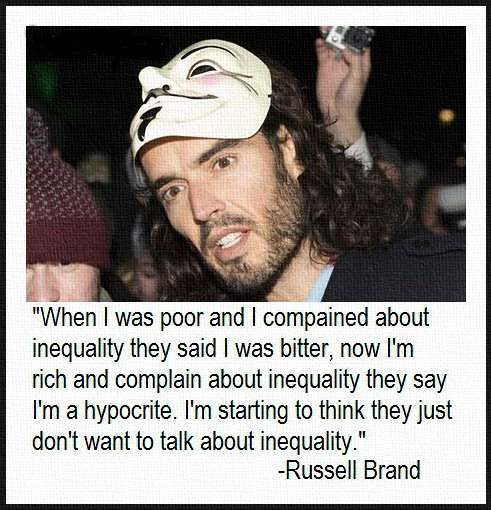
I recently shared this meme on my FB wall:

when_i_was_poor_and_i_complained_about_inequality_they_said_i_was_bitter_2014-07-23

This is what happened next:
No two people are the same.“”That’s why I prefer equal opportunities instead of equality.
No two opportunities are the same. What you might consider an opportunity I might pass up. It’s a very diverse world we live in, a wide one in which hopefully everyone can be accommodated.

‘Can be’ or ‘will be’?

And who is the real looser here?

Let’s see what the broad picture looks like:

The world’s super-rich have taken advantage of lax tax rules to siphon off at least $21 trillion, and possibly as much as $32tn, from their home countries and hide it abroad – a sum larger than the entire American economy.”

Meanwhile

education debt

And what’s wrong with that?!?
Everyone has the right to do what ever he wants with his money and why should anyone expect to be educated for free?!?

OK, let me put it differently.

Every society is like a big community, even if its members do not share an intimate knowledge of each-other.
At least theoretically an overwhelming majority of any nation share the same set of values and the same goal – the long term survival of both the population and the afore mentioned set of values.

Now please consider which society would be better at the game of survival:

One which would make it easier for as many of its members to develop as much of their individual potential as possible or one that would make it easier for a small number of its members to spirit away so much wealth that the rest would remain crippled?

One which would use the very concept of a ‘free market’ as broadly as possible – make sure that as many as possible of its members enjoy the widest possible autonomy – or one that would allow the ‘never as free as advertised’ market to degenerate into the ‘winner takes it all‘ situation we are bound to reach if we continue on our present course?

How could enough people afford to ‘wander around’ for long enough to find the opportunities that would fit them if they are saddled at birth with a huge burden – the ever burgeoning national debt?
Would enough people risk to take on any additional debt (in order to prepare themselves to make better use of the opportunities they might find) if too many of those opportunities, even if met diligently, do not pay enough to ‘eat’ AND pay back the debt?

How is a society going to survive, let alone thrive, if a lot of ‘opportunities’ (social needs) end up being ‘plugged’ by unfitting/under-skilled/’less than enthusiastic’ individuals? Or not at all?

On the ‘supply side’, what do you think of those who choose to dodge paying taxes?
On the ‘demand side’, what do you think of those who squander public money as if there is no tomorrow?

So what should we be talking about? Equality or Equal Breadth of Opportunity?
About the Bed of Procrustes or about a ‘Free Market’ where all participants are simultaneously autonomous and fully aware of their responsibility for their children’s future?

jkegsfs

“As latest batch of innocent Americans are left in pools of blood” politicians continue to do what we have permitted them to do, for too long.

Some of the conservatives offer prayers, Trump offers to “take out their families”, Hillary Clinton tweets a very well worded but other-ways transparent message (“I refuse to accept this as normal. We must take action to stop gun violence now“)  and Martin O’ Malley squares up the ‘anti-gun’ position: “Enough is enough: it’s time to stand up to the @NRA and enact meaningful gun safety laws”.

One of the worst cases of heels being dug in I’ve ever witnessed…

bp39zn1ieaaudlw

Some of the conservatives cannot get  over the ‘if it doesn’t hurt me, it doesn’t need to be addressed’ attitude while some of the democrats cannot get over the Marxist attitude which posits that everything must have a ‘material’ cause – in this case ‘the guns’.

Am I exaggerating?
Then how come the conservatives act swiftly whenever ‘terrorism’ is involved while the democrats conveniently forget that no gun can kill without a man pulling its trigger?

And while too many of the conservatives let God fix the problems they don’t consider important and the ‘democratic’ ideologues focus on the wrong target too many voters from both sides of the aisle “are left lying in pools of blood”.

So yes, “God isn’t fixing this!”.
Anyway, not until ‘we, the people’ start doing something about it.

And the first thing that needs to be done is for us to stop digging in our heels and start talking across the ideological divide.


lashes1-copy-300x210
If we want to understand what’s going on there we have realize that we are dealing with a absolute dictatorship which uses Islam as a crutch, exactly as the soviet style dictators in the so called ‘popular democracies’ were using ‘scientific materialism’ – their term for the communist doctrine.
The job of the Saudi ‘justices’ is to maintain ‘the order’ as they see fit – the kingdom as it is and the Saudi family in power, not at all to dispense justice as we know it.
In order to do that they use, ‘creativelly’, the most powerfull tool they have at their disposal: the faith shared by the majority of the inhabitants of the kindom.
It even doesn’t matter for them that in the process they are ruining any chance of a decent life for the majority of their conationals.
At first their only goal was to retain the graces of the ruling family – just as minions everywhere behave in the presence of a powerfull figure.
In time things have evolved in a malignant manner. I’m afraid that nowadays the House of Saud itself has become the prisoner of the erstwhile minions, just as every dictator eventually becomes the prisoner of his guards.

forgiveness

Some say that God created the world, a long time ago, and that’s why he is the only one who can forgive.
Some others remember how the elders taught them that keeping a grudge is far worse than having an ulcer. It will eat you alive, like a cancer.

I, personally, don’t know anything about God creating the world. I wasn’t there at that time so…
What I do know is that playing God is extremely dangerous. Not only for the impersonator but mostly for those around him. Exactly those who were amused at first by his performance – enough so that they encouraged him to continue, only to find out later how annoying the show will soon become AND that the exit door had been paddled shut behind their back, while they were happily clapping after the first gigs.
At the very end, after the impersonator had left the scene – by his own will or simply carried out, he will end up shouldering the whole blame – as he should, of course.
But I can’t stop wondering how much suffering could have been avoided if the crowd were just a tad more circumspect?

Not making very much sense, do I?

OK, first take a look at this:

No mercy

Then watch this:

go hard

Do you really think this is funny? Well… more than 38 000 of the almost two and a half million who watched this say they enjoyed it and only two and a half thousand became worried enough to express their feelings.

Most of you have not experienced how it is to live under dictatorship so I’ll use another metaphor.

You are probably quite familiar with this guy:

dirty harry

He was lionized during the ’70’s and the ’80’s for impersonating a no-nonsense cop who cut through the red tape and got things done.

Mostly by shooting the bad guys.

Don’t get me wrong.

They didn’t get anything else than they actually deserved.

What I find really troublesome about Dirty Harry is the casualness with which he killed people. And his over-reliance on guns. On brute force, that is. “Go ahead, make my day.”

It is true that at that time people were exasperated with the daily occurrence of violent crime and were desperate for a way out of that situation. I’m not going to offer you statistics or stuff, you can look them up yourself. I’ll just tell you that the Romanian television was having an almost daily news bulletin presenting the latest violent acts committed Stateside. It was all part of the propaganda, of course, but the facts were real. And plenty enough to make me wonder, I was a teenager at that time, what on Earth is going on there?

That wave of violence has subsided, as we all know. Some say it happened because of ‘broken windows policing’, some ‘freakin’ others ‘blame’ ‘Roe vs Wade’ for it while I suspect that all of the above had something to do with it but that the main ‘culprit’ was the economic upsurge that followed the ‘stagflation’ period.

Nowadays we find ourselves in another economic and psychological down-turn. With a twist though.
The recent economic troubles were brewed at home while then it started with the Oil Crisis. Much of the violence no longer starts as a robbery but has a psychological motivation – disgruntled and socially disconnected young people commit multiple acts of homicide, either by indiscriminately shooting their victims or by blowing themselves up, along with a huge amount of explosives, in densely populated areas.

And how do we respond to this fresh wave of violence?
By turning a blind eye to heavy policing? By digging fresh trenches that further divide our already highly polarized society? By another wave of over reliance on guns?

“I said it was only me and, hands still raised, slowly descended the stairs, focused on one officer’s eyes and on his pistol. I had never looked down the barrel of a gun or at the face of a man with a loaded weapon pointed at me. In his eyes, I saw fear and anger. I had no idea what was happening, but I saw how it would end: I would be dead in the stairwell outside my apartment, because something about me — a 5-foot-7, 125-pound black woman — frightened this man with a gun. I sat down, trying to look even less threatening, trying to de-escalate. I again asked what was going on.”

Go ahead, click on that quote and read the entire article. My post won’t go anywhere.

What’s the connection between what happened to Kyle Monk, the Dirty Harry movies and Putin?

For starters all those involved were …human individuals.
Kyle’s neighbor who called the police and who, when asked by Kyle ‘why did you do it’, chose to end up the conversation with “I’m an attorney, so you can go f— yourself.”
All of the nineteen policemen who played a role in this drama – and who treated a 125 pound, scantily clad, woman as if she were an armed and dangerous criminal were also human individuals.
The heads of the public administration, those who adopt and enforce policing policies are also human individuals.
The financial wizards who engineered the recent crisis belong to the same species as we do.

We, the guys who admired Dirty Harry for his toughness, are the parents of the hapless generation who blows itself up or mindlessly shoot their colleagues in campuses.

We are also the guys who are amused when bored magazine writers attribute to Putin such silly quotes as ‘it’s my job to send them to Him’.

And it’s us who applaud the Putins of this world. Only to find out, on our own skin but too late to be able to do anything about it, that the ‘hug of the bear’ is not that comfortable as it seemed from a distance.

you're Callahan


Basically, “anarchy” is about everybody for himself. And damn everybody else – even though most forget about this part.

While “secession” is mostly about someone trying to carve a ‘piece of the action’ for himself – and some people (naively?) following him. Maybe hoping that the new ruler would prove to be better than the old one?