
unless fully prepared to deal with all the consequences of getting that something.

Click here and read all the lyrics. Carefully. Twice!
unless fully prepared to deal with all the consequences of getting that something.
Click here and read all the lyrics. Carefully. Twice!
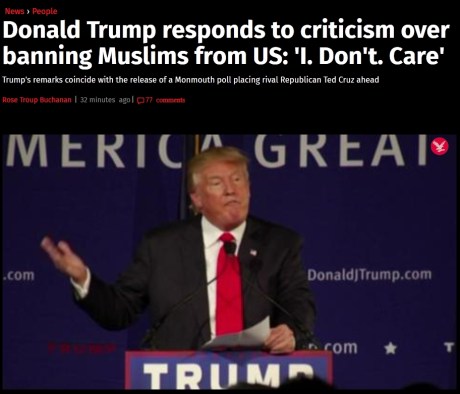
A lot of pundits on both sides of the aisle are bending over backwards trying to explain how come Trump has captured so many ‘hearts and souls’.
Here’s a very poignant explanation from a seemingly independent minded, hence free, commentator who calls himself Tonkerdog1:
“This is a different cat. This is a different phenomenon,” Luntz told reporters after conducting the focus group. “This is real. I’m having trouble processing it. Like, my legs are shaking,” he added.
What we seem to have here is a classic case of people so fed up with what they perceive as happening around them that they fall for the first con man callous enough to grab the opportunity.
I’m not going to bore you with facts about how many times Trump changed his mind and things like that. You can read them by yourself. Just click here. I’m not even going to ask you why didn’t you saw this coming when he said that:
What I am going to ask you is:
What if he’s actually sincere when he says that he doesn’t really care (for anything else but his own ego)?
And why should he?
It seems that his ‘bellowing’ followers do not read much.
“Trump Wrongs the Right”?
So what?
The Internet is choke full with ‘the Media is full of shit’ messages. Why should people start believing what the media publishes now?
When are we going to understand that the Trumps of this world don’t come out of the blue?
Not a single one of them could have become what he is today without enough of us giving him a lot of credit.
Despite the fact that not a single one of them cares a iota about any of us.

And ugly too!
Despite the fact that there is no shortage of obese women in the real world and tonnes of bad jokes about them lurk on the Internet – one of them pictured above – sensible people do not speak much on this subject. Not that the subject isn’t relevant but because normal people refrain themselves from hurting other people.
And the closer those ‘other people’ are to the speaker the more carefully he/she chooses his/hers subjects/wording.
And why is this?
Behaviorists would argue that through the constant push-pull interaction that takes place between the members of a community each of them learn to behave in a manner acceptable to everybody.
‘Insults are not acceptable’ that is.
Evolutionary psychologists would argue that useful information that is presented in an insulting manner has practically no chances to penetrate the ‘ego filter’. Hence effective communicators have learned to ‘dress’ information they really need to convey to their audience in a ‘palatable’ manner.
Take your pick.
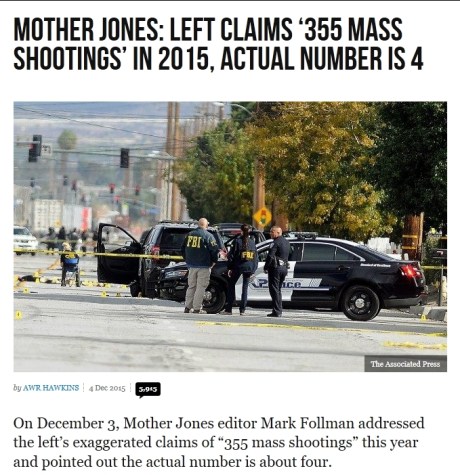
So FBI considers an incident where 4 people get killed to be a ‘mass shooting’ while Shooting Tracker considers a “mass shooting is when four or more people are shot in an event, or related series of events, likely without a cooling off period.”

“As latest batch of innocent Americans are left in pools of blood” politicians continue to do what we have permitted them to do, for too long.
Some of the conservatives offer prayers, Trump offers to “take out their families”, Hillary Clinton tweets a very well worded but other-ways transparent message (“I refuse to accept this as normal. We must take action to stop gun violence now“) and Martin O’ Malley squares up the ‘anti-gun’ position: “Enough is enough: it’s time to stand up to the @NRA and enact meaningful gun safety laws”.
One of the worst cases of heels being dug in I’ve ever witnessed…

Some of the conservatives cannot get over the ‘if it doesn’t hurt me, it doesn’t need to be addressed’ attitude while some of the democrats cannot get over the Marxist attitude which posits that everything must have a ‘material’ cause – in this case ‘the guns’.
Am I exaggerating?
Then how come the conservatives act swiftly whenever ‘terrorism’ is involved while the democrats conveniently forget that no gun can kill without a man pulling its trigger?
And while too many of the conservatives let God fix the problems they don’t consider important and the ‘democratic’ ideologues focus on the wrong target too many voters from both sides of the aisle “are left lying in pools of blood”.
So yes, “God isn’t fixing this!”.
Anyway, not until ‘we, the people’ start doing something about it.
And the first thing that needs to be done is for us to stop digging in our heels and start talking across the ideological divide.


Some say that God created the world, a long time ago, and that’s why he is the only one who can forgive.
Some others remember how the elders taught them that keeping a grudge is far worse than having an ulcer. It will eat you alive, like a cancer.
I, personally, don’t know anything about God creating the world. I wasn’t there at that time so…
What I do know is that playing God is extremely dangerous. Not only for the impersonator but mostly for those around him. Exactly those who were amused at first by his performance – enough so that they encouraged him to continue, only to find out later how annoying the show will soon become AND that the exit door had been paddled shut behind their back, while they were happily clapping after the first gigs.
At the very end, after the impersonator had left the scene – by his own will or simply carried out, he will end up shouldering the whole blame – as he should, of course.
But I can’t stop wondering how much suffering could have been avoided if the crowd were just a tad more circumspect?
Not making very much sense, do I?
OK, first take a look at this:

Then watch this:

Do you really think this is funny? Well… more than 38 000 of the almost two and a half million who watched this say they enjoyed it and only two and a half thousand became worried enough to express their feelings.
Most of you have not experienced how it is to live under dictatorship so I’ll use another metaphor.
You are probably quite familiar with this guy:

Mostly by shooting the bad guys.
Don’t get me wrong.
They didn’t get anything else than they actually deserved.
What I find really troublesome about Dirty Harry is the casualness with which he killed people. And his over-reliance on guns. On brute force, that is. “Go ahead, make my day.”
It is true that at that time people were exasperated with the daily occurrence of violent crime and were desperate for a way out of that situation. I’m not going to offer you statistics or stuff, you can look them up yourself. I’ll just tell you that the Romanian television was having an almost daily news bulletin presenting the latest violent acts committed Stateside. It was all part of the propaganda, of course, but the facts were real. And plenty enough to make me wonder, I was a teenager at that time, what on Earth is going on there?
That wave of violence has subsided, as we all know. Some say it happened because of ‘broken windows policing’, some ‘freakin’ others ‘blame’ ‘Roe vs Wade’ for it while I suspect that all of the above had something to do with it but that the main ‘culprit’ was the economic upsurge that followed the ‘stagflation’ period.
Nowadays we find ourselves in another economic and psychological down-turn. With a twist though.
The recent economic troubles were brewed at home while then it started with the Oil Crisis. Much of the violence no longer starts as a robbery but has a psychological motivation – disgruntled and socially disconnected young people commit multiple acts of homicide, either by indiscriminately shooting their victims or by blowing themselves up, along with a huge amount of explosives, in densely populated areas.
And how do we respond to this fresh wave of violence?
By turning a blind eye to heavy policing? By digging fresh trenches that further divide our already highly polarized society? By another wave of over reliance on guns?
Go ahead, click on that quote and read the entire article. My post won’t go anywhere.
What’s the connection between what happened to Kyle Monk, the Dirty Harry movies and Putin?
For starters all those involved were …human individuals.
Kyle’s neighbor who called the police and who, when asked by Kyle ‘why did you do it’, chose to end up the conversation with “I’m an attorney, so you can go f— yourself.”
All of the nineteen policemen who played a role in this drama – and who treated a 125 pound, scantily clad, woman as if she were an armed and dangerous criminal were also human individuals.
The heads of the public administration, those who adopt and enforce policing policies are also human individuals.
The financial wizards who engineered the recent crisis belong to the same species as we do.
We, the guys who admired Dirty Harry for his toughness, are the parents of the hapless generation who blows itself up or mindlessly shoot their colleagues in campuses.
We are also the guys who are amused when bored magazine writers attribute to Putin such silly quotes as ‘it’s my job to send them to Him’.
And it’s us who applaud the Putins of this world. Only to find out, on our own skin but too late to be able to do anything about it, that the ‘hug of the bear’ is not that comfortable as it seemed from a distance.
I happened to stumble upon this image on somebody’s FB wall.

And then it hit me.

Let me elaborate on some concepts first.
We have religion and we also have religions.
Regardless of whether religion comes from the Latin ‘religare’ or not it is obvious for the concerned observer that inside what is commonly known as ‘culture’ there is a tightly knit set of traditions which constitutes the common ground where all members of the community that share those convictions come to meet and ‘find the time of the day’.
Emile Durkheim, one of the founding fathers of sociology, has written a whole book on this subject – The Elementary Forms of Religious Life – and John Faithful Hamer, one of his disciples, has summed up brilliantly the whole idea: “Religion is largely a function of sociology, not theology.”
Only each community has evolved in its own distinct environment. Hence, even if for each community ‘religion’ plays the same role, there are no two religions that are similar. Simply because each of them consists, as I’ve said before, of a certain set of traditions whose main goal is to help the community make the most of the environment into which it has to make do. And since each environment is different from the next one…
And now we have arrived at the second role played by religion. To offer a certain degree of solace and certitude to the individual believer. Just as nobody can make it out by himself – regardless of whatever the anarchist libertarians might think/preach – all of us need some assurance about the world having some kind of congruence. Some of us find it in science, some others in stories which involve a God or a team of Gods and yet others in a godless narrative about how to behave in order to find, eventually, a way out of this Earthly ‘Valley of Tears’.
In order to offer that solace each individual religion has developed a certain ritual. Just as rigorous performance of calisthenics provides a certain physical well being by performing a religious ritual individuals forge a strong connection with the same minded people belonging to the same flock. That’s why some people believe that ‘religion’ comes from ‘religare’ – the Latin word for ‘binding’.
Let me now put two and two together.
We have religion as a set of guiding traditions and we also have religion as a ritual which is performed in order to bind people together so that they no longer feel alone and helpless.
Putting things this way it’s easy to observe that there are some people who are firm believers in those guiding traditions but who, for various reasons, do not feel the need to constantly reenact the ritual; others who are more or less skeptic about the traditions but who are convinced that their world would come apart if the ritual would no longer be performed and still others who are both firm believers in ‘their’ traditions and staunch performers of the ritual attached to those traditions.
From a more practical point of view the non ritualistic ‘firm believers’ will live and let live even if they are convinced the others will rot in hell while those who attach great importance to the proper performance of the ritual will try to impose it as widely as they (even im)possibly can.
So, if we need to reduce their militancy it would be easier to reduce their perceived insecurity/helplessness than to try to change their ‘religious’ convictions. Maslow taught us that it’s relatively easy to lift an individual from the base of his famous pyramid to a more comfortable level while history has taught us that it takes a lot of time to change a time-honored tradition.
Also, by helping them to overcome their perceived helplessness we’ll also help them notice the fact that each religion offers a great degree of autonomy to its followers.
BTW, that’s why many would be dictators insist on religious-like values (nationalism is also a religion), on the corresponding rituals being faithfully respected AND simultaneously do their worst in order to reduce their followers – the ordinary members of the community they intend to dominate – to a state of abject dependency. The most poignant example being Pol Pot’s Cambodia but this has happened, to various degrees, in all communist states. But not exclusively.


Somebody shared a picture on FB and I finally understood the strange relationship between the American People and their Government.

The quote belongs to, obviously, Frank Zappa. I found it in an article written by Kevin Courrier and published in CriticsAtLarge.com.
What grabbed my attention was not the fact that a musician is so passionate about politics but the huge confusion that sits at the bottom of his political weltanschauung.
The American Constitution, any constitution for that matter, is not at all a contract between the government and the people but a contract that binds together the citizens that inhabit a country. The government, any government, is ulterior to the signing of that contract so it cannot be a part of that contract.
OK, I can understand how that confusion came to be only I cannot understand how it could survive for so long.
For more than two centuries, that is.
As we all know the US were, at first, British colonies. For the last nine centuries or so Britain was run more or less according to Magna Charta – which is indeed a sort of contract between the Monarchy and the British people. But that is valid for Britain. It is the Great Britain that traces its ‘essence’ back to the idea of a divinely sanctioned Monarch who owned, entirelly, the whole country and who autocratically ruled over all the aspects of its life. And that at a certain point in history the Monarch agreed to sign a contract with his subjects, promising to treat them fairly.
But at an ulterior point in the history of the British Empire the American people had decided that they didn’t want anymore to be subjected to any worldly authority so they had sent the British Governor packing. From there on the essence of the American state was no longer the persona of the Monarch but ‘We, the People’.
That’s why the American Government is, by right, nothing more than an employee of the American People while the British one is a servant – or an employee – of the Monarch.
Let me put it a little differently. America is like a huge corporation while the citizens are its shareholders. The people own the country and the Government who runs it is the Board of Trustees. The people are the employers and the members of the government are the employees.
In Britain the Monarch is the ‘owner’, the people are ‘tenants’ and the government is the administrator of the whole business. The government is employed by the owner and payed by the tenants – who have a say because they are paying the rent, otherwise known as ‘taxes’.
Then how come, two hundred years after the Constitution that settles the conditions of ‘incorporation’ was adopted so many Americans still see the Government as being different from the ‘people’? Could it be that Zappa is right? That too few people have understood that “this nation, under God, shall have a new birth of freedom—and that government of the people, by the people, for the people, shall not perish from the earth.”?
I know, I know… These words are not from the American Constitution – they are widely attributed to Lincoln. But they describe perfectly its spirit, even if some people accuse Lincoln for being a dictator – because he didn’t allow the South to seccede, as if this decision was his to make… You see, the confusion is deep indeed. When people are passionate about something they tend to pick up from the entire picture only the pixels that fit their view of the world…
Then why so many of the ‘we the people’ still believe that the constitution is a contract between them and their Government?
Or maybe Zappa was (half) right after-all? Civics should indeed be brought back …
PS
Coming back to ‘Government of the people, by the people, for the people’ some people attribute these words to John Wycliffe and still others to Thomas Cooper.
 nicichiarasa