Archives for category: man induced fragility

Nothing existed before we came around. To notice.

They were there, alright. But didn’t existed, yet.

Most dictionaries do not discriminate between ‘being’ and ‘existing’.
But I still recall, vividly, those moments when – as a teenager, I tried to make myself remarked by the girl I fancied at that moment. More often than I’d like to remember, it was as if I didn’t existed at all.
I was standing there, making a fool of myself, yet I didn’t existed at all.

Simply because I wasn’t noticed.
By the significant one.

What do we have an economy for?

To make ends meet? To make it easier for our needs to be met?

What do we have a banking/financial system for? To mobilize capital for the economy? To make it possible for our needs to be met easier? More efficiently?

Or just for profit to be made?

“It really is possible to do two good things at once: address the abuse of the working poor by payday-loan and check-cashing outfits while expanding the range of services provided by the USPS. Media outlets have called Warren’s proposal “radical.” That’s ludicrous. She’s simply using her position and prominence to highlight the findings of a new study by the Postal Service’s Office of the Inspector General, which notes that roughly 68 million Americans are underserved by the private banking system. “With post offices and postal workers already on the ground,” says Warren, “USPS could partner with banks to make a critical difference for millions of Americans who don’t have basic banking services because there are almost no banks or bank branches in their neighborhoods.”

This is not a new idea. From 1911 to 1967, the Postal Service maintained its own banking system, allowing citizens to open small savings accounts at local post offices—actually a better approach than “partnering” with banks. The system was so successful that after World War II, it had a balance of $3 billion, roughly $30 billion in today’s dollars. Congress did away with postal banking in the 1960s, but post offices in other countries—including Japan, Germany, China and South Korea—provide banking services. Japan Post Bank is consistently ranked as one of the world’s largest financial institutions based on assets.”

Or, to put it the other way around,
‘what profit is?’

The well deserved ‘consequence’ – considered as such by the vast majority of the stakeholders, of a well-done job?
Or a self serving benchmark to be reached at all costs? Which costs are to be ‘shouldered’ by anybody else but the profiteer himself… till reality slaps us, all of us, over our faces…

There are facts which need to be checked.
And facts which are ‘somewhat’ obvious.

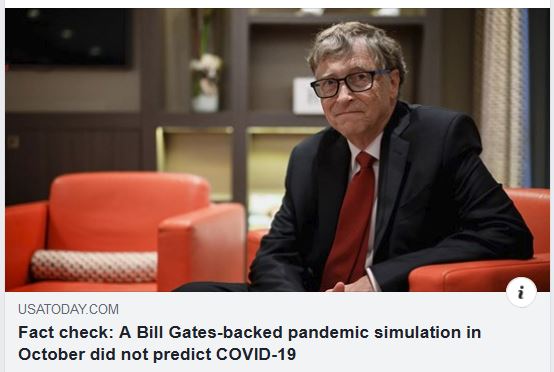
USAToday felt the need to fact check whether Bill Gates sponsoring a ‘pandemic simulation’ didn’t predict COVID-19…

What next?
Fact checking whether a fire crew exercising fire fighting didn’t predict the next … fire?!?

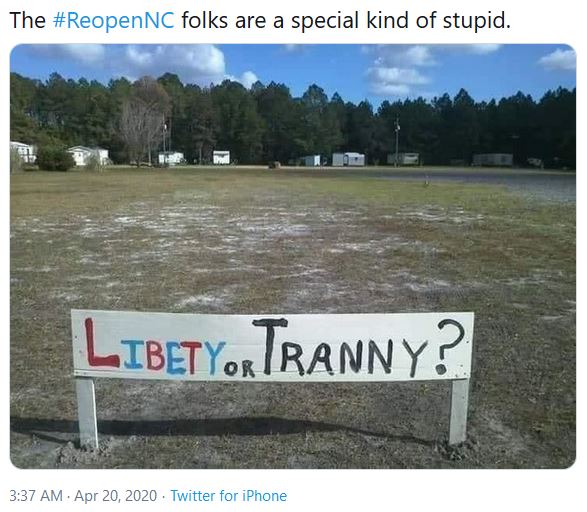
Let’s face it, in the present circumstances the picture above might mean a lot of things.

It can be a prank – somebody might have made the whole thing up just for the fun of it.
It can also express the frustration of somebody who isn’t such a good speller. Or of somebody who suffers from dyslexia?

What really interests me is how we, the ‘intellectual’ public, react to things like these.
Do we understand the frustration which lies at the bottom of this?
Do we even try to?

Or we just dismiss it as being a manifestation of stupid?

No, I don’t consider the economy as being more important than life preservation. Some very sound arguments can be found here.

But I’m absolutely convinced that treating the ‘others’ with disdain is what brought us here in the first place.

You don’t like the manner in which the likes of Trump treat those who don’t agree with them?
Then why are you doing the very same thing?

You consider yourself to be better than Trump?

Prove it.
Be nicer than him, not worse.

OK, Trump did say something.
Which isn’t exactly stupid, by the way.
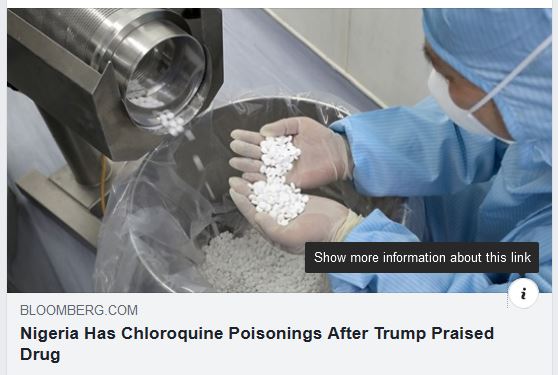
Two halfwits had self medicated themselves to death. With the very same substance Trump was peddling.
But we don’t know for sure whether those two had ever heard Trump advertising that substance. “In Nigeria, households still regularly use tablets containing chloroquine for treating malaria, even though it was banned in 2005 for first-line use because of its declining effectiveness. News of a February study in China about the use of chloroquine for the coronavirus had already sparked lively debate in Lagos, so people began stocking up.”
And there’s a lot of other people, way more knowledgeable than Trump on the matter, who advocate the same course of action.

Yet Trump is held accountable for those two ending up dead…
Are we going to get out of this state of mind?
Ever?

The sooner the better….

After all, what’s the real difference between those who see Trump as their savior and those who see Trump as their arch-enemy?

About half of our manufactured goods come from China. From half-way around the world. A shipping container needs about a month to arrive to Rotterdam from Shanghai. While ordering the merchandise takes some five minutes over the internet.

Shanghai is in China. A country so far away that hourly wages are a fraction of those in Europe. Or in the US. That being the reason for so many of our manufactured goods coming from there.

China is a country so far away that it took more than a month for the rest of the world to find out that a pandemic was brewing in Wuhan.
China is a country so far away that the CDC expert embedded in China’s Disease Control Agency was deemed useless by the current American Administration.

China is a country close enough for the Chinese tourists to had been a staple for the Italian hospitality industry. “5.3 million overnight stays in 2018
China is a country far enough for an “official opening ceremony” to had been “held at the Auditorium Parco della Musica, a multicultural complex, in the Italian capital on Tuesday, at the presence of Italian Minister of Cultural Heritage, Activities and Tourism Dario Franceschini and Chinese Minister of Culture and Tourism Luo Shugang.”

The ceremony was held because “2020 has been designated the China-Italy year of culture and tourism, as the year marks the 50th anniversary of China-Italy diplomatic ties.
“Tuesday” was the 21st of January 2020.

The same day

  • United States confirms its first case in Washington state, a man who traveled to the Wuhan area.
  • China confirms two additional deaths, a sixty-six-year-old man and a forty-eight-year-old woman
  • New cases are announced in China, including in Beijing, Shenzhen, and Shanghai.
  • Chinese state media raises number of confirmed cases to 291 and confirms 15 medical workers in Wuhan have been diagnosed with pneumonia.
  • Hong Kong confirms its first case, a person in their thirties.
  • Taiwan confirms its first case, a woman in her fifties.

The above timeline was ‘borrowed’ – through the Internet, of course, yet another example for how close we are of eachother, from https://www.thinkglobalhealth.org/article/updated-timeline-coronavirus on 3/28/2020, 12:30 GMT
Which Internet pulls us together by pooling information/data while simultaneously rips us apart by feeding us a constant stream of fake news.

We are so close together that you can send/receive almost everything (from) almost everywhere.
We are so close together that everybody who has a smart phone can see their similarly equipped buddies halfway across the world.

We’re so far apart that we still have to make up our collective mind about which comes first. The Economy or the People.
We’re so far apart that we haven’t figured out yet that there’s no such thing as a running economy without enough able bodied and mentally sane people. To produce, transport, distribute and buy the things we need.
We’re so far apart that we haven’t yet figured out that the present number of people cannot survive – let alone maintain a decent living standard, without a running economy.

Some people are convinced that nothing really changes.
That progress is an empty word.

Others are convinced that progress is everything.

And each category has its ‘extremists’:

Some people are convinced that nothing should be allowed to change.
Others are convinced that all change must be imposed, or at least approved, by them.

And the tug of war between these two categories actually hamper whatever progress happens naturally.

Mind you, both categories shoot themselves in the foot.
Each of them shoots only the ‘specific’ foot but the result is equally crippling… Both end up being iron shackles for the rest of us.

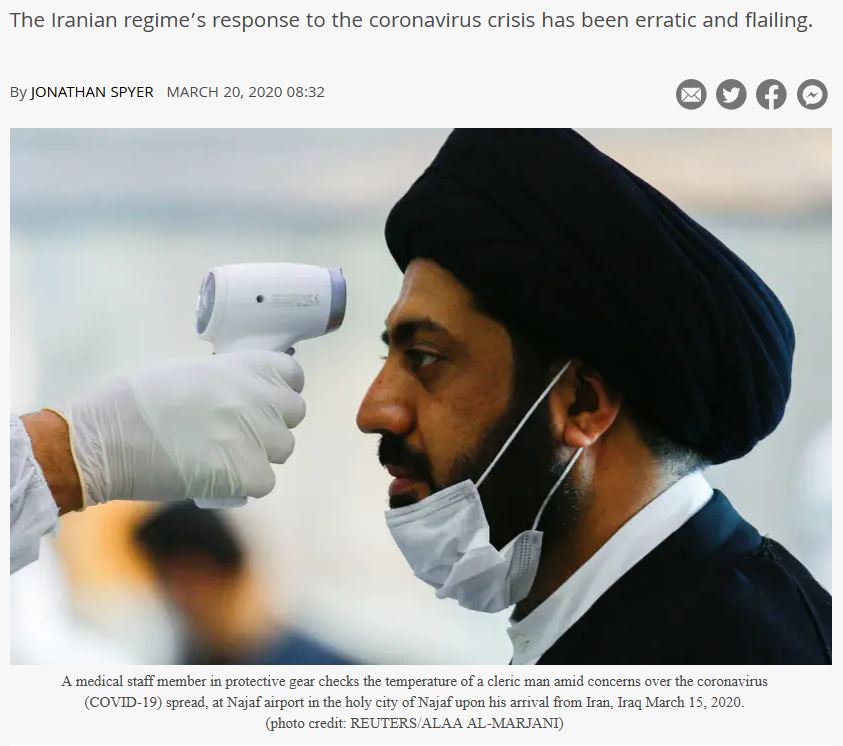
If you live on the Moon, or if enough time had passed since I’ve written this, click on the picture to read Jonathan Spyer’s excellent rendition of the facts which have driven me to post this.

Or you may proceed.

For me, there is a striking resemblance between what’s going on in Iran and what would happen in a hardcore libertarian society.

The mullahs are concerned only with spreading/enforcing their faith and consider everything else will take care of itself.

The extreme libertarians are concerned exclusively with upholding their understanding of liberty and consider that everything else would take care of itself. By itself.

And I’m convinced that everything will indeed take of itself!
After all, life has continued after communism had failed.
The communist leaders had been professedly concerned exclusively with enforcing their understanding of equality. And convinced that everything else would had taken care of itself. If only that equality could have been instated…

Yet I don’t think communism will be missed.
By those who had experienced it hard enough to understand it…

Let me make something clear.
Crystal clear!

Money, and its ‘derivatives’ – from ‘capital’ to ‘financial market’ and ‘stock exchange’, are the tools we used to get where we are now.
Without them we would be still foraging in the woods.

Only something rather insidious has started to eat the whole scaffolding from inside.
Same process has been happening with weapons. We invented them for hunting. Then used them for self protection. Against large beasts and fellow humans.
Finally, after using them to conquer and defend our liberty, we used them to subjugate others. To impose our will upon some other people.

In other words, we used guns to shoot ourselves in the foot.
Unwittingly.
Both as hapless individuals and as a cultural species.

Money – and its derivatives, have suffered the same degradation.
We used it, at first, to coordinate our efforts.
The Stock Exchange had been an excellent way to coordinate otherwise disparate means. Very few of the corporations who have changed the world into what it is now – for good and for bad, wouldn’t have come to life without the money which fuel them.
Nowadays, too many of those who trade on the Stock Market do it in a ‘barren’ manner.

They do not contribute anything but extract value.
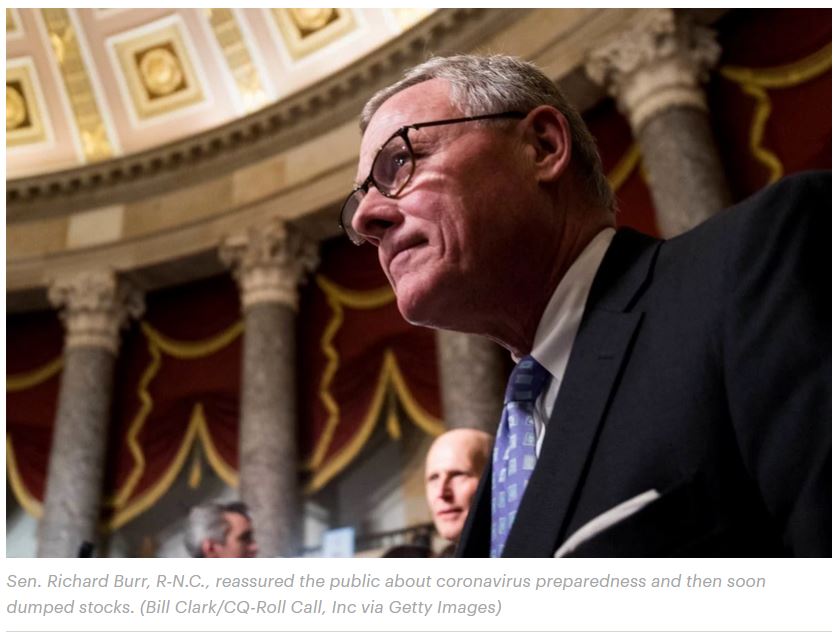
The inside traders being only the visible part of the iceberg.
Which iceberg might tank the whole contemporary ‘arrangement’.

If we keep sleeping during our watch.
And there’s no one else on deck…

Why is it so hard to predict anything?
So hard that some people believe that ‘no prediction will ever be accurate’?

Which is simultaneously true and false!
First of all, it is a prediction.
Hence, it is supposed to be false.
But it’s true!

Then, if all predictions are going to be false, why bother?

Because sometimes it works.
Or, at least, it works good enough to be useful.

Hence this query.

Will economists ever be as good at forecasting as meteorologists?
I must thank Tim Harford for this excellent question.

No. For a very simple reason.

Meteorology has to do with physics. Something which doesn’t change as you learn more about it. Only the researcher’s understanding of what is going on goes deeper and deeper into the matter.

Economy has to do with both hard facts – how much coal/arable land is available at one moment, and psychological unknowns.
What people will do if/when….
The hard facts might change – just as meteorological data does. But in a rather foreseeable manner.
What people will do… is a lot harder to predict. Simply because people change their understanding of facts, based on what they learn.

Just as the meteorologists do.
And while it is relatively easy to predict that meteorology will become more and more accurate – for the foreseeable future, at least, it is a lot harder to predict what the meteorologists will do as a consequence of their increased abilities.

Specially when a lot of money is involved.