Archives for category: man induced fragility

A knife can be used for buttering toast, slicing steak and, occasionally, for slitting  throats.
A gun can be used to hunt dinner, defend a homestead or shoot a rival.
Bare hands can knot laces, caress a woman or choke the life out of an innocent.

What makes us, humans, sometimes transform tools into weapons?

We are astonished when we learn about other animals being able to make and use tools.
Which is good. ‘Astonished’ is the opposite of ‘insensitive’. A.k.a. ‘brain dead’.

How about we, humans, learning from the rest of the animals how to solve whatever issues we have amongst us without  killing each-other?
You are aware that humans and chimpanzees are the only animals who systematically murder adult members of their own species, right?

But what instance is powerful enough to transform tool into weapon?

Human consciousness?

Is this a ‘fatality’?
The simple fact that each of us is consciously aware of the differences between ‘I’ and ‘all the rest’ means that whenever ‘survival instincts’ kick in our humanity necessarily vanishes? Entirely?
And ‘love thy neighbour as thyself’ becomes ‘dog eats dog’?

We would have already been dead by now… all of us…
Our ancestors must have discovered a way to balance our propensity to ‘stick with your own kind’ with with our need to learn new things and meet new people!
Or is it that some of us continually come up with fresh reasons for ‘war’ while we, the rest, are too lazy to do anything about it? Despite everything history has ever taught us…

The Baby Boomer experience hasn’t been the same across the world but, due to globalization, you, the next generations, share much more, experience wise, than what we did. Frustration, that is.
Having said that, I don’t think that blaming us, your ‘parents’, for everything you have to put up with, will solve much.

First of all, let me explain what I mean by Baby Boomers having experienced different things across different parts of the world.
Actually, it is fairly obvious that the American Baby Boomers had it differently than the Western European ones and that the Eastern Europeans had the almost opposite experience from the first two.
The American Baby Boomers had been raised by the absolute victors of the WWII, the Western European ones by those who had been saved – from both war and the subsequent misery, by the Americans while the third category had been ‘eased into the world’ by people freshly fitted with the communist yoke.

Yet the X-ers and the Milennials have a very common Weltanschauung, on both sides of the Atlantic.

The Internet explains only half of what’s going on. Yes, the ‘coordination’ that bind all the X-ers and the Millennials has happened through the Internet but is due to the entire Euro-Atlantic region being under the same ‘spell’.

And You, X-ers and Milennials, blame us, Baby Boomers, for the present situation.

Which, in a way, makes a lot of sense.

As a matter of fact, I, and many around me, used to put a lot of blame on our parents for the damages inflicted on all of us by the onset of communism in Romania.

Then I realized three things.

That it could have been far worse.
That each generation has to face the mistakes committed by previous one but tends to brush aside the accomplishments  inherited from their parents.

The biggest of which, Baby Boomer accomplishments, being the fact that we have somehow managed to keep ‘cool’ the WW we have inherited from our parents.

OK, unlike our parents, we’ve somehow ‘lost the peace’… that’s on us, indeed.
Those who had won the WWII  had been wise enough to help the nations which had happened to be on the losing side.  Which process didn’t take place – not on the same scale, anyway, after the fall of the Iron Curtain.
Those who had lost the WWII had been wise enough to learn something from being fooled into following the fake prophets that had brought them so much misery. And to assume their part of the blame. Again, this has yet to happen in the former communist countries.

And the third thing that I’ve learned is that no generation, however enlightened, will ever be able to stray very much from the previous one. It can, sometimes, understand and avoid a few of the mistakes committed in the past but will always be ‘tugged back’ by the ‘ways of the past’.

Is there any way out of this historical ‘vicious circle’? Preferably one that will conserve the benefits brought about by the virtuous circle spinning in parallel with the vicious one?

I’m afraid there’s no ‘one size fits all’ remedy.
Each generation has to open their collective mind and select what to take over and what to fix from what they have inherited from their parents.
Specially now, when so much of the whole world is almost in ‘sync’.

There is an almost unanimous consensus about laws having to be considered either natural or man made.

As in the law of gravity is implacable – hence ‘natural’, while the Penal Code is a lot more ‘amenable’.

Yeah, right…

Then how come Hammurabi had been able to write his Code some three and a half Millennia before Newton famously noticed that apples do fall to the ground? Besides being such irresistible objects of temptation, of course.
One way out would be to assume that Hammurabi was a lot smarter than Newton but that would be too easy, don’t you think?

Now that I’ve mentioned the noticing game, let me point out some of my own observations.
People have tried to fly way before Newton had told them this is impossible – for us, at least.
Individuals might occasionally get away with murder but murderous societies are far less stable than the more peaceful ones.
Gravity has been already ‘defeated’ while no totalitarian government has yet managed to ‘stay afloat’ in a consistent manner – no matter how many dissidents it had murdered.

Another approach to this conundrum would be to consider that natural laws deal with the non responsive kind of chaos while man made ones are meant to approximate what happens when the chaos is able to respond to what’s being thrown in it.

For instance weather and financial market. No one can change the weather – hence it is considered a non-responsive kind of chaos, while the market is constantly pushed one way or another by the various pieces of information that reaches the participants. Which participants respond to those inputs – according to their own abilities and preferences, hence the ‘responsive’ character of the market.

So, could we consider that nature is non-responsively chaotic while humans behave equally chaotic but in a responsive manner?

The key word here being ‘we’, of course.
After all, we have coined the very concept of law, we are the ones speaking about the difference between ‘natural’ and ‘man made’ and we have discovered, formulated and eventually bent all laws… both natural and man made.

It seems that the whole situation is a lot foggier than at the begging.
That I’ve messed things up instead of making some sense of them…

Let me use another tack.

First of all, let me notice that we’re surrounded by ‘things’. And that these things relate to each other. And to us, of course.
From this point of view, the world is made of things AND of the relationships that appear amongst these things.

And here’s the catch. Laws are not things. They are a small part of the relationships that appear between the things that exist in this world. And since we’ve already discovered that there are a lot more things around us than we will ever be able to ‘see’/notice, it would be unreasonably to expect us to be able to notice all the relationships that ‘tie together’ the world.

That doesn’t mean we shouldn’t try!

Returning to what we call ‘laws’, let me add yet another classification.

‘Noticed’ laws versus ‘pro-active’ laws.

In this sense ‘thou shalt not kill’, the Law of Gravity and ‘drive on one side only’ are, all three of them, ‘noticed’ laws. In the sense that things remain in order as long as we observe these laws.

On the other hand, pro-active laws are a lot more trickier.

‘Do this, do that’! …

‘Why?!?’

‘Because I know better AND/OR because I can make you obey my orders!’

While observing the noticed laws is essential in letting things flow naturally, imposing/accepting ‘pro-active’ laws is the recipe for disaster. Man made disaster.

two sided coin

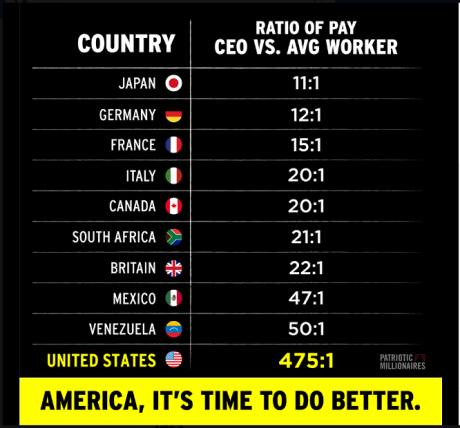
So, Japan and Germany have huge trade surpluses. Despite their workers being the best paid in the whole world. In both absolute and relative terms. Among the major economies, anyway.
Meanwhile, the US has a humongous trade deficit. Yet the American CEO-s are ‘compensated’ as if they were the best in the world…

Interesting, right?

More ideas about the same subject here:

Why is Japan Economy (surplus of over $100 Billion) a considered Weak Economy? & Why is USA Economy (deficit of over $400 Billion) Strong Economy?


I’m gonna insert three links.
They might be opened in any order, the link between them is evident, in all directions.

 “It’s a natural and powerful temptation to do unto them as they have done unto others. They have abused, reviled, and humiliated others: So let them be abused, be reviled, be humiliated. Yet if you go that way, you do not repudiate Trump. You become Trump.”

David Frum,
Michelle Wolf Does Unto the White House as It Has Done Unto Others,
The Atlantic, Apr 30, 2018

“It is particularly rich, too, to see a president who brags about his lack of political correctness and willingness to tell it like it is to be so thin-skinned he won’t even attend a party where he knows he’ll be roasted. It is revolting to see members of the press, who should have an adversarial relationship with the White House, comforting the press secretary and standing up for her honor when she is a chief architect of and apologist for these new political norms of idiotic crudeness, rank corruption, and unapologetic deceit.

Reporters allegedly expressed their sympathy to Huckabee Sanders after the dinner. This is insane. Reporters: Sarah Huckabee Sanders lies to you. She is a powerful and influential figure, and it is your job to be a check on her and the administration she speaks for – not to commiserate with her when a comedian makes some salty jokes, and certainly not to be her sympathetic friend.

Michelle Wolf ended her monologue by wishing the audience a good night, and then adding, “Flint still doesn’t have clean water.” “

Jill Filipovic,
The Bizarre Reaction to the WHCD Reveals We’re in Deeper Trouble Than We Thought,
Cosmopolitan, Apr. 30, 2018

Donald Trump is here tonight! Now, I know that he’s taken some flak lately, but no one is happier, no one is prouder to put this birth certificate matter to rest than the Donald.
And that’s because he can finally get back to focusing on the issues that matter –- like, did we fake the moon landing? What really happened in Roswell? And where are Biggie and Tupac?
But all kidding aside, obviously, we all know about your credentials and breadth of
experience. For example — no, seriously, just recently, in an episode of Celebrity Apprentice – at the steakhouse, the men’s cooking team cooking did not impress the judges from Omaha Steaks. And there was a lot of blame to go around.
But you, Mr. Trump, recognized that the real problem was a lack of leadership. And so ultimately, you didn’t blame Lil’ Jon or Meatloaf. You fired Gary Busey.
And these are the kind of decisions that would keep me up at night.
Well handled, sir. Well handled.
Say what you will about Mr. Trump, he certainly would bring some change to the White House.”

Barack Obama,
2011 White House Correspondents Dinner.

Any way you look at it, a human individual is a decision making machine.

When living in the bush, the decision making process was rather straightforward.
Information was available on a ‘what you see is what you get’ basis and bad decisions had the rather nasty habit of becoming obvious after a very short time.

Now, when living in a social context, things are a little more complicated.
Other people want from us.
Other people actually depend on convincing us to do various things and not to do other things.

‘Convincing us’ means influencing our decision making processes.
Which can be done using one, two or a combination of the following methods.

By ‘managing’ the information we have at our disposal when making a certain decision.
By altering the way in which we feel about the outcome of that decision being put in practice.

The A&B of the matter, for those familiar with the domain…

But there are two other things which are rarely discussed about these matters.

How ethical is it to manipulate other people?
Specially when the manipulated are not fully aware of what’s going on, which puts the manipulator in almost full control of the whole process.

What are the longer term consequences of the whole thing?
Is there any difference between manipulating people to ‘consume’ things which are more or less detrimental to their health and manipulating people into making far reaching political decisions?

As in ‘is there any difference between convincing people that smoking isn’t that bad for them (or at least pleasurable enough to balance the risk) and convincing them to vote for/against … (feel free to pick your own candidate/issue)?

“The researcher whose work is at the center of the Facebook-Cambridge Analytica data analysis and political advertising uproar has revealed that his method worked much like the one Netflix uses to recommend movies.”

Matthew Hindman,
https://theconversation.com/how-cambridge-analyticas-facebook-targeting-model-really-worked-according-to-the-person-who-built-it-94078

The American Revolution was fought under the banner of ‘Taxation without representation is tyranny”.
Meaning that the first Americans saw taxes as money well spent, as long as paying said taxes allowed them to vote. As in ‘being able to determine their own future’. Albeit in a collective manner.

In fewer words, the early Americans viewed liberty as being valuable enough to die for, let alone to spend some money in order to maintain it.

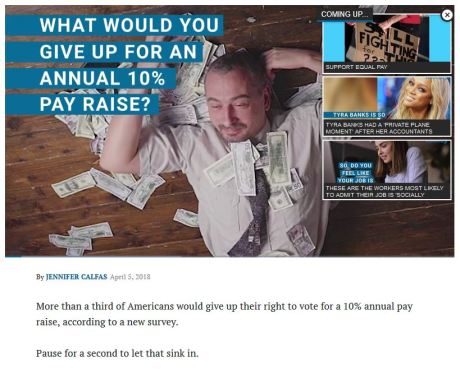
10% anual pay rise

time.com

And what made so many modern Americans willing to sell their hard won ability to vote? To determine their future?

Are they so poor that, for them, liberty has become an empty word?
Have they lost all confidence in the democratic process?
Are they so infatuated with money?

Any mix of all of the above?


Apparently, modern civilization ‘is all about the money’.

Fundamentally, it’s still about trust.

Drivers trust their follow drivers that each will stay on their side of the road, stop at the red light and yield at the famous yellow triangle.

yield


Each of us trusts that the elevators we use daily won’t fall under their own weight, that our daily bread contains exclusively what’s mentioned on the label and that tap water has been adequately filtered before being pumped into our homes through proper pipes.

We trust, and follow their advice, ‘higher authorities’. Science people, teachers, government ‘agents’…

Modern ‘consumers’ order a lot of stuff online, food included. From people they’ve never met, trusting they’ll get what they’ve read about in an add they never asked for.

We keep a lot of data online. Mails, tweets, pictures, more or less intimate thoughts shared on our FB walls. That’s the ‘free’ part. We also pay increasingly handsome amounts of money to ‘upload’ for safekeeping ‘in the cloud’ a lot of sensitive commercial and personal data.

Where ‘apparently’ meets ‘fundamentally’, in our individual/personal lives, we are flabbergasted when cars become weapons and are used to kill innocent bystanders. Our friends and relatives.

When manufacturers implement planned obsolescence, artificially increase nicotine contents in cigarettes and replace sugar with corn syrup in ‘soft drinks’.
When piped water is dirty and the authorities shrug their shoulders.
When we discover that animal fat is not as bad for us as we’ve been told for the last 50 years or so. When we realize that our children are saddled with huge debts simply because they wanted a good education. When we realize that some of the people involved with ‘government’ become part of the problem instead of part of the solution.

When our personal data becomes a merchandise.
Traded to be transformed into a manipulative tool.
Used to influence us into buying certain things.
Used to influence us into making certain political decisions.

Trust will, probably, survive for a while.
But I fear the day when too many people will have lost it.

Price tag


Human nature has evolved considerably since we’ve climbed down the proverbial tree/been made in His own image.
Some of our ancestors used to eat their fellow human beings/the first brother had killed his sibling for profit while a sizeable proportion of the present humankind governs itself in a democratic manner.
No individual has ever been able to change, by themself, the human nature. Time and time again, this has been attempted in vain. Plato, Napoleon, Marx, Lenin, Hitler, Stalin…
Yet each of us can change their own persona. This is what Buddha and Jesus have been successfully teaching us.
This is how we’ve figured out that eating our brother might satiate our hunger for the time being but will never solve the problem. Feeding ourselves for the long run demands cooperation. It cannot be achieved through mindless/cut-throat competition.
As long as more and more of us understand this, we’ll have a fighting chance to survive. As a species.

Some of my right-of-center friends maintain that political correctness is a leftist aberration while some of my left-of-center friends are convinced that most conservatives are bigoted male chauvinists cum white supremacists cum LGBTQ+ haters.

I’m afraid both are mistaken.

The way I see it, none of this has anything to do with left nor right and everything to those on each side of the divide driving themselves into self allocated and mutually exclusive corners.

Otherwise said, this dichotomy is a consequence of populism.
People residing in each ideological corner are constantly barraged with messages telling them exactly what they have prepared themselves to hear.
People residing in each corner are constantly barraged with messages deemed appropriate by those who reckon there is something to be gained, by ‘them’, from keeping those people as far apart as possible.

Maybe now, that Cambridge Analytica has just hit the fan, we’ll start to understand how fake this whole thing is.

And I can’t wrap this up without mentioning something which really bothers me.

“As I said in my How to Fail book, if you are not familiar with the dozens of methods of persuasion that are science-tested, there’s a good chance someone is using those techniques against you.

Scott Adams, blog.dilbert.com

The ‘run of the mill’ populism is directed towards the ordinary people. Which have a valid excuse for not knowing what’s happening to them.
Political correctness is a self sustaining bubble which was generated and is maintained  inside a supposedly more sophisticated medium.

Intellectually more sophisticated medium….

political correctness zizek

Hopefully, Zizek’s arguments will help us puncture this bubble!
Click on the picture above and see for yourself.