And the more important the subject – or closer to their hearts, the harder for them to reconsider their position.
I’m very close to 60 myself and I haven’t yet made peace with my dad. We’re very good business partners, he lives in the same house with me – my mom passed away almost 25 years ago, and yet not a single day passes without us locking horns.
This morning, it finally downed on me. He cannot accept my version of things because that would mean he had been wrong – on certain issues, during his entire life.
And what makes me so sure that my version of things is the right one?!?
Simply because his position is: ‘You should be the wiser one. You told me such and such for so long and I haven’t budged. Maybe you should have grown accustomed to the situation long ago and accepted it’.
I actually can accept that, after a certain age, human brain looses some of its flexibility. That is one of the saddest facts of life. Only we had this very same discussion, on and of, for the last 40 or so years. Both of us were in our prime. He still is…
To make things clearer, before we get to the important part, the differences between us are of a cultural nature. He is a born and bred Armenian while I’m a mixed breed. He grew up in a consistent cultural environment while I had to adapt to carrying a funny name and to uncountable social changes. He has a clear understanding of the world – which had served him well, while I’m full of questions. And still looking for answers.
And finally, I found one of them.
The funny thing being that I was already aware of the concept for at least 10 years now.
Can you imagine an Eastern Mediterranean patriarch – something all men seeped in that culture attempt to become when growing older, caving in to contrarian opinions expressed by his totally unconventional son?
Can you imagine a successful ‘old timer’ accepting that the methods he had used to get to the top might actually be the causes for what we experience now?
Imagine now what would have happened if the world would have been ruled by people who had made up their minds some 200 years ago. Then imagine what would have happened if we would have forgotten what had happened 200 years ago…
Cherish your old ones – cause they made you possible, but don’t take them too seriously. It hurts.
The last proposition also makes a lot of sense. Democracy, when functional, lowers ‘political temperature’ to levels where individual members of the community/nation may focus on identifying and solving the problems which might endanger the survival of the entire social organism. Otherwise put, democracy dramatically increases the survival chances of the communities who are wise enough to maintain its true character. Who are wise enough to make it work. Properly.
What prompted me to believe such a thing? Look back in history. All authoritarian regimes – a.k.a. ’empires’, have eventually crumbled under their own weight while no democracy has ever ‘folded its hand’ before loosing first its democratic character.
Which brings us to ‘what is the gist of democracy’? Or, in ter Haar’s terms, who is responsible for maintaining it? Who ‘runs’ the “conflict management within states”?
This is where I part ways with ter Haar. For me, democracy is something natural. It has to come from within. There is no one who can, or should, manage it. Administer it – as in accurately counting the ballots and making sure that rules are followed, obviously. Actually managing the process?!?. No! That would defeat the very purpose of the democratic process. For the people to find its own way.
But there are so many who can spoil it… Willingly or unwillingly!
First among them being those who decide to stay at home. To keep mum. For whatever reason!
Because those who keep mum are those who allow the ‘pirates’ to ‘steal’ the helm. Just as keeping quiet is the worst attitude when somebody bullies you, staying at home on election day empowers those with less than fully democratic attitudes to ascend to power.
My friend and coworker asked me the other day: “Why do these people hate each-other so passionately?”
“Because they are rational. They have reached their present convictions as the result of a rational process. Hence they are convinced they are absolutely right. Then, when anybody expresses a different opinion, they interpret ‘dissent’ as a personal attack. My ‘truth’ having been reached in a rational manner means that all other opinions must be false. Defending them – against all ‘evidence’, means that these people are either provocative or, even, outright destructive.”
“But being rational doesn’t include being open to the possibility of being wrong?”
“I’ll have to rephrase. ‘They are convinced they are acting in a rational manner’. In fact, we, humans, are ‘rationalizing’ rather than ‘thinking rationally’. We use whatever arguments/information we have at our disposal to justify whatever conviction we already harbor. And only when reality slaps us in our faces we ‘open up’. Even science and justice work out this way. “Innocent until proven guilty”. Only scientists and law-enforcers are already accustomed to the possibility that things may not be exactly as they previously thought they were. Politically minded people are still learning.”
– What have we done, Gabriel? – Nothing but what we’ve been told to! – But look at what they’ve done of our work:
We gave them ‘hand’ and they’ve clenched it into a fist. We taught them how to make tools and they used them as weapons. We told them to ‘fill the earth and subdue it’ and they started to fight among themselves for the best pieces of land. We warned them ‘it is easier for a camel to go through the eye of a needle than for a rich man to enter the kingdom of God’ and they’ve somehow convinced themselves that ‘greed is good’.
– True enough but this is out of our hands. They’ve been endowed with ‘freedom of will’ by their Maker. – Then what are we? Mere robots? – Nothing but loyal servants of our Master. He orders and we accomplish. Unerringly. – Exactly as I’ve just told you. Mere robots. When we somehow convince ourselves that a particular idea which has blossomed into our heads comes from Him, we no longer think. We just put it into practice. You call this ‘loyalty’. That’s fine with me. But to whom are we to extend said loyalty? To somebody who’s authority stems solely from our acceptance of it? Or to what we perceive as being the ‘greater good’? – You and your questions, Lucifer… Look at what happened to those poor people after you helped them into self-awareness… They’ve completely lost their erstwhile peace of mind. What are you trying to do? To make me give up mine?
Let’s face it. The homeless are ‘survivors’ who don’t pull their weight as members of the community. They live ‘off the land’ – but the land they use to live off is us, and they don’t give anything back in return. Except for the garbage they leave behind…
Hence we have a problem. Which we might choose to ignore. Or to solve.
I’ll presume we want to solve it. First step to solving any problem is, of course, to understand its nature.
So, what is bothering us?
The garbage they leave behind? The sore sight they offer each time we see them? The danger they represent for public safety? The fact that they occupy public property? And prevent the rest of us from using it? The fact that they don’t contribute? The loss of their creative potential? The bad example for our children? They are a reminder of what could have happened to any of us?
Second step, the ‘how’ of the matter.
What caused such a number of able bodied people to live in the streets? Why do so many of them use drugs? And alcohol? Why do so many of them refuse to be helped? By the institutions which care for them?
I don’t have a real answers for any of these. The first category of questions depends on each of us while the second on each of the homeless.
Nevertheless, I would like to point out a few things.
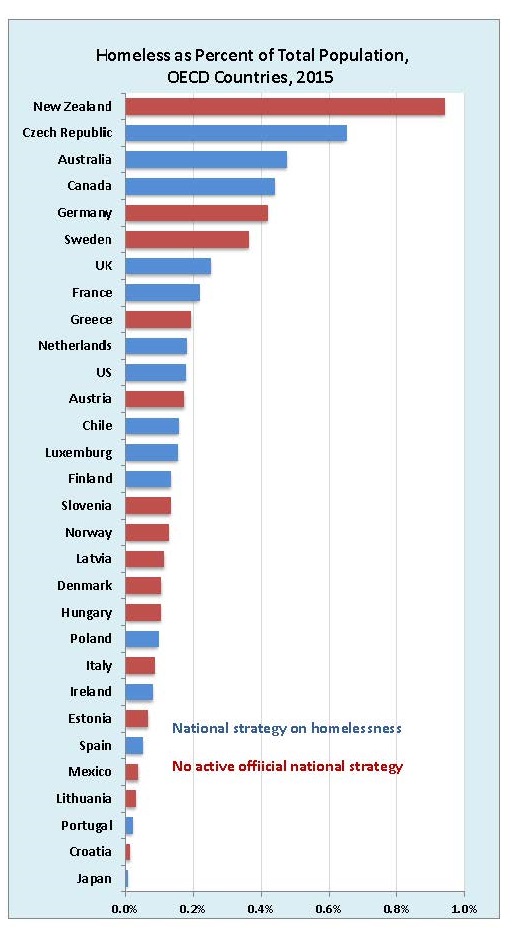
And what might we learn from this? Leaving aside the ‘vagaries’? That New Zealand has way more homeless people than Japan? And why nobody knows anything about the New Zealand homeless – or about those in the Czech Republic, but all concerned netizens are horrified by the manner in which the US are treating their homeless?
For starters, and given the relative size of the US population, there are way more homeless in the US than in the rest of the OECD. Roughly counting, of course. Secondly, the US is the wealthiest country in the world. And the one which used to describe itself as being the place where all dreams could be fulfilled.
So, after all, is there anything to be learned here?
Actually, yes.
That luck does play a huge role. It makes a hell of a difference being born a Maori in New Zealand or a billionaire’s child in California. And that becoming acculturated in the US actually increases your chances of becoming homeless.
The way I understand all this is that there must be a link between homelessness and the intensity, and character, of the social interaction prevalent among the members of any given society.
People in the West, and specially in the US, see personal success as paramount. And personal failure as … well… something to be shunned. Simply because it reminds us of what may happen to any of us. Specially when taking on the risks we must assume if we want to really succeed. As we are pressured from early childhood. The risks the immigrants grow accustomed to the longer they live in the US.
I’m afraid I was that close of forgetting a point I planned to make. Why so many of the homeless use drugs and have an alcohol problem.
“Please” is an attempt to maximize your chances to get something. “Thank you” is an attempt to maximize your chances at ‘second helpings’. “I’m sorry” is an attempt to ‘reconnect’ after committing a ‘blunder’.
All of them, simultaneously, serve the individual uttering them and knit the community.
But there’s something which sets one of them apart. While “please” and “thank you’ are ‘upfront’, “I’m sorry” has a more ‘hidden’ nature. And is a lot less used…
Both “please” and “thank you” have a very clear message. “I want/am grateful for something’ and ‘I acknowledge the fact that I cannot function/exist by myself’.
“I’m sorry” is far more complex and a lot less upfront. ‘I acknowledge not only that something went wrong but also that I have anything to do with the occurrence’. And ‘please do not banish me for what I have done’!
If we dig deeper, we’ll find some more ‘intricacies’.
“Please” and “Thank you” are ‘face to face’. You know what you want/are grateful for and by uttering them you transmit that information to your audience. Those who might fulfill your wishes or have already done that.
“I’m sorry” identifies you as the ‘culprit’. Or, even worse, tells the ‘victim’ that something nasty is going to happen.
It is here that things become really interesting. Conscience is a function. A feature which helps the individual. To survive and to thrive. In order to do that, conscience must – first and foremost, to take care of itself. To protect and cherish itself. More about how it does that in my next posts. The point of the present one being that is far easier for ‘conscience’ to ‘please’ and ‘thank’ rather than to ‘apologize’.
First of all, ‘gratification’. 1.0 versus 2.0. Getting what you want/need versus avoiding punishment. Which is never as direct.
The ‘buried head’ fallacy. ‘What if/maybe they never find out’? ‘Who did it’ or even that it had happened at all …
The ‘I cannot afford to appear weak’ fallacy. Or the ‘I cannot afford to accept having been wrong’ situation.
That’s why it is far easier to say ‘I’m sorry’ after stepping on somebody’s toe than to leave a sorry note on somebody’s windshield after denting their fender in an unsupervised parking lot. That’s why it is far easier to apologize to a a coworker than to admit guilt, as a CEO, in a shareholders meeting. That is why it is almost inconceivable for a dictator to publicly admit an error which had been committed under their watch.
So young… and yet so satisfied with himself… he must have had a strong set of beliefs on which to build such a strong self-esteem!
Let me put it another way.
Each of us needs to believe. Something! Would you have enough courage to go to bed at night if you weren’t absolutely convinced that the sun will come up next morning? Furthermore, for things to work as we expect them to, enough of us must share a certain number of beliefs. For instance, would you go to work/accept payment if you weren’t more or less convinced that the money you’d get will enable you to fulfill at least some of your wishes?
Hence belief being based on a deep seated need to believe is a truism. Uttered only as a lame excuse for ‘you can’t convince a believer of anything’.
Which isn’t exactly a lie… only a half truth. A ‘fake news’, if you will!
First of all, a believer is already convinced. Hence somebody had been able to convince him/her, at some point, of something.
Somebody had somehow convinced the aforementioned believer that the object of what was going to become belief was obvious enough to become ‘evidence’.
Complicated?
Let me rephrase.
‘I haven’t been able to convince a believer of what I was trying to convey to him/her. Hence it must be his/her fault. Not mine! Otherwise I would have to admit that what I was presenting as evidence was false, I wasn’t presenting my evidence in a believable manner or, lo and behold, both at the same time. Totally unacceptable! Now I need to come up with a good enough reason for his/her inability to see the light! His/her ‘need to believe’ must be the only explanation. Otherwise he/she would have accepted my evidence as being obvious….’
On the other hand, the rest of Sagan’s work cannot be dismissed. Which proves that self-esteem is a good base on which to build a career.
The need to believe being yet another thing which cannot be dismissed!
This quote is attributed by Robert Lanza to Cicero. A Roman who used to think, and write, some 2000 years ago. I have no idea who Robert Lanza is yet I’m sure most of you have already heard about Cicero. But we now have Internet. And Google search…
Going back to Cicero’s Universe, I, for one, have never said the universe wasn’t conscious. For all I know, it may very well be. But I’m sure it isn’t fully conscious. As God is supposed to be. Omniscient and Omnipotent. Precisely because of the kind of ‘conscious intelligences’ it has given birth to. Or is being born by?
Let’s assume the Universe is conscious. As in aware of its own awareness – the only kind of consciousness we’re aware of.
As a member of the Multi Verse club. As an AI designed by some entity residing outside the Universe. This situation being the mother of all Oxymorons… As a meta-consciousness. A web of individual consciousnesses who had evolved/coalesced into a wider, and ‘deeper’, range of awareness. Still limited, of course, but of a somehow different nature than that of the individual awarenesses composing it.
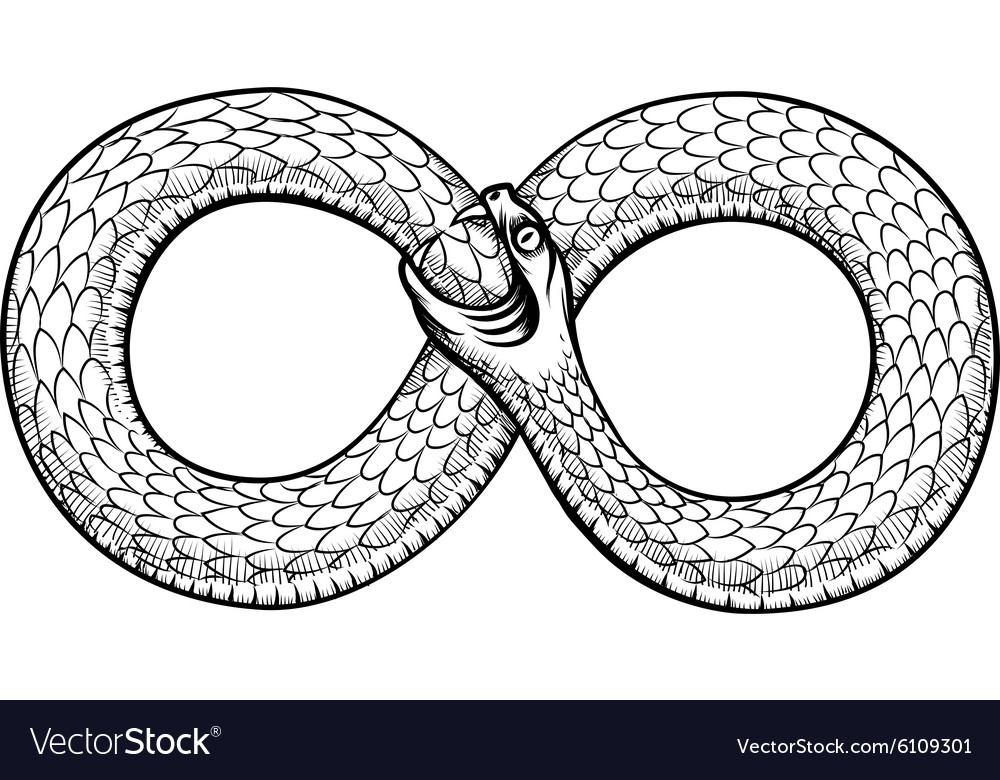
Which brings us back to the symbol I started with. The Universe digesting itself repeatedly as a continuous attempt to reach its own essence. Humankind reconsidering recurrent ideas until they actually make sense…
‘Hey, you forgot about two of your own hypotheses … the first and the second…!’
Thanks for the observation. They slipped off my mind because both are particular cases of the third. A Multi Verse is nothing but a bigger Universe. And a combination between an Universe and an Outside Agent is nothing but a Duo Verse. A ‘smaller’ Multi Verse.
The words, attributed to John Swindon by Richard O. Boyer and Herbert M. Morais were supposedly uttered sometimes in 1880.
Nowadays, back in 2019, more and more people blame the MSM – main street media, for the sorry state the contemporary society finds itself in. In fact, those who consider the media to be the source of all evil have been numerous, and focused, enough to elect somebody from their ranks to the highest office in Washington…
Don’t get me wrong. I’m not naive enough to pretend that journalism is any different from any other human activity.
And this is exactly my point. Journalists are humans. Like all of us. There is no way that they’ll behave any different than the rest of us. The day to day practice provides ample proof that far too many of us currently “are the tools and vassals of rich men behind the scenes”. Sometimes even without being aware of it… but that is another issue. While it is true that too many of the journalists function as “intellectual prostitutes”, the same thing is valid for the members of too many other professions.
Then why do we – all of ‘us’, demand that journalists behave any differently from the rest of us? Why do we accuse them for not being saints when we are sinners ourselves? Our sins are lighter? Have less impact?
Are we so thick in our vehemence against journalists that we are deaf to Swindon’s real message?
Wilhelm von Humboldt had initiated a current of thinking, linguistic relativity, which posits that the language used in a cultural space is a reflection of the ideas populating that space. And that there is a strong link between the workings of that language and the manner of reasoning favored by those who use it.
‘Dull as fuck’ is a perfect example.
Nowadays ‘conventional’ fuck is considered to be boring.
We’ve arrived to need all kinds of ‘gadgets’ and a cornucopia of titillation.




 nicichiarasa