Archives for category: man as a measure for all things

100 divided by 2 equals 50
100 divided by .2 equals 500

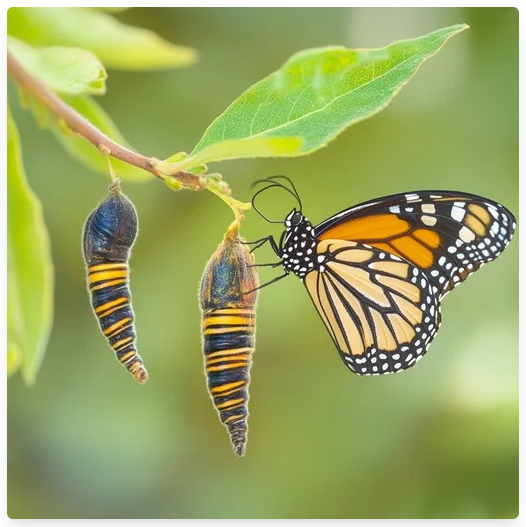
Meta. “An ancient Greek word meaning “beyond”, “after” or “behind”“
Morphe. Another Greek word, meaning “form, outward appearance; nature, character“.

So. Metamorphosis can be interpreted as both the process of changing shape and/or nature and the result of that process.
My point being that we are the ones who make the connections. Who connect the dots…

We are the ones who have noticed the link between the caterpillar and the butterfly.
We are the ones who have taken the notion of division way further than its very nature.

How much (natural) sense does it make to divide something to a divisor which is smaller than 1 ?!?
It is nevertheless possible… arithmetically speaking… we do it by carrying the rule into the ‘sub-unitary realm’ … without giving much thought to the ‘metaphysical’ aspects of the ‘operation’.
To the fact that by dividing something to a sub-unitary divisor we actually transform division into multiplication!

We do that by applying a rule beyond, also known as ‘meta’, its natural domain.

He has the opportunity.
He feels good doing it.
And he doesn’t care. About the consequences experienced by those affected.
As long as those affected are not able to affect him back, of course!
And if you analyze the whole thing in a dispassionate manner,
this is a perfectly rational behaviour!

There is a difference. Between differences.
There is a quantitative difference and a qualitative difference.

There is a quantitative difference between moral and immoral behaviours/persons. An immoral person is someone who cannot restrain themselves in certain instances. Who knows the difference between good and bad and yet cannot resist. Cannot resist doing the bad thing.
And there is a qualitative difference between a moral/immoral person and an amoral one. The amoral one’s actions are not affected by morals. That person does anything they want to do as long as they is not affected by the consequences of their doings. Regardless of whatever consequences may have to be endured by others.

Which brings us to the difference between bad and evil. Also a qualitative one.
Which difference has nothing to do with the amount of damage caused to the bystanders. And everything to do with the attitude of the perpetrator regarding their actions!

As an aside, I have to remark that we are all ‘bad’.
In the sense that all of us commit bad things. That none of us is able to completely restrain ourselves from doing immoral things. From knowingly performing ‘bad’ things. Bad for ourselves or even bad for other people.

The difference between us, normal immoral people, and the evil amoral ones being simple.

The immoral perform things which are potentially bad. For themselves and for others.
For example we smoke. Which is bad. Both for us and for all those who breathe our smoke. But the damage isn’t obvious. We might die before developing a cancer, right?
And most of us have driven a car after having enjoyed one drink too many. With no intent to commit an accident, obviously.
Meanwhile, the amoral may commit things which will certainly cause harm to other people. Regardless of whatever rationales the perpetrators invent to justify their actions. From Ponzi schemes to terrorism.

I’ve saved the juiciest bite for the end of my post.
While immoral is necessarily bad, amoral is morally neutral. Anything in between necessarily bad and necessarily good.
For instance, using weapons of mass destruction and compulsory vaccination/quarantine are amoral. Both are used with a blatant disregard towards the feelings of all those who have to endure.
The first is ‘a certain killer’ while the latter has saved entire populations… go figure!

“Before you argue with someone,
ask yourself,
is that person even mentally mature enough to grasp the concept of a different perspective.
Because if not, there’s absolutely no point.
“

“Not every argument is worth your energy. Sometimes, no matter how clearly you express yourself, the other person isn’t listening to understand—they’re listening to react. They’re stuck in their own perspective, unwilling to consider another viewpoint, and engaging with them only drains you.
There’s a difference between a healthy discussion and a pointless debate. A conversation with someone who is open-minded, who values growth and understanding, can be enlightening—even if you don’t agree. But trying to reason with someone who refuses to see beyond their own beliefs? That’s like talking to a wall. No matter how much logic or truth you present, they will twist, deflect, or dismiss your words, not because you’re wrong, but because they’re unwilling to see another side.
Maturity isn’t about who wins an argument—it’s about knowing when an argument isn’t worth having. It’s realizing that your peace is more valuable than proving a point to someone who has already decided they won’t change their mind. Not every battle needs to be fought. Not every person deserves your explanation.
Sometimes, the strongest thing you can do is walk away—not because you have nothing to say, but because you recognize that some people aren’t ready to listen. And that’s not your burden to carry.
“

I seldom quote this extensively. But this is worth sharing.
It perfectly epitomizes the difference between ‘me’ and ‘us’.
Specially in a ‘democratic’ environment.
Specially when we try to figure out what’s gonna happen to us ‘going forward’…

From where I’m standing, there’s a fine difference between doing something – planning for it, even – just because ‘that’s how we do things over here’ and performing the very same thing as the consequence of a genuinely free decision making process.

Am I making any sense here?

The words of Abraham Lincoln to honour the soldiers that sacrificed their lives in order
“that government of the people, by the people, for the people,

shall not perish from the earth”
were spoken at Gettysburg,
but these words apply as well to the countless soldiers
that died for the cause of democracy in the following 150 years.

How about people respecting each-other?

After all, government is supposed to be by the people and for the people…

Those serving in the government come from among the same people, don’t they?

“All governments suffer a recurring problem:
Power attracts pathological personalities.
It is not that power corrupts but that it is magnetic to the corruptible.”

Frank Herbert, Chapterhouse: Dune

Some people are convinced that all they have to do is to follow the rules.
Other people are convinced that freedom – their freedom, in particular – is the most important thing.

Apparently, these two convictions are incompatible.

Which is not true.

Those convinced that following the rules is the only way to ‘get there’ – wherever that might be – forget one thing. Two things, actually…
That no journey starts until the traveler makes the first step. And decides where they want to go…
Those convinced that freedom is the only important thing forget one thing. One thing only.
That whenever the traveler breaks a rule… there will be consequences!

The fact of the matter being that freedom is a human achievement.
Achieved during the long journey towards the future.
Achieved as a consequence of the process through which we have learned about rules.

‘Rules’ is our definition of ‘possible’. Defines a space where things can happen. As long as the pertinent rules are being observed, of course.

At first glance, flying is possible. For birds…
After learning the pertinent rules – and mastering certain skills – we have learned to fly. But we can continue to fly for only as long as we keep observing the pertinent rules!

At first glance, walking a rope strung between Manhattan’s Twin Towers was impossible.
Not for Philippe Petit. He had the skills and he was crazy enough. He even didn’t ask for permission… Click on the picture and read ‘all about it’. My point being that he remained alive because he had observed the laws of physics. All of them! And because the human laws he had trespassed didn’t involve the capital punishment…

I believe you already understand what I want to convey.
Have a nice week-end.

Trump did what he had promised.
The EU still debates among themselves how to respond.
Britain has already said it will wait for a while.
“Nearly 50 countries want tariff deals”.
“Canada is ‘leading the charge’ against Trump’s trade war with $60 billion worth of counter tariffs on American goods, and is urging Europe to retaliate too, Canadian Foreign Minister Mélanie Joly told Euronews in an exclusive interview.” But…

China, on the other hand….
Am I wrong or Trump’s tariffs have been used by the Chinese leaders as an opportunity to position themselves as ‘champions of the free world’? Free from Trump’s version of America…

https://www.sas.upenn.edu/~haroldfs/540/handouts/french/unintconseq.html

 “You have got to be kidding me.”
Hillary Clinton

In nature, change happens. It is produced by chance. According to rules but only when chance starts it. No one plans it, if you leave God out of the picture.
And, evolutionary wise, change ‘remains’ if it doesn’t bother too much. If the individual things/organisms affected by change are able to survive.
Please note that if ‘dramatic’ enough, change may ‘alter’ everything. A star changes constantly but at some point it will become a nova. Or even a supernova. Which event will change everything around it…

In a social setting, things are a tad more complicated.
Change, social change, is initiated. By individuals. Not necessarily according to a plan and almost always ignoring the end results. But it is always initiated by somebody.
And is allowed to stay. Or not…
By those experiencing the consequences. According to what they make of it.
Again, even in the social setting there are rules. Just as in nature. But while the natural rules are enforced by nature itself, the social rules need to be enforced. By people. By those who end up experiencing the consequences of the afore mentioned rules being enforced properly. Or not…

What am I babbling about?

You’re not comfortable with a bragging pussy-grabber signing presidential orders in the Oval Office?
How comfortable were you when Clinton got away with “I did not have sexual relations with that woman!“
You’re not comfortable when ‘US national-security leaders’ establish a private group on a social network to share sensitive data?
How comfortable were you when a Secretary of State had established a private e-mail server to handle official messages? And got away with it…

Do I need to continue?

“If the only tool you have is a hammer,
you tend to see every problem as a nail”

Abraham Maslow

“The answer: Free market capitalism”?!?

I was arguing in the previous post that we think using images stored in our memory. While we are convinced that we deal with real ‘objects’… ‘Hammers’ versus ‘nails’…

As you should have already noticed, Abraham Maslow had said more or less the same thing sometimes in the first half of the previous century… Well, he was a ‘clinical’ psychologist while I’m nothing more than an engineer. He was interested in how our mind works, I’m interested in the consequences of how our minds work. If you understand what I mean…

‘And what about the pretext you used for today’s post?’

Free market capitalism is nothing but an environment. Man made, for sure, but also ‘natural’. As in ‘evolved’ to the present state as opposed to ‘designed’ in the present state.
Free market capitalism doesn’t do/cause anything. People toiling in this environment do whatever happens here.

Gravity doesn’t cause any falls.

Gravity pulls us, all of us, towards the center of the Earth.
Regardless.
Of us walking sober in the middle of the town versus skating ‘under the influence’ on a thin iced lake in the middle of nowhere.

What would the world do if…?

Which of the worlds are we talking about here?

Recent developments have helped me to understand something.
And no, not the fact that there are more worlds out there. One happy about what’s going on, one horrified and a few rather indifferent.

Trump being elected for a second term as President of the United States hasn’t changed much in the real world. Not yet, anyway.
What it had changed, dramatically, was our image of the world. Of the US, in particular, but also of the world as a whole.

This development has helped me to understand that we don’t deal in realities.
We don’t consider things, make decisions, by examining the things themselves. No!

We consider things by examining the images we have in our minds.

We look at things and we get a ‘set of data’. A virtual image.
We recollect from our memory whatever other information we have on the subject. Another image.
We put two and two together. And we reach a conclusion.
Most of the time ignoring the fact that we’ve been dealing with images instead of the real thing.

Until we are forced to acknowledge that our image was incomplete. Inaccurate…
Or that, simply, we’ve chosen to see what was more comfortable for us!

If it walks like a duck…
James Whitcomb Riley

By 1917 it seemed to Lenin that the war would never end and that the prospect of revolution was rapidly receding. But in the week of March 8–15, the starving, freezing, war-weary workers and soldiers of Petrograd (until 1914, St. Petersburg) succeeded in deposing the Tsar. Lenin and his closest lieutenants hastened home after the German authorities agreed to permit their passage through Germany to neutral Sweden. Berlin hoped that the return of anti-war Socialists to Russia would undermine the Russian war effort.

Do you remember the story about the early American Colonists “gifting of blankets and linens contaminated with smallpox” to the native inhabitants of the place?
It worked, to a degree, because the natives had no prior experience with the disease. Their immune systems had no prior experience with this pathogen. Which had been construed as an opportunity by those who had cooked up the plan, even though – in those times – nobody had any idea about ‘immunity’.

Lenin was also effective towards pulling the Czarist Empire out of WWI. Do we really care whether he was aware of the fact that he had been used as a 5-th column by Kaiser Wilhelm II’s strategists?

Do we learn anything?