Archives for category: man as a measure for all things

“The resistance that had been everywhere at first faded as the years went on.
The spectacles were exciting. Being amid the crowds was exciting.
The certainty, the unity—the pleasure in being superior to the scorned minority,
as well as the Dostoevskyan pleasure in overthrowing everything
—was exactly what had been missed.
Politicians, business leaders and others who should have known better
—and some who later deeply regretted it—drifted to his side, quietly,
often one by one, drawn by the thrill of power, plus the useful patronage it could give.
There also was the pleasure, relief, in not being targeted themselves.“
David Bodanis, The Art of Fairness: The Power of Decency in a World Turned Mean (2021)
Life, in general, is about species evolving in a given set of circumstances. If the circumstances allow it, live will appear. And survive for as long as the circumstances remain livable. We must keep in mind that life changes the environment in which it evolves.
Social life, the human kind in particular, is about cultural species evolving in given sets of circumstances. For as long as the circumstances remain livable, cultural species will continue to evolve. To put their culture to work and to build civilizations. Each set of circumstances influencing both the culture which inhabits the circumstances and the civilization being built there.

Currently, there are three main categories of cultures. Imperial, democratic and incomplete.

I will start by noting that those cultures which are ‘incomplete’ have remained so because they didn’t have enough time to make ‘full use’ of the limited resources they had at their disposal.
The difference between the imperial and the democratic cultures being the fact that the imperial ones stagnate as soon as they reach a certain level of development while the democratic ones continue to evolve for as long as they manage to remain democratic. To retain their ability to change as soon and as far as they need in order to survive. To maintain their democratic character.

Need proof?
Are you familiar with any empire which had lasted for long?
The Egyptian? 33 dynasties covering 3 millennia? Is that long enough for you?
Well, not so fast. ’33 dynasties’ actually means 33 different empires. It was very seldom that a dynasty ended when/because there was no available successor… Most dynasties were removed from power rather than petered out. And, nevertheless, who cares about why a certain dynasty was replaced by the next one?!? The simple fact that it was replaced is enough for me. The replaced dynasty was no longer able to cope! Hence it had to make place for the next one. Another set of decision makers, naturally following a (however slightly) different mantra.

Don’t believe me? Consider any other empire. Evaluate the duration for which each dynasty had managed to hold the helm. And compare it with the fact that the Roman Republic had survived, as a functional democracy, for almost 5 centuries.

And no, Europe isn’t the only place where democratic forms of self-rule had happened during human history. Kurultai, Loya-Jirga… The mere existence of the concepts is proof enough for the budding democracies which might have developed in those places, given enough time and resources.

Then, if democracy is so much ‘better’ – as in more helpful towards the survival of a certain set of mores/culture – then why is it so ‘scarce’?
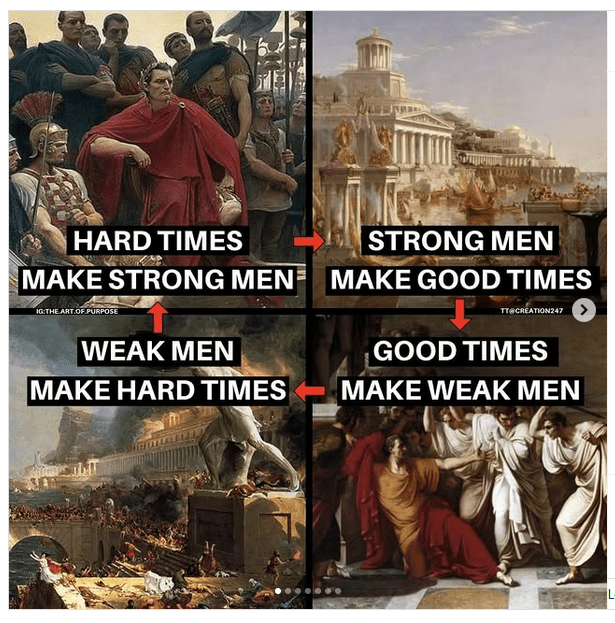
Well, for democracy to remain functional, at least some wise men need to remain both strong and focused on the job at hand. Otherwise, the helm will be confiscated by the would be strong but not so wise….

And why is it that good times tend to make weak people?
First of all, good times tend to weaken ‘the people’. Not as much to weaken the individuals living a good life as to make them careless. To take the good times for granted. To convince them that ‘times’ will continue to remain good regardless…..

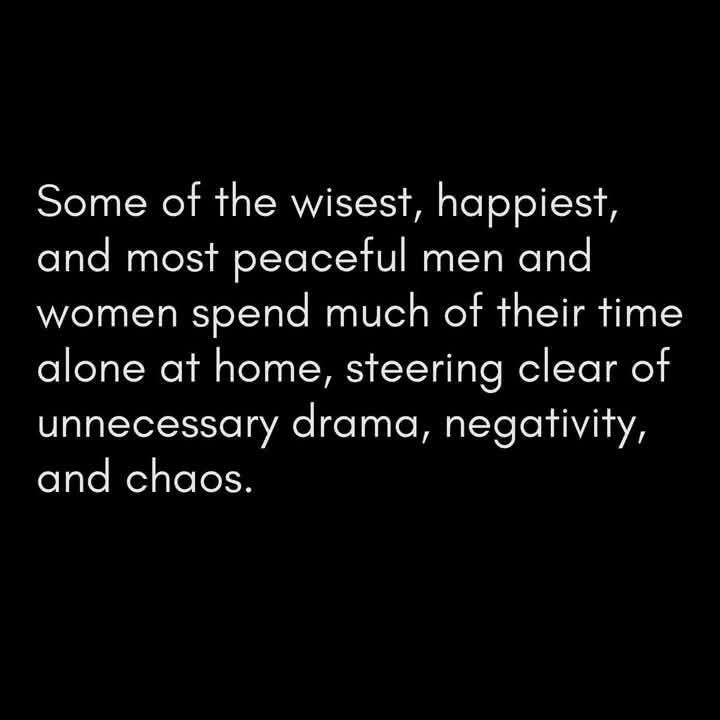
Not having to struggle for their day to day existence tends to make ‘some of the wisest, happiest, and most peaceful men and women to spend much of their time alone at home, steering clear of UNNECESSARY drama, negativity and chaos’.

This being how successful democracies sometimes succumb to tyranny and how empires eventually crumble under their own weight.

Sometimes reading about history is not enough.
You might need to live at least some aspects of it…

I’m sure most of you are familiar with this notion.
With the notion that war is an art and that Sun Tzu was at least a notable teacher. In this domain.
And the second place goes to

Now, that we have established whom we consider to be the THE greatest experts on war, would you be so kind as to tell me when was the last time that China – or Germany, for that matter – had vanquished their opponents? After their respective treaties on war had been compiled…

My point being that a really ‘successful’ war ends with both parties understanding that there’s no point in fighting one.
That whenever the winner starts boasting about their exploits, that war has been fought for nothing. The winner might have won the war but they certainly had lost the peace.
My secondary point – and, maybe, the more important one – being that we tend to treat the current war using the knowledge gathered during the previous one, Which seems rational, right?!?

Yeah… well… The only successful war in our recent history – and only partially at that – was WWII.
WWI was fought for nothing. At the end, the victors had copied the actions of those who had won the previous wars. Imposed hefty reparations upon the vanquished. Hence the advent of Hitler.
WWII was not only terrible but also widespread. France, Germany, Italy, the Central Europe and, to a central extent, the Great Britain have been so thoroughly destroyed that people there did learn their lesson. No more war. Hence a completely different approach to peace than after WWI.
Inclusion of the former aggressor instead of punishment.

The next global war was the Cold one.
Fought mainly between the two WWII victors who had not directly experienced war. The US and the USSR.

What?!?

Well, just think about it.
France, Germany, Italy and so on had been occupied. Experienced hot war on a first hand manner for years on end. Great Britain had not only fought but had also been bombarded.
The US had fought in the war but only Hawai’i had directly experienced it.
And when it comes to the USSR the situation is… complicated. The eastern part of the WWII had been fought mainly in Ukraine and in the western part of Russia proper. The only main city directly affected by war was Sankt Petersburg/Leningrad. The rest of the Russian Federation had experienced less disturbance than western Ukraine in the present conflict.
And what did the free world do after the Cold war had been concluded? Specially the Americans?
Boasted? About their exploits?

How was the loser treated?
The westerners tried to do what the allies had done after WWII? Integrate the loser into the ‘brave new world’? Without understanding that the loser had not accepted its status?

We don’t get what we deserve,
we get what we put up with.

How did we get here?

Then

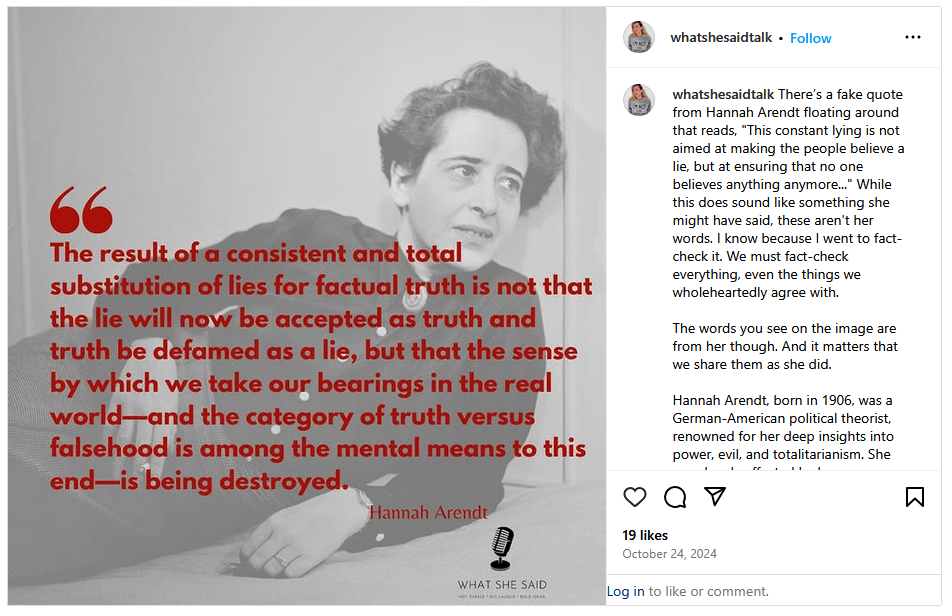
What is Truth?
Pilate

Well, there are two kinds of truth.
The one you feel with your shin when you hit a coffee table.
And the one you feel in your heart when those present laugh at you hopping on one leg while caressing the hurt one.

Which two kinds of truth divide us, people, into two categories.
Those trying to patch ‘an ever-changing truth’ out of many individual pictures – each of them the consequence of a ‘shin’ happening to connect with a portion of the ‘outside world’. Which people are currently known as ‘scientists’.
And those trying to reach ‘the truth’. By thinking, by divination, by… God only knows what any other means… Philosophers, theologians, quacks…

I was trained as an engineer.
To notice needs and to design solutions while evaluating the possible consequences of those needs being met by the proposed solutions. Which places me squarely into the first category.

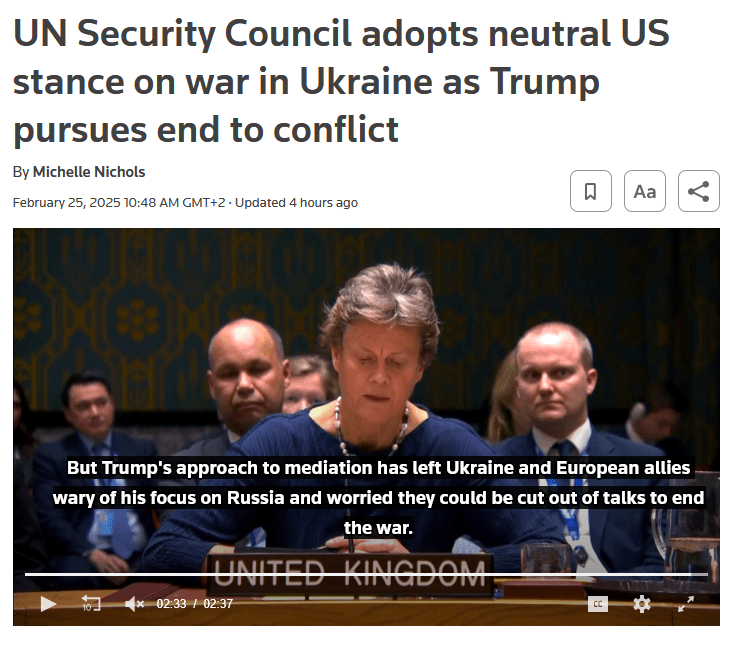
“Russia’s U.N. Ambassador Vassily Nebenzia acknowledged “constructive changes” in the U.S. position on the conflict. He told the council the resolution was “not an ideal one,” but “a starting point for future efforts towards peaceful settlement.””

By sending the Red Army to invade Ukraine, Putin had crossed a red line.
The rest of the world noticed.

Some played possum. ‘Let’s stay out of it. And maybe, maybe, get something for ourselves’.
The majority said “No! This is too much.”

Russia does have veto-power in the UN Security Council. Hence the dead-lock.

The Biden led US and the EU had chosen to support Ukraine. And to sanction the Putin regime.

Every day, people are being killed. Soldiers on the front and civilians under aerial bombardment.
Reasonable individuals want the fighting to stop.

Easier said than done.
Putin might say: ‘My bad!’ and tell his soldiers to go home.
Ukraine might agree, on its own volition, with enough of Putin’s demands. And, hopefully, get at least a respite.
Or those helping Ukraine might say: ‘We had enough. From now on, you’re on your own.’

Putin is not yet ready to back off. Ukraine is not yet ready to cave in.
‘Somebody’ is getting ready to act as a mediator.

What are the immediate consequences?

Putin is back. No longer an outcast!

Is the rest of the world ready?
For it to go back? Back to what was going on before WWI but on a far wider scale?

“You are permitted in time of great danger
to walk with the devil until you have crossed the bridge“

Bulgarian Proverb

““The man has now become like one of us, knowing good and evil. He must not be allowed to reach out his hand and take also from the tree of life and eat, and live forever.” So the Lord God banished him from the Garden of Eden to work the ground from which he had been taken.”

Bulgaria is a Balcanic country. Having evolved more or less together, the Balcanic countries share many cultural traits. Nevertheless, individual countries do have their own characteristics. Bulgaria does have a particular one.
The name, Bulgaria, comes from a Turkic tribe. Who had conquered the area in the VII-th century and established the first Bulgarian Empire. Yet the Bulgarian people is mainly Slavic. Speaks a Slavic language and has remained Christian Orthodox despite having been ruled directly by the Islamic Ottoman Empire from 1396 to 1878. Hence it is safe to consider that the Bulgarians do know a thing or two about keeping their shit together, don’t you think?

On the other hand, who, in their right mind, would want to find themselves on the other side of the bridge? Alone with the devil?!?

Maybe ‘devil’ has different meanings for different people…

We, in our cozy world, where everything is just about fine, consider the devil to be the absolute evil.
We are taught to believe that.

Yet things were not so clearly cut in the good old days.

The Bulgarian experience suggests that when the shit hits the fan, maybe it is wiser to put aside some of the things which made you consider your neighbour was ‘untouchable’ and join forces with them. Until the real danger is gone…

An even older experience, the one shared in the Bible, suggests that the Devil had a defining contribution in us becoming ‘like one of them (Gods)’. After all, it was ‘he’ who had taught Eve to eat the fruit which empowered her to “know good and evil”. It was ‘he’ who prodded Eve, who prodded Adam, to become conscious human beings…

Let me continue this post by sharing a story. Not a funny one but which fits in this context.

Once upon a time, there was a nonconforming sparrow who decided not to fly south for the winter. However, soon the weather turned so cold that he reluctantly started southward. In a short time, ice began to form on his wings and he fell to earth in a barnyard, almost frozen. A cow passed by and crapped on the little sparrow. The sparrow thought it was the end. But then the manure warmed him and defrosted his wings. Warm and happy, able to breathe, he started to sing. Just then a large cat came by and hearing the chirping, investigated the sounds. The cat cleared away the manure, found the chirping sparrow and promptly ate him.
Now, it may seem that there are no lessons here, but there are. In fact, there are three:
1. Everyone who shits on you is not necessarily your enemy.
2. Everyone who gets you out of shit is not necessarily your friend.
3. If you’re warm and happy in a pile of shit, keep your mouth shut.

Allen Klein

I’m not sure about 3. though. Keeping your mouth shut is not always the best option. Not in the longer run…
Use your better judgement instead of letting others tell you what to do.

Having just told you to use your own better judgement instead of letting others tell you what to do, I now suggest that you click on the following link. And read Niemoller’s life story:
https://hmd.org.uk/resource/pastor-martin-niemoller-hmd-2021/

It’s one thing to be able to see white from black.
And a lot more complicated to see black and white…

Being reasonable means listening to what the world has to say about things.
Being reasonable means being open minded.

Being rational means balancing your means with your wishes.
Being rational means actively identifying resources which might help you attain your goals and the pitfalls you need to avoid.

Being reasonable means choosing goals which ‘do not disturb’.
Being rational means transforming things into what they should be. Into what you think they should be…

Being reasonable means getting along.
Being rational means going alone.

Being reasonable means trying to get all in.
Being rational means being able to get to the bottom of it.

The point being that evolution is about the species, not about the individual.
And this point can be made out but individually…

“Insanity is doing the same thing
over and over again
and expecting different results”

Rita Mae Brown

“Knowledge is limited. Imagination encircles the world.”

First celebrated as a brilliant physicist, Einstein had later been recognized as an ‘all rounder’.
So much so that he was found ‘guilty’ for other people’s words.

Rita Mae Brown?!?
Why bother mention her? If you want ‘to back’ up such an important saying, you’d better come up with a really famous ‘promoter’. Preferably a dead one…

‘And your point is…?’

On January 27, the day when Auschwitz was liberated 80 years ago, I shared this on FB:

Some people took exception. Interpreting this as an allusion to what’s currently going on in the US, they asked me to ‘be specific’.

“I don’t protest the protesters but their particular way of doing it. Without any consideration for the ‘collateral damage’ and turning a blind eye towards the already experienced facts.”

My point being that Hitler didn’t invent antisemitism. Germany wasn’t the first country where large scale pogroms were organized.
Pogrom is a Russian word. “To wreak havoc, to demolish violently”.
The way I see it, ‘pogrom’ is not only a tragedy – for both victims and perpetrators – but also a symptom.
A symptom that something is amiss in the society which allows it to happen.

To protest something is fully justified.
If unhappy about something, one is fully entitled to try to prevent that something from happening. Again…
But it would be ‘unreasonably’ to ‘prevent’ it in a way that will be even costlier than the ‘feared development’. Particularly ‘unreasonably’ if the method had already been experimented!

Those supporting Hitler were ‘protesting’ the Versailles Treaty.
Just as Lenin’s Bolsheviks were protesting what had happened during the czarist Russia.
Hitler and Lenin protested by perpetrating crimes even more heinous than those they were protesting.

They should have known better.
Those who supported them, of course… for it was the supporters who had ultimately experienced the consequences!
After all, one doesn’t have to be a rocket scientist to understand that the simple fact that this time it is the others who are at the receiving end of what’s going on doesn’t make it right. In no way better than what we have experienced. And continue to… The misery experienced by the others does not annihilate ours!

And the LORD God said,
Behold, the man is become as one of Us,
to know good and evil;
and now, lest he put forth his hand,
and take also of the tree of life,
and eat, and live for ever.

“And the LORD God called unto Adam, and said unto him, Where art thou?“

Adam called back and we all what happened next.

The serpent was cursed for his role, Eve was cursed for tempting Adam and Adam was cursed for….
In the end, all those involved – including the serpent, for whatever reason – were banished from the heaven. “Lest he put forth his hand…”

What are we to understand from all this?
That God, the omniscient and all powerful Father, was ‘evil’?
He must have known what was going to happen… he was omniscient, wasn’t he?

There are people who believe the Bible to be an accurate rendering of the past.
I happen to be one of them.
Only I don’t interpret what I read in the literal sense… the narrative is true, those things did happen, only not in the ‘real’ world. The Bible is not the story of flesh but a story of mind.

It is the story of what has happened in our minds. In our collective mind!

Genesis is the story of how we’ve grown conscious!
Starting from the sensations perceived during our interaction with the ‘real’ world – read ‘serpent’ – and using the evolutionary accrued ability to speak among ourselves – we’ve learned to identify ‘information’.
We, like all other living things, were already able to make the difference between good and ‘bad’. All living things ‘know’ what’s good for them and what to avoid. Or, at least, act as if…
We, like all other primates and along many other animals, were already adept at ‘reading minds’. Were already able to figure out intentions.
As conscious ‘human beings’ we have started to attribute intent! “To know good and EVIL”!

So evil is of a conscious nature, right?

‘How about ‘God’? Is it real?’

Sorry, I don’t have a reasonable answer for this question.
All I know is that the God so many of us believe in is nothing but a representation.
A figment of our collective imagination. And since we cannot imagine things but starting from the real world, there is a strong possibility that there is something, somewhere, which fits, however loosely, our concept. Our concept of a God…

Humberto Maturana, The origin and conservation of Self…
https://constructivist.info/radical/pub/hvf/papers/maturana05selfconsciousness.html
Frans de Waal, Are we smart enough to know how smart animals are?
https://www.goodreads.com/book/show/30231743-are-we-smart-enough-to-know-how-smart-animals-are

We use words to build narratives.
Which, supposedly, help us in our quest for meaning.
Yet everything does nothing more than alleviate our fear.

At some point in my life, some 6 years after Ceausescu had been chased from his presidential palace, I discovered the Stock Exchange. I had read about it, was under the impression that I knew how it worked but never had the opportunity to trade on in. Living in a communist country prevents you from trading on the free market, you know.
To cut a long story short, I had a lot of beginner’s luck.
And I wanted more. So I started to learn about it. Fundamental analysis, technical analysis, accounting… investor’s psychology, decision making theory…

But it wasn’t enough.
So I went back to school. Sociology this time.
I was no longer trying to beat the market, I only wanted to understand what was going on.
Not only in the market but in our minds. By that time, I had already learned that investors were – and still are – torn apart by greed and fear.

So, what’s going on?
What are we doing here?

Two things cannot exist
simultaneously
in the same place

Logic, ‘the correct way of thinking’, starts from the notion that no two things can exist, simultaneously, in the same ‘place’. Not even in our own head… Until they do, actually.

I’ll make a break here and tell you about Oscar Hoffman. A Romanian Teacher.
Who kept telling us, those who had the privilege to hear him teaching,
‘It’s not enough for a proposition to be valid from the logical point of view. It also has to make sense. Epistemologically speaking.’

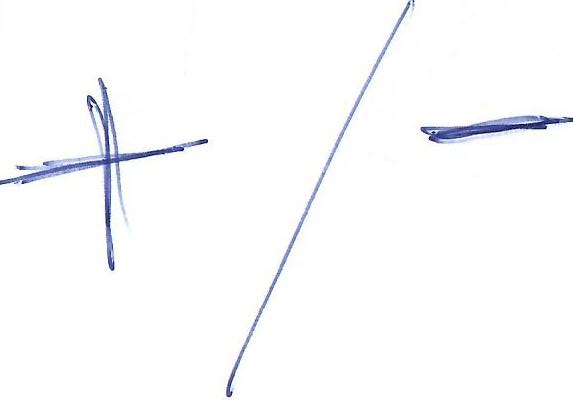
The bottom part of the picture describes a stance which does make some epistemological sense and is seriously deficient when examined logically.
The top part is logically correct but also includes the meaning hidden in the bottom part.
Let me elaborate.

“100% irrefutable study that is proof and absolutely statistically significant.”
Absolute BS.
No scientific study has ever proved anything. Other than the facts examined confirm, or contradict, the hypothesis being tested during that study. Hence the hypothesis is allowed to stand, temporarily, as a theory or declared to be wrong.
A single study being claimed to be ‘absolutely statistically significant’ is so outrageous that it isn’t worth any comment.
“100% paid studies with an agenda and of little to no value or significance whatsoever”…
Nowadays 99.99% of the studies do involve money changing hands. Scientists have to eat and ‘money’ want to learn things. Hence ‘agendas’, on top of ‘money’.
‘Little to no value’ makes a lot less sense. If those studies yield results without any “value or significance whatsoever”, then why is any money involved and any time spent? To discuss about them, let alone to put them together….
To fit an agenda?
The scientists involved – all of them?!?, “100%” – are frauds and all those paying the hefty sums of money are suckers?
Then how can be explained the huge technological leap and the scientific breakthrough we currently witness?

‘Outlier’ versus ‘General trend’, is a far more ‘logically sound’. But also a lot more vague… The first proposition/picture, when examined with an open mind, does include everything claimed by the science deniers and the conspiracy speculationists. An outlier can be right, all change starts with one, and trends can be wrong. As all of them end up being…

So. What will it be?
Are we going to let ourselves be divided into warring camps?
Or understand ‘superposition’? Accept that having an agenda is not necessarily bad and that money is an excellent servant but a horrible master?
Or continue the current trend? Until we will have killed each-other along the line of divide et impera while repeating at nauseam ‘greed is good’?