Archives for category: limited rationality

As much as we’d like it to be unique, reality is a spectrum.

Varying from factual to ‘seat of the pants’. And everything in between.

But what is this thing we call ‘reality’?

The key word here being “we”, of course!

First of all, reality is a concept. Which covers everything we know it exists ‘out there’.
Mind you, not everything ’which exists out there’, only ‘what we know about’.

We know about how?
Here’s where things become really interesting.

Maturana says that we, humans, are the first animals able to ‘observe themselves observing’ – his definition of ‘self-awareness’.
We not only observe things, we’ve developed the ability to set them apart from us. To understand that ‘things’ are both separated from us and still connected to us.
Even this understanding of ours comes in various degrees.
Some of us behave as if there is no tomorrow while others have developed intricate thought systems which connect our past actions (a.k.a. ‘sins’) with our future (a.k.a. ‘redemption’).

‘But most of the religious people base their faith on myths rather than facts!’

Well… myths are facts too.
Not in the sense that all the content of all myths had necessarily happened!
My point being that a story becomes a myth/fact as soon as enough people believe in it. Regardless of that story being a factual description of a real incident, an interpretation thereof or even the figment of somebody’s imagination.

Too much confusion… facts are no longer factual, reality is no longer real… everything is in a sort of limbo…

Yep. You’ve got the gist of it.
Our own consciousness has thrown us in limbo. Which, obviously, is yet another of our own inventions…
The funniest thing being that our consciousness hates being in limbo. And tries to explain everything it comes in contact with. Which explains why we have so many myths.

Now, if we want to explain the difference between the factual and the seat of the pants realities, we need to retrace the whole argument.

We have the ‘real’ reality – everything that exists out there, and the conceptual one. Everything that actually exists versus what we know it exists. Or it may exist.
What we know it exists can be further divided into things we think we have completely understood, things we ‘know’ but we still cannot fully explain and things which continue to baffle us.
For instance, we think we know everything there is to be known about internal combustion engines, we know when we are in love but we cannot explain ‘love’ and we are completely baffled by the callousness of some of our brethren.

Chapter 1.
Feelings, perceptions, facts.

Everything starts with a feeling.
Followed by a reaction.
Which, in biology/psychology/sociology is whatever the feeling organism does after it has been ‘poked’.
At this level, everything happens ‘mechanically’. Even for the most ‘sophisticated’. None of us is aware of what’s going on inside out gut yet a lot of information is being exchanged during the digestion process. We might ‘be there’ when we eat but our presence is not requested while our digestive tracts break down our food into usable ‘chemicals’.

Organisms which are capable of learning sometimes transform their feelings into perceptions.
In the sense that their reactions are no longer determined exclusively by their genes. In some instances they use their learned knowledge to improve their reactions, hence their chances to survive.
Think, for instance, of the many things our dogs do for us. Without having a clear understanding of whats going on but, nevertheless, faring a lot better than their wild cousins, the wolves. Or about the huge amount of data passed from one generation of elephant matriarchs to the other.

Further up the decision chain are the conscious species.
Those whose individuals are capable of ‘observing themselves observing’.
This self awareness is what makes the difference between being capable of being trained and that of actually being able to learn. To choose what you consider to be important and to decide according to that particular piece of information.

This being how facts are born.
We, self aware intelligent individuals, notice something. Deem it to be of a certain importance and, hence, call it a ‘fact’.
Regardless of that something actually having happened or being nothing more than a figment of our imagination.


DSC_0007

The way I see it, this lady is freer, in body and mind, than most of us will ever be.

Authoritarianism, of all ‘flavors’, depends on the ‘father figure’ being absolutely convinced that he is well above the rest. And it is this height which enables him to despise the rest, to the tune of not caring, at all, about how they feel about things.

‘I’m calling the shots, because I can, and the rest of you would better suck it up!’

Democracy, on the other hand, depends on people relying on each other. Enough of them are convinced that none of them is above error. Regardless of their ideological convictions, people who are convinced that democracy works are willing to accept advice from their peers. Or, at least, they listen carefully to what their peers have to say about issues.

The key word here being ‘peers’.

Nobody pays real attention to ideas coming from below or from above. If from below, that idea has to be almost obvious to pass the filter while everything coming from above is interpreted as an order. And executed if there’s no alternative or stalled/ignored whenever possible.

Both authoritarianism and democracy have proved themselves useful.

No war has ever been won by a democratically led army and no authoritarian regime has ever resisted for long. Meanwhile no democracy has ever crumbled as long as it has retained enough of its democratic spirit.
Yes, there are many examples of democracies becoming corrupted and eventually failing. Only this had happened after the democratic spirit had vanished into the smoke of ‘politics’.

Let me remind you that Alexandre the Great, one of the most admired generals and state-men of the world, was educated by Aristotle. Who was the favorite pupil of Plato. The esteemed philosopher who had invented the concept of ‘priest-kings’ – specially educated individuals who were meant to rule the rest.
Needless to add that Plato had witnessed Pericles simultaneously building the Parthenon and burying the Athenian democracy.
While Aristotle (384-322 BC) had lived long enough to witness his pupil conquering the entire ‘civilized world’ and dying an abject drunkard.
Greece, one of the places which had nurtured an enormously important part of the human culture, never fully recovered from the consequences of Plato’s ideas being put in practice.

Are we going down the same chute?
Is this the proper manner in which to engage those ‘on the other side of the isle’?

giving birth to a democrat

Well, this is yet another perfect example of a sentence simultaneously true, false and indeterminable …

First of all, it is indeterminable simply because we’ll never know, let alone ‘for sure’, everything ‘under the sun’.
It is obviously false because we continuously discover things previously unknown to us. From another trench on the bottom of the ocean to a new satellite circling around Jupiter. Not to mention the huge number of materials and gadgets which have not ‘seen the light of day’ until the moment they have been invented by us. And they might have been made starting with raw materials which had previously existed… but denying their novelty would be shortsighted… to say the least.
And it is obviously true because no matter how many things we have discovered/invented, we have remained practically the same. We entertain the same passions and fears, we continue to behave in certain ways…

And the worst part is our refusal to learn from past experiences…

We’ve experienced the malignant consequences of the extreme ‘propaganda’ used by the nazis during WWII.
By the communist regimes trying to build ‘the new man’.
And we’re currently ‘repackaging’ the same king of destructive propaganda into ‘fake news‘…

Are we nuts?

Specially that we already know that what we learn actually changes our brain…

As I mentioned before, life is about individual organisms being able to interact with their environment and species being able to evolve as a reaction to what happens in the same environment.

Interaction between environment and individual organisms is based on sensations.
The organism ‘feels’ itself and its environment and (re)acts  based on the gathered information.

The (re)action ca be very basic – as in voluntarily abstaining from breathing when submerged in water, to utterly sublime. Writing a love poem or saving a toddler from a burning house.

Please note that only writing a love poem ‘demands’ a human being. Abstaining from breathing while under water comes naturally for all animals which don’t have gills while saving a toddler from a burning house can be very well ‘performed’ by a dog.

I mentioned earlier that (re)actions can be grouped in three large categories. ‘Mechanical’, ‘learned’ and ‘self-supervised’, a.k.a intentional.

The ‘mechanical’ ones being those also known as ‘instinctive’. They are practically inscribed in our DNA and constitute our default mode. None of us – plant, animal or human, needs any training whatsoever in order to ‘perform’ them.

The ‘learned’ – or ‘trained’, (re)actions are those which depend heavily on past experience. They start from the same kind of sensations as the instinctive ones but the organism takes the time to transform the sensation into a perception before (re)acting.
A very good example would be riding a bike. A child can learn to do it well before becoming able to entertain such complicated notions as ‘destination’ or ‘goal’. They are simply happy to do it. Same thing being valid for trained circus dogs or monkeys.

The really tricky (re)actions are the ‘intentional’ ones. Those which are performed under self supervision. Of which we are, at least perfunctorily, aware.

‘OK, very nice recap. You’ve already covered this ground. Get to the point!’

I’ve already reached it.
According to this ‘scheme’, given the fact that we pretend to be rational and that we all live in the same world, all of us should behave more or less in the same manner. Right?

‘Like bees? Or ants? Like a school of fish?’

Yeah, something along that line…

‘Or like Pol Pot/B.F. Skinner tried to teach their respective followers?’

You’re stretching it a little bit but yes, you could say that …

‘But this ain’t happening! Not even the most bigoted followers of any cult nor even the most disciplined soldiers will ever behave in such a manner…’

I told you we’d already reached ‘the point’! You made it yourself…

And here’s why:

Yes, we all live in the same world.
More or less…

But we shouldn’t forget the differences!

Biological ones come first.
Those which make each of us feel differently, even when all of us experience the very same conditions. Temperature, time past from the last meal, elevation from the sea level, etc., etc.

On top of those come the ‘social’ differences.
In this instance ‘social’ has a far wider meaning than in everyday life. Yes, there is a huge difference between individuals belonging to different social strata but that’s only a small part of what I have in mind.
‘Social’ differences means all differences consecutive to the ‘mere’ existence of human society.
Let’s make a thought experiment and evaluate the ‘social’ differences between a guy born in what we now call France some 20 000 years ago and another guy born in the same place 2 000 years later. What do you reckon?
OK. Now let’s consider a Frenchman born in 1920 – two years after the end of the WWI, and his son, born in 1947. Would it make any sense to compare the two sets of differences? Those between the conditions encountered by the two prehistoric guys separated by two almost inconsequential millennia and those encountered by the father and son born 27 years apart in the XX-th century?
Or we could compare a native of the Amazonian forest to a New Yorker. Both born in, say, 1999. Statistics have it that the Amazonian native might already be dead…

Small wonder then that perceptions are so different from one individual to another… given that individual perceptions depend on both our senses and our individual experiences – which, in their turn, depend heavily on where and when each of us have been born.

Right now I feel the need to insist on the difference between sensation and perception.
Sensation being, simply put, what we feel while perception is what reaches our conscious mind.

‘What?!?’

Yeah…  strange, isn’t it?
Let’s return to ‘riding a bike’ for a moment.
It was a big moment when your dad removed the ‘helper’ wheels and you soloed for the first time, right? Just as big as when you walked for the first time… only you can’t remember that, do you?…
You were paying very close attention to everything you were doing… while your father kept telling you ‘relax, you’ll be fine’…
And now – if you’re still riding, of course, you do it instinctively. You pay attention only to where you’re going, without bothering about maintaining the balance or other ‘mundane’ things like that. The whole process takes place ‘behind the scene’. It was you who had learned what to do. Consciously, of course. Only once learned, the whole ‘thinking process’ was moved ‘to the attic’. Out of the way, that is.
There are a lot of things which are done in this manner. Subconsciously and not unconsciously. Riding bikes, driving cars, operating machinery… perceiving the world…
We learn how to do it – according to some rules which depend on our culture, and then we continue to do it subconsciously. For all our lives or until something happens. For instance, until we move to a country where they drive on the ‘wrong’ side of the road. And we have to learn some new rules…

Otherwise put, ‘perceiving’ means subconsciously making sense of what we feel by using some previously acquired ‘rules of thumb’. Those who specialize in this field use ‘heuristics’ to describe them.
The problem with the rules of thumb being that they can very easily become ‘cognitive biases’. A.k.a. ‘fences’ which divert us from the ‘straight and narrow’. As in the situation when some of us feel uneasy in the presence of an unknown person with a different skin color.

‘But what happens when consciousness kicks in?’

I thought you’d never ask…

It depends.
On many things. Both ‘social’ and individual.
On the education experienced by each particular individual, on their ‘brain power’ and, last but not least, on something vaguely called ‘individual character’. Something which some people are convinced it can be educated, one way or another, while others are convinced it is ‘hard wired’ into each of us.
If you ask me, both are right. In various, individual, degrees. Character has as much to do with how each of us have internalized their particular experiences as it has with how much ‘spiritual stamina’ exists into each of our souls.

On the practical side of the matter, after each perception reaches the frontier of our consciousness, each of us starts digesting it in earnest. As in attributing ‘value’ to it. Determining whether what has just happened was a consequence of an intention or a happenstance.  Then whether that intention was good or bad. And, finally, the ‘judging’ consciousness establishes a plan of action.  Which can vary from ‘do nothing’ to ‘no holds barred’.

Which explains why no two people will ever react in exactly the same manner when confronted with the very same set of circumstances. There are no two individuals who feel exactly the same, have been exposed to the very same cultural influences AND internalized them in exactly the similar manner. Nor have exactly similar characters and amounts of brain-power.

But what was Mathew trying to tell us?
I’m afraid we are dealing  here with a badly translated metaphor.
‘Poor in spirit’ doesn’t make much sense… unless we consider it an attempt to dull our senses… which may make some sense in certain circumstances…
Only I’m more interested here to determine what Mathew tried to say rather than to interpret the intentions of those who had done the translation. And of those who had, manually, copied the many successive generations of Bibles which had been produced until Gutenberg had, for the first time, printed it in many identical copies.
So, the way I see it, Mathew was speaking of those who are able to stop their conscious mind from building far-flung ‘scenarios’ out of everything that happens to them. Or in their vicinity.

Very similar to the Buddhist concept of ‘non-attachment’?

Well… we do live in the same world, after-all… and we have been ‘made’, more or less, ‘the same’.
We might not be identical, nor having had the very same experiences during our lives… but we do have a lot in common. Despite our differences.

SPOKEN

According to Britannica.com, language is “a system of conventional spoken, manual, or written symbols by means of which human beings, as members of a social group and participants in its culture, express themselves. The functions of language include communication, the expression of identity, play, imaginative expression, and emotional release.”

Since we’re already dealing in conventions, I’m going to ask you to consider this:
How about we redefine language as ‘any manner in which information is transported across space and or time between two entities which have the possibility to interpret, act and or otherwise intervene on/influence the message, the situation described by the message or both at the same time’?

You’ll surely notice that the second definition is more inclusive that the first, of course. And you’ll also notice the differences. Which aren’t that dramatic, after-all…

– ‘Conventional’…
‘Classic’ languages – English, Chinese, French, Urdu, German,  etc., are more the result of ‘natural evolution’ than of any ‘straightforward’ convention… while Esperanto, the most conventional of the spoken languages, didn’t make it too far.
In this sense, the ‘natural’ languages – those which have evolved ‘on their own’, without any intentional intervention from those who use it, are not that far away from the ‘classic’ languages. Birds have ‘vocal’ manners of sending distress and ‘sexual’ signals; monkeys and apes also; even social insects, ants and bees, dispose of an entire array of chemicals, sounds and gestures used to convey freshly gathered information from one individual to another.

– ‘by means of which human beings, as members of a social group and participants in its culture, express themselves’.
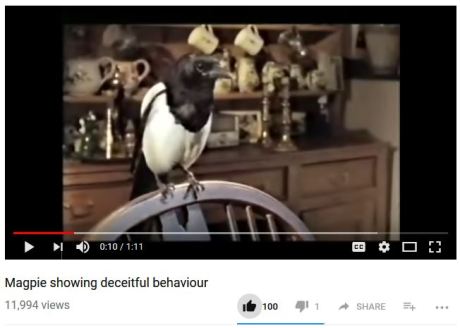
Really? What’s all this brouhaha about ‘expressing one’s self’? A call for help, ‘expressed’ in any way, shape or form, remains a call for help… regardless of the manner in which it has been expressed. Articulated language, Morse code, sign language or a simple sob. Same thing is valid for a warning call. Most of the times, the caller does it ‘instinctively’ and not to gain any ‘social points’ by ‘expressing’ their care for the rest of the ‘cultural community’ ‘conversant’ in the language used to make the call. The magpie in the video above is one of the exceptions, not the rule. Otherwise, the whole signaling ‘industry’ would have been abandoned long ago… due to the very evolutionary forces which have made language what it is today.

Don't cry wolf

– ‘The functions of language include…”
Isn’t this funny?!? ‘The functions of language include…’ How about ‘some of functions we, users of language, have been able to identify are… “.
Or even ‘some of the uses we’ve been able to put language to are …’?

Quite a lot of confusion… isn’t it?

But language was supposed to make things clearer, not muddier… right?

Tell that to those dogs… the ones sent chasing ghosts by the fake distress calls ‘jokingly’ (?!?) emitted by the magpie in the video at the top of my post…

So…

– ‘Spoken’ language.
Or should I call it ‘extemporaneous’? The way I see it, most ‘spoken’ language is uttered on the spur of the moment… or used to be, anyway.
Nowadays, spoken words can be carefully prepared long time in advance… even made to ‘faithfully’ mimic an impromptu message…

– ‘Written’ language.
While ‘spoken’ messages’ have been used, extemporaneously, for a huge amount of time – and not only by humans, as I mentioned earlier, ‘writing’ has been a late invention. Ours.
Or, at least, this is how we like to believe…
The most important characteristic of ‘written’ – as opposed to ‘spoken’, being ‘verba volant, scripta manent’. ‘Spoken words fly away, written words remain’!
The earliest scripts, both cuneiform and hieroglyphic, were used to ‘transport’ information through time. At first, to conserve data rather than what we currently call ‘complex information’. Inventory and ‘identity’ rather than information which may – or even has to, be interpreted in order to make sense. The early cuneiform clay tablets contained ‘cargo manifests’ and only later some of them had been used to ‘conserve’ the Story of Gilgamesh.

– ‘Operational’ language.
Aren’t you tired of that magpie yet?
Have you even watched the video?
Did you notice how the dogs reacted to the fake distress calls? For the umpteenth time, probably…
For the purposes of the present post, it doesn’t matter whether the magpie actively/conscientiously makes fun of the dogs or just acts out of some sort of an instinctive boredom… something akin to the bright spots we sometimes see when ‘confronted’ by a pitch-black environment. It also doesn’t matter whether the dogs are actually fooled every-time they go out to chase the invented fox or they do it because they experience the same kind of boredom like the one which ‘fuels’ the magpie.
For me, all that counts is the consistent manner in which the target reacts to the message transported through the use of this particular kind of language. It is this kind of consistency which determines the ‘operational’ nature of certain languages.

And now, let’s get to the ‘fun’ part.

The calls emitted by the magpie can be construed as being ‘spoken’, right?
They are of a ‘vocal’ nature, are fleeing by definition – unless someone records them using some artificial devices… yet they are also ‘operational’… since the dogs faithfully execute what they are ‘told’ to do…
Now, if we think of it, most natural languages are ‘operational’ indeed.
Ants and bees use them to direct ‘practical’ action, not to ‘express themselves’…
Calls used by most animals relate to avoiding danger, signaling food or ‘expressing’ sexual ‘desire’… and have little or no connection with anything else.
In this respect, the magpie is an exception, not the rule. And even here, the message is ‘formulated’ ‘operationally’. Simply because magpies don’t ‘know’ any other kinds (uses) of language.

We, humans, have bucked the trend only in the sense that we’ve developed kinds of languages lax enough to allow ‘thinking’.

I’m sure that all of you have noticed that when considering the pros and the cons to something you think using a language, right?
A language ‘lax’ enough to accommodate ‘what if’!

Something which doesn’t ‘fit’ in the ‘language’ used by most nursing babies to ask for more milk…

“All power tends to corrupt; absolute power corrupts absolutely” Lord Acton.

“If the benevolent ruler stays in power long enough, he eventually concludes that power and wisdom are the same thing. And as he possesses power, he must also possess wisdom. He becomes converted to the seductive thesis that election to public office endows the official with both power and wisdom. At this point, he begins to lose his ability to distinguish between what is morally right and what is politically expedient.”

Ben Moreell, Power Corrupts, 2010

“All governments suffer a recurring problem: Power attracts pathological personalities. It is not that power corrupts but that it is magnetic to the corruptible.”

Frank Herbert, Chapterhouse: Dune

According to Lord Acton, given enough time, even the most benevolent ruler will, if his opinions go unchallenged, ‘loose his bearings’.
According to Herbert, we’re in an even worse situation. Chances are very slim for a benevolent ruler to even become powerful enough to make a difference… before being overwhelmed by corruption…

Then how come we survived for so long? For so much time?

First of all, until recently, no ruler – regardless of how corrupt/inept or even how powerful, had no means to inflict more than a passing wound to ‘humanhood’. During the last five centuries, things have changed a bit… And no, this is not exclusively about the nuclear button. Cortez, Pizzaro, the African slave traders, Hitler, Stalin and those who had produced the 2008 financial melt down hadn’t used very sophisticated tools…
Secondly, I’m not sure there are nearly enough really bad characters to explain all the man made evil in the world.

Then how could we explain what’s going on?

“If the benevolent ruler stays in power long enough, he eventually concludes that power and wisdom are the same thing. And as he possesses power, he must also possess wisdom.”

Ups!
But does this happen?
The ruler slowly convinces himself or the whole thing is a consequence of the contemporary mantra?
That being elected to office means having beaten your opponents! As if politics were a sort of generalized fighting, not a cooperative effort of the entire community…
Which would, indeed, lead any rational agent to the conclusion that the longer somebody survives in a powerful position, the more ‘right’ he must be…

Then what would be easier to change?
The rational conclusion of those who survive in powerful positions or our current misapprehension about what politics should be?

The oldest surviving civilized nation, China, calls itself Zhongguo.
The Middle Kingdom. ‘In the middle’ of the barbaric people that surrounded her but also at middle distance between Heaven and the rest of the Earth. The aforementioned barbarians.

And, according to Confucius, it was the emperor’s job to ‘keep things as they should remain’.

Which makes sense. After all, the whole kingdom was the exclusive property of the emperor. And whose job is to watch over one’s property?

Well, things went on long enough for those involved to believe this was the natural order of things.
Until the whole arrangement was upset by a small number of people which had come, more or less ‘under their own steam’, from the other side of the world. And who were, at that time, a lot less civilized than the Chinese.

How can be explained something like this?
OK, the Aztec and the Inca empires might have been primitive relative to the Spanish invaders. They might have prevailed over the small number of invaders by brute force but they had been overcome by the sheer novelty and the apparent sophistication of the assailants.
But China had been in contact for centuries with the rest of the ‘civilized’ world! And way advanced than the rest. Both culturally and economically.

So, what had happened?
How can something like this be explained?

We might try to take the ‘historical route’. And observe that, exactly as Confucius and Laozi had told us, China’s destiny had been tightly linked to the ability of those in charge – the emperors, to manage the empire. From the paleolithic migrations until the Mongol invasion in 1271, nothing from outside had any significant impact over the Chinese hinterland. But the fortunes of those living in that hinterland had oscillated from the misery induced by almost constant ‘live conflict’ during the Warring States period to the various prosperous eras. The Han, Tang and Song dynasties, to mention just a few of them.
The same principle had been valid also for what went on while foreign dynasties had been in power. As long as the ‘managers’ were doing their jobs, things continued to improve. As soon as the helm was grabbed by an incompetent leader… all hell broke loose.

But is the emperors’ incompetence enough to explain what had happened during the XIX-th century? The most advanced, and numerous, nation on Earth had been subjugated – for all practical purposes, by a bunch of drug pushers pretending to act in the name of the far away, and far weaker, British King?

Or we can take the sociological route.
Along which we’ll notice that the ‘drug pushers’ were only nominally subjects of the British Empire. Which empire was behaving imperially only towards the exterior while inside it was already a democracy!

Sounds familiar?

Ancient Athens, the first known democracy, had dominated the Eastern Mediterranean for as long as it had retained its democratic character and had failed, abysmally, each time it had reverted to tyranny?
Ancient Rome had established a huge empire as a democratic republic and collapsed four short centuries after becoming a totalitarian empire?
And so on…?

And what might be the difference between a totalitarian empire and a democratic one?
On the face of it, a democratic empire sounds like an oxymoron… yet there’s plenty of such examples in our history…

As you might guess from the title of this post, the ‘famous’ middle class was both the engine and the explanation for the ease with which the ‘democratic’ empires had been established. And yes, the Spanish and Portuguese ones can be explained in the same manner. At that time none of the Iberian monarchies was yet behaving in the absolutist manner they had pursued as soon as the looted precious metals had started to pour in…

But what makes the middle class so special?

Nassim Nicholas Taleb would tell you that the middle class has enough skin left in the game to really care about the outcome and I’m going to add that the middle class is simultaneously distanced enough from the fray to act in a reasonable enough manner.

Let me put back, for a short while, my historian’s cap.

Most of us consider that the middle class is a late appearance. That most of the time, humankind had been divided in two. The haves and the have-nots. The powerful and the meek.
Well, I’m not so sure about that…
For the first 60 000 years after we had learned to speak – which had made us really human, we had been living in small packs. Led by the more powerful male member of the group – if we consider that our ancestors used to behave like our Chimpanzee cousins, or ‘self managed’ in a more or less democratic manner if our ancestors had used the model followed by our other cousins, the Bonobos.
Or we could look at how the surviving ‘primitives’ lead their lives. None of the Hadzabe, Yanomami or Inuit, who have survived in the most difficult conditions on Earth, have a hierarchical social structure.
Primitives?!? Maybe… but not because of their social arrangements. After all, they are freer than most of us.
And what is it that we, proudly modern people, value more than our individual freedom?

Money? I’m going to let this rest… for a while.

Let’s go back to our ancestors.
Who, by all indications, had been living as ‘extended middle class societies’. Without any 0.1% and without people who went to bed hungry while the rest of the gang had been gorging themselves.
Let’s remember now that during those times we had actually transformed ourselves from apes to humans. And if you consider this to be a small feat, just try to teach a bonobo to speak. Then remember how many people who had been born in poor and backward countries are now successful business people or scientists. After passing through a thorough educational process, true! Only that educational process is in no way accessible to any bonobo…
Don’t disparage the long evolution we had graduated from, as a species, while living in ‘extended middle class societies’.

‘But you haven’t explained what you mean by middle class! Most of us see the middle class as those people who make a certain amount of money each year and you keep speaking about primitive people… who have absolutely no use for any money…!’

OK.
For good or for bad, our present society consist of three categories of people.
The haves, the in-between and the dirt poor.

I’m not going to assign numerical values to any of these.
Taleb’s Skin in the Game criterion is far more useful in this situation.

The haves qualify only after they have no skin left in the game. In the sense that they have so much ‘money’ that come hell and/or high water they feel safe. What they make of this world is heavily influenced by the thick ‘insulation’ which separates them from the rest of the world.
The dirt poor – or the lumpen proletariat, in Marx’s terms, have all their skin in the game. In fact, they are the famous ‘Boiling Frog’. They have no way of leaving the kettle so…

In a sense, both haves and the dirt poor are  prisoners. Neither can leave their respective cell blocks. Simply because the dirt poor have no way to go anywhere while almost none of the haves would be able to survive ‘outside’.
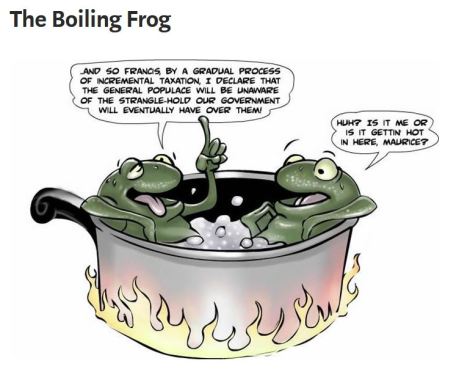
the boiling frog

Wesley Chang, The Boiling Frog, Medium.com

Which leaves us with the middle class.
Who have some resources stashed away – or enough credit available, to weather some crises. But not enough to last them for their entire remaining lives.
Which makes the middle class the only really interested people in the long term well being of the entire society. The only ones really interested in maintaining the freedom of the market as the main economic engine. The only ones really interested in maintaining democracy as the main manner of avoiding catastrophic mistakes perpetrated by the too powerful autocrats.

Or, from a psychological point of view, we can look at the haves/dirt poor as being stuck in an immobile state of mind while the middle class are the only open minded members of the society.
In fact, I prefer this last approach.
You see, until recently the American Dream was relatively accessible. With some luck, a ton of determination and a fair amount of brain power, the sky was the only limit. Belonging to any of those three categories, haves, middle class and dirt-poor was as much about the state of mind of those involved as it was about actual economic conditions.
The haves were free to consider the big picture, the dirt poor could contemplate brighter perspectives while the middle class were doing their thing. Keeping the whole show afloat.

I’m afraid we have reached an inflexion point. A watershed mark, if you prefer.
For whatever reason – I’m not ready to tackle this subject right now, we’ve become so preoccupied with something in particular that we’ve lost sight of everything else.

Including the middle class.

Exactly those which were supposed to maintain their cool heads and open minds.
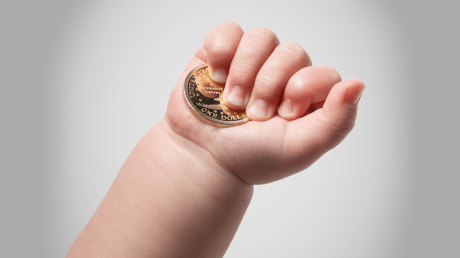
part of the problem

Matthew Stewart,
The 9.9 Percent is the New American Aristocracy,
The Atlantic

Apparently, heretics are hated while nonbelievers are simply despised.

Does any of this make any sense?

Actually, yes.

First of all, faith is like riding a bike.
If you stop moving, you either fall or you  have to put a foot on the ground.
And, after you learn how to do it, you don’t have to think about it anymore.
All is fine as long as you keep on moving…

Secondly, some people need to learn how to curb their initial enthusiasm… which is not such an easy thing to do… and the more dedicated among them have the greater difficulties…
Let me give you an example from the world of the martial arts.
The corpus of knowledge pertaining to this domain includes a series of resuscitation and first aid methods. Very efficient ones.
Our current, safety above all attitude, would mandate for these methods to be taught first to every new student. Which doesn’t happen. Age old experience has demonstrated that ‘enthusiastic’ newcomers would hit/choke each-other far harder and take far less precautions when knowing that resuscitation is so readily available. This is why these powerful methods are taught only to the more experienced,  and self controlled, practitioners of the art.

Going back to the difference between heretics and nonbelievers, let me point out another less obvious thing.
Most of us are imprinted with a faith or another in our early childhood. Way before any of us was capable of thinking for their-selves. As a consequence, most of us are very relaxed towards something which is both very familiar and shared by most of those around us.

Until something happens, that is.
Something which contradicts our faith. Something which might force us to ‘stop the bike’. Which might cause us to fall. Or stop and reconsider.

And this is the real difference between heretics and nonbelievers.

As believers, we’ve always known about nonbelievers. That they’ll go straight to hell. There’s nothing unsettling for us about that. They are so different from us that, practically, they don’t count. We might bump into them on the street, we might even do business with them… but, in the end, they don’t count.
They cannot influence our ‘deep thinking’. The way we see the world.

Heretics are something totally different. They are people like us, who share most of our beliefs and who behave almost like us on most occasions.
If we don’t pay special attention, we might confuse them with ‘our own people’.
And by being so close to us, they constantly remind us that, maybe, it is us who are wrong. About that small thing which makes the difference between us and them.
I must add here that ‘fresh’ converts have the ‘worst of it’. They had already reconsidered their faith, reached a conclusion and are now under a more intense pressure to defend their ‘deliberate choice’. The ‘born again’ are in the very same situation, choosing to comeback to an erstwhile lost faith is no different from adopting a new one.

This pressure is unbearable. Having to nurse such a huge doubt is like a devil constantly whispering in our ear… A culprit must be found, blamed for the torment we had to endure and punished for their arrogance. For their audacity to exist. To constantly remind us that there are alternatives to what we’ve been led to believe.

And this is valid for all kind of faiths. The phenomenon is not restricted to the religious world.
People who had vaccinated their children actually hate those who had chosen not to.
Well, some of them… I’ll come back to this…
Atheists hate the faithful.
The progressives hate the conservatives and the conservatives respond in kind.
Those who believe the Earth is round hate and/or make fun of those who are convinced  the Earth is Flat… and so on…

In this situation, people might ask themselves ‘how come we hadn’t yet slit each other’s throats in sleep?’

‘well, some of them…’

The point being that, most of the times, the haters are a small minority. Most of the believers have either understood that the main tenet of all ‘faiths’ is ‘don’t harm anybody unnecessarily and respect all other human beings/opinions’ or actually have better things to do than to split hairs.

Which brings us to the present situation.
When various ‘con-artists’ have learned to inflame hate and to prod the haters to fight each-other.

Only both the haters and the rest of us – the silent majority who, until know, have been too lazy to intervene, have forgotten that ‘divide et impera’ had always ended up disastrously. Usually for those who allowed themselves to be divided and, quite often, for the ‘imperators’ themselves.

Both Alexander the Great and Cesar, two of the most acclaimed generals and political figures, had ended up both prematurely and in an undignified manner. After causing enormous suffering to both the conquerors and the conquered.
Let’s not forget that Greece had practically disappeared from the world stage after Alexander the Great and that Cesar had been the first – well, the second, of the long list of Roman dictators who had led the empire to its eventual demise.
This might have been a ‘natural’ occurrence. ‘Natural’ as in ‘then inevitable’.

But why repeat it, now that we’ve already learned how it invariably ends?