Archives for category: limited rationality

We’ve been told to go on as usual.

I’m not pointing fingers here.
I just try to convince you how hard it is to make the right decisions. ‘Going forward’ as opposed to ‘looking back’.
I just try to convince as many of you as possible to stop for a moment and think about it. As dispassionately as possible.

We’ve also been told that we need to flatten the curve.
That our systems were not prepared enough for the onslaught that was going to happen.
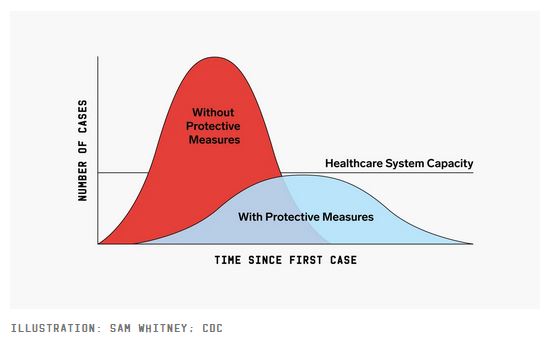
Some people continued ‘as they were’ while others tried to ‘flatten the curve’.

For a while.
Now, after some time, people from both categories have started to entertain second thoughts.

Trying to figure out what’s going on here, I’ve asked my self a couple of questions.

Who had chosen to go on as usual and who had chosen to distance themselves from the rest of the society?

‘Go on as usual’ first:
– Those who don’t trust the government.
– Those who are convinced nothing can happen to them.
– Those who felt they had no alternative. Who live paycheck to paycheck or who provide essential services to the society. Like healthcare for instance. Or those who bake our daily bread. Pump the water we drink. Tend the generators who lighten our bulbs and power the computer I use to write this post.

Now those who attempt to ‘flatten the curve’:
– People who tend to trust the authorities.
– Those who understand they should really protect themselves. Who are older and/or already sick.
– Those can work from home.
– And people who are otherwise fine but afford to distance themselves from the fray. Those who have enough resources to do it.

Am I imagining things or the picture is already a lot clearer?

And the other question now.
Why the second thoughts?

Because things have unfolded more or less as the government said they were going to.
Because things have started to happen. If not to them, directly, at least to some of those living around them.
Because there still is no alternative in sight. And because there is nothing much to convince them that their efforts are appreciated by the rest of the society.

Because the government might have been right to tell them to ‘lie down’. But because the same government has failed to do enough in the meantime. Not to mention what it had failed to do before.
Because staying put allows you to start thinking. ‘What next? For how long can we go on like this?’

So.
What next?
What are we doing to convince those who actually keep us going to continue doing so?
What are we doing to convince those who have chosen to restrict their lives to a barren minimum that their efforts are worth it?

What are we doing to convince everybody that there will be a life worth living at the end of all this?
https://i.imgflip.com/3ua749.jpg

Well, we must remember that solutions came a lot easier when we refuse to think inside a box. Inside any box. No matter how large or how nice.

Every time I understand/notice that somebody tries to frame my thinking process, I go ‘ballistic’.

I try to raise my mind perpendicularly above the frame. So that I may observe the limits.

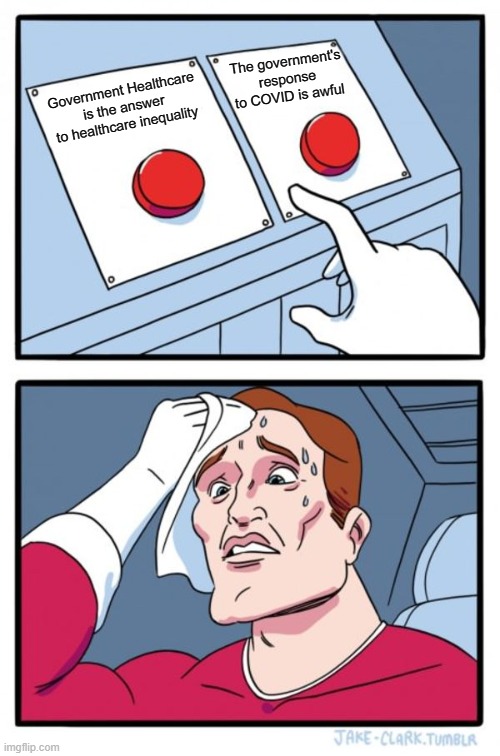
Every time when somebody is presented with an ‘either/or’ option there is a strong likelihood that the situation merits a more nuanced approach.
As in ‘yes, the government was terrible at handling COVID-19’ and ‘yes, the government – as our servant, should be mandated by us, the people, to coordinate the help we need in our hour of need’.

How can we reconcile these two?
Simple.
Hire a better government and keep a keen eye on it!

And, if I’m not mistaken, wasn’t democracy meant to do exactly this?

About half of our manufactured goods come from China. From half-way around the world. A shipping container needs about a month to arrive to Rotterdam from Shanghai. While ordering the merchandise takes some five minutes over the internet.

Shanghai is in China. A country so far away that hourly wages are a fraction of those in Europe. Or in the US. That being the reason for so many of our manufactured goods coming from there.

China is a country so far away that it took more than a month for the rest of the world to find out that a pandemic was brewing in Wuhan.
China is a country so far away that the CDC expert embedded in China’s Disease Control Agency was deemed useless by the current American Administration.

China is a country close enough for the Chinese tourists to had been a staple for the Italian hospitality industry. “5.3 million overnight stays in 2018“
China is a country far enough for an “official opening ceremony” to had been “held at the Auditorium Parco della Musica, a multicultural complex, in the Italian capital on Tuesday, at the presence of Italian Minister of Cultural Heritage, Activities and Tourism Dario Franceschini and Chinese Minister of Culture and Tourism Luo Shugang.”

The ceremony was held because “2020 has been designated the China-Italy year of culture and tourism, as the year marks the 50th anniversary of China-Italy diplomatic ties.”
“Tuesday” was the 21st of January 2020.

The same day

  • United States confirms its first case in Washington state, a man who traveled to the Wuhan area.
  • China confirms two additional deaths, a sixty-six-year-old man and a forty-eight-year-old woman
  • New cases are announced in China, including in Beijing, Shenzhen, and Shanghai.
  • Chinese state media raises number of confirmed cases to 291 and confirms 15 medical workers in Wuhan have been diagnosed with pneumonia.
  • Hong Kong confirms its first case, a person in their thirties.
  • Taiwan confirms its first case, a woman in her fifties.

The above timeline was ‘borrowed’ – through the Internet, of course, yet another example for how close we are of eachother, from https://www.thinkglobalhealth.org/article/updated-timeline-coronavirus on 3/28/2020, 12:30 GMT
Which Internet pulls us together by pooling information/data while simultaneously rips us apart by feeding us a constant stream of fake news.

We are so close together that you can send/receive almost everything (from) almost everywhere.
We are so close together that everybody who has a smart phone can see their similarly equipped buddies halfway across the world.

We’re so far apart that we still have to make up our collective mind about which comes first. The Economy or the People.
We’re so far apart that we haven’t figured out yet that there’s no such thing as a running economy without enough able bodied and mentally sane people. To produce, transport, distribute and buy the things we need.
We’re so far apart that we haven’t yet figured out that the present number of people cannot survive – let alone maintain a decent living standard, without a running economy.

Some people are convinced that nothing really changes.
That progress is an empty word.

Others are convinced that progress is everything.

And each category has its ‘extremists’:

Some people are convinced that nothing should be allowed to change.
Others are convinced that all change must be imposed, or at least approved, by them.

And the tug of war between these two categories actually hamper whatever progress happens naturally.

Mind you, both categories shoot themselves in the foot.
Each of them shoots only the ‘specific’ foot but the result is equally crippling… Both end up being iron shackles for the rest of us.

Life, in general, is a matter of calibrating the intercourse between the inside of the organism and the environment in which it tries to survive. Or thrive…

Social life, both in general and in particular, is a matter of calibrating social intercourse between the members of a society in such a manner that, statistically speaking, the individual members would find it easier to survive/thrive in the given physical environment.
Simply because each surviving/thriving individual adds resilience to the social organism/network.

COVID-19 is nothing but yet another test.
For now – for as long a so many of us are still in ‘surviving mode’, it doesn’t matter “how” or “why”.
All that matter is ‘what’.

“What WE do about it!”

Distance ourselves from the others and allow the pandemic to cool down?
Distance ourselves from the others and allow each of our individual minds to think for itself?

While keeping in mind that long term survival requires the physical presence of as many of us as possible? That our own long term well being requires us to cooperate towards that common goal? As Adam Smith taught us?

Then things will eventually cool down.

And we will have been learned yet another thing.

Both individually and as a cultured species.

I’m sure you’ve already learned everything worth knowing about how to flatten the curve…

My post is about something else.
About the need to think with our own heads.
Individually. Each on their own.

More damages are caused by the manner in which we have chosen to react than by the pathogen itself.

‘Then what should we do?’

I don’t know. And I just told you to stop taking cues, blindly.

There is something I do know.
Nobody can get out of something like this on its own. Alone.
And another thing. If we get out of it as a herd, we’ll very soon end up in another trap.

‘Damned if you do, damned if you don’t… I really can’t figure out what you want to say….’

OK.
We, humans, are social animals.
We not only raise our young – all mammals do that, we raise them in a social context. We live in groups and we raise our children to belong there.

Living in a social context has consequences. From being prone to infestation to having adopted specific behaviors.
Humberto Maturana is actually convinced that our very conscience – ‘our ability to observe ourselves while observing‘, a paraphrase, is a product of us leading our lives in close community.

One of these specific behaviors is the herd instinct.
Whenever in a dire strait, the members of a group pay a lot more attention to the rest of the group than in the ‘peaceful moments’.
This has two bright sides and one huge drawback.

All members of a group paying close attention to the others makes it easier for those who need it to get attention. And help.
All members of a group paying close attention to the others makes it easier for the group to follow when one of them finds a way out.
All members of a group paying too close attention to the others makes it very likely that the entire group will dash out at the first opportunity. Without checking first where they’re going to land. Nor whether there are any other opportunities.

Another specific behavior is ‘opportunism’.
Some of us have figured out that by keeping their chill in a crises they are more likely to identify whatever opportunities might exist in that moment.
And the deeper the crises, the bigger the opportunities.

Theoretically, these two should work like a charm.
The opportunists keep their chill, look around, identify the best way out and the rest of the herd follows them to safety.
A win-win situation.

Yeah… but!

Wouldn’t it be a way lot better whether all (or, at least, ‘more’) of us would keep their chill? Wouldn’t we be able to identify even more ways out?
It would take a lot more time? We’d need to discuss things over, to negotiate… we’d have to exert a lot of discretion…
True enough. Hence we’d need to evaluate two things. First, how urgent the dangerous situation is and, then, whether a better alternative would be worth searching.

And something else. In a ‘follow me blindly’ situation there’s no going back. The consequences for a hasty choice might be tremendous.

We might end up with more people being hurt by our blunder-some reaction than by the cause which had spooked us.

Yet another specific behavior is responsibility.
Living in a social context means that, sooner rather than later, individuals are censored for their actions. By the rest of the community or, sometimes, by the stark reality.
Unfortunately, sometimes entire communities are censored, by the stark reality, for not behaving responsibly. For not imposing responsibility upon their members.

For not taking enough time before choosing between flight and fight.

Let me put things into perspective.
How many of you have chosen to continue smoking despite having been warned?
How many of you have emptied the shelves despite being told there’s enough for everybody? Or that there will be soon enough?
How many of you do not smoke in the presence of your children? Because you know it will hurt them?
How many of you have taken active measures to protect the elderly? For the very same reason…

As for the economy being the main casualty of the present scourge…
I’m afraid ‘the economy’, as we know it, has been dying for quite a while now. That’s why it is so susceptible to SARS CoV-2.

The Ancient Greeks had come up with the concept of ‘oeconomia’ as the art of making the ends meet. Adam Smith had described the free market as the place/environment where competing agents made it so that people – solvent demand, could satisfy their needs.
Nowadays, too many of us understand/accept ‘economy’ as the art of getting rich. ‘Free’ in ‘free market’ is understood as ‘free’ to do anything you want. Because very few are asked to answer for the long term consequences of their actions.

The economy, as the manner in which we cooperate towards fulfilling our needs, has fallen prey to our gluttony. And to our nearsightedness.
Greed is not good. And SARS CoV-2 is only an eye opener, not the cause for the current implosion.

The only real difference between us and the rest of the living world is our ability to make informed decisions.

Since this is a rather vast subject, I shall divide it into chapters.

  1. From feeling to sentiment.

Something prompts us into action. Always. No matter whether we are aware of it or not, there is an underlying cause for each of our actions.
And when we speak about actions which imply our awareness, those causes penetrate our conscience as feelings.

We, more or less automatically, pull back our hands when they touch a hot stove. That is a reaction. Caused by a feeling.

Most of us – the able bodied, of course, would consider going into fire to save a loved one. Or a stranger. Even if pursuing that line of action might get us burned.
‘Going into fire’ – compared to ‘pulling back our hands’, implies making a decision. Which action – ‘making a decision’, is caused by a sentiment.

Sentiment being a feeling which has penetrated not only our conscience but our self-awareness as well.
We not only feel a sentiment, we relate to it. We’re not only aware of it, we elaborate on it.

Hence the difference between a reaction and a decision.
For as long as we allow ourselves to be driven by feelings, we only react to what’s going on around us.
If, and only when, we successfully transform feelings into sentiments we are able to actually decide. To control, to a degree, what’s happening in/to our lives.

To add some meaning to our, otherwise ‘mere’, existence.

My friend and coworker asked me the other day:
“Why do these people hate each-other so passionately?”

“Because they are rational. They have reached their present convictions as the result of a rational process. Hence they are convinced they are absolutely right. Then, when anybody expresses a different opinion, they interpret ‘dissent’ as a personal attack. My ‘truth’ having been reached in a rational manner means that all other opinions must be false. Defending them – against all ‘evidence’, means that these people are either provocative or, even, outright destructive.”

“But being rational doesn’t include being open to the possibility of being wrong?”

“I’ll have to rephrase. ‘They are convinced they are acting in a rational manner’. In fact, we, humans, are ‘rationalizing’ rather than ‘thinking rationally’. We use whatever arguments/information we have at our disposal to justify whatever conviction we already harbor. And only when reality slaps us in our faces we ‘open up’. Even science and justice work out this way.
“Innocent until proven guilty”. Only scientists and law-enforcers are already accustomed to the possibility that things may not be exactly as they previously thought they were. Politically minded people are still learning.”

Let’s face it. The homeless are ‘survivors’ who don’t pull their weight as members of the community. They live ‘off the land’ – but the land they use to live off is us, and they don’t give anything back in return. Except for the garbage they leave behind…

Hence we have a problem.
Which we might choose to ignore. Or to solve.

I’ll presume we want to solve it.
First step to solving any problem is, of course, to understand its nature.

So, what is bothering us?

The garbage they leave behind?
The sore sight they offer each time we see them?
The danger they represent for public safety?
The fact that they occupy public property? And prevent the rest of us from using it?
The fact that they don’t contribute?
The loss of their creative potential?
The bad example for our children?
They are a reminder of what could have happened to any of us?

Second step, the ‘how’ of the matter.

What caused such a number of able bodied people to live in the streets?
Why do so many of them use drugs? And alcohol?
Why do so many of them refuse to be helped? By the institutions which care for them?

I don’t have a real answers for any of these.
The first category of questions depends on each of us while the second on each of the homeless.

Nevertheless, I would like to point out a few things.

Very few of the homeless have been born on the street.
Most of them have been educated into the values of the society to which each of them belongs. Very few are recently arrived immigrants, at least in the US.
“we found that the longer that immigrants had lived in the United States, the greater their risk for homelessness. This is a unique finding that has not been reported before and suggests that immigrants are more likely to shed previous practices and attitudes from their origin countries over time as they live in the United States, which can put them at increased susceptibility to mental illness, substance abuse, and other factors that can increase homeless risk.This idea would be consistent with the literature finding that the health immigrant effect declines for immigrants in the United States as they acculturate and develop habits and practices similar to native residents”. J. Tsai, X.Gu, Homelessness among immigrants in the US

Why do I bother? Specially if I don’t have any answer?

The way I see it, each society is a social organism.

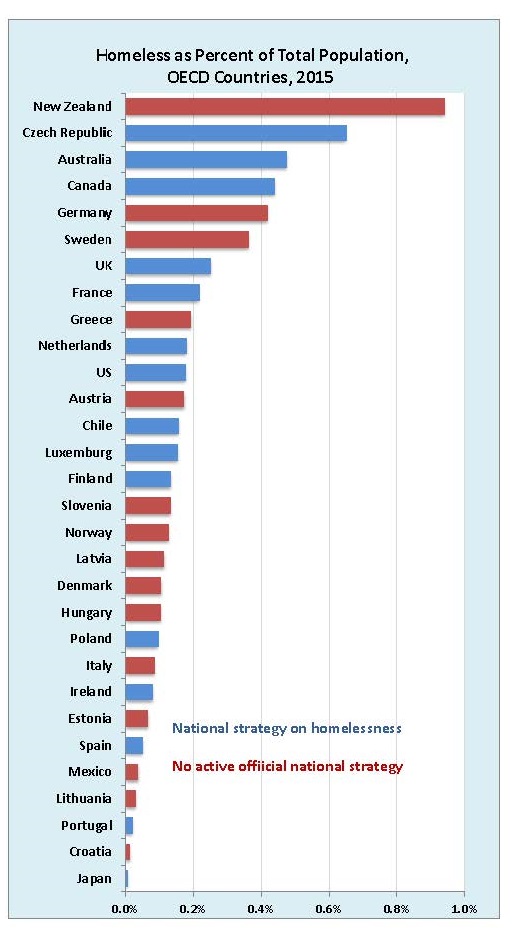
This image had been labeled ‘misleading’ by the Reddit users who cared enough about the subject. And rightly so. “This data is incredibly unreliable. It spans from 2009 to 2015 in different countries and has different criteria for defining homelessness.”
More about how this kind of data is been gathered and why it becomes misleading can be found in the OECD report on the subject. Click here for the 2019 one.

And what might we learn from this? Leaving aside the ‘vagaries’?
That New Zealand has way more homeless people than Japan?
And why nobody knows anything about the New Zealand homeless – or about those in the Czech Republic, but all concerned netizens are horrified by the manner in which the US are treating their homeless?

“”Where are we going to go now?” Denver closes park near Capitol, clears homeless camp citing rats, health hazards.”

For starters, and given the relative size of the US population, there are way more homeless in the US than in the rest of the OECD. Roughly counting, of course.
Secondly, the US is the wealthiest country in the world. And the one which used to describe itself as being the place where all dreams could be fulfilled.

Then, and this is only a hunch, there is the ‘small’ problem of the ‘native citizens’. Oops… not a mere hunch anymore. “In 2013, 12,754 Māori were homeless, comprising 32% of the homeless population compared to comprising just 14.9% of the total population” Same considerations may be taken into account when evaluating the situation in Australia and Canada while Europe has a rather consistent Roma population. Many of whom continue to live in a ‘traditional’ manner.

So, after all, is there anything to be learned here?

Actually, yes.

That luck does play a huge role. It makes a hell of a difference being born a Maori in New Zealand or a billionaire’s child in California.
And that becoming acculturated in the US actually increases your chances of becoming homeless.

What?!?

Have you already forgotten? 😦
““we found that the longer that immigrants had lived in the United States, the greater their risk for homelessness. This is a unique finding that has not been reported before and suggests that immigrants are more likely to shed previous practices and attitudes from their origin countries over time as they live in the United States, which can put them at increased susceptibility to mental illness, substance abuse, and other factors that can increase homeless risk.This idea would be consistent with the literature finding that the health immigrant effect declines for immigrants in the United States as they acculturate and develop habits and practices similar to native residents”.” J. Tsai, X.Gu, Homelessness among immigrants in the US

The way I understand all this is that there must be a link between homelessness and the intensity, and character, of the social interaction prevalent among the members of any given society.

People in the West, and specially in the US, see personal success as paramount. And personal failure as … well… something to be shunned. Simply because it reminds us of what may happen to any of us.
Specially when taking on the risks we must assume if we want to really succeed. As we are pressured from early childhood.
The risks the immigrants grow accustomed to the longer they live in the US.

I’m afraid I was that close of forgetting a point I planned to make.
Why so many of the homeless use drugs and have an alcohol problem.

“The new study, led by NIDA’s Dr. Marco Venniro, required rats to choose between social interaction with another rat or access to a drug (heroin or methamphetamine). The animals consistently chose social interaction when given the choice, and this was true when they were first given access to the drug or when they were experienced drug takers.”

So young… and yet so satisfied with himself… he must have had a strong set of beliefs on which to build such a strong self-esteem!

Let me put it another way.

Each of us needs to believe.
Something!
Would you have enough courage to go to bed at night if you weren’t absolutely convinced that the sun will come up next morning?
Furthermore, for things to work as we expect them to, enough of us must share a certain number of beliefs. For instance, would you go to work/accept payment if you weren’t more or less convinced that the money you’d get will enable you to fulfill at least some of your wishes?

Hence belief being based on a deep seated need to believe is a truism. Uttered only as a lame excuse for ‘you can’t convince a believer of anything’.

Which isn’t exactly a lie… only a half truth. A ‘fake news’, if you will!

First of all, a believer is already convinced.
Hence somebody had been able to convince him/her, at some point, of something.

Somebody had somehow convinced the aforementioned believer that the object of what was going to become belief was obvious enough to become ‘evidence’.

Complicated?

Let me rephrase.

‘I haven’t been able to convince a believer of what I was trying to convey to him/her. Hence it must be his/her fault.
Not mine!
Otherwise I would have to admit that what I was presenting as evidence was false, I wasn’t presenting my evidence in a believable manner or, lo and behold, both at the same time. Totally unacceptable!
Now I need to come up with a good enough reason for his/her inability to see the light!
His/her ‘need to believe’ must be the only explanation. Otherwise he/she would have accepted my evidence as being obvious….’

On the other hand, the rest of Sagan’s work cannot be dismissed.
Which proves that self-esteem is a good base on which to build a career.

The need to believe being yet another thing which cannot be dismissed!