Archives for category: In English

He has the opportunity.
He feels good doing it.
And he doesn’t care. About the consequences experienced by those affected.
As long as those affected are not able to affect him back, of course!
And if you analyze the whole thing in a dispassionate manner,
this is a perfectly rational behaviour!

There is a difference. Between differences.
There is a quantitative difference and a qualitative difference.

There is a quantitative difference between moral and immoral behaviours/persons. An immoral person is someone who cannot restrain themselves in certain instances. Who knows the difference between good and bad and yet cannot resist. Cannot resist doing the bad thing.
And there is a qualitative difference between a moral/immoral person and an amoral one. The amoral one’s actions are not affected by morals. That person does anything they want to do as long as they is not affected by the consequences of their doings. Regardless of whatever consequences may have to be endured by others.

Which brings us to the difference between bad and evil. Also a qualitative one.
Which difference has nothing to do with the amount of damage caused to the bystanders. And everything to do with the attitude of the perpetrator regarding their actions!

As an aside, I have to remark that we are all ‘bad’.
In the sense that all of us commit bad things. That none of us is able to completely restrain ourselves from doing immoral things. From knowingly performing ‘bad’ things. Bad for ourselves or even bad for other people.

The difference between us, normal immoral people, and the evil amoral ones being simple.

The immoral perform things which are potentially bad. For themselves and for others.
For example we smoke. Which is bad. Both for us and for all those who breathe our smoke. But the damage isn’t obvious. We might die before developing a cancer, right?
And most of us have driven a car after having enjoyed one drink too many. With no intent to commit an accident, obviously.
Meanwhile, the amoral may commit things which will certainly cause harm to other people. Regardless of whatever rationales the perpetrators invent to justify their actions. From Ponzi schemes to terrorism.

I’ve saved the juiciest bite for the end of my post.
While immoral is necessarily bad, amoral is morally neutral. Anything in between necessarily bad and necessarily good.
For instance, using weapons of mass destruction and compulsory vaccination/quarantine are amoral. Both are used with a blatant disregard towards the feelings of all those who have to endure.
The first is ‘a certain killer’ while the latter has saved entire populations… go figure!

Ce coincidență!
43% suferă de analfabetism funcțional și
41% votează cu George Simion…

Cred că situația merită o analiză mai nuanțată.

Sunt, într-adevăr, foarte mulți ‘analfabeți funcționali’. Numai că…
Termenul, în sine, este înșelător.
Analfabet este cineva care nu știe să citească. Funcțional este cineva care funcționează. Care se descurcă.
Analfabet funcțional este cineva care se descurcă cu toate că nu știe să citească.
Și atunci?!? De ce s-ar mai strădui să învețe?…
Am impresia că cei care se reped să împartă oamenii în categorii n-au prea nimerit-o de data asta!
Conform internetului, „Definiția uzuală a analfabetismului funcțional este incapacitatea de a înțelege ideea unei povești.” Adică ‘o persoană care știe să citească dar nu prea știe să gândească. Care nu poate să înțeleagă un mesaj scris de o altă persoană’.

Hopa!
Din câte știam eu, înțelegerea e treaba celui care încearcă să comunice și nu a celui care este ținta comunicării. Aici e vorba despre ABC-ul marketingului. Inclusiv a celui politic…
Dacă vrei să fii priceput – adică să te-nțeleagă lumea, vorbește pe limba celor cărora te adresezi!
Dacă nu ești în stare să faci acest lucru, elementar, și după aceea tot tu ești cel care te superi pe oameni că nu te înțeleg…

Poate ar fi cazul să schimbăm puțin termenul.
„Alfabet disfuncțional”. Adică cineva care nu face față cu toate că știe să citească…
Nu mă apuc acum să fac paradă. Da, știu ceva engleză. Și da, asta ar fi o mai bună traducere a termenului „functional illiteracy”. Mai gândiți-vă un pic…

De fapt și de drept, avem de a face cu oameni care nu înțeleg, din diverse motive, un text care referă la ceva ce nu face parte din domeniul lor de expertiză.
Aproape toți suntem experți în câte ceva. Altfel am muri de foame…
Dar foarte puțini dintre noi știm să facem analiză pe text! Pentru că nu e treaba noastră…

‘Specialiștii’ vorbesc despre ‘nevoia de gândire critică’.
Despre nevoia de a pune la îndoială mesajele pe care le primim. Despre nevoia de a verifica. De a merge la sursă…
Alți specialiști vorbesc despre nevoia de încredere.
Și toate astea în timp ce marea majoritate dintre noi am fost educați să citim cu atenție și să aplicăm cu strictețe regulile! De la instrucțiunile de folosire a ascensorului până la procedurile după care ne îndeplinim sarcinile de serviciu!
Cine, unde și când ne învață despre ‘gândirea critică’?!? Despre cum să facem deosebire între când e bine să avem încredere și când ar fi cazul să punem la îndoială?!?

Ca să facem treaba asta, să facem deosebirea între cele două situații, avem nevoie de un set de valori!
De un set de instrucțiuni, dacă vă sună mai bine, despre cum se folosește gândirea critică. Dacă vrem să obținem ceva…
Dacă vrem să obținem soluții. Soluții în loc de fundături!

Nu de mult am trecut printr-o pandemie. Unii dintre noi, din prea multă gândire critică, au refuzat să se vaccineze. Acum refuză să-și vaccineze copiii…

Să revenim.
Setul acela de valori, pentru a rămâne valabil, are nevoie de reglaje fine. Și are nevoie să fie susținut, continuu, de o serie de specialiști în domeniu. De specialiști care să aibe credibilitate. De intelectuali. De figuri publice cu anvergură care să genereze încredere.
De politicieni care regleze fin treburile publice.
De antreprenori care să genereze bunăstare.
De artiști care să ne facă viața mai frumoasă.

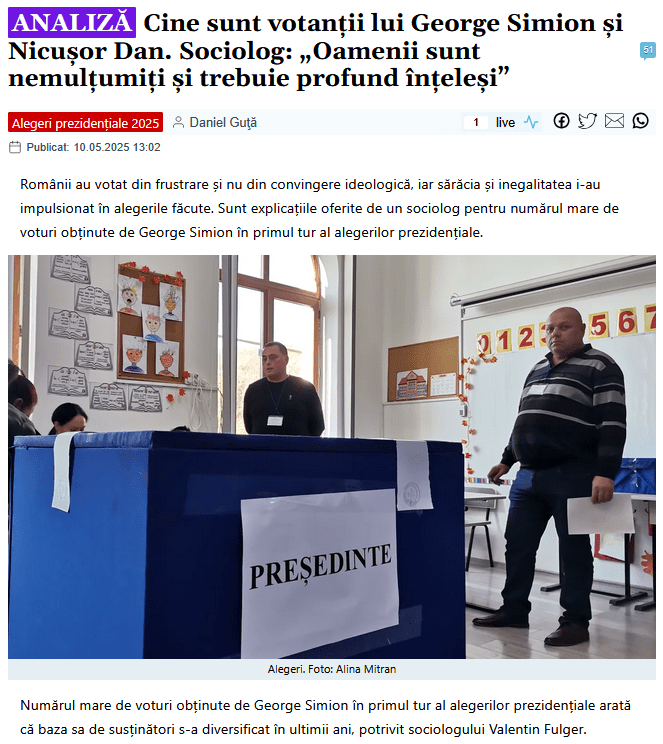
Suntem în situația în care 41% dintre noi au votat într-un anume fel. În condițiile în care, la primul tur, abia jumătate dintre noi s-au decis să facă efortul.
Unii dintre noi, care au votat altfel decât cei 41%, s-au apucat să spună tot felul de chestii despre ei. Despre cei 41%.
Câțiva au încercat să înțeleagă.

Uite ce am înțeles eu.

Cei 41% au votat mai ales din frustrare.
De fapt, cam 65% dintre voturile exprimate au fost ‘anti-sistem’. Vă las pe voi să faceți calculele.

Și atunci?
De ce 41% au ales ce au ales?

Pentru că spațiul public a fost abandonat!

Pentru că prea mulți dintre politicieni și-au văzut mai degrabă de politicile lor.
Pentru că prea mulți dintre antreprenori au rămas la stadiul de afaceriști. Preocupați atât de mult de succesul propriei afaceri încât au neglijat faptul că afacerile de succes au nevoie de un mediu stabil. De o societate stabilă!
Pentru că prea mulți dintre intelectualii adevărați s-au retras în turnurile lor de fildeș. Acolo unde s-au învățat să trăiască încă de pe vremea lui Pingelică.

Oamenii de rând, oamenii obișnuiți, cei care fac totul posibil, au rămas la dispoziția ‘orchestratorilor’.
Exasperarea oamenilor, care n-a mai avut cum să se exprime după ce bătăușii lui Dragnea i-au maltratat pe manifestanții din vara lui 2018, a fost instrumentalizată în furie.
Iar pandemia a fost un mediu de cultură extrem de propice.
Modul în care cei aflați la butoane au răspuns la problemele apărute a transformat societatea într-o oală sub presiune.
Exasperarea deja prezentă a fost identificată ca fiind o resursă extrem de valoroasă. Pentru ‘ei’. Pentru cei care au pus la cale, în folos propriu, toată chestia ‘asta’.
Exasperarea a fost transformată în furie.
Cu ajutorul social-media și în situația în care cei care ar fi trebuit să se ocupe de gestionarea vieții publice au dormit în cizme.

Înțelegem?
Că fără exasperarea publicului, ‘orchestratorii’ n-ar fi avut ce să orchestreze?
Ce exasperare să instrumentalizeze în furie?
Facem ceva pe chestia asta?!?

Before you argue with someone,
ask yourself,
is that person even mentally mature enough to grasp the concept of a different perspective.
Because if not, there’s absolutely no point.

Not every argument is worth your energy. Sometimes, no matter how clearly you express yourself, the other person isn’t listening to understand—they’re listening to react. They’re stuck in their own perspective, unwilling to consider another viewpoint, and engaging with them only drains you.
There’s a difference between a healthy discussion and a pointless debate. A conversation with someone who is open-minded, who values growth and understanding, can be enlightening—even if you don’t agree. But trying to reason with someone who refuses to see beyond their own beliefs? That’s like talking to a wall. No matter how much logic or truth you present, they will twist, deflect, or dismiss your words, not because you’re wrong, but because they’re unwilling to see another side.
Maturity isn’t about who wins an argument—it’s about knowing when an argument isn’t worth having. It’s realizing that your peace is more valuable than proving a point to someone who has already decided they won’t change their mind. Not every battle needs to be fought. Not every person deserves your explanation.
Sometimes, the strongest thing you can do is walk away—not because you have nothing to say, but because you recognize that some people aren’t ready to listen. And that’s not your burden to carry.

I seldom quote this extensively. But this is worth sharing.
It perfectly epitomizes the difference between ‘me’ and ‘us’.
Specially in a ‘democratic’ environment.
Specially when we try to figure out what’s gonna happen to us ‘going forward’…

From where I’m standing, there’s a fine difference between doing something – planning for it, even – just because ‘that’s how we do things over here’ and performing the very same thing as the consequence of a genuinely free decision making process.

Am I making any sense here?

The words of Abraham Lincoln to honour the soldiers that sacrificed their lives in order
“that government of the people, by the people, for the people,

shall not perish from the earth”
were spoken at Gettysburg,
but these words apply as well to the countless soldiers
that died for the cause of democracy in the following 150 years.

How about people respecting each-other?

After all, government is supposed to be by the people and for the people…

Those serving in the government come from among the same people, don’t they?

2010

Former Pennsylvania judge Michael Conahan has pleaded guilty to a racketeering conspiracy charge for helping put juvenile defendants behind bars in exchange for bribes.
He is accused along with former judge Mark Ciavarella of taking $2.8m (£1.8m) from a profit-making detention centres. Mr Ciavarella denies wrongdoing.

2024

“Conahan’s actions destroyed families, including mine, and my son’s death is a tragic reminder of the consequences of his abuse of power,” Sandy Fonzo said to the outlet. “This pardon feels like an injustice for all of us who still suffer. Right now I am processing and doing the best I can to cope with the pain that this has brought back.”
Similarly, Amanda Lorah, who at age 14 was wrongfully imprisoned as part of the scheme, told WBRE: “It’s a big slap in the face for us once again.
“We had … time taken away from us. We had no one to talk to, but now we’re talking about the president of the United States to do this. What about all of us?”

2025

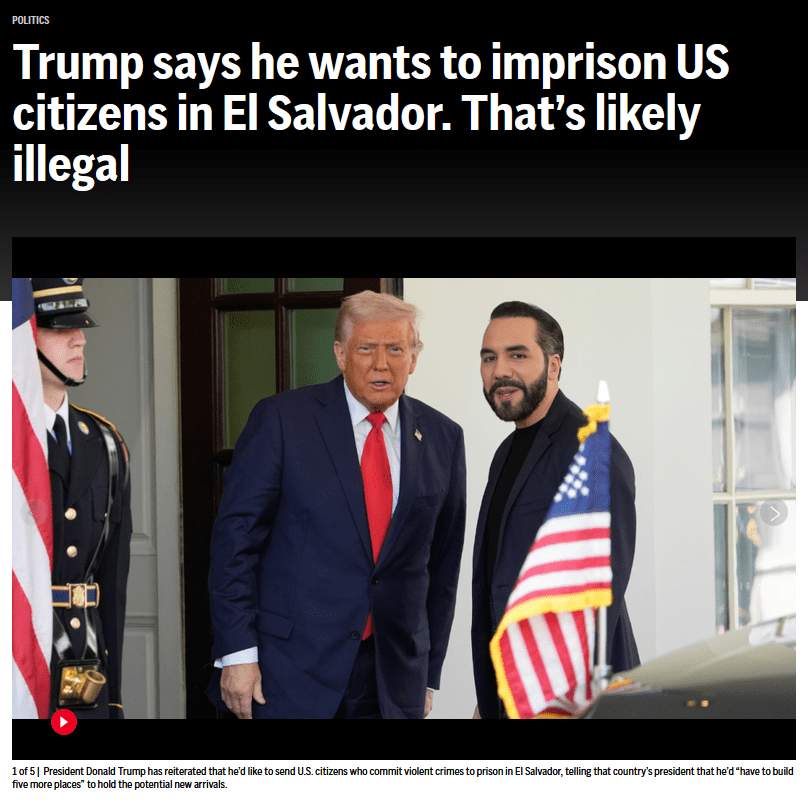
President Donald Trump on Monday reiterated that he’d like to send U.S. citizens who commit violent crimes to prison in El Salvador, telling that country’s president, Nayib Bukele, that he’d “have to build five more places” to hold the potential new arrivals.
Trump’s administration has already deported immigrants to El Salvador’s notorious mega-prison CECOT, known for its harsh conditions. The president has also said his administration is trying to find “legal” ways to ship U.S. citizens there, too.

Back in 2020

The question was posed, “Why do people continue supporting Trump no matter what he does?” A lady named Bev answered it this way:
“You all don’t get it. I live in Trump country, in the Ozarks in southern Missouri, one of the last places where the KKK still has a relatively strong established presence.
They don’t give a shit what he does. He’s just something to rally around and hate liberals, that’s it, period.
He absolutely realizes that and plays it up. They love it. He knows they love it.
The fact that people act like it’s anything other than that proves to them that liberals are idiots, all the more reason for high fives all around.
If you keep getting caught up in “why do they not realize this problem” and “how can they still back Trump after this scandal,” then you do not understand what the underlying motivating factor of his support is. It’s fuck liberals, that’s pretty much it.
Have you noticed he can do pretty much anything imaginable, and they’ll explain some way that rationalizes it that makes zero logical sense?
Because they’re not even keeping track of any coherent narrative, it’s irrelevant. Fuck liberals is the only relevant thing.
Trust me; I know firsthand what I’m talking about.
That’s why they just laugh at it all because you all don’t even realize they truly don’t give a fuck about whatever the conversation is about.
It’s just a side mission story that doesn’t matter anyway.
That’s all just trivial details – the economy, health care, whatever.
Fuck liberals.
Look at the issue with not wearing the masks.
I can tell you what that’s about. It’s about exposing fear. They’re playing chicken with nature, and whoever flinches just moved down their internal pecking order, one step closer to being a liberal.
You’ve got to understand the one core value that they hold above all others is hatred for what they consider weakness because that’s what they believe strength is, hatred of weakness.
And I mean passionate, sadistic hatred.
And I’m not exaggerating. Believe me.
Sadistic, passionate hatred, and that’s what proves they’re strong, their passionate hatred for weakness.
Sometimes they will lump vulnerability in with weakness.
They do that because people tend to start humbling themselves when they’re in some compromising or overwhelming circumstance, and to them, that’s an obvious sign of weakness.
Kindness = weakness. Honesty = weakness.
Compromise = weakness.
They consider their very existence to be superior in every way to anyone who doesn’t hate weakness as much as they do
.”

“All governments suffer a recurring problem:
Power attracts pathological personalities.
It is not that power corrupts but that it is magnetic to the corruptible.”

Frank Herbert, Chapterhouse: Dune

Some people are convinced that all they have to do is to follow the rules.
Other people are convinced that freedom – their freedom, in particular – is the most important thing.

Apparently, these two convictions are incompatible.

Which is not true.

Those convinced that following the rules is the only way to ‘get there’ – wherever that might be – forget one thing. Two things, actually…
That no journey starts until the traveler makes the first step. And decides where they want to go…
Those convinced that freedom is the only important thing forget one thing. One thing only.
That whenever the traveler breaks a rule… there will be consequences!

The fact of the matter being that freedom is a human achievement.
Achieved during the long journey towards the future.
Achieved as a consequence of the process through which we have learned about rules.

‘Rules’ is our definition of ‘possible’. Defines a space where things can happen. As long as the pertinent rules are being observed, of course.

At first glance, flying is possible. For birds…
After learning the pertinent rules – and mastering certain skills – we have learned to fly. But we can continue to fly for only as long as we keep observing the pertinent rules!

At first glance, walking a rope strung between Manhattan’s Twin Towers was impossible.
Not for Philippe Petit. He had the skills and he was crazy enough. He even didn’t ask for permission… Click on the picture and read ‘all about it’. My point being that he remained alive because he had observed the laws of physics. All of them! And because the human laws he had trespassed didn’t involve the capital punishment…

I believe you already understand what I want to convey.
Have a nice week-end.

Trump did what he had promised.
The EU still debates among themselves how to respond.
Britain has already said it will wait for a while.
“Nearly 50 countries want tariff deals”.
Canada is ‘leading the charge’ against Trump’s trade war with $60 billion worth of counter tariffs on American goods, and is urging Europe to retaliate too, Canadian Foreign Minister Mélanie Joly told Euronews in an exclusive interview.” But…

China, on the other hand….
Am I wrong or Trump’s tariffs have been used by the Chinese leaders as an opportunity to position themselves as ‘champions of the free world’? Free from Trump’s version of America…

https://www.sas.upenn.edu/~haroldfs/540/handouts/french/unintconseq.html

 “You have got to be kidding me.”
Hillary Clinton

In nature, change happens. It is produced by chance. According to rules but only when chance starts it. No one plans it, if you leave God out of the picture.
And, evolutionary wise, change ‘remains’ if it doesn’t bother too much. If the individual things/organisms affected by change are able to survive.
Please note that if ‘dramatic’ enough, change may ‘alter’ everything. A star changes constantly but at some point it will become a nova. Or even a supernova. Which event will change everything around it…

In a social setting, things are a tad more complicated.
Change, social change, is initiated. By individuals. Not necessarily according to a plan and almost always ignoring the end results. But it is always initiated by somebody.
And is allowed to stay. Or not…
By those experiencing the consequences. According to what they make of it.
Again, even in the social setting there are rules. Just as in nature. But while the natural rules are enforced by nature itself, the social rules need to be enforced. By people. By those who end up experiencing the consequences of the afore mentioned rules being enforced properly. Or not…

What am I babbling about?

You’re not comfortable with a bragging pussy-grabber signing presidential orders in the Oval Office?
How comfortable were you when Clinton got away with “I did not have sexual relations with that woman!
You’re not comfortable when ‘US national-security leaders’ establish a private group on a social network to share sensitive data?
How comfortable were you when a Secretary of State had established a private e-mail server to handle official messages? And got away with it…

Do I need to continue?

“If the only tool you have is a hammer,
you tend to see every problem as a nail”

Abraham Maslow

“The answer: Free market capitalism”?!?

I was arguing in the previous post that we think using images stored in our memory. While we are convinced that we deal with real ‘objects’… ‘Hammers’ versus ‘nails’…

As you should have already noticed, Abraham Maslow had said more or less the same thing sometimes in the first half of the previous century… Well, he was a ‘clinical’ psychologist while I’m nothing more than an engineer. He was interested in how our mind works, I’m interested in the consequences of how our minds work. If you understand what I mean…

‘And what about the pretext you used for today’s post?’

Free market capitalism is nothing but an environment. Man made, for sure, but also ‘natural’. As in ‘evolved’ to the present state as opposed to ‘designed’ in the present state.
Free market capitalism doesn’t do/cause anything. People toiling in this environment do whatever happens here.

Gravity doesn’t cause any falls.

Gravity pulls us, all of us, towards the center of the Earth.
Regardless.
Of us walking sober in the middle of the town versus skating ‘under the influence’ on a thin iced lake in the middle of nowhere.

What would the world do if…?

Which of the worlds are we talking about here?

Recent developments have helped me to understand something.
And no, not the fact that there are more worlds out there. One happy about what’s going on, one horrified and a few rather indifferent.

Trump being elected for a second term as President of the United States hasn’t changed much in the real world. Not yet, anyway.
What it had changed, dramatically, was our image of the world. Of the US, in particular, but also of the world as a whole.

This development has helped me to understand that we don’t deal in realities.
We don’t consider things, make decisions, by examining the things themselves. No!

We consider things by examining the images we have in our minds.

We look at things and we get a ‘set of data’. A virtual image.
We recollect from our memory whatever other information we have on the subject. Another image.
We put two and two together. And we reach a conclusion.
Most of the time ignoring the fact that we’ve been dealing with images instead of the real thing.

Until we are forced to acknowledge that our image was incomplete. Inaccurate…
Or that, simply, we’ve chosen to see what was more comfortable for us!