Archives for category: gender roles

Men grow up ‘against’ their fathers.
Women grow up with their mothers.

Men try to ‘fix’ their relationship before the older one ‘grows out’.
Women don’t have this problem. By the time they have reached that stage of the relationship, they are beyond the point of no return.  Either not really speaking to each other or so ‘in sync’ that there’s no difference of opinion left to speak of.

Statistically speaking, of course.
For both genders.

‘You can’t beat a picture like this one.’

_DSC0158.jpg

‘Yeah, right…’

_DSC0159

DSC_0007

The way I see it, this lady is freer, in body and mind, than most of us will ever be.

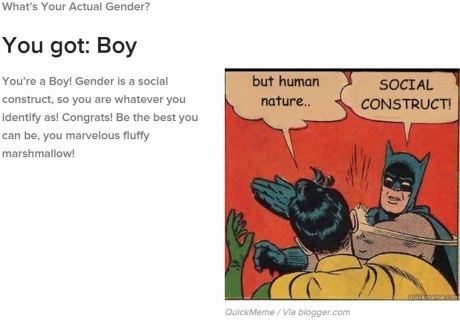
Human Nature as a social construct

Now, that some doctors are not only able but also willing to perform sex/life changing surgery, the subject has spawned a rather hot debate.

The ‘inputs’ being ‘sex’, ‘gender’ and ‘how each of us feels about it’.

Feels about what?

Well… this is the tricky part.
The what of the matter isn’t so simple…

There are so many things that might be felt here…

How each of us feels about the sex they have been born with.
How each of us feels about the gender role assigned to their particular sex by the particular culture into which they have been born.
How each of us feels about those who have enough courage/money to assume another gender/change their sex.

Please note that while neither the society nor the individuals have anything to do with the birth sex, both the society and the individuals are instrumental in shaping all those feelings.

Since sex/gender is too ‘hot’ right now, let me take a parallel road.

Many of my friends are glad when I invite them to dinner. To a home cooked dinner.
Their appreciation has driven me to improve my cooking skills, over time.
Yet in my culture, men are not supposed to cook – if they are not professionals, of course.
Which I’m not.
Yet very few people, if any at all, see anything strange here.
That being the social construct part.
On the other hand, cooking implies certain individual characteristics. For instance, I find it harder when my nose is running. I have to do it ‘mechanically’. It also demands a lot of patience and the ability to plan in advance. Not to mention the fact that one needs both hands.
My point being that cooking, and gender, is based on a certain physical configuration – both hands, a working nose – a certain state of mind AND a lot of study/social conditioning.

My real point being that every ‘social construct’ is based on ‘nature’.
Just as no builder will ever be able to build anything without ‘bricks’, no society will ever be able to build anything out of nothing.
And just as all builders have to adapt their plans to what they have at their disposal, all social constructs will be limited by ‘human nature’ – how ever adaptable and ingenuous it might be.

Now it’s the moment to remind you that other cultures have dealt differently with this matters. Driven by different kinds of necessity.

“It began hundreds of years ago, deep in the Albanian Alps—an unusual tradition where women, with limited options in life, took the oath of the burrnesha. A pledge to live as a man. To dress like a man, to work like a man, to assume the burdens and the liberties of a man. But these freedoms came with a price: The burrneshas also made a pledge of lifelong celibacy. Today these sworn virgins live on, but their numbers have dwindled. Many Albanians don’t even know they exist. What happens when the society that created you no longer needs you? And how do you live in the meantime?”


“In Samoa, gender identity is largely based on a person’s role in the family and if one family has numerous sons and no daughters, it’s not uncommon to raise one of the boys as a girl.

In fact, being a Fa’afaine or the practice of males adopting female gender roles and the attributes traditionally associated with women is deeply embedded in much of Polynesia.”

Confused?

You’re not alone…

“Some Polynesian elders believe there are boys born with the “Fa’afafine spirit,” while others say it can be nurtured.”


We, humans, pride ourselves on many things.

On being smart/intelligent. And on being the only animals able to brag about their achievements with their peers…

But what is it that qualifies us as humans?
That would, of course, depend on what a human really is…

OK, let me use another tack.
What are we really good at? What sets us apart from the rest of the animals?

Practical intelligence? Our ability to solve really complicated problems?

Then watch this wild New Caledonian Crow treating itself to a piece of meat.

new Caledonian crow

Our ability to figure new meaning and to overcome our natural impulses?

Then read about Sheba the Chimp using language to suppress her greed:

In a celebrated study that investigated impulse control, Sally Boysen of Ohio State University asked chimps to choose between two dishes of M&Ms®.

SALLY BOYSEN: Now, you watch real carefully. We’re going to put one, two, three, four down here. Are you watching, Miss Priss? Sheeby? And we’re going to put two in here.

Give those to Sarah. Okay.

Well, I have to give these to Sarah, and Sheeba gets two. So Sarah gets four and Sheba only gets two. Aw, too bad.

NARRATOR: The twist was that the chimp got the candy she didn’t point to. Could the chimp learn to resist her impulse to reach for the bigger pile?

SALLY BOYSEN: You want Sarah to have these? It’s okay, it’s okay. You get to have that one. Yeah, Sarah gets five, and Sheba gets one. Oh, that is such a shame.

NARRATOR: Amazingly, chimps never overcame their greedy urges. They always reached for more and, so, ended up with less.

SALLY BOYSEN: And Sheba gets two, so Sarah gets four. See?

NARRATOR: Impulse studies have also been run on humans. In a classic experiment from the 1970s, a researcher gave a four-year-old a simple choice.

RESEARCHER : So, if you wait for me to get back, I’ll give you this bowl with all of these gummy bears, okay? But if you can’t wait, you can push that button, like this, and then I’ll come back and you can have this bowl with just this one gummy bear, okay? Okay, I’ll be right back.

NARRATOR: According to an inconclusive but intriguing study, the longer children resisted temptation, the higher their S.A.T. scores were years later. In any case, the differences between people are small compared to the gap separating humans and apes.

BRIAN HARE: Maybe one of the first things that happened during our species evolution is we became much less emotionally reactive. And maybe that’s one of the big differences that may explain why we solve problems so differently. We sort of got control of our emotions.

NARRATOR: Can apes be given skills to help them master their emotions? Sally Boysen trained a chimp to understand numerals. Then she repeated her M&Ms experiment, but now offered different pairs of numerals rather than treats.

SALLY BOYSEN: You want to give two to Sarah? Okay. Two goes to Sarah, and you get six.

NARRATOR: Remarkably, chimps were now able to learn what they couldn’t before: point to the smaller number to get the bigger prize.

Symbols can make you free. They can help distance an ape from its impulses. But outside of the lab, apes don’t seem to use symbols. Still, ape minds seem to share many of the amazing features of the human mind.

There is a video which depicts all this. Click on this link and see if it’s available “in your area.” http://www.pbs.org/wgbh/nova/nature/ape-genius.html.

How about our consciousness? Our ability to ‘observe ourselves in the act of observing‘.
Well, that alone wouldn’t have made us any more special than an octopus…

self aware octopus

But what if our individuality resides in us having taken all three to ‘a different level’? One which hasn’t yet been attained by anybody else? Not necessarily higher, mind you!

I’ll deal with ‘trade’ now and I’m afraid you’ll have to come back for the rest.

‘Trade’ wasn’t even mentioned in those three examples?
What was the crow trying to do?
Feed itself? As in exchange matter with the ‘outside’?
What was Sheba trying to do?
Figure our what was going on? As in trading information with the surrounding world?

In this sense all living things are engaged in all forms of trading? And continue to do so for as long as they remain alive?
What did I tell you about us doing nothing really new? Only different?

OK, we had already figured out – long before Adam Smith described it as ‘division of labor’, that by dividing tasks amongst us we’ll be able to accomplish far more things than if we had attempted ‘individual autarky’. And then we had invented ‘trade’, as a manner of exchanging the different wares each of us was proficient in doing…
Wait! Even this is not really ‘new’!
Mother Nature had already invented sexual reproduction – a very extreme ‘division of labour’, a very long time ago…. but not before bacteria were already adept at ‘trading’ genetic information.


Now the serpent was more crafty than any of the wild animals the Lord God had made. He said to the woman, “Did God really say, ‘You must not eat from any tree in the garden’?”
The woman said to the serpent, “We may eat fruit from the trees in the garden, but God did say, ‘You must not eat fruit from the tree that is in the middle of the garden, and you must not touch it, or you will die.’”
“You will not certainly die,” the serpent said to the woman. “For God knows that when you eat from it your eyes will be opened, and you will be like God, knowing good and evil.”
When the woman saw that the fruit of the tree was good for food and pleasing to the eye, and also desirable for gaining wisdom, she took some and ate it. She also gave some to her husband, who was with her, and he ate it. Then the eyes of both of them were opened, and they realized they were naked; so they sewed fig leaves together and made coverings for themselves.
Then the man and his wife heard the sound of the Lord God as he was walking in the garden in the cool of the day, and they hid from the Lord God among the trees of the garden. But the Lord God called to the man, “Where are you?”
He answered, “I heard you in the garden, and I was afraid because I was naked; so I hid.”
And he said, “Who told you that you were naked? Have you eaten from the tree that I commanded you not to eat from?”
The man said, “The woman you put here with me—she gave me some fruit from the tree, and I ate it.”
Then the Lord God said to the woman, “What is this you have done?”
The woman said, “The serpent deceived me, and I ate.”
So the Lord God said to the serpent, “Because you have done this,
“Cursed are you above all livestock and all wild animals!
You will crawl on your belly and you will eat dust all the days of your life.
And I will put enmity between you and the woman, and between your offspring and hers; he will crush your head, and you will strike his heel.”
The Lord God made garments of skin for Adam and his wife and clothed them.
And the Lord God said, “The man has now become like one of us, knowing good and evil. He must not be allowed to reach out his hand and take also from the tree of life and eat, and live forever.” So the Lord God banished him from the Garden of Eden to work the ground from which he had been taken. After he drove the man out, he placed on the east side of the Garden of Eden cherubim and a flaming sword flashing back and forth to guard the way to the tree of life.

So, a pair of innocent brats are allowed by their parent to play in an orchard. And told that they’re welcome to eat any fruit but those hanging from two trees.
The “craftiest” of the other kids tell them that the fruit of one of the forbidden trees are not only good tasting but also ‘good for you’ – ‘you’ll have your eyes opened and you’ll be like your father’.
The pair follow the advice they had just received, develop a certain self awareness – of their nakedness, for starters, and try to fashion some clothes for themselves.
Hearing their father coming, the children hide behind some trees – like all of them do, after they had done something which they were not supposed to.
The father calls for them and, before showing themselves, they speak to him from their hiding. Again, like all other children. Before and after them.
Discovering that they had tried to ‘cover themselves’, the father asks them: ‘How did you find out that you were naked? Have you eaten from the forbidden tree?’

I’m going to take a break here. Just to wonder. Why had the omniscient father to see his children’s makeshift clothing in order to know what had happened?
Back to our story.

Confronted by the father, the boy apportions the blame on everybody-else’s shoulders but his: ‘the girl you had put at my side made me eat those fruit’. And the girl graciously passes her portion to their ‘teacher’: ‘it was the serpent who told me it was OK’.

Sounds familiar? From the kindergarten?

The father, omnipotent like all other fathers, starts to punish the characters of the drama.
Really?!?
In fact, what is described here as ‘the punishment’ is nothing but each of the three ‘finding out’ the true roles in which each of them ‘had been cast’ for the play which was about to begin. Life on Earth.

And we have to notice that the father/director, misericordious as he’s always been, leaves us some thinly veiled instructions and explanations.

“And I will put enmity between you and the woman, and between your offspring and hers; he will crush your head, and you will strike his heel.”
What clearer warning about the perils of inconsiderate ‘enmity’? And also about the need to consider all possible consequences of an act… Why crush somebody’s head without a proper reason and why bite someones heel just for the fun of it? Only to start/maintain a horribly vicious circle?

And why banish those who ‘know good and evil’ from ‘living forever’?

You’ll have to come back for my next post to find out about that.

Let’s face it, all of us have asked ourselves, ‘why do we have to go through all this’?

Why are we thrown into this world, without any of us ever been asked about it, only to end up dead?

Well, I haven’t got an answer to this particular question. Sorry for getting your hopes too high.

But, thanks to a friend of mine, I’ve just found the answer to the next best one.

‘Now, if we’re already here, is there anything that we can do about it?’

The gamut of a potential answer to this question runs from ‘end it this very minute’ to ‘let’s do our best, which ever that might be’.

‘End it this very minute’ has the obvious plus of avoiding any additional suffering to that already experienced – and we pretty much know what we can expect as we’ll be getting older, and the equally obvious minus that no one knows what tomorrow will bring.

Literally.

Who amongst us knew, thirty five years ago, that communism will fall? With a bang!
Who amongst us knew, thirty years ago, that the internet will allow us to exchange ideas so fast, across so much of the world?
Who amongst us knew, five minutes ‘before’, who was the soul-mate each of us have been so happy to share everything with since ‘that happy moment’?

OK, let’s do our best then.
But what is this ‘best’?
How can we define it?!?

To each, their own…

It was exactly here that my friend’s input was invaluable.

“Curiosity is an important source of wisdom, but nowhere near as important as pain.”

The very moment that I was reading this, my fingers started to itch:

“I’m afraid both are ‘equally’ important.
The way I see it, curiosity and pain are, intellectually speaking, very similar to man and woman. You cannot have wisdom without a ‘healthy’ dose of both curiosity and pain, just as you cannot possibly conceive a child without enough of both man and woman.
Furthermore, the kind of wisdom/child you end up with depends heavily on how well both factors manage to cooperate in their ‘discourse’. Not to mention how important is the ‘environment’ where wisdom is ‘attempted’ and ‘child’ is raised.
In this sense, curiosity and pain are just as equal as man and woman are equal.
Or should I say ‘so complementary that neither of them can fulfill their meaning if the other is absent’?”
At first glimpse, this whole thing seems extremely reductionist.
What about those who cannot/want not to have children? Am I implying they’re wasting their lives?
And what about the few who cannot even comprehend the concept of wisdom? Are they to be ‘set aside’?!?
Take a deep breath!
What I’ve just understood is simple.
Basically, these are the only two things over which we have the slightest degree of control.
To give birth – to the next generation of humans, and to learn. To add something to the accrued understanding which is known as ‘culture’.
‘End it, this very minute!’ versus ‘Do our best!’
In order to add something to the future of mankind, not all of us actually need to ‘give birth’. Not all of us actually need to become the next Steven Hawking – I have chosen him as an example because he had just passed away this morning.
But how better this world will become as more and more of us will learn to balance ‘curiosity’ and ‘pain’?
As more and more of us will learn to encourage ‘curiosity’ – their own as well as that of others?
As more and more of us will train themselves to apply only the least amount of ‘curative pain’ whenever they are in control?
As more and more of us will understand that in so many instances both curiosity and pain are more a matter of chance than of ‘due diligence’, and, as a consequence of their newly found understanding, will be more willing to extend a helping hand to both curious and painful?
Flash back from earlier this morning.
Another friend of mine had mentioned a Russian proverb – his translation, I don’t speak the language.

“Do not try “raising/shaping” your kids.

Whatever you do, they’ll still grow to resemble you.
Educate/shape yourself.”
There’s nothing else left to be done but to shape ourselves.
This way we’ll contribute both to the future of mankind and to our own.
It’s a lot nicer, and safer too, to live among people who entertain an atmosphere of mutual respect amongst all of them than to attempt to survive in a ‘top dog takes all’ ‘urban jungle’.
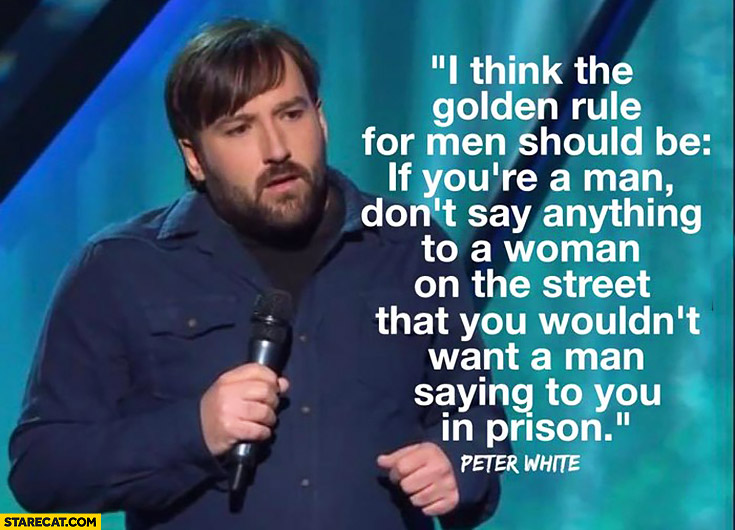
the golden rule
prison gender
I get the hang of it, and I fully agree with it, but I’m afraid this has to be rephrased.
Actually, I’m not at all sure that being incarcerated would automatically change my ‘gender’.
And while I fully support gender equality in the work place, I have this deep feeling that there’s something more involved here.
Functionally, which excludes any attempt to establish an hierarchy, men and women are simultaneously complementary and equal.
I’m not talking exclusively about making/raising kids here.
Otherwise we wouldn’t have been so different.
And the differences wouldn’t have been so complementary.
Insisting on any of ‘equal’ or ‘complementary’ would be worse than wrong.
It would be either neutering or disempowering.
As in counterproductive. A.k.a. dysfunctional.

The current “Me too” campaign – long overdue, should be an eye opener.

Pointing out the perpetrators is a good start and we have a long way to go.

If we want to significantly reduce sexual harassment we need to examine ourselves, men and women, in a mirror.

How many times, as men and women, have we heard other men bragging about their sexual exploits, and said nothing?
How many times have we learned about other men using their rank/position to sexually impose themselves upon women, our colleagues, and did nothing?

And these were the easy ones…

Who raised and educated the present generation of sexual predators? Their mothers and fathers? Their teachers and neighbors? Who had put together the ‘sex sells’ culture which currently permeates everything?
How many women had voted for the ‘American Pussy Grabber’, despite the fact that he had proudly bragged about the whole thing? Why so many women, including ‘his’ wife, agreed that receiving oral sex in the Oval Office was something completely different from ‘having sex with that woman’?
How many women, including actresses, have used their charms to snare their bosses/business partners? And got away with it?
Why is it that in most countries the legislation which punishes the ‘working girls’ does not incriminate their clients?

About the future, I mean!

no kids

This ‘piece of information’ keeps bouncing inside the Internet and is interpreted in various manners.

From ‘what to expect from leaders who are ‘this’ selfish’ to “I find it trashy and irrelevant. Merkel’s husband has two sons, btw.
Well… Macron’s wife also has her own children. And a few nephews.

What startled me was this reaction.
I’m under the stark realization that the most intelligent of the population have the fewest children, which might not bode well for voting statistics in the future.”

While the observation is, of course, correct, I’m afraid the interpretation attached to it is somewhat ‘confused’.

First if all, it’s not ‘intelligence’ that drives people to give birth to fewer children. Intelligence – coalesced at social level – helps a population to increase its living standard. As such, children no longer die young so parents no longer have to have so many of them. In order to have somebody help you in your older days you no longer have to give birth to more than two or three children.

If intelligence alone would have prevented people from having children Israel and the US would have been at least as ‘childless’ as Japan or most of the European Countries.
On the contrary. The US is still in a better situation than the EU, 1.8 vs 1.6, while Israel thrives at 3.1

Another way of making sense of what’s going on is to consider that people no longer make kids simply because they have reached the conclusion that ‘money’ can just as well help them cope during their older days. Since so few children live with, or at least near, their old parents this no longer seems so farfetched as it may look at first glance…

But what’s going on in Israel? They also have enough money…

The country needs soldiers to defend it’s very existence?

But, you know, Israel is a free country. Those kids could leave anytime before being drafted. As some of them do.

But most of them stay! Freely!

Then how about people giving birth having at least some connection with ‘hope’?
As in people having hope for a better tomorrow? One worth defending?

One worth making children for?