Archives for category: freedom

Vatican scrambles after pope appears to deny existence of hell.

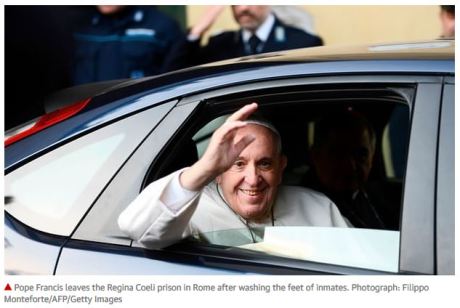
Francis washing feet of inmates

“The controversy came as Pope Francis washed the feet of 12 prisoners at Rome’s Regina Coeli prison on Holy Thursday. Among the inmates were two Muslims, an Orthodox Christian and a Buddhist. He told them: “Everyone has the opportunity to change life and one cannot judge.”
It was the fourth time since becoming pope that he held mass in an Italian prison. “I am a sinner like you but today I represent Jesus … God never abandons us, never tires of forgiving us,” he added.”

“The Holy See issued a terse statement saying a lengthy article published in La Repubblica on Wednesday by Eugenio Scalfari, 93, the newspaper’s founder, was “the fruit of his reconstruction” and not “a faithful transcription of the Holy Father’s words”.

While the Vatican conceded that Scalfari, an atheist who struck up a friendship with Francis in 2013, had held a private meeting with the pontiff before the Easter weekend, it said an interview had not been granted.

During the meeting Scalfari asked the pope where “bad souls” go, to which he was quoted as responding: “They are not punished. Those who repent obtain God’s forgiveness and take their place among the ranks of those who contemplate him, but those who do not repent and cannot be forgiven disappear. A hell doesn’t exist, the disappearance of sinning souls exists.””

OK, and where’s the problem?

“… in 1999 Pope John Paul II announced that hell was “the ultimate consequence of sin itself … rather than a place, hell indicates the state of those who freely and definitively separate themselves from God, the source of all life and joy”.”

Since ‘nihil sine Deo’, where’s the difference between ‘disappearing’ and ‘becoming definitively separated from God’?!?

“The Catholic church’s teachings affirm the existence of hell and its eternity, saying “the chief punishment of hell is eternal separation of God”.”

If I’m not mistaken – and I’m not, many people belonging to the same Catholic church once behaved as if sinners were able to buy ‘respite tickets from hell’, for themselves or for their friends and family…
The Council of Trent instituted severe reforms in the practice of granting indulgences, and, because of prior abuses, “in 1567 Pope Pius V canceled all grants of indulgences involving any fees or other financial transactions” (Catholic Encyclopedia). This act proved the Church’s seriousness about removing abuses from indulgences.

Humans are biased. We tend to interpret what we are told and to bend everything we learn towards what we want to believe.

How about going back to basics.

God loves us.
Simply because He had made us in His own image.
And, just like any other reasonable parent, He knows that His children are far from being perfect. Hence He must have had perfected a method to correct our transgressions.

On the other hand, eternal damnation doesn’t make much sense, does it?

What loving Father could envision any number of his children suffering till the end of time, whenever that might come?

What about a simpler alternative than trying to out-guess God?

For who knows a person’s thoughts except their own spirit within them? In the same way no one knows the thoughts of God except the Spirit of God.

1 Corinthians 2:11

Pope Francis’s words make a lot of sense. To me!
There’s also very little difference between his interpretation of hell and that expressed by Pope John Paul II.
How can anything continue to exist when separated from the all encompassing God?
What loving Father would give up, for good, any number of his children? Regardless of their transgressions…

Who has done this and carried it through, calling forth the generations from the beginning?

I, the Lord—with the first of them and with the last—I am he.”

Isaiah 41:4

You see, adding the fact that we’re all sinners to the possibility of an eternal hell would lead us to the conclusion that we’re all doomed. For the eternity.
If God would allow it, of course.

Doesn’t make much sense, does it?
Then how about us striving to minimize our sins here, while we still have this opportunity, and leave the rest to somebody who knows better?

Apparently, modern civilization ‘is all about the money’.

Fundamentally, it’s still about trust.

Drivers trust their follow drivers that each will stay on their side of the road, stop at the red light and yield at the famous yellow triangle.

yield


Each of us trusts that the elevators we use daily won’t fall under their own weight, that our daily bread contains exclusively what’s mentioned on the label and that tap water has been adequately filtered before being pumped into our homes through proper pipes.

We trust, and follow their advice, ‘higher authorities’. Science people, teachers, government ‘agents’…

Modern ‘consumers’ order a lot of stuff online, food included. From people they’ve never met, trusting they’ll get what they’ve read about in an add they never asked for.

We keep a lot of data online. Mails, tweets, pictures, more or less intimate thoughts shared on our FB walls. That’s the ‘free’ part. We also pay increasingly handsome amounts of money to ‘upload’ for safekeeping ‘in the cloud’ a lot of sensitive commercial and personal data.

Where ‘apparently’ meets ‘fundamentally’, in our individual/personal lives, we are flabbergasted when cars become weapons and are used to kill innocent bystanders. Our friends and relatives.

When manufacturers implement planned obsolescence, artificially increase nicotine contents in cigarettes and replace sugar with corn syrup in ‘soft drinks’.
When piped water is dirty and the authorities shrug their shoulders.
When we discover that animal fat is not as bad for us as we’ve been told for the last 50 years or so. When we realize that our children are saddled with huge debts simply because they wanted a good education. When we realize that some of the people involved with ‘government’ become part of the problem instead of part of the solution.

When our personal data becomes a merchandise.
Traded to be transformed into a manipulative tool.
Used to influence us into buying certain things.
Used to influence us into making certain political decisions.

Trust will, probably, survive for a while.
But I fear the day when too many people will have lost it.

Price tag


Human nature has evolved considerably since we’ve climbed down the proverbial tree/been made in His own image.
Some of our ancestors used to eat their fellow human beings/the first brother had killed his sibling for profit while a sizeable proportion of the present humankind governs itself in a democratic manner.
No individual has ever been able to change, by themself, the human nature. Time and time again, this has been attempted in vain. Plato, Napoleon, Marx, Lenin, Hitler, Stalin…
Yet each of us can change their own persona. This is what Buddha and Jesus have been successfully teaching us.
This is how we’ve figured out that eating our brother might satiate our hunger for the time being but will never solve the problem. Feeding ourselves for the long run demands cooperation. It cannot be achieved through mindless/cut-throat competition.
As long as more and more of us understand this, we’ll have a fighting chance to survive. As a species.

So.
A bunch of ‘well intended people’ had somehow laid their hands on a ‘trove of personal data’ and used it, commercially, to influence electoral processes.
The data was gathered by ‘creatively’ exploiting the ‘opportunities’ put in place by the very existence of Facebook and by the manner in which so many people chose to use the said ‘social network’.

And most of us blame it on ‘Zuckerberg’.

OK, I can understand the psychology of all this.
I can also understand those who put the entire blame on anybody but ‘Zuckerberg’…

Let’s gather some facts.

“Facebook has lost nearly $50 billion in market cap since the data scandal”. recode.net, Mar 20, 2018
In one day, Zuckerberg’s net worth fell $5 billion”. qz.com,  Second day it had fallen a further 4 billion…
Anyway, some 31 ‘missing’ billions used to belong to some other people but Zuckerberg.
Weren’t they supposed to take good care of their property? Weren’t they supposed to check what Zuckerberg, Facebook’s CEO, was doing with their money?


“In Hidden-Camera Exposé, Cambridge Analytica Executives Boast Of Role In Trump Win” npr.org, March 21, 2018
CA’s CEO wrote that the firm had “teamed up with Leave.EU” — then furiously backpedalled”
Impossible to say how much influence Cambridge Analytica’s efforts had over Trump becoming the 46-th American President or Brexit. If any at all.
Yet who bears more responsibility for these developments?
The guys who came up with those ideas in the first place? Trump and Cameron?
The guys who made them possible? The Republican Party Convention who had nominated Trump to run and the British House of Commons who had voted 544-53 in favor of the “United Kingdom European Union membership referendum, 2016”?
The guys who had campaigned above the board, in any direction?
Those who had exerted their influence ‘under the radar’? ” “We have already helped supercharge Leave.EU’sial media campaign by ensuring the right messages are getting to the right voters online, and the campaign’s Facebook page is growing in support to the tune of about 3,000 people per day.

Or those who, through their daily decisions, had created the premises for so many people to convince themselves that Trump was good enough for President and that it would better for Britain to ‘leave’?

Yeah, it’s only normal to blame others for our own mistakes.
But how sustainable is it?

In my previous post, Loyalty, I proposed a four dimensional analysis of an interaction.

The nature of the interaction.
Who are the participants.
The intensity of the interaction.
The manner in which the interaction is changed by the passage of time/changes the passage of time.

I’m going to use the method in my attempt to understand the legislative process.

Hammurabi, “the best known and most celebrated of all Mesopotamian kings“, is famous for, among other things, having compiled one of the best preserved – hence best known, ancient codes of law.

“When he began ruling the city-state of Babylon, he had control of no more than 50 square miles of territory. As he conquered other city-states and his empire grew, he saw the need to unify the various groups he controlled.
Hammurabi keenly understood that, to achieve this goal, he needed one universal set of laws for all of the diverse peoples he conquered. Therefore, he sent legal experts throughout his kingdom to gather existing laws. These laws were reviewed and some were changed or eliminated before compiling his final list of 282 laws.”

Having learned that, it becomes safe to say that a ‘legislative process’ is a development which clarifies the relationship between a ruler and his subjects.

But why would an absolute ruler – as they used to be in those times, put a cap on his own authority? Why would he limit his own powers? Why not judge each case individually? Why not do according to his ‘present mood’ on each occasion?

For two reasons.
As his empire grew, he wasn’t able anymore to judge all the cases by himself. He had to delegate at least some of his judicial powers. And he didn’t want the appointed judges to do as they pleased, without any ‘guidance’.
Secondly, as his empire grew, more and more people – following diverse traditions and bylaws, became incorporated in his empire. He wanted all of them to enjoy the same level of justice and he didn’t want to alienate any one of them.

For this he had first gathered the existing laws throughout his kingdom. He didn’t want to impose his own ‘weltanschauung’ on everybody else, he only needed to build an effective ‘governing tool’.
And he had understood that a law actually makes sense only if it reflects the mores of those asked to abide by it. This way, those who have to ‘police’ those people have to deal exclusively with the relatively few trespassers. Had his laws been a ‘wholesale invention’, the job of the government/police would have been enormous, the costs incurred would have been prohibitive and the result uncertain – to say the least.

I’m sure that most of you noticed that the last paragraph was about the intensity of the relationship so I’ll jump directly to the last dimension.

We have the history of the legislative process and we have history itself.
Is it farfetched to consider ‘history itself’ as the ‘success and failure’ story of how the legislative process has influenced the fate of various people?

Hammurabi had a predecessor. He wasn’t the first to have conquered the entire Mesopotamia. Sargon the Great of Akkad had done the same thing a few centuries before him. There is though a marked difference between Sargon and Hammurabi.

“It is a testimony to his rule that, unlike Sargon of Akkad or his grandson Naram-Sin from earlier times, Hammurabi did not have to re-conquer cities and regions repeatedly”

Joshua J. Mark, Hammurabi, http://www.ancient.eu/hammurabi/

From then on, history is choke full of examples leading to the same conclusion.

The ancient Romans were sticklers for the rule of law – and everything went OK as long as the rulers kept their part of the bargain, yet the first major ‘Roman’ code was compiled by Justinian, the Byzantine emperor, long after the Western part of the Imperium had collapsed. And is imperious for us to remember, in this context, that so many of the Roman emperors had a rather ‘erratic’ behavior…

This example also suggests that there’s no real need for complex and all encompasing code. All it takes is for both rulers and ruled to do their respective jobs in a responsible manner by implementing the existing rules of the land in a reasonable manner.

Fast forward to Great Britain.
The only modern country without a written constitution.
And one of the best working countries in the world, too… except for the last two years or so… I’ll leave it there, for now.
OK, it resides in an island, which somehow insulates it from outside intervention and provides better conditions for stability. Yet it would be very hard to deny the correlation between the legislative stability and relative political continuity that can be observed throughout the British history. Specially when you compare them to what happened in the rest of Europe during the same period.
France is at it’s fifth Republic in less than two and a half centuries.
Germany had morphed from an aggressive Reich to a republic, but not before bringing the whole world to the brink. Twice!
Italy cannot get a grip on itself… Spain almost killed itself during the Civil War, the Greek people had allowed some of its citizens to ‘steal’ almost everything in the country…

What is the common point between all these countries? All of them had been run, during the last 10 centuries or so, in a lot more centralized manner than Great Britain? Their legislative processes have been mostly a top down thing while the one in England had started with Magna Charta? Which was anything but top down!

Coda.

I still need to educate my writing.
I started putting my thoughts down on paper – up in the Cloud, actually, as a manner of bringing my mind to some sort of order.
My success is relative.
I start writing about a certain subject having a certain goal in mind. Yet sometimes that particular goal fades as I write and others, more important, jump at me from various corners.

Now, there’s this ‘small’ issue regarding the ‘Constitution’.

Like any other Law, it defines an interaction between people. Hence, it belongs to the same ‘legislative’ realm.
On the other hand, while the Law defines what a certain person might or might not do and what is the punishment for trespassing, the Constitution delineates the whole environment where the entire social life will take place.
In a sense, the early constitutions were contracts between an erstwhile ruler and his ‘former’ subjects. Both parties entering this contract transforms the relationship between them changes.
While an absolute ruler would give a law as a promise – I’ll behave in such and such way if/when you, the people, will do such and such, when entering the contract known as constitution the ruler acknowledges a new statute for his erstwhile subjects.

Erstwhile ruler and erstwhile subjects become sort of equals.

Constitutions adopted by countries organized as republics go one step further. They actually proclaim the status of equality among all their citizens.

Unfortunately there’s a second similarity between Law and Constitution. Both have to be read and implemented by people.
And there is a difference if most of the people choose to read and implement them in good faith – for the common good, or whether too many of ‘the people’ choose to interpret the law/constitution in a manner that would be beneficial exclusivelly for them.
For those powerful/skillful enough to manipulate enough of the rest into believing that ‘this is how it has to be’.

This is how ‘the road to hell is paved with good intentions’ has come to be coined…


PS. I borrowed the first block-quote from ushistory.org and they implicitly asked me to publish this information.
I’m only happy to oblige, given the wealth of information which is available on their site.
Thank you.
The origin of the rest of the quotes can be determined by simply clicking on them. All the links will open in new tabs.

AUTHOR ushistory.org
TITLE OF PAGE Hammurabi’s Code: An Eye for an Eye
TITLE OF PROGRAM Ancient Civilizations Online Textbook
URL OF PAGE http://www.ushistory.org/civ/4c.asp
DATE OF ACCESS Monday, March 19, 2018
COPYRIGHT 2018

As most other words, loyalty describes a ‘multidimensional interval’ rather than the ‘precise something’ most of us usually expect.

What kind of loyalty?
Loyal to whom/what?
How far would it go?
How is it affected by the passage of time?/How does it change the passage of time?

I’ve been mulling over this subject for more than 10 years now…

For me, this is closely related to the famous “Prisoner’s dilemma”.
You now, where two guys break the law together, get caught, are indicted for two felonies and the prosecution  has solid evidence only for the lesser charge. The two guys are held in separate cells, with no way to communicate, and are pressed hard to confess of the higher charge and/or to betray the other guy. During the interrogation each of them learns that:
– If both betray, each of them gets 2 years in prison.
– If one betrays and the other stays mum, the snitch walks and the ‘mute’ gets 3 years.
– If both shut up, each of them gets a year for the lesser charge.

Interesting enough for somebody who was never in such a situation. And it gets even more interesting if you start reading what the ‘pundits’ have to say about the whole thing.

The ‘cold rationalists’ maintain that it’s only logic for both of them to betray, simply because this is the only sure way to avoid the longer sentence. You never know what the other guy might do in a pinch, right?
The more down to earth, specially those with a more ‘intricate’ knowledge of the ‘underworld’, will loose no time to point out that something like that won’t happen if the the pair belongs to the mob…
Those with economically biased minds will be quick to point out that both of them should shut up simply because this way the team would ‘minimize the aggregate cost’.
Last but not least, sociologists will consider that it’s a good thing, for the society at large, that the criminals tend to be more disloyal than the law abiding citizens – otherwise crime would be even harder to fight than it is now.

Confused?

Then let be present the situation from the ‘loyalist’ point of view.

The ‘what’ of the matter has to do with the proportion between ‘blind’ and  ‘willingly/knowingly assumed’. A mobster will be loyal because he has no other alternative – he’d walk into a self-sprung trap if he’d snitch on his partner while a true friend/brother would be loyal for completely different reasons.

Loyal to a person? To a ‘moral value’? To a ‘time honored tradition’? To a ‘local custom’?
If both guys were loyal to each other…
If both were loyal to ‘do no harm unto others’ they wouldn’t have got here in the first place…

As far as ‘distances’ are involved… In the standard example, as ‘formalized’ by Albert W. Tucker, there’s a relatively small difference between what both of them ‘get’ if both of them snitch and what the ‘mute’ would get if the other one would choose ‘the easy way out’. It’s only fair to presume that the pressure for both of them to betray the other would be far bigger if the ‘betrayed mute’ would be ‘rewarded’ with ten years instead of three while ‘mutual betrayal’ would remain at two each.

Time… isn’t this the most interesting dimension? Where you can only look, but never actually go, back and where haze always increases with distance …
Time, where the ‘good’ kind of loyalty helps those who ‘practice’ it and where bad loyalty constitutes an extremely heavy dead-weight …

How to tell ‘good’ from ‘bad’ in this case?

Consider the long term fate of the provinces/countries controlled by organized crime or by any-other form of dictatorship. No capo/dictator/authoritarian figure would ever be able to impose his will over the rest of the population, absent the loyalty of his supporters…

OK, loyalties are what defines us. What keeps us in one piece. What keeps all of us together.
In fact, the few of us who have no loyalties are nothing but sociopaths.

“Joseph Newman argues that the sociopath has an attention bottleneck that allows him to focus only on one activity or train of thought, to the exclusion of others. Researchers, including Howard Kamler, say that the sociopath lacks not “moral” identity but self-identity altogether.”

Hence, it’s up to the rest of us to spot them and to protect ourselves against them.

How?!?

By not extending misplaced loyalty towards them, of course!

Sociopaths are people who have little to no conscience. They will lie, cheat, steal and manipulate others for their own benefit. They know exactly what they are doing, they just don’t care because they don’t think that way. If you are naive enough, they will brainwash you into doing exactly what they say and what they want which is the only time a sociopath is truly happy.

‘They know exactly what they are doing’…

What’s keeping us from doing the same thing? From keeping at least an eye open for those who demand undeserved loyalty? Under which ever disguise and under which ever pretense?

Part II ended on the Western side of the Mediterranean sea, right before WWII.
Which, by the way, was a consequence of the WWI victors making a terrible mistake.

For the III-rd part we have to cross to the Eastern side of the aforementioned sea and to fast forward to the aftermath of WWIII. The Cold One, if you haven’t figured that out by yourselves.

I’m going to make a small detour now and bring back a subject that I’ve already mentioned.
The changing nature of war itself.
Up to the start of WWI we had war as a conflict between ethnic/imperial chieftains while from then on really important wars had been started by ethnic/imperial chieftains and won by the attacked democracies. The key word here being ‘won’.
Which is not exactly true.
Those wars had not as much been won by the victors as lost by the aggressors. All that the democracies had to do was to (actively) resist long enough for the aggressors to rot from within and crumble under their own weight.
Actually all three WWs had been lost from the first moment. Simply because the aggressors had been inflexible ‘imperiums’ – social systems where the decision making mechanisms were controlled from the top in a more or less absolute manner.

Let’s go back to Syria.
What we had here was a population who had lost patience with being mistreated by a dictator and which, somewhat encouraged by what was going on globally, had tried to ‘buck the rider’. To carve a better future for themselves.

Just as in Spain, almost a hundred years ago, things had become way more complicated than they should have been.
Opportunists of all persuasions and from almost all over the world have jumped in to the occasion. And all those who could have dragged their asses instead of doing something useful for the longer term did exactly that. Dragged their asses and done nothing.

The parallel is staggering. Unfortunately things are becoming far worse and far more complicated.

In Spain, the world had perceived the whole movement as being predominantly of a communist nature. Which, eventually, made it so. Perception wise, in this case.
In Syria, the world perceived the whole movement as being predominantly of an islamist nature. Which, eventually, made it so. Simply because only the islamists of the world became involved, while all the rest did next to nothing. On the really ‘progressive’ side, that is.

In Spain, the only ‘outside’ power which had intervened decisively was the loser of the previous WW. More precisely, the decisive intervention was carried on by the  dictatorship established over the population which had felt mistreated after WWI.
In Syria, the ‘outside’ power which intervenes decisively, helping the ‘regressives’, is the loser of the previous WW. More precisely, the most effective outside intervention is carried on by the authoritarian regime established over the population which had felt mistreated after the Cold War. In Syria’s case we also have a second intervention on the side of the ‘regressives’, carried on by yet another authoritarian regime established over yet another population which feels mistreated by some of the most powerful governments on this Planet.

Then we have the popular sentiment in the rest of the World.
In Spain, people from some 50 nations had volunteered to fight on the Republican side. Very few of them entertained any communist convictions and most of them had a place of their own where to return after the war was over. And when they did return, they were welcome to do so.
Syria has also seen her ‘fair share’ of volunteers. But there’s a marked difference here. While those who went to fight on the Republican side in Spain were animated by some romantic ideals, most of the aliens who came to fight in Syria were driven by a sort of desperate ennui and an acutely perceived lack of any perspective in their countries of origin.
While those who went to Spain did it to help the Spaniards fulfill their dream, those who went to Syria were hoping to carve a piece of land where to build theirs.
While those who went to Spain were welcomed back by their families and neighbors, those coming back from Syria are shunned by their relatives and investigated by the authorities of the states they are returning to.

And the most complicated aspect of the whole thing is ‘separatism’.

To be continued.

We are constantly being told that we’re living in the best possible world.

I agree with that.
Of course it’s the best possible one… specially since there’s no other!

On this side of the Styx, anyway…

Let’s get real now.

This is the Century when we’ve managed to open up all corners of our round Planet. We’ve ‘conquered’ the most remote and inhospitable places – both poles, all mountain tops and most of the ocean floor, including that beneath the Arctic Ice Sheet, and, way more important, made most of the Earth solid surface accessible for almost everybody. By car, by train, by plane, by bike, by ferry …
We’ve managed to populate all the ‘cubicles’ designed by Mendeleev and we found uses for most of them.
We’ve managed to identify a vast array of natural resources. We’ve developed matching technologies to exploit each of them, to transform and combine them into what we thought it would fit our fancies and to distribute the results to whomever wished to receive them.
We’ve continued to develop already invented means of communication and we transformed them into something totally different. Practically, we’ve restored the world to it’s ‘Golden Age’. We now live in the Global Village.

Which is not that much different from the old one…

Now, with the world watching Aleppo burn, Daraya fall, and Idlib and other Syrian cities suffer so brutally, Pope Francis’s description of Syria as “abandoned and beloved” rings chillingly accurate. After Bosnia, I was sure the international community would never again stand by and watch in silence as hundreds of thousands of people were bombed relentlessly, starved, beaten, traumatized, and denied the most basic human rights, including education and medical facilities. During the height of the worst years in Sarajevo, from 1992 to 1994, you could chart the ebb and flow of the city’s hope, like the steady flow of the Mijacka River, whose shelled bridges we had to run across to avoid getting hit by snipers. Food supplies ran out; soldiers were getting slaughtered on the fronts; the hospitals’ generators went down.

Janine Di Giovanni, From Sarajevo to Aleppo, Lessons on Surviving a Siege,
The Atlantic, October 12, 2016

What happened with “only a fool learns from his own mistakes, the wise man learns from the mistakes of others“?

OK, back to square one…

1918 had seen the end of the First World War.
Which was the first ‘mixed’ war and the one which should have been the last…

‘The last’ part is obvious, let me elaborate on ‘the first mixed’ one.

Basically, people are both lazy and easily frightened. Their natural tendency is to ‘give in’, a.k.a. ‘trade in’ rather than ‘fight for it’ ‘to the ultimate consequence’.
Which actually makes a lot of sense. Just imagine what would have happened if we were just a tad more combative than we used to…

Need a clue? Click on the picture below.

sex bonobos chimps

Welcome back.

The proposition “Laziness and congeniality is our default mode (mood?)” is valid but from a ‘statistical point of view’.
On a ‘case by case approach’, the manner in which each of us reacts in specific circumstances depends both on those circumstances and on our own interpretation of what’s going on. In fact, it’s our individual consciousness which makes things even more complicated than the situation described in the video above.

During most of our history, human social arrangements have closely resembled those of the chimpanzees. Alpha males have somehow managed to climb to the top of the food chain while the ‘laziness’ of the rest kicked in and allowed the alpha males to do more or less what they pleased.
Which had included a lot of unwarranted aggression.

Up to WWI, most wars had been started by aggressive rulers who had somehow convinced their followers to attack one or more of the neighbors. Which neighbors were also organized more or less like a chimpanzee troupe – ‘lazy and congenial people’ ruled by which ever alpha male was aggressive/cunning enough to remain in power.
These social arrangements had a very interesting consequence.
All conflict was between rulers and all wars were ‘turf wars’.
The belligerents were not attempting to out-kill each-other but to establish hierarchies. More prosaically, war was nothing but ‘protection racket’. The loser had to pay a certain amount of money to the winner – ‘war reparations’, surrender a piece of the ‘turf’ or both at the same time.

In time – due to particular circumstances, some of what are currently known as ‘nations’ have learned that ‘chimpanzee social order’ leads to unnecessary suffering and have (re)invented an alternative. A.k.a. democracy.

WW1 was the first major war which pitted authoritarian regimes against democratic ones.
Yes, humankind had already witnessed some wars which had been started by more or less democratically run countries – the British Empire had attacked the Boer Republics in South Africa, for example, only this is but a blog post, not a 500 page dissertation…
Unfortunately, the democracies which had won the WWI had behaved totally inappropriately… with dire consequences. For them, as well as for the rest of the world.

The Treaty of Versailles imposed a huge amount of war reparations upon the main loser. Germany.
Two consequences have arisen from here.

The obvious one was WWII. And almost nobody disputes this.
The less obvious one was that those war reparations had transformed war itself.

A democratically run coalition imposing war reparations upon a defeated and leaderless/dispirited population had transformed war from a dispute between rulers into a dispute between nations.

This was the ‘accelerant’ used by Hitler to start the second funeral pyre which had engulfed Europe…

Democratically run nations behaving inconsiderately towards other nations also established an immensely dangerous precedent.

The first example of which had occurred less than 20 years later in Spain.


According to various theories, history is cyclical.
Meaning that we keep doing more or less the same things – or ‘errors’, until we figure them out for what they are.
And then we do them again, under a different guise…

“In China, people must use identity documents for train travel. This rule works to prevent people with excessive debt from using high-speed trains, and limit the movement of religious minorities who have had identity documents confiscated and can wait years to get a valid passport.

While this is the first time Chinese officials have used glasses to implement facial-recognition, the technology is widely used by police. China is also currently building a system that will recognize any of its 1.3 billion citizens in three seconds.”

We’ve spent most of our previously mentioned history living in closely knit and relatively small communities.
We made huge ‘progress’ during that time.
The period had started when we had climbed down from our ancestral tree – or had been made by God, take your pick, and had ended – for most of us, anyway, when we had moved to what we presently call ‘cities’.

Win some, loose some.

Apparently, ‘city-slickers’ are more ‘advanced’ than their rural cousins.
More people living together allows for a deeper division of labour, hence a higher specialization. Productivity increases faster and accumulated knowledge becomes simultaneously deeper and wider.
Unfortunately, all these come at a cost. At first for the individuals and, ultimately, for the society at large.

Living in smallish, and necessarily closer knit, groups provides a lot of ‘natural’ social solidarity. Individuals feel that they belong somewhere and, by sheer necessity, give relatively much to the community. Effort as well as attention.
Lost in the city‘, individuals are simultaneously freer to experiment/innovate and also more prone to growing alienated. So alienated as to become a danger to themselves and/or to those living around them.

On the other hand, small communities, where everybody knows everybody else, necessarily generate a lot of social conformity.
Individuals enjoy a lot of (relative) security and psychological comfort but don’t have very much lee-way.
Innovation, technological as well as social, is slower in this circumstances.
It took us some 130,000 years to ‘invent’ speech, another 65,000 to ‘invent’ writing and then, after no more than 6 short millennia we invented the printing press.
Less than another 6 centuries later we have the Internet.

Writing was invented by the Assyrians – an ‘imperial’ people who lived in cities and who needed a ‘technology’ to keep track of taxes due on the commercial trades which sustained the whole civilization.
Basically the same thing was repeated in many other places. Ancient Egypt, Ancient China, etc.
Written records and favorable geography had allowed the imperial administrations to control relatively vast tracts of land, relatively huge amounts of people and marshal considerable resources to whatever goals considered worthy by those who controlled the flow of information.
Writing down ones thoughts/discoveries also made it possible for humankind to better store its knowledge about everything. ‘Hard copies’ travel better through time than oral traditions.

Until something went wrong.
We all know that all those ancient ‘imperiums’ had crumbled, despite having been the most advanced civilizations of their times.
Other, more nimble, competitors were able to outmaneuver the older behemoths.
Maybe because the old behemoths had exercised too much social control?
‘Written’ central administration was able to marshal enough resources for the ruler to be able to impose stiffer rules towards his own personal safety. The most immediate consequence being that increased social conformity stifled innovation and, hence, created the conditions for the others to catch up, outmaneuver and eventually leave the behemoths behind…

The printing press had a relatively smaller impact than the mere pen.
OK, information was more readily available to those who wished to learn – hence the boost in science and technology, but was ‘useless’ as a ‘coercive tool’. It doesn’t make much difference to someone who wants to control a system whether the information used to do such thing is hand written or ‘pressed’. The small number of ‘insiders’ need to keep that information under tight control so…

The latest ‘gizmo’, the internet, is a totally different development than the printing press.
While the latter is unidirectional – from the author to the wide public, the former goes both ways with equal ease.

Each of us can, almost instantly, become a ‘shooting star’ and, simultaneously, all of us can be monitored by whom ever has the necessary means.

As if we’ve backtracked to a ‘Global Village‘.
In more ways than one.

In a traditional village, everybody knows more or less everything there is to be known about everybody else.
In the Global Village everybody can learn considerable amounts of information about almost anybody worth following while those with enough means can learn almost everything about everybody. Then analyze that information to whatever depth they are able to.  And store it for as long as they find any use for it.

What we call reality exists.
Regardless of us being able to faithfully express whatever we know about it.
Regardless of how much of what we know we are willing to share with others.
Regardless of some of us using their knowledge to impose themselves upon the less knowledgeable.

The irrefutable proof about reality being a fact is not that we have chosen to call it so. Or even to call it at all.

The irrefutable proof that reality is factual is, duh, another fact.
That nobody, no matter how knowledgeable, powerful or both at the same time, has ever been able to impose their will upon the said reality for any significant length of time.

No dictator has ever been able to consistently subdue a people. To kill it, yes. To consistently subdue it, NO. Lately, most of them have also lost an erstwhile relatively common ability… that of bequeathing their power to their intended successor.
No scientist has ever been able to pretend they really knew what they were talking about. No genuine scientist, that is… That they have a clue… yes. Of course!
A fair understanding of what’s going on… that is increasingly plausible.

That at least one of the above possesses the ultimate knowledge/power about even the minutest portion of reality…