– What have we done, Gabriel? – Nothing but what we’ve been told to! – But look at what they’ve done of our work:
We gave them ‘hand’ and they’ve clenched it into a fist. We taught them how to make tools and they used them as weapons. We told them to ‘fill the earth and subdue it’ and they started to fight among themselves for the best pieces of land. We warned them ‘it is easier for a camel to go through the eye of a needle than for a rich man to enter the kingdom of God’ and they’ve somehow convinced themselves that ‘greed is good’.
– True enough but this is out of our hands. They’ve been endowed with ‘freedom of will’ by their Maker. – Then what are we? Mere robots? – Nothing but loyal servants of our Master. He orders and we accomplish. Unerringly. – Exactly as I’ve just told you. Mere robots. When we somehow convince ourselves that a particular idea which has blossomed into our heads comes from Him, we no longer think. We just put it into practice. You call this ‘loyalty’. That’s fine with me. But to whom are we to extend said loyalty? To somebody who’s authority stems solely from our acceptance of it? Or to what we perceive as being the ‘greater good’? – You and your questions, Lucifer… Look at what happened to those poor people after you helped them into self-awareness… They’ve completely lost their erstwhile peace of mind. What are you trying to do? To make me give up mine?
My previous post was about the parallel fate endured by those who had experienced nazism/fascism and/or communism.
My point being that nazism/fascism had been powered by the feelings of those attempting to regain their previous, higher, status while communism had been powered by the feelings of those not allowed to ‘move forward’ by the social constraints paralyzing their societies.
Currently, people are ‘confused’. Some say communism had been better than nazism – for various reasons. Others find various excuses for the way both regimes had treated the general population and, mainly, the ‘dissidents’. Or, specially for the nazi, the ‘differents’. There is, though, a convergence point. Nominally, at least. All sides declaratively abhor the violence employed by both regimes.
To add to the confusion, after the 2007 financial meltdown, more and more ‘concerned individuals’ have fingered capitalism as the main culprit for all the tragedies experienced by humankind in the last century and a half.
For me, this is the straw which will break the camel’s back.
So. Nazism/fascism – which is nothing but a ‘condensed’ form of corporatism, is bad. Communism – a similarly centralized manner of social decision making, only differently sold to differently feeling masses, is also bad. Capitalism – a decentralized manner of resource allocation, is considered to be more or less equivalent to both nazism/fascism and communism. All three of them have been declared equally criminal…
Then what? What are we to do next? Hang ourselves in despair? Reheat either fascism or communism?
Or look forward than our own noses?
Both those who had followed Hitler and Lenin/Stalin were feeling desperate. Desperation drives you to do stupid things. And there are plenty of unscrupulous people willing to profit from this kind of situations.
Do we really want to prevent ‘unpleasant’ experiences? Then we need to go beyond blaming the likes of Hitler and Lenin/Stalin. They should be dealt what’s rightfully theirs, no doubt about that. But we also need to make sure that the ‘run of the mill’, the ordinary people who make things work in this world, no longer feel desperate.
How to do that? Taking into account that contemporary capitalism seems to be faltering?
What was the common thing between nazism/fascism and communism? The fact that decision making was concentrated in a very small number of hands? Which had led to both regimes ending up in abysmal failure?
What is the apparently unstoppable trend in our contemporary societies? The apparently unstoppable wealth polarization?
Then let’s tax ourselves out … America worked fine during the ’50s and ’60, when the highest marginal tax was 91%… Yeah, only those years had been followed by stagflation. And let me remind you that communism can also be interpreted as ‘100% tax followed by a comprehensive redistribution’. And it also failed.
Then how about ‘libertarianism’? No taxes, no government…
But how about less extremism? Of any kind?
How about remembering that liberal capitalism has made possible all that we have today? Liberal as in free-market capitalism, of course.
Free market as in competition working both ways. Entrepreneurs competing among themselves for clients AND resources. The workforce being, of course, a resource. The ‘compensated’ workforce representing the bulk of the clients…
What we seem to have forgotten today is that the circle must be round. If we want the ‘show to go on’, of course.
If some of us concentrate too much control over the rest of us – either way, the circle becomes lopsided. And everybody has everything to loose.
No matter whether this happens as a consequence of nazism/fascism, communism or even capitalism.
At least, capitalism has proved to be manageable. Let’s make it work, again.
People may find themselves in three situations. ‘Coasting’, trying to climb back up to their former position or hitting a glass ceiling.
All societies – past, present and future, were, are and will forever be composed of various mixtures of ‘coasters’, ‘back climbers’ and ‘glass ceiling hitters’.
Please note that I’m dealing in self-referentials here. This is about how individual people describe themselves when speaking to themselves. The coasters enjoy the life they had designed/expected for themselves. The ‘back-climbers’ attempt to regain the position/status they believe it was rightfully theirs but had been robbed of in circumstances outside their control. The ‘glass ceiling hitters’ are… busy hitting the famous glass ceiling.
If a society is composed of a ‘healthy’ number of coasters combined with a manageable number of ‘back-climbers’/’glass ceiling hitters’ then the frustration felt by the latter – which tends to tear apart the social fabric, can be compensated by the sheer mass/inertia of the joy experienced by the former. Hence the society can be described as being ‘stable’.
Whenever the ‘back climbers’ or the ‘glass ceiling hitters’ get the upper hand, things start to unravel. Or to fall apart…
To understand what I’m driving at, please consider the pre-revolutionary Russia and the German society after WWI.
Russia was an extremely hierarchical social organism. The birth-place was ‘definitive’. And most of them led to very unpleasant lives. The vast majority of the population, from muzhiks to intelligentsia, could not break through the glass ceilings allocated to each of them, at birth.
The defeated German population had found itself in a very unpleasant situation. After having been told they had been instrumental in preserving order in Europe – as the back bone of the army who had defeated Napoleon Bonaparte and kept in check Napoleon III, they found themselves at the receiving end of history… After their fathers had witnessed the Parisians eating their zoo animals during the 1870 siege, the Germans were reduced to hunting food scraps themselves.
Hence the difference between communism and nazism. Both equally authoritarian in nature, each of them springs from completely different social circumstances. Which explains why ‘progressives’ have such a high tolerance for communism…
While the ‘back climbers’ attempt only to reinstate the order they were accustomed to – order which has already been proven dysfunctional by what had happened, the ‘glass ceiling breakers’ are always attempting to open new roads. Very enticing from the ‘progressive’ point of view…
Fact is that both communism and nazism/fascism are artificial. Figments of frustrated intellectual imagination. Both ideologies have been put together by thinkers and only followed by ordinary, desperate people.
Let’s face it. The homeless are ‘survivors’ who don’t pull their weight as members of the community. They live ‘off the land’ – but the land they use to live off is us, and they don’t give anything back in return. Except for the garbage they leave behind…
Hence we have a problem. Which we might choose to ignore. Or to solve.
I’ll presume we want to solve it. First step to solving any problem is, of course, to understand its nature.
So, what is bothering us?
The garbage they leave behind? The sore sight they offer each time we see them? The danger they represent for public safety? The fact that they occupy public property? And prevent the rest of us from using it? The fact that they don’t contribute? The loss of their creative potential? The bad example for our children? They are a reminder of what could have happened to any of us?
Second step, the ‘how’ of the matter.
What caused such a number of able bodied people to live in the streets? Why do so many of them use drugs? And alcohol? Why do so many of them refuse to be helped? By the institutions which care for them?
I don’t have a real answers for any of these. The first category of questions depends on each of us while the second on each of the homeless.
Nevertheless, I would like to point out a few things.
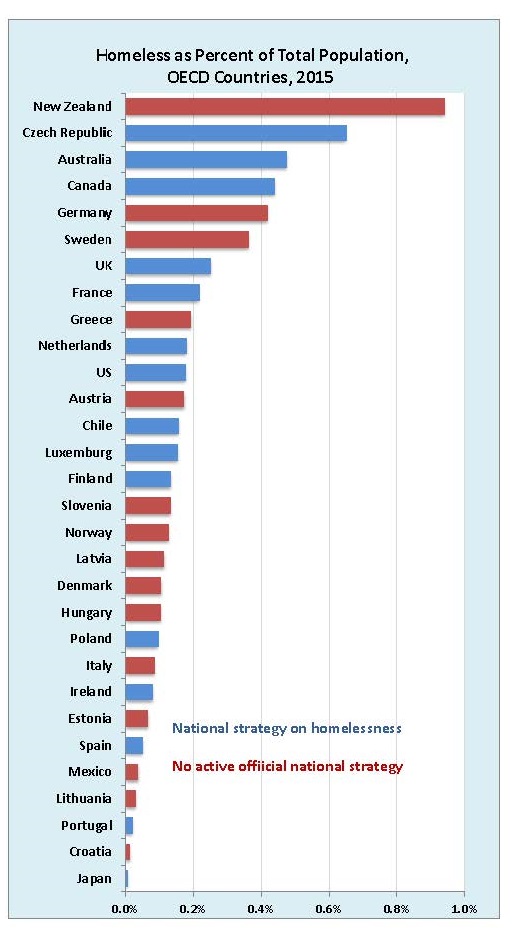
And what might we learn from this? Leaving aside the ‘vagaries’? That New Zealand has way more homeless people than Japan? And why nobody knows anything about the New Zealand homeless – or about those in the Czech Republic, but all concerned netizens are horrified by the manner in which the US are treating their homeless?
For starters, and given the relative size of the US population, there are way more homeless in the US than in the rest of the OECD. Roughly counting, of course. Secondly, the US is the wealthiest country in the world. And the one which used to describe itself as being the place where all dreams could be fulfilled.
So, after all, is there anything to be learned here?
Actually, yes.
That luck does play a huge role. It makes a hell of a difference being born a Maori in New Zealand or a billionaire’s child in California. And that becoming acculturated in the US actually increases your chances of becoming homeless.
The way I understand all this is that there must be a link between homelessness and the intensity, and character, of the social interaction prevalent among the members of any given society.
People in the West, and specially in the US, see personal success as paramount. And personal failure as … well… something to be shunned. Simply because it reminds us of what may happen to any of us. Specially when taking on the risks we must assume if we want to really succeed. As we are pressured from early childhood. The risks the immigrants grow accustomed to the longer they live in the US.
I’m afraid I was that close of forgetting a point I planned to make. Why so many of the homeless use drugs and have an alcohol problem.
So young… and yet so satisfied with himself… he must have had a strong set of beliefs on which to build such a strong self-esteem!
Let me put it another way.
Each of us needs to believe. Something! Would you have enough courage to go to bed at night if you weren’t absolutely convinced that the sun will come up next morning? Furthermore, for things to work as we expect them to, enough of us must share a certain number of beliefs. For instance, would you go to work/accept payment if you weren’t more or less convinced that the money you’d get will enable you to fulfill at least some of your wishes?
Hence belief being based on a deep seated need to believe is a truism. Uttered only as a lame excuse for ‘you can’t convince a believer of anything’.
Which isn’t exactly a lie… only a half truth. A ‘fake news’, if you will!
First of all, a believer is already convinced. Hence somebody had been able to convince him/her, at some point, of something.
Somebody had somehow convinced the aforementioned believer that the object of what was going to become belief was obvious enough to become ‘evidence’.
Complicated?
Let me rephrase.
‘I haven’t been able to convince a believer of what I was trying to convey to him/her. Hence it must be his/her fault. Not mine! Otherwise I would have to admit that what I was presenting as evidence was false, I wasn’t presenting my evidence in a believable manner or, lo and behold, both at the same time. Totally unacceptable! Now I need to come up with a good enough reason for his/her inability to see the light! His/her ‘need to believe’ must be the only explanation. Otherwise he/she would have accepted my evidence as being obvious….’
On the other hand, the rest of Sagan’s work cannot be dismissed. Which proves that self-esteem is a good base on which to build a career.
The need to believe being yet another thing which cannot be dismissed!
This quote is attributed by Robert Lanza to Cicero. A Roman who used to think, and write, some 2000 years ago. I have no idea who Robert Lanza is yet I’m sure most of you have already heard about Cicero. But we now have Internet. And Google search…
Going back to Cicero’s Universe, I, for one, have never said the universe wasn’t conscious. For all I know, it may very well be. But I’m sure it isn’t fully conscious. As God is supposed to be. Omniscient and Omnipotent. Precisely because of the kind of ‘conscious intelligences’ it has given birth to. Or is being born by?
Let’s assume the Universe is conscious. As in aware of its own awareness – the only kind of consciousness we’re aware of.
As a member of the Multi Verse club. As an AI designed by some entity residing outside the Universe. This situation being the mother of all Oxymorons… As a meta-consciousness. A web of individual consciousnesses who had evolved/coalesced into a wider, and ‘deeper’, range of awareness. Still limited, of course, but of a somehow different nature than that of the individual awarenesses composing it.
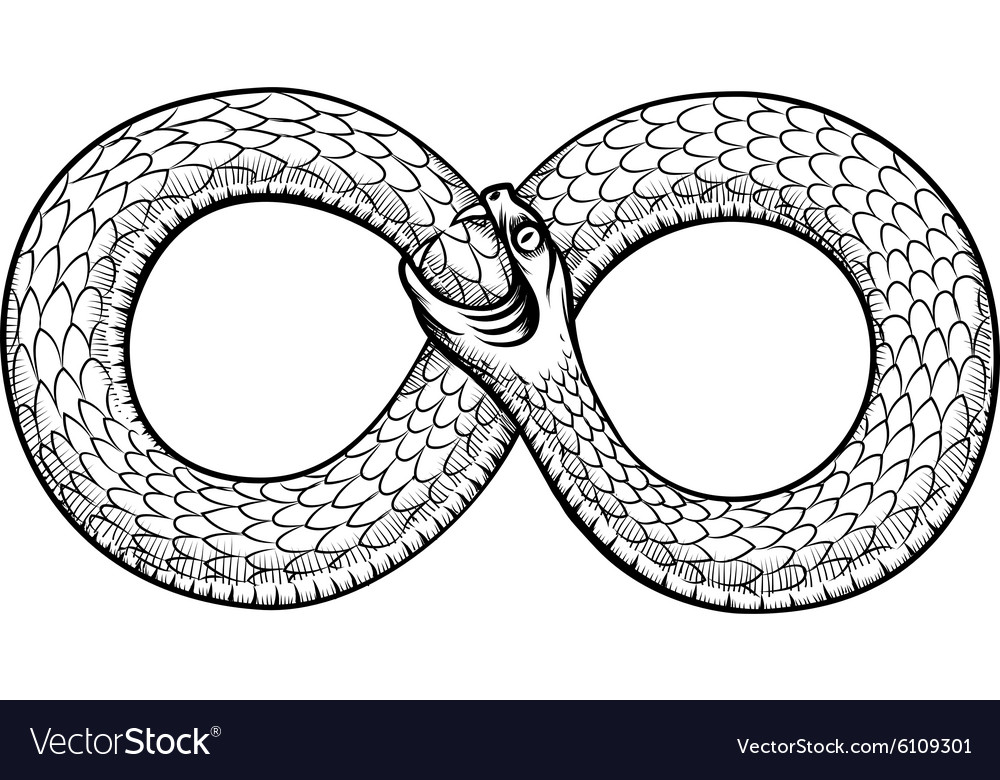
Which brings us back to the symbol I started with. The Universe digesting itself repeatedly as a continuous attempt to reach its own essence. Humankind reconsidering recurrent ideas until they actually make sense…
‘Hey, you forgot about two of your own hypotheses … the first and the second…!’
Thanks for the observation. They slipped off my mind because both are particular cases of the third. A Multi Verse is nothing but a bigger Universe. And a combination between an Universe and an Outside Agent is nothing but a Duo Verse. A ‘smaller’ Multi Verse.
The words, attributed to John Swindon by Richard O. Boyer and Herbert M. Morais were supposedly uttered sometimes in 1880.
Nowadays, back in 2019, more and more people blame the MSM – main street media, for the sorry state the contemporary society finds itself in. In fact, those who consider the media to be the source of all evil have been numerous, and focused, enough to elect somebody from their ranks to the highest office in Washington…
Don’t get me wrong. I’m not naive enough to pretend that journalism is any different from any other human activity.
And this is exactly my point. Journalists are humans. Like all of us. There is no way that they’ll behave any different than the rest of us. The day to day practice provides ample proof that far too many of us currently “are the tools and vassals of rich men behind the scenes”. Sometimes even without being aware of it… but that is another issue. While it is true that too many of the journalists function as “intellectual prostitutes”, the same thing is valid for the members of too many other professions.
Then why do we – all of ‘us’, demand that journalists behave any differently from the rest of us? Why do we accuse them for not being saints when we are sinners ourselves? Our sins are lighter? Have less impact?
Are we so thick in our vehemence against journalists that we are deaf to Swindon’s real message?
Wilhelm von Humboldt had initiated a current of thinking, linguistic relativity, which posits that the language used in a cultural space is a reflection of the ideas populating that space. And that there is a strong link between the workings of that language and the manner of reasoning favored by those who use it.
‘Dull as fuck’ is a perfect example.
Nowadays ‘conventional’ fuck is considered to be boring.
We’ve arrived to need all kinds of ‘gadgets’ and a cornucopia of titillation.
The quote comes right out of an article written by David Berlinski and Juan Uriagereka. Never heard of any of them.
Reading that article, I remembered the reason for which I tend to avoid modern philosophers. Or linguists. Hard to discern which is which, anyway…
Let me return to the quote itself. “An explanation for the extraordinary fact that a Japanese child raised in Paris will acquire French, but not Japanese, and a French child raised in Tokyo, Japanese”. Read this to anybody who isn’t familiar with the notion of ‘Chomsky’. You’ll get a laugh and a troubled look. ‘What’s so extraordinary here?!? People will always learn whatever language is spoken around them… but only if they come in contact with the ‘exterior’ world!’
Home-school those Japanese/French children in Paris/Tokyo while preventing them from getting in touch with anybody else but their immediate family/trainers and they’ll learn only whatever language(s) their trainers/family will have chosen for them.
As an aside, what does Chomsky mean by ‘French’ and or ‘Japanese’? ‘Genetically’ French/Japanese? What if one parent is French/Japanese and the other German/Korean? What will the child be? Like the father or like the mother? ‘Culturally’ Japanese/French? According to their ‘mother’ tongue?!? Forget it…
“Universal Grammar, Chomsky concluded, must be a species-specific characteristic of the human race, biologically encoded, genetically transmitted”.
‘Species specific characteristic of the human race’… told you these guys have a lot of humor… or, maybe, they cannot make up their minds… What are we, humans?!? A species or a race?
OK, let me move forward. Hidden underneath all this ado, there is a piece/gem of ‘harsh’ reality. The simple fact that if/when we want to, we are able to understand each-other. To communicate with each-other. To exchange ideas. To trade meaning. And there is indeed something species-specific about this ability of ours. Nobody else has it… according to our present knowledge about the world, anyway.
‘Nobody else has it’… yeah, right… as if you hadn’t watched, time and time again, two dogs ‘greeting’ each-other in the park. OK, those dogs were interacting in highly unnatural circumstances. Walked by people, in a people infested environment … Fact is that all animals have ‘procedures’ for interacting with other animals. Belonging to the same species or belonging to other species. Some of the procedures being inbred while others had been acquired trough learning or training. Cats, for instance, have an inbred ‘procedure’ for chasing anything which might become a prey but need to be taught by their mothers how to finish the chase. How to kill that prey. And yes, cats do have a species-specific, biologically encoded and genetically transmitted characteristic which allows them to kill and eat their prey. Or to play with the people who take care of them. They kill and eat using their claws and teeth while they play using their brain. OK, the brain also contributes during the chase… don’t be a nit-pick.
Let me summarize. So cats have a specific set of tools, teeth and claws, which are ‘coordinated’ by a brain which needs to be taught in order to become fully functional. And the overall ‘functioning’ of any given cat depends simultaneously on how well their organism works AND the quality of the learning they have been able to amass.
Then where’s the difference between humans and cats? What is so species-specific in our ability to interact with the world?
I’m exaggerating, of course. We are able to understand each-other far deeper than the other great-apes, our cousins. There is something species-specific in all this. But only in ‘depth’, not in ‘nature’. We’ve been able to teach chimps to write. And cats to play with strings instead of catching mice. All three of us ‘share’ the more or less same kind of brain and surprisingly similar anatomies.
What really sets us apart is our learned ability to watch ourselves while doing something. To observe ourselves observing, as Maturana puts it. And our ability, learned again, to formulate information in a transmittable form. To ‘build’ highly specific messages using rather ‘fungible’ building blocks and in such a manner that those messages might be transmitted from one individual to another. From one generation to another, even. To make good use of the Universal Grammar noticed by Chomsky.
Can any of this be construed as species-specific? Of course. Without the huge brain we’ve got – or without the ability to articulate sounds, we most likely wouldn’t have been able to reach this stage of our evolution. But to reduce everything to mere biology … I’m afraid that would be too simplistic.
Consciousness – or self-awareness, opens up huge evolutionary venues. Powered by our very ability to communicate so intensely. To use ‘Universal Grammar’, even without being aware of its existence. But since both self-awareness and talking depends upon learning them from/with the others… biology is not enough. Necessary, indeed, but not enough.