Archives for category: Culture

Acest post a fost inspirat de “Pentru tine”, citit pe entuziasm.ro

Problema altruismului e intr-adevar spinoasa. Rationalistilor le vine greu sa creada ca cineva rational (si rationalistii cred ca toata lumea actioneaza rational) poate face ceva care nu are un efect benefic asupra propriei persoane.
Si totusi, in mod aparent paradoxal, altruismul manifestat catre straini ‘absoluti’ exista si se manifesta continuu. Rationalistii cauta in draci explicatii.
Iata-o pe a mea. (Si eu ma consider tot rationalist dar nu absolut)
Altruismul este o constructie sociala. Adica este ‘predat’ de la o generatie la alta si modelat in urma interactiunilor dintre membrii comunitatii respective.
Dupa cum spunea Darwin evolutia are loc la nivelul speciilor si nu a indivizilor. La oameni evolutia are loc la nivelul comunitatilor. Fiecare dintre acestea dezvolta cate o cultura, adaptata circumstantelor – geografice si istorice – in care comunitatea/cultura respectiva a evoluat.
Comunitatile/culturile care au reusit sa isi adapteze, in mod continuu, raportul dintre coeziunea sociala care tine la un loc pe membri lor si autonomia permisa acelorasi membri la conditiile specifice carora trebuie sa le faca fata supravietuiesc. Celelalte nu.
Ei bine altruismul neinteresat este o masura a acestui raport intre coeziune si autonomie.
Lipsa lui denota o lipsa totala de coeziune sociala si atunci comunitatea respectiva se va dizolva de la sine.
Exagerarea in directie contrara semnifica lipsa respectului pentru individ, adica lipsa de autonomie individuala (unii ii spun libertate). Adica osificare respectivei comunitati. Incapacitatea ei de a continua procesul adaptativ. Exit.

Imi propusesem sa revin la preocuparile mele de natura mai mult teoretica decat practica dar se pare ca nu sunt in stare sa rezist tentatiei.

In seara asta, dupa multe pertractari, s-a intamplat.
Marea confruntare care urma sa aleaga apele.

Nu cred ca s-a intamplat acest lucru.
Mie unuia nu mi s-a parut ca aceasta ora si jumatate a adus ceva nou in ceea ce ii priveste pe cei doi competitori, fiecare dintre ei doar a confirmat ceea ce toti stiam deja despre ei.
Tocmai de aceea nu intentionez sa vorbesc de la inceput despre ce s-a intamplat acolo.

Foarte interesant a fost ceea ce s-a intamplat dupa aceea.
Comentariile.

Tocmai pentru ca nu s-a intamplat nimic nou, nici macar in ceea ce priveste difuzarea acestei confruntari – doar televiziunile de stiri au preluat aceasta emisiune, cel putin din cate am observat eu – comentatorii au inceput sa disece mai ales prestatiile ‘artistice’ ale celor doi si, intr-o mai mica masura, modul in care au fost ajutati, sau nu, de staffurile de campanie.
Foarte interesant, intr-adevar, dar poate un pic pe langa problema.

USL-ul ne-a promis ca ne va scapa de Basescu. N-a reusit. Basescu mai are un pic si ne va scapa el singur de el insusi – i se va termina mandatul in mod natural.

Aritmetic – daca ne gandim la faptul ca aproape 9 milioane de oameni au votat pentru demiterea lui – foarte multi alegatori romani se cam saturasera de el de vreo doi ani incoace. Nu stim precis daca de persoana lui sau de rolul jucat de acesta: presedinte-jucator pana la limita regulamentului si cateodata chiar dincolo de ea. Putem doar sa presupunem ca de ambele. N-a fost sa fie. Pe de o parte n-au fost destui cei care au votat pentru demitere iar pe de alta ‘sistemul’ a hotarat ca mai bine sa o lase asa cum a cazut decat sa-si asume riscuri – daca poporul nu stie ce vrea n-o sa ne apucam noi acum sa facem valuri.

Reintorcandu-ne la cei doi, de data asta chiar a sarit in ochi – pentru cine a vrut sa vada – deosebirea fundamentala dintre ei.
Ponta s-a desfasurat: activ, pregatit, cu date, cu initiativa. Pana la urma este nu doar mai tanar ci si in plina viteza – conduce de doi ani o tara intreaga din functia executiva de prim ministru si se pare ca ii si place.
Despre Iohannis nu se poate spune ca doar s-a aparat, a lovit si el – cateodata chiar puternic. Dar a fost mult mai calm, nu s-a agatat de amanunte si chiar s-a ferit cu abilitate de capcane garnisite cu cifrele precise pe care un prim ministru in exercitiu le are la degetul mic.

Cu alte cuvinte Ponta a fost jucatorul activ – rol pe care il exerseaza deja de doi ani si care se potriveste de minune varstei sale – pe cand Iohannis a fost elementul reactiv al intalnirii – ajutat atat de temperament cat si de experienta sa mai lunga de viata.

“(1) Preşedintele României reprezintă statul român şi este garantul independenţei naţionale, al unităţii şi al integrităţii teritoriale a ţării.
(2) Preşedintele României veghează la respectarea Constituţiei şi la buna funcţionare a autorităţilor publice. În acest scop, Preşedintele exercită funcţia de mediere între puterile statului, precum şi între stat şi societate.”

Si acum vine intrebarea la care trebuie sa raspundem duminica:
Ce fel de presedinte vrem?

Jucator activ sau mediator reactiv?

Noi trebuie sa facem aceasta alegere, nu mai este nimeni altcineva care sa o faca.

Da, in mod evident rezultatele pe care le va obtine cel care va fi ales vor depinde, in mare masura, de echipa pe care alesul va sti sa o coaguleze in jurul său. Iar acea echipa sunt sigur ca va tine cont de mesajul pe care il vom trimite noi, adica de genul de om pe care il vom alege. Si aici intram intr-un fel de rationament circular. Sunt convins ca fiecare dintre cele doua staffuri de campanie a analizat cat a putut de bine toata aceasta actiune inainte de a face o recomandare.
Din pacate singura metoda realista de a determina care dintre cele doua staffuri a ‘avut dreptate’ este de a astepta rezultatul votului. Staffurile n-au avut – sau cel putin n-ar fi trebuit sa aibe – ca țintă obtinerea unei prestatii artistice cat mai ridicata din partea candidatului sfatuit ci una care sa ii creasca acestuia sansele de a fi ales. Adica un mod de comportament care sa se potriveasca cat mai bine cu ce ne dorim noi, alegatorii, de la viitorul presedinte.

Si atunci? Sa alegem dupa prestatia artistica sau dupa ce fel de tip de presedinte ne dorim?

Iesirea din acest rationament circular ne apartine tot noua.

frustrare

Teoria metodologica sustine ca o cercetare, de orice fel pana la urma, poate fi facuta in doua feluri.

‘Cercetatorul’ poate iesi ‘pe teren’ sa stranga datele de care are nevoie pentru a ‘masura’ fenomenul care i-a starnit interesul sau poate folosi niste date deja stranse – de altii si eventual pentru cu totul si cu totul alte scopuri.
(Analiza secundara a datelor)

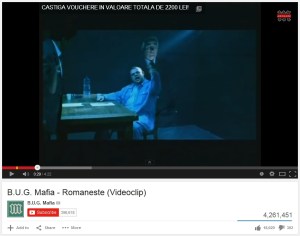
Cand suntem pusi fata in fata cu asemenea ‘creatii artistice’ precum cea a BUG Mafia fiecare dintre noi reactioneaza in felul lui.
Unii se oripileaza din cauza limbajului extrem de frust si intorc scarbiti spatele.
Altii se amuza si recunosc, in sinea lor sau pe fața, ca in spatele fatadei pornofonice isi itesc capetele cateva adevaruri incomode.
Pe mine m-a izbit intrebarea ‘cat de frustrati trebuie sa fie cei mai mult de 4 milioane de ascultatori pentru a asculta asa ceva’?

Sa ma explic.
Simpla aparitia a unui cantec de genul asta nu este mare scofala.
Mai ales in conditiile zilei de astazi aproape oricine poate compune si inregistra un astfel de video clip. Si sunt destul de multi nemultumiti pe lumea asta care sa faca asa ceva.
Mai mult. Exista un public pentru care simpla prezenta a ‘termenilor tehnici’ presarati din belsug aici reprezinta o atractie irezistibila numai ca in conditii normale genul asta de public este relativ putin numeros.

Ori noi avem aici mai mult de 4 milioane de vizualizari.
Popularitatea cantecului asta este de fapt expresia unei cantitati considerabile de frustrare, mai ales ca ‘spatiul cultural’ despre care vorbim acopera nu mai mult de 20 milioane de oameni.

A vous de jouer

I shared a video clip on FB a couple of days ago, I’ll post the link at the end of this entry.

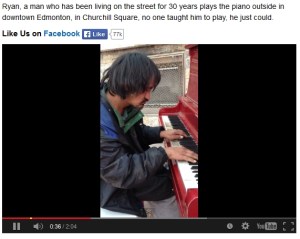
It was about a homeless artist in Edmonton, Canada, who taught himself to play the piano and I was wondering where did he find a piano on the streets to do that.

This is how I found out that: “There’s a public piano on the sidewalk in downtown Fargo (North Dakota . It’s in front of an art gallery and is free for anyone to play. (It’s covered during rain and taken indoors for winter, of course.) The plan is to acquire and “sprinkle” more of them around downtown. It’s very popular.”

I was very glad but my happiness was both short-lived and and quickly born again: “The first piano placed on the corner of First Ave. and Broadway in Fargo was vandalized within 10 days. When it comes to public art, our biggest challenge lies in defining the type of behavior our community will tolerate. We must hold each other accountable for our actions. I am working with the local police and with business owners to create ways to reduce the potential for future vandalism.”  
What’s going on there is way bigger than a lonely enthusiast sharing his piano with the passersby. It’s an entire project and the guys aren’t going to give up so easily.

Even more important is that the project is supported by the community: the pianos are donated by the general public and expenses are covered by private sponsors (Kickstarter “helped” a lot) while the big heart behind all this is Susanne Williams.

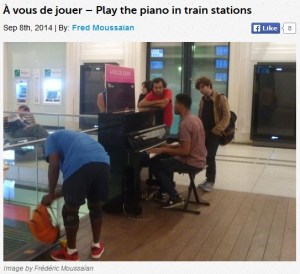
On this side of the Atlantic, or more specifically in Paris, pianos have found another way to get in touch with the general public. They have somehow convinced the managers of most rail-stations to have one installed near the platforms used by the commuters, as can be seen in the picture that opens my post. Click on it if you want to find out more.

While searching the internet to find out more about ‘street pianos’ I discovered Luke Jerram, the artist who in 2008 had the idea to launch “Play me, I’m yours” : ”

‘The idea for Play Me, I’m Yours came from visiting my local launderette. I saw the same people there each weekend and yet no one talked to one another. I suddenly realised that within a city, there must be hundreds of these invisible communities, regularly spending time with one another in silence. Placing a piano into the space was my solution to this problem, acting as a catalyst for conversation and changing the dynamics of a space.’
Luke Jerram, International artist and creator of ‘Play Me, I’m Yours’

Now I wonder if Luke Jerram and Ryan know about each other.
Ryan playing the piano

Thanks Maria Flieth and Paul Wehage for providing me the initial information for this post.

Me and my limited vision. I consider myself to be a person who is relatively well connected to the world at large yet I could never conceive of somebody not only dreaming about but actually bringing pianos out on the boardwalk for everyone to play.
Maybe it is high time for the rest of us to unleash their dreams.
And to start working on them!

“”We have not merely stumbled upon truth in spite of error and illusion, which is odd, but because of error and illusion, which is even odder.” Balfour”, courtesy of Philip F. Crenshaw who shared this on his Facebook wall.

“The good thing is that after only god knows how many times we have stumbled upon a truthful thing, we finally recognized it for what it was: a gem lying in mud for us to pick it up!” Me

It is up to us to decide how we put traditional precepts into practice!

islamic law about marriage

And what is there to stop the father from accepting her choice except for his ego or self serving interests?

Click on the picture, watch the video and then tell me what ‘higher instance’ forced any of those people to do what they did, to make the choices they made..
All individuals featured in this video belong to the Afghan people and, presumably, to the Muslim faith. Yet their attitudes cover the entire spectrum. Don’t tell me there is no such thing as free will and individual responsibility.

What forced the father to give away his daughter as compensation for his son’s “sins”?
Peer pressure?!? (‘Relatives’ that may become belligerent if their demands are not met.)
But who are these ‘peers’ if not human beings themselves?

When are we going to understand that we can not quell yesterday’s conflict by inflicting fresh sufferance?
This just doesn’t work!

“Although hospitals are prohibited from denying treatment to patients seeking emergency care, it should be expected that they will charge for services provided. Emergency charges are usually covered in full by most insurance programs. Uninsured patients will be responsible for costs following treatment.”

And that is because in the US health care is seen more as an industry providing services for individuals than anything else.

In a sense this situation is perfectly understandable. Yersinia Pestis is endemic in the Western US but America has never seen a major outbreak of plague. Why? Simple. American cities are far apart and were built way after humankind learned that washing yourself is good for you. This is why America, as a nation, has never experienced a major pandemic except for the Spanish flu in 1918 when 20 to 40% of worldwide population fell ill and 670 000 Americans died.
Only this was children’s play compared to the European experience. While for most of the Americans ‘plague’ is some biblical punishment that zealots keep threatening us with for Europeans the word brings back memories of the Great Death that has visited  the continent from 1347 up to 1600. OK, most of us weren’t present at that time but an epidemic that kills one third of the population – as it happened in 1347-1398 – leaves more than a scar on the collective memory of the population. It alters the way society works.
I won’t enter into details now but experiences like that prompted ‘political’ rulers to ponder upon the need to take care of the ailing/sick portion of the population. Both to prevent such diseases from spreading so violently and to mitigate their effects once they had befallen on their subjects. And no, they weren’t soft-hearted lefties but hard core pragmatists: every major epidemic left behind not only a deficit of workforce but also it drastically reduced the number of ‘conscriptable’ males, something very dangerous for a kingdom in an era of constant ‘international’ aggression.

Here is what britannica.com has to say about this: “Stirred by the Black Death, public officials created a system of sanitary control to combat contagious diseases, using observation stations, isolation hospitals, and disinfection procedures. Major efforts to improve sanitation included the development of pure water supplies, garbage and sewage disposal, and food inspection. These efforts were especially important in the cities, where people lived in crowded conditions in a rural manner with many animals around their homes.”

In fact this is how the European style Public Health System came into being. If you’d compare a community with an organism it would be the social equivalent to the immune system, a section of the whole thing that (automatically) fights infection without individual cells having to bother with anything.

“But we are not MINDLESS CELLS, we are FREE human beings!” I hear some some of my conservative friends shouting at me.
“If they want protection they should get insurance!”

Fair enough, only:

We humans are not at all independent but, at most, autonomous. Try living by yourself, isolated somewhere if you don’t believe me.

I’m not talking about individuals here but about whole communities. The Black Death didn’t bring any benefits to any of the peoples of Europe, it didn’t just cull the misfits leaving more breathing space for the powerful to develop their potential. The disappearance of one third of the population teared apart the entire social fabric and I don’t think there where many, if any, people glad of what had happened in those times.

Insurers and service providers work for profit, not as a public service. As such any insurance is limited, one way or another, and each service provided bears an individual cost that is accrued to the total bill. Even Lloyds, the only place in the world where somebody could buy unlimited liability insurance has drastically curtailed the practice.
So, in the present conditions, who is going to pick up the tab if a real pandemic will happen in the US?

Not to mention the ‘technical’ and regulatory hurdles that appear due to the in-existence of a ‘national health care system’:
“U.S. hospitals may be unprepared to safely dispose of the infectious waste generated by any Ebola virus disease patient to arrive unannounced in the country, potentially putting the wider community at risk, biosafety experts said.
Waste management companies are refusing to haul away the soiled sheets and virus-spattered protective gear associated with treating the disease, citing federal guidelines that require Ebola-related waste to be handled in special packaging by people with hazardous materials training, infectious disease and biosafety experts told Reuters.”
“CDC advises hospitals to place Ebola-infected items in leak-proof containers and discard them as they would other biohazards that fall into the category of “regulated medical waste.” According to DOT guidelines, items in this category can’t be in a form that can cause human harm. The DOT classifies Ebola as a Category A agent, or one that is potentially life-threatening.
DOT regulations say transporting Category A items requires special packaging and hazmat training.
CDC spokesman Tom Skinner said the agency isn’t aware of any packaging that is approved for handling Ebola waste.
As a result, conventional waste management contractors believe they can’t legally haul Ebola waste, said Thomas Metzger, communication director for the National Waste & Recycling Association trade group.”

As of now individual solutions have been worked out. Americans are inventive and resourceful people but so far they had to deal only with isolated incidents. I hope things will peter out before anything more intense will take place but I also hope that those with vision will use this opportunity to educate the wider public about the necessity of a nation wide system capable to deal with medical problems of this magnitude.


Tomorrow will be a full century since the ‘Miracle of the Marne’, a battle from the WWI during which the French managed to stop the seemingly invincible German army at some 35 miles from Paris. Apparently the Germans erroneously appraised the state of the French army and lost a huge opportunity while the French had shown a lot more stamina and determination than they were credited for.

Also there are some chances that tomorrow will be remembered as the first day of peace in Eastern Ukraine after many month of (un)civil war.

What I would like to do now is take a fresh look at what we know as ‘wars’. Hot, cold, asymmetric, commercial, trade…you name it.

There are two interesting definitions that I would like to share with you:
“War is the continuation of politics by other means.”  This one belongs to Claus von Clausewitz, the mastermind behind the German strategic thinking during the second half of the XIX-ht century. The most immediate impression one gets from reading it is that war, per se, is a legitimate tool when it comes to solving problems. You try ‘diplomacy’ first but if that doesn’t work there is always the option of “WAR”.
“War is only a cowardly escape from the problems of peace.” A XX-ht century hippie tree hugger? Not exactly… Another German, a writer this time, who had witnessed the WWI as a mature thinker – Thomas Mann, 1875 – 1955. I don’t know when had Mann come up with his definition but it is quite the opposite from the one proposed by his fellow countryman. On the other hand I cannot fail to observe that while in von Clausewitz time Germany was on the rise as a military power during Mann life it had suffered two humiliating defeats.

To be continued.


“Rotherham: In the face of such evil, who is the racist now?”

I understand that in the current circumstances ‘racism’ ‘sells’ but shouldn’t we refrain from making things worse than they already are? After all we live in this world too, don’t we?!?

What happened there is that in the last 16 years fourteen hundred (1400) kids were raped, mostly by Pakistani men, while the authorities did nothing. Not because they didn’t know, mind you.
And instead of trying to understand how come the entire social organism failed abysmally some continue to play the blame game…

The key to all these is the fact that those children were abused not only by the rapists themselves but also by the authorities.
Further more the rapists thought it was OK to do what they did (they wouldn’t have done it on such a large scale otherwise but they were horribly wrong) while the authorities should have known, at least deep in their hearts, that they were acting  cowardly – to use the least inflammatory word.

And the main hurdle that needs to be overcome is indeed ‘racist’ thinking and ‘politically correctness’ – in the twisted acception that this notion has been given lately.

“Powerless WHITE working-class girls were caught between a hateful, IMPORTED culture of vicious misogyny on the one hand, and on the other a culture of chauvinism among the police, who regarded them as worthless slags. Officials trained up in DIVERSITY and POLITICAL CORECTNESS failed to acknowledge what was effectively WHITE slavery on their doorstep. Much too embarrassing to concede that it wasn’t WHITE people who were committing racist hate crimes in this instance.”

Racism isn’t about the color of the skin, it’s about putting the blame, squarely and indiscriminately, on ‘the different other’.
Ignore the capitalized words while reading the last quoted paragraph and you’ll understand what I mean. Don’t worry that the last sentence has become a lot more powerful this way… those who perpetrated this, both the rapists and the authorities, were not people at all! Regardless of their creed or anything else.


Ma bantuie de ceva vreme ideea unui articol despre ce rol mai are religia in viata ‘omului modern’.

Cel de acum este doar un ‘amuse-gueule’ starnit de o intamplare povestita de Simona Tache in Jurnalul ei Roz de Cazarma:

“Bunicile neortodoxe nu se mantuiesc…”

Cuvantul ‘Religie’ vine de la latinescul ‘reliegare’, care inseamna ‘a fi conectat la’/’legat cu’.
Mai pe romaneste fiecare credinta religioasa este, in realitate, doar un bagaj cultural (adica acumulat in timp) care l-a ajutat pe posesorul sau (comunitatea care are grija de el) sa supravietuiasca incercarilor la care a fost supus. Tocmai de aceea respectivele comunitati au, in general, respect fata de acel bagaj – chiar daca li se pare, cateodata cel putin, destul de greu de purtat.
OK, OK, ‘bagaj cultural’, ‘supravietuire’…ce legatura au toate astea cu ‘a fi conectat la’ ?!?

Simplu.
O comunitate umana este un grup structurat de oameni care traieste intr-un anume spatiu, corect?
Ori pentru ca asa ceva sa supravietuiasca, adica sa continue sa existe, inseamna ca acel grup de oameni trebuie sa fie in stare sa-si pastreze/adapteze structura la schimbarile aparute in respectivul mediu/spatiu.
Adica omenii, constituentii acelui grup, sa fie in stare sa formeze/pastreze/adapteze legaturi (reguli de interactiune) intre ei si, in acelasi timp, sa stabileasca/pastreze/adapteze o interactiune functionala cu mediul/spatiul in care traieste comunitatea respectiva.
Daca oamenii s-ar certa/fura tot timpul intre ei comunitatea s-ar destrama foarte repede iar indivizii ar ajunge sa traiasca mizerabil chiar daca toate astea s-ar intampla in mijlocul celui mai fertil/mirific loc de pe Pamant.
Pe de alta parte, daca cea mai unita comunitate din lume ar fi, ca prin minune, transferata intr-un Paradis extraterestru despre care n-ar avea nici o informatie membrii acelei comunitati ar avea serioase probleme in a determina ce sa bea si sa manance inainte de a muri cu totii de foame si de sete. Asta ca sa nu mai spun ca s-ar putea sa le fie si frica sa respire daca aerul din jurul lor ar fi o ceata roz, de pilda, iar astrul de pe cer ar fi de culoare …verde. De fapt sunt convins ca marea majoritate dintre membrii acelei comunitati ar innebuni instantaneu.

Pai si atunci sa nu te miri cum de niste seturi de informatii/obiceiuri/traditii indelung selectionate in timp (comunitatile respective au supravietuit, nu?) si care au avut ca scop/obiect sa reprezinte un liant in interiorul acelor comunitati precum si legatura dintre acele comunitati si habitatul lor au ajuns sa constituie subiect de disputa aprinsa (cateodata chiar armata) atat in interiorul comunitatilor, intre comunitati cat si intre comunitati si mediul lor inconjurator?

Nu ma credeti?
Ati auzit de razboaiele religioase dintre catolicii si reformatii francezi? Dar de razboiul civil din Irlanda de Nord?
Dar de faptul ca cel mai mare dusman al Iranului este de fapt Arabia Saudita? (Unii sunt musulmani shiiti iar ceilalti suniti)
Iar povestea locuitorilor din Insula Pastelui e intr-adevar incredibila. Navigatori excelenti au colonizat insula venind dinspre Oceania. Pe vremea aceea insula era acoperita de paduri. Material excelent, atat pentru constructia de nave cat si pentru transportul imenselor statui pe care au inceput sa le construiasca. (Aproape toate civilizatiile, cand ajung la apogeu, incep sa se plictiseasca si sa construiasca chestii imense si la limita posibilitatilor lor tehnologice. Monumentul de la Stonehenge, piramidele egiptene, catedralele vest europene, zgarie-norii cu care ne laudam de vreo 70 de ani incoace …) Si au taiat padurile alea atat de repede incat nici macar nu au reusit sa termine toate statuile. Si pentru ca nu mai aveau din ce sa-si faca nici macar o barca au inceput sa moara de foame – nu puteau sa pescuiasca de pe mal – si sa se razboiasca intre ei. Cind au fost descoperiti de europeni, la vreo cateva sute de ani dupa ce taiasera ultimul copac, traiau atat de primitiv incat europenii au crezut ca statuile alea fusesera ridicate de altcineva…
Fac o paranteza. Se pare ca teoria asta, lansata de Jared Diamond in 1995 (si reeditata in 2011, http://www.amazon.com/Collapse-Societies-Succeed-Revised-Edition/dp/0143117009) nu este in intregime corecta. Cica oamenii ar fi avut o contributie dubla la respectiva despadurire, in afara de faptul ca au taiat copacii direct au mai adus cu sine, atunci cand au colonizat insula, niste sobolani care ar intensificat fenomenul. Nici nu mai conteaza daca acei sobolani au fost adusi din greseala – cam greu pe genul de pirogi de care le foloseau acestia – sau ca animale crescute pentru carne. Cert este ca interventia omului, intentionata sau nu, a fost cea care a rupt niste legaturi/echilibre care supravietuisera timp de milenii. http://www.americanscientist.org/issues/pub/rethinking-the-fall-of-easter-island/4.

Si acum?

Mai cautam pretexte pentru ‘divide et impera’ sau intelegem in sfarsit ca ‘unirea (cooperarea pe baza de respect reciproc) face puterea’?