Archives for category: corruption

Modern England was shaped by a bunch of ‘French immigrants’ led by William II of Normandy. In the following centuries England and France fought each-other bitterly, in one instance for more than 100 years. Yet they ended up being best buddies, close enough to have fought, and won, two World Wars.

France and Germany started as the two wings of the Carolingian Empire. After it was divided in 835, France was the first to become a national state and, for a while, was Europe’s hegemon of sorts. During that period the French culture had influenced heavily the life of the entire German area. Take a walk through the Sanssouci palace in Potsdam and the Schonbrunn in Wien if you need any confirmation.
But none of this stopped a considerable number of French and German leaders from marshaling numerous armies that fought each-other bitterly, for various reasons.

In fact one could say that Europe itself was forged during those battles.

In this context, the Peace of Westphalia – that ended a 30 years long war, can be considered the seed of what we have now: a system of sovereign states that interact according to a set of practices that have been enshrined into international law.

But it seems that one war was not enough for the rulers that happened to gain precedence in both French and German speaking areas of Europe. So others followed. Culminating with the two World Wars that have involved almost the entire planet.

And what do we have now?
An European Union that has been built precisely in the spirit of the Franco-German Elysee Treaty signed in 1963?

So, could we say that Europe is the success story of so many nations, speaking different languages and having various cultural traditions, who have finally learned to live in peace?
Who have finally learned to silence the war-mongering among them?

Who have finally realized that they are “better off together than apart” and that what it takes for this to happen is “Mutual respect, no love, …but a considerable amount of curiosity“?

Then how come we are not able to extend that wisdom, that literally soaked in blood body of  knowledge, to cover the current events?
How can we not find in ourselves an effective way to help the so many people who are literally dying outside our closing gates?

Why is it that so many of us still pay any attention to those who teach us to ‘circle the wagons’ and to ‘leave behind those who didn’t make it’?

This tactic seldom worked, if ever.

I published yesterday a post on this subject. In Romanian.

Today I stumbled upon another article which uses almost the very same manipulative tools. In English this time.

legal public urination

“Of all the things one could think of that New York City needs more of, public urination doesn’t immediately come to mind. But New York’s City Council, which is so far left it almost collides with the right, is about to make it happen thanks to it’s Speaker, a Puerto Rican nationalist who supports terrorists and rejects the Pledge of Allegiance.”

 Now can someone explain to me how can decriminalizing something be interpreted as an encouragement towards that something?
And what’s the use of making it a crime to urinate or to drink in public? A crime? Something that will be written into your rap sheet and follow you all your life?
Let’s imagine for a moment that you are a 19 year old who had one too many beers. And had to take a leak. A cop happens to be in the area. Now tell me what are the chances that he’ll look the other way if you’re white? And if you’re black?
Do you understand, at least now, what the ‘liberal official who sponsored this change’ meant by ‘helping the minorities reach their full potential’?
Who’s going to give a real chance to a ‘minority’ with a criminal record? Who has the time to check that his only crime was ‘public urination’? Or that he had a beer in front of his porch? Not exactly in front of his porch, because he used to live in a ‘public housing facility’ but you get the general idea…
Reality check no 1.
How about providing some places where people can relieve themselves? Porta-johns for instance? Or functional public rest-rooms in all New York subway stations?
Now I’m wondering what the author meant by “But New York’s City Council, which is so far left it almost collides with the right, is about to make it happen thanks to it’s Speaker, a Puerto Rican nationalist who supports terrorists and rejects the Pledge of Allegiance.“?
What has the Pledge of Allegiance have to do with anything? What’s the relevance of the Speaker’s ethnicity, beyond the fact that belonging to a minority increased her awareness of the way the minorities are treated by some of the law enforcement officers?
And how come a ‘supporter of terrorism’ has been elected Speaker in the first place?
What’s going on here?

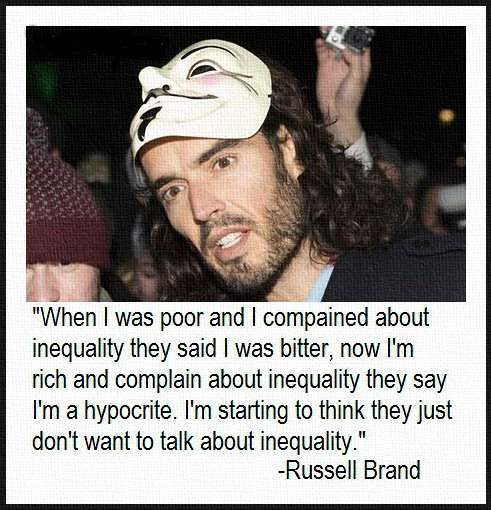
I recently shared this meme on my FB wall:

when_i_was_poor_and_i_complained_about_inequality_they_said_i_was_bitter_2014-07-23

This is what happened next:
No two people are the same.“”That’s why I prefer equal opportunities instead of equality.
No two opportunities are the same. What you might consider an opportunity I might pass up. It’s a very diverse world we live in, a wide one in which hopefully everyone can be accommodated.

‘Can be’ or ‘will be’?

And who is the real looser here?

Let’s see what the broad picture looks like:

The world’s super-rich have taken advantage of lax tax rules to siphon off at least $21 trillion, and possibly as much as $32tn, from their home countries and hide it abroad – a sum larger than the entire American economy.”

Meanwhile

education debt

And what’s wrong with that?!?
Everyone has the right to do what ever he wants with his money and why should anyone expect to be educated for free?!?

OK, let me put it differently.

Every society is like a big community, even if its members do not share an intimate knowledge of each-other.
At least theoretically an overwhelming majority of any nation share the same set of values and the same goal – the long term survival of both the population and the afore mentioned set of values.

Now please consider which society would be better at the game of survival:

One which would make it easier for as many of its members to develop as much of their individual potential as possible or one that would make it easier for a small number of its members to spirit away so much wealth that the rest would remain crippled?

One which would use the very concept of a ‘free market’ as broadly as possible – make sure that as many as possible of its members enjoy the widest possible autonomy – or one that would allow the ‘never as free as advertised’ market to degenerate into the ‘winner takes it all‘ situation we are bound to reach if we continue on our present course?

How could enough people afford to ‘wander around’ for long enough to find the opportunities that would fit them if they are saddled at birth with a huge burden – the ever burgeoning national debt?
Would enough people risk to take on any additional debt (in order to prepare themselves to make better use of the opportunities they might find) if too many of those opportunities, even if met diligently, do not pay enough to ‘eat’ AND pay back the debt?

How is a society going to survive, let alone thrive, if a lot of ‘opportunities’ (social needs) end up being ‘plugged’ by unfitting/under-skilled/’less than enthusiastic’ individuals? Or not at all?

On the ‘supply side’, what do you think of those who choose to dodge paying taxes?
On the ‘demand side’, what do you think of those who squander public money as if there is no tomorrow?

So what should we be talking about? Equality or Equal Breadth of Opportunity?
About the Bed of Procrustes or about a ‘Free Market’ where all participants are simultaneously autonomous and fully aware of their responsibility for their children’s future?

not2bdemocracy

Enter a caption

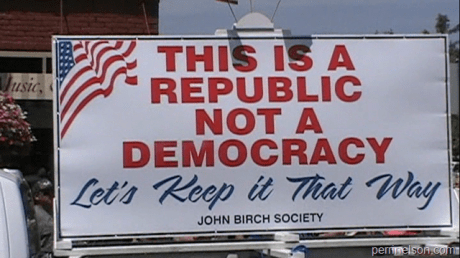
Our nation did not become great because our form of government was created as a socialist, communist, or any form of democracy; it was specifically created as a constitutional republic.

I’ve been trying for some time now to figure out the origin of this huge confusion.

Yesterday, during an exchange on this subject, a FB friend of mine used this link to prove her argument:

An Important Distinction: Democracy versus Republic


And there it was, laying in plain sight, THE explanation I was too blind to find it by myself.

It is important to keep in mind the difference between a Democracy and a Republic, as dissimilar forms of government.

Come again?!?

Since when democracy has become a “form” of government?
If you want to discuss about forms of government you have basically two: republican and monarchic. In a republic the head of state is changed from time to time, sometimes in a more or less democratic manner, while in a monarchy it is customary for that head of state to be replaced only after his death and by a person which has already been known for quite a while.

That was not what you had in mind? You meant what kind of interaction exists between the governed and the government?
‘Cause only in this realm we may speak about the difference between democracy – where the population has a say about its fate – and dictatorship – where the rulers don’t give a damn about the wishes of those who allow themselves to be ruled from above.

Don’t believe me?
Then please consider the British Empire. It is headed – nominally – by a monarch who has had no power for the last two hundred years or so and has NO – absolutely NO – constitution. Yet its democratic traditions can be traced down to the Magna Carta – a ‘compact’ signed in 1215 between the King (John of England) and his ‘free subjects’.

I used ‘ ‘ around ‘free subjects’ to highlight the fact that this is an oxymoron AND that the basic function of Magna Carta was to solve that oxymoron.
It actually doesn’t matter much what was written in that compact. The very fact that the King – erstwhile considered an almost divine person who until then had absolute power over his subjects and the land under his control – sat down at the same table with some of his erstwhile subjects and by his own signature conceded that they were “free” (‘all free men have a right to justice and a fair trial‘) signifies the dawn of a new kind of interaction between those at the no longer opposed ends of the society.

OK, things didn’t evolve smoothly. The Magna Carta wasn’t enforced in earnest until a lot later but still, the bird was out of the cage.

My point being that until we understand that the difference between ‘republic’ and ‘democracy’ is the same as the one between apples and oranges – and that we should stop comparing them – we are stuck.

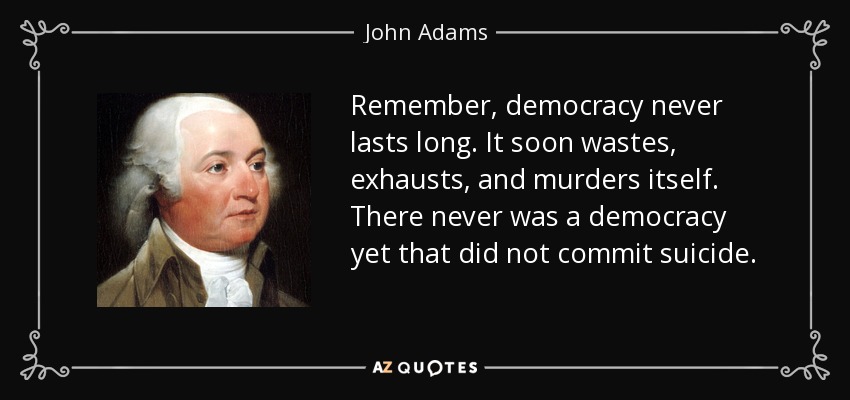
So, am I somewhat implying that John Adams was wrong?

quote-remember-democracy-never-lasts-long-it-soon-wastes-exhausts-and-murders-itself-there-john-adams-0-19-42

Not at all. All I’m saying is that he used a poetic license and that the quote is not only incomplete but also used in a misleading way.

“I do not say that democracy has been more pernicious on the whole, and in the long run, than monarchy or aristocracy. Democracy has never been and never can be so durable as aristocracy or monarchy; but while it lasts, it is more bloody than either. … Remember, democracy never lasts long. It soon wastes, exhausts, and murders itself. There never was a democracy yet that did not commit suicide. It is in vain to say that democracy is less vain, less proud, less selfish, less ambitious, or less avaricious than aristocracy or monarchy. It is not true, in fact, and nowhere appears in history. Those passions are the same in all men, under all forms of simple government, and when unchecked, produce the same effects of fraud, violence, and cruelty. When clear prospects are opened before vanity, pride, avarice, or ambition, for their easy gratification, it is hard for the most considerate philosophers and the most conscientious moralists to resist the temptation. Individuals have conquered themselves. Nations and large bodies of men, never.”

OK, he made the same confusion between ‘forms’ of government and social relationships between the people and those in power, only this is an understandable mistake. But, to his merit, he made it amply clear that it is the very “passions” of the people that “when unchecked, produce the same effects of fraud, violence, and cruelty”!

This is precisely the job that every constitution – not only the republican ones – is called to fulfill. Or a powerful enough tradition – please remember that the British ‘Empire’ has no constitution to this day.

Coming back to the notion of democracy I must add that it might not work properly, no matter how well written the constitution that presides over the process, unless the people who uses this form of collective decision making entertains the proper mental and moral attitude.
If the entire society isn’t permeated by enough mutual respect among its members then what Adams had warned us against is about to happen – regardless of any constitution. Or even under the cloak of the existing one.

You see, proper democracy works because it creates a frame where all those interested in the matter – all stake-holders – have the opportunity to express their grievances. This way the society is able to find out what doesn’t work properly and to take the appropriate measures.
But if there is not enough mutual respect going on around, things may become ugly, eventually. Just as Adams told us. When mutual respect weans out we stop caring about anything else but our own personae and ‘passions’ are no longer ‘checked’.
Society no longer acts like an organism and people become divided into smaller ‘mobs’ whose leaders fight each-other – sometimes under a democratic disguise – for followers.

That’s when democracy ceases to be a venue for a civilized debate about ideas and become an arena for the bloodiest sport of them all. Politician-ism.

That’s when some people start thinking like this.
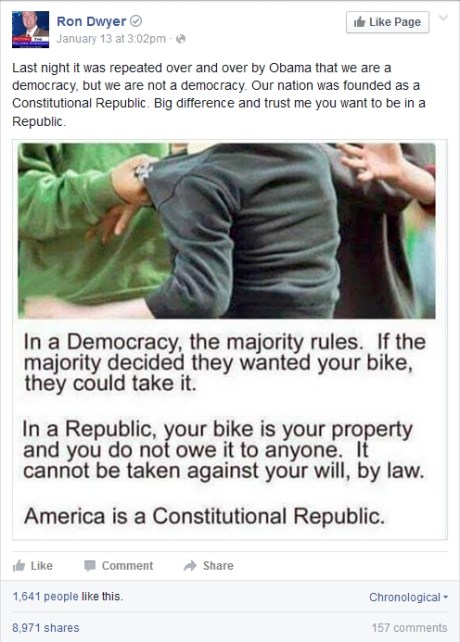
democracy, bikes

Or even like this:
jbs_3

Let me tell you something.
I’ve been living under a republican regime for all my life. Only for the first 30 years that republic was a communist one. It even had a constitution – and at the first glance it wasn’t such a bad one. But believe me, you don’t want to experience that kind of republic.

What you really want is true democracy, the one where people respect each-other. It doesn’t matter if that happens in a republic or in a kingdom. It is enough that it works, and for that to happen it is enough for the people to ‘check their passions’.

And mind you!  Whenever 51% of the voters band together to confiscate the bikes that the others have acquired through honest means, that’s no longer democracy but mob rule. Something that could very easily degenerate into communism. That’s what you want to avoid, not bona fide democracy.

050c31042a04e93467298c7458c219af4cbcc6-wm

For some time now I’ve been wondering how come so many people who define themselves as being Christians – “Again I tell you, it is easier for a camel to go through the eye of a needle than for a rich person to enter the kingdom of God.“, Matt 19:24 – are so passionately defending the very concept of (private)”property”.

Could it be that Marx was right after all: “Private property is the result of alienated labor.” ?!? And so many of us have been wrong for so long?

“The right to private property is the social-political principle that adult human beings may not be prohibited or prevented by anyone from acquiring, holding and trading (with willing parties) valued items not already owned by others. Such a right is, thus, unalienable and, if in fact justified, is supposed to enjoy respect and legal protection in a just human community.”

Trying to understand the source of this dichotomy I adopted a two pronged strategy. First I looked up the word itself and then I tried to deepen my understanding of the entire concept.

It’s absolutely obvious that ‘property’ comes from ‘proper’.
‘Proper’, in its turn, has two basic meanings: ‘fit for use‘ and ‘pertaining to one individual‘. The first one has evolved into ‘propriety’, “the state or quality of being correct and proper” while the second has become ‘property’, “thing owned“.

So, do all these etymological arguments make it any easier for us to accept that respecting each others’ right to private property is what introduced a certain degree of functionality in the human society?

‘But aren’t you contradicting yourself?
At the beginning of your post you suggested that ‘property’ might not be as good as advertised and now you say that the ‘right to private property’ is ‘good for you’?
Will you make up your mind, for Christ’s sake?’

Now, that I’ve reached the conceptual stage of my analyses, I must bring to your attention the fact that a right is nothing but an opportunity while each (piece of) property is a thing – even those  which are not of a ‘substantial’ nature. ‘Intellectual property’, for instance, is a ‘measurable thing’ even if you cannot put your finger on it while the ‘right to intellectual (or any other kind of) property’ is (an infinite) something which patiently waits for (a rightful) somebody to make (proper) use of it.

Maybe this is what Christ tried to tell us in the first place. That it’s not property itself that stands between us and our salvation but our (improper) attitude towards it. That it’s not the object of our property that is the problem but how we make use of our right to private property.
After all Christ told the “young rich man” “If you would be perfect, go, sell what you possess and give to the poor, and you will have treasure in heaven; and come, follow me.” (Matt 19:21). ‘Go sell, give and THEN follow me’, not ‘come help me ABOLISH the very right to private property’, as Marx used to preach to his followers.

To understand the difference between what Christ and Marx said about this subject let’s see how these two relate to the notion of ‘Man’.

In Christ’s book God took a lump of dirt and ‘made Man in His own image’ while in Marx’s narrow materialistic vision “it is not the consciousness of men that determines their existence, but, on the contrary, their social existence that determines their consciousness.”

Basically both of them start with the same ‘materiel’ – the mundane ‘star dust’ that Mendeleev distributed throughout his table – but what a difference at the end of the ‘assembly line’!

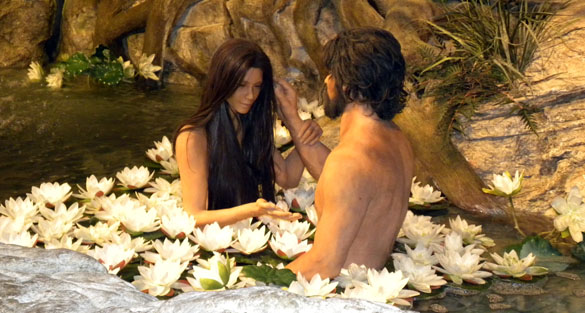
adamevebefore

Being made ‘in His Own image’ not only means that all Men (and Women) are created equal but also that each of them shares in His Divine Nature. Hence the origin of our free will, of our ability (‘right’, opportunity) to be saved. Compare this to how Marx described the human society:

“The Communists, therefore, are on the one hand, practically, the most advanced and resolute section of the working-class parties of every country, that section which pushes forward all others; on the other hand, theoretically, they have over the great mass of the proletariat the advantage of clearly understanding the line of march, the conditions, and the ultimate general results of the proletarian movement.

The immediate aim of the Communists is the same as that of all other proletarian parties: formation of the proletariat into a class, overthrow of the bourgeois supremacy, conquest of political power by the proletariat.

The theoretical conclusions of the Communists are in no way based on ideas or principles that have been invented, or discovered, by this or that would-be universal reformer.

They merely express, in general terms, actual relations springing from an existing class struggle, from a historical movement going on under our very eyes. The abolition of existing property relations is not at all a distinctive feature of communism.”

articlefiles-mv003370610000-96750_bd

As somebody who has lived for 30 years under communist rule let me translate this from ‘Newspeak‘ into plain English:
‘History suggests that those who figure out the inner workings of this world  have, from time to time, the opportunity to take over the show. Now is one of those moments. The ‘fat cats’ have been so greedy lately that the regular people are growling under the very heavy yoke that has been placed on their shoulders.  That’s why we have the opportunity to unsettle the ‘old’ from their positions and to plant our fat asses in their comfortable chairs.
And the first thing we must do in order to achieve that goal is to abolish the right to private property. People are so fed up with what was going on lately that they’ll go along. They have grown to hate so much the ‘greedy plutocrats’ that most of them won’t notice that in the (revolutionary) process they’ll lose the very last shrouds of personal autonomy they still have. Without the right to dispose of the results of their own labor they’ll be at our mercy’.

Who was right between the two?

Well… Both, unfortunately.

The communists did run the show, at least for a while. And we all know to which results.
On the other hand it seems that in the longer run miss-using the right to private property is indeed a powerful drawback. The already too long sequence of economic crises caused, ultimately, by nothing else but our own greed has indeed given birth to a generalized state of psychological malaise.

I don’t know about what’s gonna happen in the next world – or if it exists at all – but I’m sure that if we don’t learn, fast, how to use, properly, the right to private property things will become too hot for our own good in this one.

The only one we are sure about.

Further reading.
During my research for this post I found this very interesting take on the same subject:

“Zwolinksi argues that libertarians are right to support private property, but also that private property is more complicated than we sometimes think.”

lashes1-copy-300x210
If we want to understand what’s going on there we have realize that we are dealing with a absolute dictatorship which uses Islam as a crutch, exactly as the soviet style dictators in the so called ‘popular democracies’ were using ‘scientific materialism’ – their term for the communist doctrine.
The job of the Saudi ‘justices’ is to maintain ‘the order’ as they see fit – the kingdom as it is and the Saudi family in power, not at all to dispense justice as we know it.
In order to do that they use, ‘creativelly’, the most powerfull tool they have at their disposal: the faith shared by the majority of the inhabitants of the kindom.
It even doesn’t matter for them that in the process they are ruining any chance of a decent life for the majority of their conationals.
At first their only goal was to retain the graces of the ruling family – just as minions everywhere behave in the presence of a powerfull figure.
In time things have evolved in a malignant manner. I’m afraid that nowadays the House of Saud itself has become the prisoner of the erstwhile minions, just as every dictator eventually becomes the prisoner of his guards.

coruptia ucide

Every 25 years or so Romania startles the rest of the world.

In 1989 we had to pass through the bloodiest Revolution in the Eastern Block in order to get rid of the most unreasonable communist dictator in Europe, bar Stalin of course.
In 2015 we had to be awaken by a disastrous fire in a night club to oust a prime minister who is currently under investigation for alleged corruption.

What’s going on here?

Some history first.

For the last 2000 years the Carpathian mountains have been the first obstacle that had to be negotiated by the migratory peoples that came to Europe from the depth of Asia.
Since for the first 1000 years on the plains where now lie Northern Poland and Northern Germany there was nothing to be plundered while the Northern shores of the Sea of Marmara were harboring a very rich city – Byzantium – most of those tribes transformed the area between the Carpathians and the Black Sea into a sort of highway. That’s why whatever forms of political structures the local population – the proto-Romanians – were trying to set had very short lives. They usually were fleeting fiefdoms run by chieftains from the migratory tribes whose authority survived only till the next, and more powerful, tribe arrived in the region.
After the huge Russian plains have been somewhat stabilized by the establishment of the Crimean Khanate the situation became even more complicated. The area was a battle ground for Bulgarians, Turks, Tartars, Hungarians and later Austrians and Russians. Besides the constant political instability this situation included the fact that very seldom the people who were in charge with running the place had a strong connection with the people they were leading. If any at all.
This had very insidious consequences, the most important being a huge distrust of authority. The present days libertarians would argue that this is a good thing… Well, think again.

If the people do not, not at all that is, trust those who happen to be in power and those in power do not care at all about those under their patronage you have the ‘perfect’ set of circumstances for the onset of an all pervasive corruption.

During the last five centuries the Western Europe has slowly evolved from Feudalism – the rule of he who happened to be powerful enough, tamed by some traditions inspired by religion, to what is now known as ‘The Rule of Law’. Meanwhile, in the European provinces occupied by the Ottoman Empire people lived in an almost schizophrenic manner. They passionately hated their rulers – and did their best to cheat them when ever they could, while developing a very strong respect for traditions, the only thing that kept the people together.
By the way, this is also the explanation for what has happened in the former Yugoslavia, where strong ethnic and religious allegiances were played upon by callous political adventurers.

This constant distrust/disdain between the rulers/administration and the general public has only deepened during the Soviet imposed communist rule and produced a real chasm between these two social strata. And it’s exactly this divide that is the reason for which all dictatorial regimes fail abysmally, sooner or later.
A convincing explanation for this was provided, long ago, by Pareto: ‘whenever the circulation of the elites (social mobility) is hindered, the society where this is happening is in great danger’.
Another way of explaining the unfailing demise of any dictatorship is corruption. When ever the rulers do not care about anything else but their very short term interests and the ruled do their best to cheat the system the corruption becomes so pervasive as to clog the entire social mechanism.

If left to itself this cancer can lead to implosion. The Roman Empire, for instance, didn’t fell because it was mortally wounded by the barbarous migrant tribes. It had became so weak because of wide spread corruption as to allow the barbarians to provide him with the fatal blow… Just consider what Caligula used to do for fun… The Soviet Empire did almost the same thing.
Now that I’ve reached this point I’ll have to remind you that corruption does not always have to be about money but covers all instances when people misuse, intentionally, their power.

You see, people make mistakes.
There is no way of avoiding this.
And the main difference between a corrupt society and one which is more or less ‘normal’ is that in a normal society he who notices a mistake has at his disposal enough means to report that mistake to the relevant authorities while having a decent chance to survive the attempts of the ‘perpetrator’ to ‘cover his tracks’.

The fire that started the current uprising in Romania was nothing but the final straw that broke the camel’s back. People have witnessed, individually, so many instances of corruption that had become fed up with it. But each of them wasn’t quite sure about what the guy next door was going to say/do about it. Meanwhile the authorities were more a part of the problem than providing a solution.

When this tragedy struck a lot of people have finally understood that this has to stop. And took their grief to the street.

Basically, “anarchy” is about everybody for himself. And damn everybody else – even though most forget about this part.

While “secession” is mostly about someone trying to carve a ‘piece of the action’ for himself – and some people (naively?) following him. Maybe hoping that the new ruler would prove to be better than the old one?

Here in the West we have a ‘healthy’ mistrust in almost everything, including the press.

Yes, some of the media outlets have indeed became manipulative or basically empty of meaning.
We shouldn’t forget though that we, the public, have contributed to this situation. We are the ones who buy/follow this kind of media. And, above all, we allowed them to condition us into following ‘our’ media outlets. When was the last time any of you watched a show or read an article coming from a media outlet which doesn’t belong to ‘your political affiliation’?

Meanwhile out there some brave journalists operate in less than ideal conditions:


Hürriyet’s editor-in-chief Sedat Ergin

“You raided our home at midnight with stones and sticks. You stayed there for hours. You chanted, “You dog Doğan, do not test our patience.” You chanted “Re-cep Tayyip Er-do-ğan” slogans and “God is great.”
There are some people who push a button. There are groups who are ready to act when the button is pushed. How did this happen? Let’s track it step by step.”

To me this just another proof that what is going on in the world right now has very little to do with ‘religion’ per se and almost everything to do with the individuals who manipulate our religious sentiments for their own benefits.

And we let them get away with it. Includingly by pretending that the media is not to be trusted and then believing, indiscriminately, everything that comes out of ‘our’ media outlet (loudspeaker).

Could it be that the raiders were pissed off not only by Hurriyet’s constant criticism towards Erdogan but also by this article?

Why do we bash the West but not Saudi Arabia?

I thought the modern mantra was ‘make as much money as you can, in a legal way – if possible’….
Meanwhile the likes of Trump are lionized for their exploits yet those who are happy to nibble some crumbs from Uncle Sam’s table are treated with scorn!
Is there any real difference between Trump using eminent domain to rob people of their homes and the guys depicted above scamming the federal budget?

You may also want to check what Snopes.com has to say about the matter.