Archives for category: collective identity

Unfortunately, sometimes essential meaning is lost not only ‘in translation’ but also during ‘interpretation’.

While reading an excellent article about Zineb el Rhazoui, a Charlie Hebdo survivor, I encountered the notion that “Islamophobia is not an opinion: it is an offense.

Come again?!?

Is it possible that anybody might be offended by someone who’s being afraid? Regardless of that fear being reasonable or not?

Since that notion was said to have been promoted by Collective against Islamophia in France I checked their site, hoping to understand what they mean by that.

“For the CCIF, Islamophobia has a clear definition:
It consists of all acts of rejection, discrimination or violence against institutions or individuals on the basis of their real or perceived belonging to the Muslim faith.”
OK, so they are not offended as much by the fear itself but by the heinous actions some people take against people belonging to the Muslim faith, on the basis of the real or faked fears felt by the perpetrators.
But this is far from being OK.
What these guys are doing is confounding people’s minds.
They keep preaching that ‘Islamophobia is bad’ to people who are very naturally afraid of the actions perpetrated by some wackos who pretend to be Muslim.
This doesn’t make any sense.
It’s like saying that people living in a seismic area should not be afraid of earthquakes. And instead of building their houses in a certain manner they should go to the shrink and treat their unreasonable fears.
If some people who pretend to be Muslim behave in a totally unacceptable manner it is not reasonable to expect that all Muslim will behave in the same way but after so many bad things that have been committed by people pretending to belong to the Muslim faith it would be unreasonable not to try to understand what is going on.
On the other hand those who strongly disagree with the CCIF, Zineb el Rhazoui among others, make the mistake of deepening the confusion instead of calling the bluff for what it is:
“This is very dangerous because it has even entered the dictionary as hostility towards Islam and Muslims. Yet criticism of an idea, of Islam or of a religion cannot be characterized as an offense or a crime. I was born and lived under the Islam of Morocco and live in France and I have the right criticize religion and this dictatorship of Islamophobia that says I have no right to criticize! If we criticize Christianity it doesn’t mean we are Christianophobes or racist towards the ‘Christian race.’”
In real life criticism is one thing while violence – verbal violence, even – and rejection are completely different things.
Confounding these two categories is feeding the very monster who is menacing all of us – militant intollerance.
The article about el Rhazoui also mentions her latest book: “Destroy Islamic Fascism“.
I don’t agree with all the ideas excerpted there but there’s one which should grab the attention of all Muslims who describe themselves as being moderate:
“As for mainstream or moderate Muslim clerics, El Rhazoui tells Women in the World that during the Burkini debate in France not one Imam stood up and said “Hey, wait a minute, you can be Muslim and wear a [regular] bathing suit.””
She also says that ““The Muslim religion has its place in the modern world if it submits itself fully to the laws that rule humanity today: universal principles of equality between men and women, sexual and individual freedom, and equality for all, no matter your creed or religion. Until Islam has admitted this and accepted that the freedom of men and women is superior to it, Islam will not be acceptable.””
I’m afraid there’s a small problem with this.
A religion exists only as long as it has followers and inasmuch as those who belong to it choose to make of it.
It is not ‘Islam’ that has to ‘admit’ anything but the Muslim people themselves.
In this sense it is counterproductive for us, the free thinkers of the world, to peruse the Quran in search of violent episodes and then use them to demonstrate that ‘Islam is not a religion of peace’.
What we need to do, if we want to destroy the Fascism which happens to be of Islamic nature, is to win more and more Muslims to our side.
Making fun of their main Book and of their Prophet won’t achieve that. On the contrary.
On the other hand, giving in to even the most unreasonable things in the name of ‘tolerance’ isn’t helping either.
The Federal Court of Canada ruled in February 2015 that the policy requirement for women to remove their niqabs during their oath swearing at Citizenship Ceremonies is unlawful, as it interferes with a citizenship judge’s duty to allow candidates for citizenship the greatest possible freedom in the religious solemnization or the solemn affirmation of the oath. The Minister of Citizenship and Immigration filed a notice of appeal to challenge this decision at the Federal Court of Appeal and the lower court’s decision is not in effect until the appeal has been decided by the Court.  As a result, women who wish to swear a citizenship oath may not do so with their faces covered.
What kind of oath is that which is pledged by a faceless person?
How strong is that person’s adherence to our value regarding ‘openness and transparency’ and how willing is that person – or her husband/father/mother/sibling who makes her wear a niqab, presumably against her will – to respect and promote our notion of gender equality?
PS I
And how about replacing ‘Islamophobia’ with ‘anti-islamism’?
PS II
Why is it that the spelling checker suggested me that I should write ‘anti-Islamism’ while ‘antisemitism’ is not usually written using a capital s?

A sizeable number of Americans, Republicans even, have understood that Bush 43 wasn’t such a great President. When leaving office he had the lowest approval rate “of any president in modern times”.

Yet he is a man who knows to atone for his mistakes.
He knew how to apologize after blurting, ‘under influence’, “how is sex after 50?” to his female neighbor when seated at his parents dinner table in Maine and he effectively extracted himself from politics at the end of his not so glorious mandate, even though he had started it “believing he was God’s agent here on Earth to rid the world of evil.”
By the end of it, Bush “had become much more aware of the limitations of the office and his own shortcomings” and had started to take actions “contrary to his deepest beliefs“.

Actually Bush’s excesses constitute, in part, the explanation for the huge number of people who showed up to ‘landslide’ Obama into the Oval Office.

Then why are so many Americans still endorsing Trump?
After failing to offer a plausible apology for the ‘locker room banter’ that had surfaced recently.
For implying that a woman was  ‘not attractive enough’ for him to ‘grab her by the pussy‘.
After accusing the press for “rigging the system” against him when all they did was to publish his own words…

The media could indeed do a better job at covering the entire spectrum – a lot of interesting things about Clinton are hardly mentioned while Gary Johnson is all but absent – only this doesn’t explain the insistence with which some of the Republicans keep obsessing about Trump.

Even after some of their own party bosses have started to ‘see the light‘.

Their hoping that  ‘he will defend the Supreme Court’ resides on assuming that ‘The Donald’ would act, if elected, as a bona-fide Republican.
What in Trump’s behavior ever made them believe such a thing?

Do they really want to relieve the Bush experience, only at a different – a lot lower, that is – level?

Specially after more of his antics have came to light…

I couldn’t find any current data so I’ll have to make do with what the Atlantic had published a month ago.

trumps-base

So, a little over 12% of his votes come from college, or higher, educated women while the total is no less than 48%.

Now, would you care to guess which of these women will continue to disregard his being ‘automatically attracted to beautiful’ and keep rooting for him?

Would you even consider Hillary Clinton as a likely candidate?

“Even though she found the job distasteful, Rodham mounted what she felt was her strongest possible defense of Taylor. As Newsday reporter Thrush wrote in 2008, “Her approach, then and now, was to immerse herself in even unpleasant tasks with a will to win.””

At that time Clinton had been ordered by a judge to defend a rapist – which all practicing lawyers can expect to be asked to do.
“Once she no longer had a choice in the matter, Clinton said in a 2014 interview that she had a professional obligation to give Taylor the strongest possible defense.

“I had a professional duty to represent my client to the best of my ability, which I did,” she said.

Gibson (the prosecutor who tried the case)  recalled that the young lawyer worked overtime on the case in hopes of impressing the court, which might them help establish the reputation of her new legal aid clinc.”

Further more:
“Despite her discomfort with the case, Clinton aggressively defended her client. In an affidavit to the court, she said a child psychologist had told her that children “from disorganized families,” such as the victim, “tend to exaggerate or romanticize sexual experiences.” “

In this sense is it possible that even a college educated woman, like Hillary Rodham Clinton, might vote for somebody like Trump, simply because she might consider other things to be more important than his bragging about ‘grabbing beautiful women, who allow him to do it because he is a “star”, by their pussies’?

OK, you’ll tell me that in the voting booth each of us should behave in a ‘personal’ rather than a ‘professional’ manner.

I’ll up the ante and ask you what kind of person is able to efface his/her personal self so efficiently, simply in order to ‘help establish his/her professional reputation’?

Or accept a gleeful ‘pussy grabber’ as the most powerful person on Earth?

From time to time certain ideologies spread far enough to produce noticeable results.

Trump: ….You know, I’m automatically attracted to beautiful — I just start kissing them. It’s like a magnet. Just kiss. I don’t even wait. And when you’re a star, they let you do it. You can do anything.

Bush: Whatever you want.

Trump: Grab ’em by the pussy. You can do anything.”

After the recordings had been ‘miraculously’ unearthed the ‘divide’ has moved considerably.

Republicans Desert Trump in Droves” but he still enjoys a lot of support:

“Donald Trump can easily convince most objective observers of both parties that what he has said and done in relation to women on a personal level is not as objectionable as what Bill and Hillary Clinton have said and done in relation to women on a personal level.

Although it is true that Trump is not running against Bill but against Hillary, what Bill said and did as president is relevant since Trump is running for the office once occupied by Bill, who set the bar for presidential relationships with women lower than any other president (with possible competition from Franklin D. Roosevelt and John F. Kennedy before the advent of the Internet).”

“Keeping in mind that the Democratic Party has imposed Hillary on the electorate as its choice for the highest office in the land, we must also take note of how Hillary and Donald dealt with their spouse’s respective but disrespectful dalliances. When Trump found out about the alleged infidelity of his second wife, he didn’t maintain the relationship for ulterior motives,  but divorced her. When Hillary found out about the dalliances of her husband, she not only:


Historical facts do suggest that a certain number of ‘powerful figures’ did have an excess of testosterone which manifested itself in a less than an ‘elegant’ manner.

From Julius Caesar (who, according to Suetonius, was described by Curio as “Every woman’s husband and every man’s wife”) to Bill Clinton we have a huge list of ‘powerful’ public figures who couldn’t ‘keep it’ in their pants.

And not all of them have been involved in politics.
Jimmy Saville, Bing Cosby and Jeffrey Epstein are just a few names that came to my mind.

Only there is a small but fundamental difference between all these and “The Donald”.

Their ‘indiscretions’ were perpetrated more or less secretively and no more than a finite number of people – women or men – were abused by each of them.

Meanwhile Trump not only has no qualms when bragging about his habits in an almost public manner – the tape was recorded in the context of a TV show – but he would also extend his ‘greetings’ (“grab ‘hem by the pussy”) to all “beautiful” women that would happen to come close to him!

He actually acts as a standard bearer for what is currently known as “rape culture“!
Effectively offering ‘theoretical background’ for future ‘transgressions’.

In this respect there is no real difference between those who maintain that Trump’s words are not so bad as Bill Clinton’s actions – simply because they want to keep Hillary Clinton from returning to the White House – and Hillary Clinton herself – who supported her husband in order to remain there.

evangelicals-support-trump

And this is the second connection between Trump’s words and extremist positions.

“All women since Eve, the world’s first sinner, were born in sin and sinners by birth became more or less sinners by practice.” (Luke 7:36-50) but also “Somalia is in the grip of famine and chaos but officials there are inspecting bras

You see, the first rule of extremism is to ‘herd’ people together according to one obvious characteristic and settle their fate according to that characteristic – without paying any attention to the individual circumstances of any of those involved.

Hence all Muslims must be vetted, all immigrants must be deported, all beautiful women ‘grabbed by their pussies’…

Small wonder that we are now living in a world where ‘gang rape’ has become such a common occurrence…

rs_560x373-150317085235-1024-dolce-gabbana-gang-bang

“Finally, let me say that religious extremism is the other face of political despotism. We cannot get rid of the extremism before we end the despotism.

Democracy is the solution.”   (Alaa Al Aswany, When women are sinners in the eyes of extremists, The Independent, 2009)

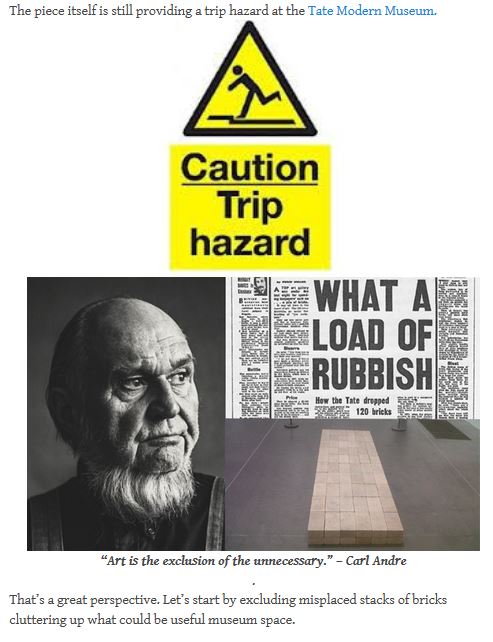
Some 50 years ago Carl Andre displayed 6 stacks of bricks on the floor of the Tibor de Nagy art gallery in New York.

None of them was sold so the artist “returned all but 200 of the bricks to the brickyard to get his money back”.

They were remade in 1969, from a different kind of bricks – the factory had closed in the meantime, and one of them was bought, in 1976, by London’s Tate Gallery for $12.000 – the equivalent of $50.000 in today’s money.

Equivalent VIII 1966 by Carl Andre born 1935

Not without creating a lot of controversy.

what-a-lot-of-rubbish


Which ‘tripped’ me into writing the present comment.

I’m not going to discuss Andre’s art or philosophy. It’s so obvious that you can actually trip on it.

What’s bewildering me is the intensity with which some people contest the things they don’t even understand.
OK, each of us have the right to express ourselves. To criticize everything.

But why do it so aggressively?

What if we are the ones who don’t have a clue?

Who ‘are as thick as a brick‘, instead of as “Thick as a Brick” as we consider ourselves?

Could it be that it’s our own unwillingness to see which has allowed the ‘(thick as) thieves’ to bring the ‘Conspiracy of Fools‘ upon our heads?

“The purpose of Halacha is to disturb. To disturb a world that cannot wake up from its slumber because it thinks that it is right.”
Rabbi Dr. Nathan Lopes Cardozo

What is currently known as the ‘North Atlantic Civilization’ is a construction whose blue prints have been initiated in the Middle East, on the Banks of Jordan.

The Jews, those who had started the process and one of the very few peoples/cultures who have survived since that era, have reached a very interesting stage in their development.
Rabbi Dr. Nathan Lopes Cardozo discusses, in a series of articles, some very important ‘contemporary issues’.
For those of you who are unfamiliar with the context:
“The word “halakhah” is usually translated as “Jewish Law,” although a more literal (and more appropriate) translation might be “the path that one walks.” The word is derived from the Hebrew root Hei-Lamed-Kaf, meaning to go, to walk or to travel.”
Yigal Amir had killed Yitzhak Rabin in an attempt to halt the Oslo Peace process and
Baruch Goldstein had killed 29 and wounded 125 in “the Muslim prayer hall at the Tomb of the Patriarchs in Hebron.

When reading Dr. Cardozo’s considerations please engage yourself in a mental experiment. Try to identify at least one aspect of those mentioned here that doesn’t fit the rest of the North Atlantic cultural space.
I encourage you to use the links and read Dr. Cardozo’s articles in full. I have selected some of his words trying to suggest something, there is a lot more to be learned there.

“One of the greatest tragedies of Judaism in modern times is that certain halachic authorities, as well as people like Yigal Amir and Baruch Goldstein, forgot to study the first book of the Torah. They have become so dedicated to the letter of the law that they have done the inconceivable and have caused the degradation of Halacha.”

http://www.cardozoacademy.org/thoughts-to-ponder/the-desecration-of-halacha/

“It is for this reason that Halacha has always developed on the basis of case law, and not because of overall well-worked-out ideologies. It is sui generis. Much depends on circumstances, the kind of person we are dealing with, local customs, human feelings, and sometimes trivialities. God, as Abraham Joshua Heschel explains, is concerned with everydayness. It is the common deed—with all of its often trivial and contradictory dimensions— that claims His attention. People do not come before God as actors in a play that has been planned down to the minutest detail. If they did, they would be robots and life would be a farce.”

http://www.cardozoacademy.org/thoughts-to-ponder/chaos-theory-halacha-part-1-3/

“Not only do we see a considerable amount of chaotic halachic literature, published by numerous authorities, which seems to lack consistency and order, but we may even find contradictions in the various writings of one halachist. This doesn’t mean that the writer lacks a particular line of thought and some basic principles; it just means that within these norms almost everything is an open market.

I believe this is the reason why the Conservative movement, with all its good intentions and great scholarship, was unable to grasp the imagination of many halachic authorities. It is not the lack of knowledge, but rather the over-systematization that is responsible for this. Once there is too much of a unified weltanschauung and agenda, Halacha loses its vitality. The multitude of attitudes, worldviews, chaotic thinking and sometime wild ideas, through which the greatest halachic authorities freely expressed their opinions, is what kept the Orthodox halachic world alive. In some sense, and even almost paradoxically, Orthodox Halacha is less fundamentalist than Halacha in other movements within Judaism.

None of this should surprise anyone. When looking into the Talmud, which is the very source of Halacha, we find a range of opinions so wide, and often radical, that it is almost impossible to find any sense of order. There’s a reason why the Talmud is compared to a sea in which storms create unpredictable waves and turbulence. The revealed beauty of this natural phenomenon is what attracts people to gaze at the sea for hours on end. It reflects their inner world, which thrives only in the presence of tension, paradox and chaos.”

http://www.cardozoacademy.org/thoughts-to-ponder/chaos-theory-halacha-part-2-3/

“In my opinion, Halacha is in need of more “chaos.” It must allow for many ways to live a halachic life unbound by too many restrictions of conformity and codification. It must make room for autonomy on the part of individuals, to choose their own way once they have undertaken to observe the foundations of Halacha. Acceptance of minority opinions will have to become a real option, and some rabbinical laws must be relaxed so that a more living Judaism will emerge. While some people need more structure than others, in this day and age we must create halachic options that the codes such as the Mishneh Torah of Maimonides and the Shulchan Aruch of Rabbi Yosef Karo do not provide.

Surely those who prefer to live by the strict rules of the codes should continue to do so. For some, these rules are actually a necessity – even a religious obligation – since this may be the only way they can experience God. But they should never become an obstacle to those who are unable to adhere to them. Labeling these new approaches “non-Orthodox,” or “heresy,” is entirely missing the point.

I wish to be clear: I am not advocating Reform or Conservative Judaism which, as I stated earlier, have paradoxically become overly structured and agenda-driven. They lack sufficient “chaos” to make them vigorous.

While there is great beauty in attending synagogue three times a day to pray, we clearly see that much of it has become mechanic – going through the motions, but no religious experience. Yes, it’s better than not being involved in any prayer at all, but the price we pay is increasing by leaps and bounds. It is pushing many away. Codification is the best way to strangle Judaism. By now, Orthodox Judaism has been over-codified and is on its way to becoming more and more irrelevant.

I believe that one of Halacha’s main functions is to protest against a world that is becoming ever more complacent, self-indulgent, insensitive, and egocentric. Many people are unhappy and apathetic. They no longer live a really inspiring life, even though they are surrounded by luxuries, which no one would have even dreamed of only one generation ago.

The purpose of Halacha is to disturb. To disturb a world that cannot wake up from its slumber because it thinks that it is right. The great tragedy is that the halachic community itself has been overcome by exactly those obstacles against which the Halacha has protested and for which it was created. Halachic living has become the victim of Halacha. The religious community has succumbed to the daily grind of halachic living while being disconnected from the spirit of Halacha, which often clashes with halachic conformity for the sake of conformity. Many religious people convince themselves that they are religious because they are “frum.” They are conformists, not because they are religious but because they are often self-pleasers, or are pleasing the communities in which they live.

Large numbers of religious Jews live in self-assurance and ease. The same is true of the secular community. Both live in contentment. But as Rabbi Dr. Louis Jacobs notes: “Who wants a life of contentment? Religion throughout the ages has been used to comfort the troubled. We should now use it to trouble the comfortable…” ”

http://www.cardozoacademy.org/thoughts-to-ponder/chaos-theory-halacha-part-3-3/

That makes a lot of sense, doesn’t it?

What would we be without ‘our values’?
How could we judge things/people and evaluate situations without being guided by them?

But what if the ‘objects of our judgement’ do not belong to the same value system as we do?

What then?

I’m writing this immediately after reading a FB post. A female teacher, who ‘tries to be vegan’, has rather abruptly informed one of her female students “I don’t eat animals”, right after she had finished boasting about hunting a deer with her father. The student’s face ‘fell of’ and the teacher was wondering whether the Principal will chastise her.

So.
Is ‘not eating animals’ a value?
What is a value, after all? And do we go on affirming our values on every occasion?

By Google-ing ‘value’ one gets “principles or standards of behaviour; one’s judgement of what is important in life.”they internalize their parents’ rules and values””
It seems that a value is something extremely personal, ‘one’s judgement of what is important in life’, but also something that is learned from somebody else, “they internalize their parents’ rules and values”…

In this situation it would it be safe to say that a value is something which is simultaneously considered important by both a group and the individual members of that group?

Doesn’t make much sense? Except from an ‘arithmetical’ point of view?

Well… Let me give you an example.
Europe used to be a Christian continent.
Not anymore. A considerable number of Europeans no longer belong to any church and a lot of them do not consider anymore that God is their Maker.
But, on the whole, most Europeans still consider Christianity to be a ‘value’. Because they understand the role played by Christianity in the development of humankind, because there still are a lot of people who share this faith… the really important thing here being that very few Europeans would purposefully deface a Christian symbol, even when/if nobody would ever find out who did it. And this is valid even for the majority of the hard-core atheists.
At the same time, very few Europeans would – even among the believers – dream of imposing their creed, by force, on other people.

So what is the real value here? ‘Faith in God’ or ‘Live and let live’?

Actually I’m convinced that there is a direct connection between these two.

The Old Testament teaches us that ‘God made Man in his own image.’
It is very simple to make another step forward and understand that those who had written this believed that all men (or at least all those who shared their values) were equals among them (simply because they had been cast in the same ‘mould’) and, at the same time, that each of them shared at least a spark of divinity (the mould having a divine origin).
Europeans shared this value for two millennia.
No wonder that at some point it had morphed into what we now call ‘the human rights’ – a very similar concept/value, which produces the same social consequences: ‘Live and let live’.

Then how come some of the Christians felt very comfortable when using the sword as an argument to convert ‘the pagans’ to the only ‘true religion’?

Well… an alternative definition for ‘value’ could be ‘a certain conviction, reached out rather as a consequence of a specific set of circumstances than as a rationally deliberated conclusion, and shared by the members of the group living under those circumstances’.
According to this hypothetical definition the functional role of a value would be to ‘make it easier’ for each of those people. The ‘shared’ value would constitute a communication medium among the members of the community and a standard/guide for each of the individuals.

The problem with all this, as proven all along the human history, being that from time to time people act as if ‘values’ are ‘castles to be defended’. Or even ‘banners which have to be implanted on conquered soil’. Remember the Christians who used the sword to baptize pagans? Or the pyre to cleanse the souls of the sinful witches and those of the wicked heretics?

What happened in those moments with ‘Live and let live’? What drove those people to forget that ‘the others’ were also made ‘in His image’?

Or, in our days, how come there are so many people who consider that it’s OK to practically insult others while professing their own ‘values’. Which are not so widely shared as they would like them to be.

The strangest thing of all being that this very insistence, which sometimes becomes bullying, constitutes one of the reasons for which some of those values have such a hard time being accepted by ‘the others’.

Quite a lot of things are currently going on on our Earth.
Many of them have a planetary importance and some of them make it into the news bulletins.
The manner in which they are selected by the editors speaks volumes about our, collective, mind set.

So let’s see what BBC, one of the most important news outlets, deemed as being important enough to make the cut this early morning – September 8, 2016.

news

US elections, Technology, A peek into how the Chinese Government manages its country, A little ‘human touch’ – an Australian family caving in to mental illness, A short but heated discussion about ‘ugly buildings’

An so on…

The Middle East Crises is buried somewhere in “More World News” but still only two clicks away from the main page while if you want to find out more about the “Worst SE Asia Haze for 20 Years” you have to specifically search for it despite BBC itself wondering, only three short days ago: “Could air pollution cause brain damage?”

OK, but what about those ‘damned phones’?

So don’t you find it rather strange that ‘Apple’s new IPhone ditches headphone socket‘ makes it to the ‘first page’?


Abraham Maslow, the initiator of ‘humanistic psychology’, has been described as being “concerned with questions such as, “Why don’t more people self-actualize if their basic needs are met?” and basically why don’t people try to reach their full potential.”

“To over simplify the matter somewhat it is as if Freud supplied to us the sick half of psychology and we must now fill it out with the healthy half. Perhaps this health psychology will give us more possibility for controlling and improving our lives and for making ourselves better people. Perhaps this will be more fruitful than asking “how to get unsick”. (A. Maslow, Toward a Psychology of Being,)

In a sense Maslow follows in the footsteps of J.J. Rousseau.

“Although, in this state [civil society], he deprives himself of some advantages which he got from nature, he gains in return others so great, his faculties are so stimulated and developed, his ideas so extended, his feelings so ennobled, and his whole soul so uplifted, that, did not the abuses of this new condition often degrade him below that which he left, he would be bound to bless continually the happy moment which took him from it for ever, and, instead of a stupid and unimaginative animal, made him an intelligent being and a man” (J.J. Rousseau, The Social Contract)

In more than one sense.

Both consider that society presents its members with almost endless opportunities for self em-betterment, both wonder how come so few make good use of those opportunities and both have been accused of things they have never done.

Rousseau has been falsely accused of being the father of the ‘Noble Sauvage’ – and the quote above proves his complete innocence, ‘stupid and unimaginative animals’ can be mistaken for ‘noble savages’ only by those ‘abused’ by their ‘new condition’ – while Maslow’s detractors – who have failed to scientifically validate all aspects of ‘the hierarchy of needs’ – are questioning the scientific nature of Maslow’s ideas instead of reconsidering their own positions. (The truth being that Maslow had stated upfront that “I yield to the temptation to present it (his notion of a ‘Psychology of Health’, which includes the concept of ‘self-actualization’) publicly even before it is checked and confirmed, and before it can be called reliable scientific knowledge“)

Unfortunately it is rather obvious that while Maslow has successfully detailed what it takes for an individual to ‘ripen’ into the situation of being able to ‘reconsider its own self’, he failed to reach as far as Rousseau was able to. While the latter deplored the fact that ‘the abuses of his new condition often degrade him below that which he left’ the first blindly entertained the notion that self-actualization is necessarily a positive process.

I’ll use only two examples to illustrate my theory, even if by doing so I’m presenting myself as a target for the ‘science-nazi’.
First take a glance at those who founded/were involved in running LTCM. All of them had very respectable careers behind them at that moment. Why did they feel the need to get involved in such a risky business? For those of you unfamiliar with the financial world LTCM was a hedge fund which had to be bailed out in 1998 after losing $4.6 billion, a huge amount of money for those times.
Then tell me what drove Bernard Madoff, an already very successful ‘operator’ in the financial market  to transform the wealth management branch of his company into a huge Ponzi scheme that eventually lost some $18 billion of actual money ($65  billion if the fabricated gains are added to the total)? Not to mention the fact that he involved his family into the daily operation of his company, leading to his brother being sentenced to 10 years in prison and one of his sons committing suicide… – the other one died of lymphoma a few years after Madoff had been incarcerated.

Could it be that this ‘self-actualization’ business depends on two things, the character of the individual involved and the kind of interaction that exists between him and the community of which he is a member? Meaning that if the ties are weak the character of the individual becomes the dominant factor?

And since nobody’s perfect…

“It is not power that corrupts but fear. Fear of losing power corrupts those who wield it and fear of the scourge of power corrupts those who are subject to it.” (Aung San Suu Kyi, Freedom from Fear)

But also

All governments suffer a recurring problem: Power attracts pathological personalities. It is not that power corrupts but that it is magnetic to the corruptible.” Frank Herbert, Chapterhouse: Dune

I’ll end up saying that it’s not the governments that have a ‘recurring problem’ but the peoples themselves. By definition governments come and go, it’s the peoples that stay behind and must suffer the consequences of ‘self-actualizations’ went wrong.

Recent riots in the US and the need to respond in force to the ever growing number of terrorist acts happening in the Western Europe has prompted some to worry about the specter of a potential ‘police state’ that might be lurking somewhere in the future.

Those who have first-handedly witnessed what it means to live in a real police state have a dissenting view on this subject:

“I live in a bona fide, real world, living, breathing police state: the People’s Republic of China. I live, in short, in the real thing, not in the cartoonish caricature of a police state that people have in mind when they hear the term. . . . The role of the police in a police state isn’t to control citizens’ lives. That’s a myth that’s almost laughable. . . . The role of the police in a police state is to protect the power structure from change. That is it in its entirety. Anything which doesn’t endanger the powers that be is unimportant to the police. Anything which does endanger the powers that be is brutally suppressed. . . . I have more direct, personal freedoms here in China than I ever had in Canada. So do most Chinese people. The only freedom they (we) lack is the freedom to criticize the government in public. . . . A competent, stable, secure police state doesn’t need brutality to keep itself in power. It’s insecure states (of any kind!) that find the need to brutalize their citizens to ensure compliance.” Michael Richter courageously posting on his FB wall.

Having myself lived for 30 years in a real police state – one that was insecure enough to terrorize its citizens – I can vouch for what Michael Richter tells us.

On the other hand police, in every society, acts like an ‘immune system’. Its job is to maintain the status quo. Basically it tries to maintain the entire ‘organism’ in ‘working order’. And here come the differences.
If that society is a normal one the police tries to maintain an ‘unbiased’ order.
If the society itself is biased the police will favor one side of the society.
Those who are favored by the police will consider this to be ‘normal’. Those who feel the brunt of the police action will reach the conclusion that they live in a ‘police state’.

Evolutionary theory teaches us that living things are able to maintain, for quite long time, a certain level of in-balance. For instance, warm blooded animals are, for most of their lives, either hotter or colder than their environment. And yet they manage to survive.

If the balance is not tilted too much, in either direction.

Same thing with the ‘police state’.

Basically all societies are biased. And all police forces in the world have to guard an in-balance or other.

As I mentioned before, as long as that in-balance is manageable – and the population at large is OK with it – the police can do its job without stepping over too many toes.

But if the in-balance that the police has to maintain becomes unmanageable, more and more people will consider they live in a police state and, at a certain point, something will break. The people’s acceptance of the police, the police-men’s willingness to impose that in-balance over their fellow citizens or even both at the same time.

This is so obvious that even the Ancient Romans issued a stern warning on the subject.

In reality ‘Fiat justitia, ruat caelum’ doesn’t mean “Let justice be done though the heavens fall.” but ‘Let justice be just, otherwise the heaven will fall upon your (collective) head’.