Archives for category: collective identity

Language is the tool we use when we consciously transmit, receive or glean information.

While the ‘transmitting&receiving’ part is rather simple, ‘consciously and ‘glean’ might need some explaining.

You’ve all heard about ‘body language’.

Actors use it consciously to convey emotion and sometimes even meaning while profilers use it to glean information unconsciously distributed by their marks.

Artists use specific ‘modes of expression’ – language, actually – to convey emotion/subliminal meaning to sometimes unsuspecting audiences.

Skillful ‘communicators’ have learned how to chisel a message – using most common words, printed or spoken – to obtain ‘maximum impact’.

By now I’m sure you’ve already gleaned what I meant by “‘consciously’ and ‘glean'”.
Contrary to popular belief, only one half of those ‘immersed’ in communication need to be conscious of what is going on in order for language to be in use.

Actors can influence their audience without the audience being privy to acting tools.
All of us freely distribute a lot of information about ourselves – through walking, eating, manner of speaking, etc., etc. – which can be ‘deciphered’ with ease by those knowledgeable in this trade.
All of us are inundated by all kinds of advertisement – commercial, political, religious, you name it – but very few of us are aware of the full picture which is being played for us.

In a sense, those of us who can sense anything are like any device connected to the internet.

If it’s connected, it can be hacked‘.

But nothing’s as bad as it seems.
Devices can be plugged off or fire-walled while we can stop watching crap.
And, of course, we can put our brains to work, in earnest, before buying into anything which is hurled towards us.

The current “Me too” campaign – long overdue, should be an eye opener.

Pointing out the perpetrators is a good start and we have a long way to go.

If we want to significantly reduce sexual harassment we need to examine ourselves, men and women, in a mirror.

How many times, as men and women, have we heard other men bragging about their sexual exploits, and said nothing?
How many times have we learned about other men using their rank/position to sexually impose themselves upon women, our colleagues, and did nothing?

And these were the easy ones…

Who raised and educated the present generation of sexual predators? Their mothers and fathers? Their teachers and neighbors? Who had put together the ‘sex sells’ culture which currently permeates everything?
How many women had voted for the ‘American Pussy Grabber’, despite the fact that he had proudly bragged about the whole thing? Why so many women, including ‘his’ wife, agreed that receiving oral sex in the Oval Office was something completely different from ‘having sex with that woman’?
How many women, including actresses, have used their charms to snare their bosses/business partners? And got away with it?
Why is it that in most countries the legislation which punishes the ‘working girls’ does not incriminate their clients?

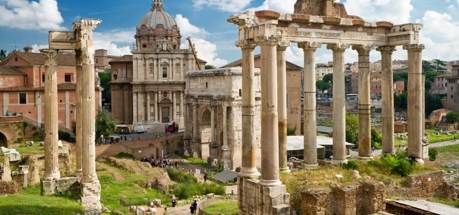
do as the Romans do.

According to UrbanDictionary.com, “it has become shortened so often, some people don’t get it anymore. It’s an analogy making use of the strict rule of the ancient Roman empire”

Wikipedia mentions that it’s “a proverb attributed to Saint Ambrose”, meaning “that it is advisable to follow the conventions of the area in which you are residing or visiting.”

OK, seems sensible to follow the rules, specially when their are enforced vigorously. Furthermore, why rock the boat – specially when visiting a place? Or shortly after you’ve just moved in?

How about after becoming familiar with the local mores?


fall of Rome


Could there be anything more behind these words?

The proverb dates from an era when Rome was the center of the world. Of the Mediterranean world, anyway…
Could it also mean ‘do as the Romans do and you’ll share into the benefits enjoyed by the rest of them’? In line with ‘don’t rock the boat, lest the others will throw you out’?

In other words, the proverb suggests that ‘herding is good for you’.

Which is true. Most of the time, anyway.

Specially when you know when to bail out…

In this context I must remind you that mighty Rome ended up being sacked by a succession of rogue thieves… some of them hired by the emperors to guard the borders because the Roman citizens had became too ‘adept’ at ‘panem et circenses’ to bother anymore with bearing arms…

It seems that not all things done by the Romans were actually worth doing.

How about exercising our brains instead of sheepishly following the herd?
No need to insult the others, ‘rock the boat’ or anything else dramatic.
Just honestly give them the reasons for your dissent.
If they are wise – and you are right, of course, they’ll come your way.

If not… you should either follow the rules… or change the herd.


Farfetched?

Somebody was asking the other day on Facebook “how can you prove that a table doesn’t exist?”
The answer, ‘walk through the place where that table is supposed to stand’ is so obvious that it hurts.

So, was that table real or not?

You see, a table may exist in two kind of places. In a store/room/backyard and in the imagination/memory of the guys who designed/made/owned it. It can remain ‘in storage’ long after it was forgotten by everybody and/or can be remembered long after it was destroyed.
A tree, on the other hand, can exist – and die, without anybody ever noticing it. Or could have been lovingly planted and taken care of by somebody. Who might die even before the tree ever reaching maturity…

But how can any of us determine whether a table, or a tree, is real or not?

By attempting to walk through it, and hurting ourselves, we only determine that there’s something there. Not at all that we’d hurt ourselves by hitting a tree or a table…

OK, there’s yet another possibility.

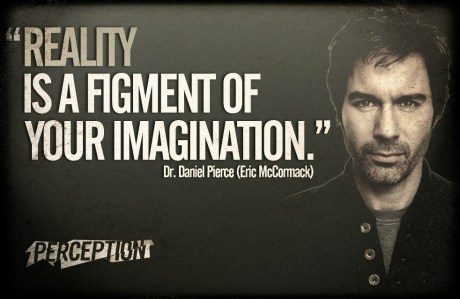
reality figment

Dr. Pierce – who, by the way, was produced by the imagination of a screen-writer, reminds us that neurologically there’s no way of telling apart a dream/nightmare/vision from a ‘legitimate’ perception.

So.
Then it would be possible for whatever each of us perceives on a daily bases to be nothing but some-kind of an elaborate multidimensional movie. Or prank. Played on each of us by some extremely bored ‘arcade operator’. Or by a lab-technician performing some kind of an experiment… In this scenario all other people each of us has ever met would be nothing but characters imagined by the guy who had written the script/devised the experiment…
A slightly different scenario would be that our planet (the whole world?) is a theater, we are the spectators and most of what we perceive is the movie which is played on (for?) us. In this variation we are free to speak amongst us (discuss the movie?) and this would be the explanation for why our perceptions are coordinated so well. After all, all English speakers use the same word for table/tree and most of us are able to differentiate between a table and a chair. Or between a tree and a weed…

Or we could take a completely different road!
There’s a guy, Humberto Maturana, who has reached the conclusion that most humans are not simply aware but also aware of their own awareness. And that this is what really makes us human.
In fact, his ideas make a lot of sense. A dog is aware. If house trained, it will not pee inside and most of them are able to differentiate between their owners and some strangers. But it takes a fully functional human being to step outside of themselves and examine their actions/status.

Without this very self awareness, none of us would be considering ‘reality’. We’d simply walk around the table/tree or directly through the clear space and never waste a second considering whether the table/tree is real.

Or what reality really is.

In this scenario, reality is more like a table than like a tree.
It resembles a tree in the sense that it existed long before any of us ever thought about it and it is like a table in the sense that in order to consider it we need to imagine it first.

Reality exists.
In both scenarios and along both roads. It doesn’t matter whether in the first one we are fed fake sensations and led to believe whatever the screen writer wants us to believe. In order to do that, the screen writer has to exist in the first place. We also have to exist, otherwise there wouldn’t be anyone to watch the movie!
OK, maybe what we perceive has nothing to do (very little?) to the real reality. But that doesn’t mean that a certain reality doesn’t exist at all. Even in the first scenario.

Coming back to the second road, we cannot pretend that OUR reality exists outside us.
Yes, there is a reality – THE reality, which lurks somewhere outside our reach.
What we’re able learn from it, and all we’ll ever be able to learn, is what we’ll be able to imagine first.

Think of it. What do we do when we come across something new?
First we try to classify it among our memories. In fact we try to remember whether we already have a word for it. One imagined by one of our ancestors.
If not, we imagine one ourselves.
And only then we can proclaim that the new thing has been discovered. That it has become ‘real’.


A whole century has passed since the events described in Erich Maria Remarque’s Nothing New on the Western Front/Im Westen nichts Neues.

Not that we’ve learned much during this time…

1968

Brezhnev sends Russian troops to freeze back the Prague Spring.
Ceausescu, the communist dictator who ruled Romania at that time, refused to take part. He had even summoned enough courage to chastise the ‘outside intervention’.

Ceausescu praga

“No excuse can be found for…”

1978

Ten years later he was driven around London in a state carriage by Queen Elizabeth.
As a pat on the the back for his apparent independence from Moscow, as an attempt to weaken the communist ‘camp’ … both at the same time…
Never mind… We, Romanians, were very proud at that time while Elizabeth – and her advisers, must have had quite a heart-burn… specially later, after Ceausescu had started flying his true colors…

Ceausescu cu Lizica

1989

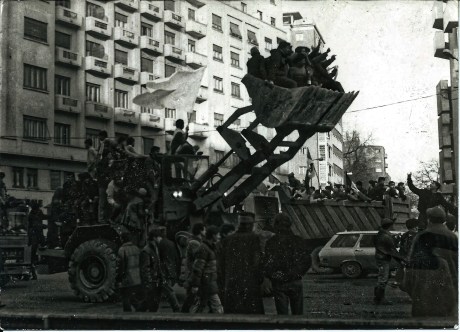
Romania’s was the second to last European communist regime to disintegrate and the only one which had ended in a self inflicted blood bath.  Ceausescu, and his wife – ‘the Presidential Couple’!, were shot at the end of a very short trial during which both had been found guilty of genocide, treason and subversion.

1989 Cu excavatorul la revolutie2005 Niagara

2014

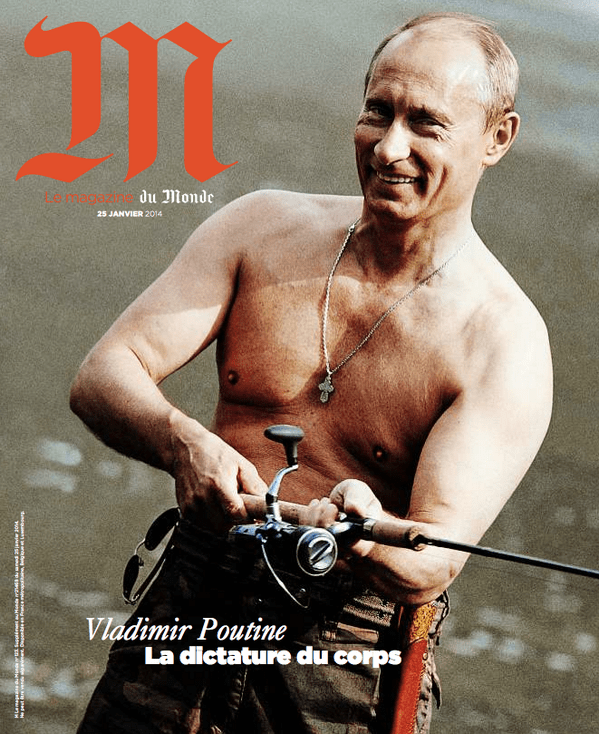
Twenty five years later, Russia’s rising star was lionized by some in the European media.

the emperors clothes

Hungary’s Prime Minister was jokingly hailed as “the dictator” by the President of the European Commission.

Orban the dictator


Currently the Americans are trying to determine whether Putin has somehow influenced their last electoral process,

Putin Trump Hamburg

while Orban continues to build walls around Hungary.

hungary wall

Small wonder then for these two to become bosom buddies, regardless of what drives each of them…

Putin honorary

“Putin will receive the honor in the Parliament during his visit to the 2017 World Judo Championships in Budapest on Monday.”
“Putin will attend the judo by invitation of Prime Minister Viktor Orbán. It will be Putin’s second visit to Hungary this year.”


Recent developments have resurrected a Soviet era concept.

Whataboutism.

 “Whataboutism refers to the practice of deflecting criticism by pointing to the misdeeds of others. Oxford Dictionaries defines it as “the technique or practice of responding to an accusation or difficult question by making a counter-accusation or raising a different issue.”
Essentially, it’s an appeal to hypocrisy ― a logical fallacy also known as “tu quoque.” Instead of proving that your opponent’s claim is wrong on its face, whataboutism argues that it’s hypocritical of the opponent to make that claim at all.”

The current bout of whataboutism came about when Trump and his supporters tried to deflect the public condemnation of neo-nazi activism after a young woman had been killed by a white supremacist.

So, which is worse?
Communism or nazism?

I’ll make a small detour here and ask myself ‘what’s wrong with the spell checker? Why insist that nazism should be written with a capital N? Is it a nation? It’s OK for communism to start with a lower case letter, same thing for all other political denominations… what’s so special about nazism?!?’

Back to business.

One way to answer the question would be to asses the damages incurred as a consequence of each of them being put in practice.

Easier said than done. There are a lot of similarities between these two but also a huge difference. Precisely that which makes it very hard to compare the consequences of each of them having been experimented.
Nazism and communism have evolved in totally different social environments and have been fueled by closely related yet different public feelings.

This is why I’m going to change tack.
Why attempt to establish a relative hierarchy on the axis of evil when they can be studied together?
As the left and right wings of the same carrion eating bird which feeds itself on the countless societies ruined by authoritarianism?

After all, any attempt to determine which is worse does nothing but normalizes ‘whataboutism’ itself, doesn’t it?
Regardless of which wing flaps first….

DSC_0138net

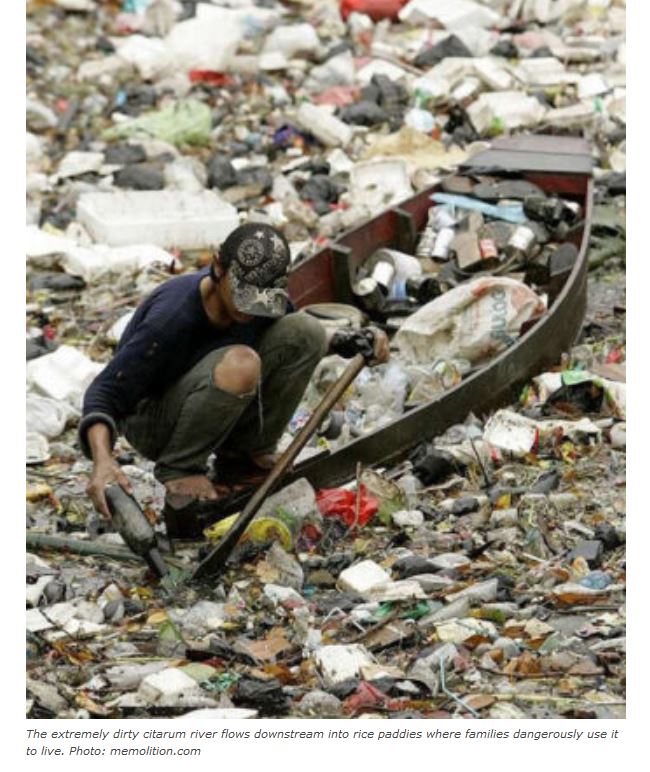
I’ve reached the conclusion that thinking and digesting have very much in common.

Citarum 2

We can’t do it by our own. Those of us who don’t cooperate/speak with those around them, don’t have what to eat or what to think about.

Both processes imply three stages. Identification, absorption, use.
We use cultural models to identify both our food and the important issues.
Absorption – through our gut/conscience, is both highly specific to each individual and governed by our common DNA/shared cultural traditions.
The ‘products’ of the digesting/thinking process are, again, used both in public as well as in private. Part of the energy we get from our food is consumed ‘cooperatively’ with our ‘coworkers’ while most of our thoughts end up either verbally expressed or put in practice.

Both processes, digesting as well as thinking, increasingly change the environment where we, and others, live.

Citarum 1

Seven years ago somebody was elected to the Senate of the United States.

Despite

“Candidate’s Words on Vietnam Service Differ From History”

Six years later, another guy became POTUS despite the newspaper who published the article above having mounted quite a vigorous campaign against him.

The really interesting thing is that the second guy uses the information published in the newspaper seven years ago to smear the first guy while constantly accusing the same newspaper of being a relentless purveyor of fake news…

trump blumenthal

Now, which is stranger?

That two guys had managed to muster enough public support to get elected into public office, despite their shoddy relationships with the truth?

Or that newspapers continue to bother themselves?

“Fabrications have long been a part of American politics. Politicians lie to puff themselves up, to burnish their résumés and to cover up misdeeds, including sexual affairs. (See: Bill Clinton.) Sometimes they cite false information for what they believe are justifiable policy reasons. (See: Lyndon Johnson and Vietnam.)

But President Trump, historians and consultants in both political parties agree, appears to have taken what the writer Hannah Arendt once called “the conflict between truth and politics” to an entirely new level.

From his days peddling the false notion that former President Barack Obama was born in Kenya, to his inflated claims about how many people attended his inaugural, to his description just last week of receiving two phone calls — one from the president of Mexico and another from the head of the Boy Scouts — that never happened, Mr. Trump is trafficking in hyperbole, distortion and fabrication on practically a daily basis.”

“We are the last (semi) stable democracy on the planet without a universal health care system. Elsewhere in the world, health care is a utility taken for granted, like safe tap water or electricity. They pay for it, just like we pay for garbage service or highways, and it costs far less than our broken system. That is not an opinion. That is a reality easily revealed with a bit of travel. Like embattled cult members, we deny ourselves better policy outcomes to protect our deluded beliefs about the nature of markets and preserve our odd pathologies around race. That’s a choice we make…”

Chris Ladd,
Why Republicans Cannot Replace the ACA, Or Accomplish Anything Else,
forbes.com, Jul 20, 2017

ACA means “Affordable Care Act”.

‘Affordable’ for whom?

For those left out, of course…
And who was going to pay the difference?
Those already in, obviously…

See what I mean?

Health care can be seen in many ways.
As yet another opportunity for profit to be made – one of the best actually, since health is such a valuable commodity.
As a ‘social benefit’ extended by the society at large to (all?) its constituents. America already takes care of its elders, children and veterans, doesn’t it?
A combination of the first two. A free market where many independent health care providers cater for the needs of their customers – free to choose among the various providers – while the bills are picked up by a third party, financed through public contributions.

The only problem with the third option being our current obsession with money.
For as long as we’ll let ourselves be governed by the current mantra, “greed is good”, we’ll continue to perceive health care as nothing but yet another opportunity for some to get rich at the expense of everybody else.

How about an Efficient (Health) Care Act?
Opening the market – by allowing the patients to freely choose their doctors and by preventing  monopolies – would drive down the costs.
Cutting the middle-men – the insurance companies would no longer be needed since the public contributions would be collected by a public authority – would also help.

Would such a scheme work?
As I mentioned earlier, not before we give up ‘greed‘.
In order to trust yet another public authority with even more money we’d need at least some hope about that authority being populated by really honest people.
We’d also need many more ‘health care providers’ who actually love to help their patients – and make a decent living out of it – instead of so many people becoming involved with this ‘industry’ simply because it is among the very ‘rewarding’ ones.
And when I say ‘health care providers’, I mean all of them. Not only the doctors and the nurses – most of them do love their jobs and perform them almost heroically. (Some of/too many of) the Big and Small Pharma, (some of) the hospital ‘owners’, etc., etc….

Should we extend this scheme to other areas? Education, for instance? You bet!

Should we apply the same ‘weltanschauung’ to the rest of the economy?
Minus the ‘single payer principle’, of course?
Well, last time I read his work, Adam Smith was talking about “the Nature and Causes of the Wealth of Nations” and about “Moral Sentiments“, not about greedy individuals becoming filthy rich at the expense of their fellow human beings.

“In almost every other race of animals each individual, when it is grown up to maturity, is entirely independent, and in its natural state has occasion for the assistance of no other living creature. But man has almost constant occasion for the help of his brethren, and it is in vain for him to expect it from their benevolence only. He will be more likely to prevail if he can interest their self-love in his favour, and show them that it is for their own advantage to do for him what he requires of them. Whoever offers to another a bargain of any kind, proposes to do this. Give me that which I want, and you shall have this which you want, is the meaning of every such offer; and it is in this manner that we obtain from one another the far greater part of those good offices which we stand in need of. It is not from the benevolence of the butcher, the brewer, or the baker, that we expect our dinner, but from their regard to their own interest. We address ourselves, not to their humanity but to their self-love, and never talk to them of our own necessities but of their advantages. Nobody but a beggar chuses to depend chiefly upon the benevolence of his fellow-citizens. Even a beggar does not depend upon it entirely. The charity of well-disposed people, indeed, supplies him with the whole fund of his subsistence. But though this principle ultimately provides him with all the necessaries of life which he has occasion for, it neither does nor can provide him with them as he has occasion for them. The greater part of his occasional wants are supplied in the same manner as those of other people, by treaty, by barter, and by purchase. With the money which one man gives him he purchases food. The old cloaths which another bestows upon him he exchanges for other old cloaths which suit him better, or for lodging, or for food, or for money, with which he can buy either food, cloaths, or lodging, as he has occasion.”


Before proceeding any further, let me introduce you to two other, more distanced, cousins of ours. Gorilla and Orangutan.

Orangutan leads a semi-solitary life in the Bornean and Sumatran Jungle. They are fairly large animals, males tip the scales at 200 pounds or so, and need a lot of food. They eat mostly fruit and, in times of scarcity, bark, flowers, insects and eggs.
It was their ‘eating habits’ which had shaped their social lives:
Food is often scarce in the rain forest and that is why the orangutan is a semi-solitary creature. In times of great abundance of food, orangutans may use the opportunity to socialize and gather in small groups.
Because they live solitarily, the young siblings must on one hand learn ‘everything’ before starting their adult lives and they don’t have anybody to learn from but their mothers. Hence they stick around for longest. A baby orangutan will nurse until about six and continue to live with their mothers for a few more years. Two or three for the males, five or six for the females – on top of everything else the females have to learn “mothering skills” and for them the only way to do it is to watch their own mother taking care of the next sibling.
As a consequence of all this, the females give birth only once every 8 years, “the longest time between births of any mammal on earth. (This results in only 4 to 5 babies in her lifetime.)” Not a very efficient survival strategy, for the species I mean…

Gorilla has adopted a different feeding strategy.
This is actually a joke. It wasn’t ‘the gorilla’ which has ever adopted anything, least of all ‘a survival strategy’. The ‘adoption process’ had been fueled by chance, had been ‘censured’ by  the realities of their living places and was later labeled as “evolution” by Charles Darwin.
Coming back to our distant cousins, gorillas are even larger animals than orangutans.
300-400 pounds, for the males, versus 200. Hence they need even more food.
An adult Grauer’s gorilla male is estimated to eat 30 kg of plants every day, an adult female about 18 kg.” The difference being that gorillas eat a lot of leaves.
When they have the opportunity to choose, they will surely pick up fruit but they are much more adapted to eating leaves than orangutans are. As a consequence they do not need to ‘spread around’ as thinly as orangutans do, the young can also learn from the rest of the pack so females can give birth every 4 years instead of every 8.

Is there any link between all this babbling and the stated subject of your post?

Actually yes.

As gorillas and orangutans are teaching us, together is easier than each by its own.
Being able to give birth every 4 years is a huge evolutionary advantage over having to wait 8 years before becoming pregnant again.

But this is not all we can learn from our cousins.
Male gorillas, at 300 to 400 pounds, are formidable defenders. Their only enemies, except for humans, are the leopards.
Compare 350 pounds with less than 100 for a chimpanzee/bonobo male.
That would be a good starting point to figure out why silver-backs – mature male gorillas who despotically reign over their 1 to 5 females – can afford to drive out their sons after they become sexually mature while the chimpanzee alpha males, who lead troops of up to 50 members, will allow other mature males to live by – and to have intercourse with some of the females living in the same group.
The second reason being that gorillas eat, almost exclusively, plant matter, supplemented with some insects, while chimpanzees form hunting parties in order to catch, kill and eat other animals, including monkeys. And one can ‘graze’ by himself while hunting is way easier in cooperation with others.

Feeding habits can explain quite a lot, isn’t it?

Let’s make a step further and turn back, as I promised in my previous post, to the differences between chimps and bonobos.
Well, bonobos hunt, just as efficiently as the chimps do, only they are less inclined to murder their neighbors.
Just one suspected killing observed during “92 combined years of observation at four different sites“, for the bonobos. In the other camp, 152 killings, 58 directly observed and the rest “counted based on detective work“, gathered over “426 combined years of observation, across 18 different chimp communities“.
The second difference, that I find interesting in the context of ‘capitalism’, is the size of the ‘colonies’. Bonobos live in way bigger groups than the chimpanzees. 100 versus 40 to 60, I’m not sure whether this had any impact over the relative fate of chimps or bonobos but it is surely relevant for how capitalism works. Stick around.

One more ‘animal story’ and I’ll wrap everything up.

“We previously reported that chimpanzees were unable to optimally select the smaller of two candy arrays in order to receive a larger reward. When Arabic numerals were substituted for the candy arrays, animals who had had prior training with numerical symbols showed an immediate and significant improvement in performance and were able to select reliably the smaller numeric representation in order to obtain a larger reward. Poor performance with candy arrays was interpreted as reflecting a response bias toward the intrinsic incentive and/or perceptual features of the larger array. In contrast, the Arabic numerals represent numerosity symbolically and appear to promote response choice on the basis of abstract processing of numerosity, with minimal interference from the inherent properties of the choice stimuli. The present study tested the hypothesis that, for mixed symbol-candy choice pairs, the requisite processing of the abstract numeral may foster a mode of numerical judgment that diminishes the interfering incentive/perceptual effects of the candy stimuli. The results were consistent with this hypothesis. Whereas performance on candy-candy arrays was significantly below chance levels, performance on numeral-candy choice pairs was significantly above chance and comparable with performance on numeral-numeral pairs.”

OK, OK, don’t shoot the messenger… those guys were writing a scientific paper, not a blog post… let me ‘translate’ it in simpler words.

There is a relatively simple psychological test involving two bowls full of candy.
One of them containing more pieces than the other.
The test consists of a child being asked to choose between those two bowls, after being told that the candy from the chosen bowl will be given to somebody else and the candy from the second bowl, the unchosen one, will be given to the child. The test is repeated a number of times and most of the children, 4 year olds and above, learn quite quickly to point to the bowl containing the smaller number of candy.
If, instead of children, chimpanzees are asked to choose between the two bowls, they continue to point to the bigger number of candy, even after the umpteenth repetition.
Now here comes the really interesting part.
Dr. Boysen and other scientists from Ohio State University, had previously taught a chimp, Sheba, not only to count but also to read numbers. One digit numbers…
When Sheba was subjected to the test, using real candy, she had responded exactly as the other chimps had done before her. She was unable to wrap her head around the notion that she will get the candy from the OTHER bowl. But as soon as the researchers had replaced the actual candy with digits written on small cartons… bingo! Sheba had become a lot wiser and had very quickly figured out that choosing the bowl with the smaller number (of candy) was a far better option.

Let me put two and two together.

Our cousins, the great apes, have given us a valuable lesson about cooperation.
Orangutans have to raise their offspring as single mothers. A very time consuming process which limits the number of siblings to 4.
Silver-backs don’t need much help to defend their families. So they can afford to drive off any potential competition… but they cannot hunt. Or do anything else ‘in concert’ with their peers.
Chimpanzees have learned to tolerate each-other, to a degree. They can form larger communities and engage in cooperative endeavors. Hunting and warfare.
Bonobos have developed a very efficient method to quell tension which may appear among themselves and to subdue rogue members of the community, without actually killing them. With no apparent benefit… except for us…

History is telling us, shouting at us even, that authoritarian regimes are short lived. Shorter and shorter lived, as we come closer to the present day.
Ancient Rome had lasted for almost a 1000 years. 2000 if we take Byzantium into account.
The British Empire was de facto dissolved, more or less peacefully, after less than 500 years, along with the rest of the European colonial empires.
The Russian Czarist Empire had buckled under its own weight after some four centuries, reinvented itself as the Soviet Union and faltered again after less than a century.
The rest of the ‘modern’ dictatorships have crumbled even faster, with only two notable exceptions: North Korea and Cuba.

Mighty commercial ventures, which had seemed impregnable in their heydays, are now almost forgotten memories. From the British East India Company to the now infamous ENRON…

Yet humankind, as a whole, had fared better and better.
OK, we did bring a lot of ‘man made’ misfortune over our own, collective head.
Only every little piece of that misfortune had been produced and inflicted in an authoritarian setting.

From Alexander the Great (?!?) to Hitler, history is full of ‘leaders’ who had somehow convinced their subjects to foolishly follow orders. Eventually, everybody got killed in the process. The leaders as well as the hapless subjects…
From John Law – ‘the son of a Scottish banker, a gambler and playboy who had killed a man in a duel‘ before insinuating himself at the top of France’s financial establishment during the first part of the XVIII-th century, where he had orchestrated a “system” closely resembling a Ponzi scheme – to Bernard Madoff, the economic and financial history is full of ‘tycoons’ who have led their their subordinates, and a considerable portion of the financial markets, to utter disaster.

And some of us still consider that ‘greed is good’… Maybe they should read again about Sheba and the candy bowls…

I can hear some of them protesting: “In the real world, there is nobody to switch the bowls! ‘Finders keepers, losers weepers'”
Yeah, right… tell that to some of those who had won the lottery… “About 70 percent of people who suddenly receive a windfall of cash will lose it within a few years, according to the National Endowment for Financial Education.

Then why are we still so obsessed with money?
Like Sheba was with those candy?
Why do we collectively continue to behave like a bunch of three years olds?

Maybe because money have proved, over the centuries, to be very reliable tools?
Because profit has been a very good measure for a company’s ability to survive? If corroborated with other indicators, but that’s another story…

At some point I mentioned that capitalism only works if the market where its wares are traded is really free. Meaning that that market has to work under the rule of law and that nobody in that market should allowed to become so powerful as to dominate the others.

Well, that was a lie.
Actually, capitalism works anywhere.
Those running the late Soviet Union have tried to convince the rest of the world that monopolies might work.  Various ‘business men’, including some very successful ones, try to convince us of the same thing. “Competition is for losers” they say… OK, I can understand why they keep trying… That’s what the entrepreneurs are for! “To boldly go where no man has gone before.”
My point being that markets which are not presently free will become free with the passage of time. No matter what!
No political arrangement has ever been strong enough to contain a dysfunctional economy. That’s why the Soviet Union, and the rest of the communist camp, had crumbled. That’s why we have a crises every time the government, with the best intentions, abruptly intervenes in the economy. Or fails to do so and allows monopolies to exist for too long…

Capitalism actually works.
Look around us.
I could give you a myriad examples. I’ll settle for two.
Romania, which less than 30 years ago was struggling under the communist yoke, now has one of the fastest internet in the world.
Some 40 years ago, when my uncle had emigrated to America, long-distance  phone calls were so expensive that he barely afforded to call his mother more than twice a year… nowadays two people can chat for hours across the planet, for free, over the internet. With video…

How about we letting it do its magic without some of us trying to drain ‘undeserved advantages’ from the process?
And no, those trying to ‘drain undeserved advantages’ are not the real culprits for what is going on!
A really free market is not one where a big bully with a huge stick makes sure that nobody steals from its neighbor.
That would be the definition for a police state!
A free market is one where people organize themselves, hire a normal guy with a smallish stick to take care of thieves and then call him every-time when they see a robbery taking place.

Nowadays too many of us actually admire the thieves and try to bribe the guardian.
While the rest idly walk by, as if what’s going on under their own noses is not going to affect them in a very short while …