Archives for category: collective identity

George Bush, Barack Obama and Donald Trump are going for a job interview with God.


It so happens that I’m old enough to remember the original version of this joke…

Bill Clinton, Hillary Clinton, and Al Gore were in an airplane that crashed. In heaven, they found God sitting on the great, white throne. He addressed Al first. “Al, what do you believe in?” Al replied, “Well, I believe I won the election in 2000, but it was your will that I did not serve. I’ve come to understand that now.” God thought for a second and said, “Very good. Come and sit at my left.” God then addressed Bill. “Bill, what do you believe in?” Bill replied, “I believe in forgiveness. I’ve sinned, but I’ve never held a grudge against my fellow man, and I hope no grudges are held against me.” Again, God thought for a second and then said, “You are forgiven, my son. Come and sit at my right.” God then turned to Hillary and asked, “Hillary, what do you believe in?” She replied, “I believe you’re sitting in my chair.

Old enough to remember the political jokes Romanians shared among themselves before Ceausescu, the communist dictator, was toppled during a bloody uprising…

Can’t stop wondering about why so many people continue to make the same mistakes all over the planet…
And how come ordinary people’s initial reaction to arrogance always consists in jokes being thrown at the guy who proudly wears that arrogance!

I keep hearing about this issue and I can’t stop wondering about how parallel to each other are those defending this idea with those denying its merits.

Pro:

-Robots are eating more and more jobs so more and more people will end up hungry.
-AI will make robots so productive that it will be far more efficient to use robots than human workers.
-A decent income is a human right.

Con:

-This is a socialist move, hence it will end up in failure – no other reason offered.

As it is obvious to all, both sides score big.

Yes, including ‘a decent income is a human right’ and ‘all socialist ideas end up in failure’.

Then what are they fighting each-other about?!?

Let me rephrase that.
WHY are they fighting, in the first place?

Because neither listen to what the other has to say… as simple as that…

Let me discuss some of the practicalities involved.

Robots eating up jobs and AI being able to continually increase financial efficiency are so evident that they do not deserve much consideration.

‘All socialist moves ended up in failure’.
We need to define socialism in order to make sense of this sentence.
Mainly because ‘socialism’ is one of the most abused words nowadays, on a par with liberalism. Sometimes they are even considered synonyms…
Well, ‘liberalism’ comes from liberty and  bona fide liberalism is concerned with individual freedom.
Socialism, on the other hand, comes from social. And is concerned with the the workings of the entire society.
The point being that there are two types of socialism. One which is ‘somewhat’ synonym with liberalism – the ‘reverse’ side of liberalism, actually, while the latter is the exact opposite.

I’m not making any sense?

Let me start from the other side.
All forms of socialism which have failed have been excessively centralized forms of government. And it was because of that excessive centralism that they had failed, not because of being ‘socialist’. The evident proof being that the same thing has happened with all right-wing dictatorships, which had used the very same excessively centralized decision making mechanism – the totalitarian government …

Which brings us back to the problem at hand.

For Universal Basic Income to work – or Guaranteed Basic Income, as some insist on calling it, it has to be financed.
Through taxes, right? Which means that those owning the robots would have to be somehow convinced to give up a huge proportion of their profits… Then why bother in the first place…? Why start any businesses, at all?
We’ll have the government run the whole show? Remember what history teaches us about centralized decision making?

So?!?

Well, not all is lost while there’s still hope!

Let me rearrange the arguments.

We not only live in an inherently limited space, with inherently limited resources, but we’ve also finally started to understand our predicament. Which calls for as much efficiency as possible.
Only for a different kind of efficiency than that we’ve accustomed ourselves to.

Until recently, we’ve been trying to get as much money under our belts as possible. Without much regard for anything else.
That’s why we’ve been cutting down secular forests, feeding almost all the fish we’ve been pulling from the oceans to the domestic animals we were raising for their meat, polluting our breathing air, selling our fellow humans which happened to had a different skin color than ours into slavery… As if there was no tomorrow…

Slowly, we’ve started to realize that this won’t work for very much longer.

That no matter whether we’re responsible for the global warming – or if it’s real at all, sooner or later we’ll exhaust the planet.
OK, it is highly plausible that we’ll discover/learn to use new classes of resources.
But this eventuality doesn’t constitute, in any way, a valid reason for us to continue squandering the meager resources we have at our disposal.

Hence the need for increased efficiency.

Only this has to be a different kind of efficiency. The kind that focuses on minimizing waste instead of maximizing profits. The kind that recycles because it makes obvious sense, not because it is cheaper.

Along the same path we’ll discover that it would make a lot of sense to help the less developed nations to catch up with the most advanced ones.
For starters, because the ‘advanced economies’ no longer need cheap workers. They use robots instead.
Secondly, because better living people tend to have less children than those struggling to survive. And we’ve already agreed about the planet being rather limited…

Nothing too fancy… until now, right?

Well, the next item will be trickier..

Remember that Ford had raised dramatically the wages he paid to his workers?
With tremendous results?

OK, his reasons were not the ones, generally but erroneously, attributed to him.
He didn’t do it to ‘encourage’ his workers to buy cars from him… or because of philanthropy…

Actually, it was the turnover of his staff.

At the time, workers could count on about $2.25 per day, for which they worked nine-hour shifts. It was pretty good money in those days, but the toll was too much for many to bear. Ford’s turnover rate was very high. In 1913, Ford hired more than 52,000 men to keep a workforce of only 14,000. New workers required a costly break-in period, making matters worse for the company. Also, some men simply walked away from the line to quit and look for a job elsewhere. Then the line stopped and production of cars halted. The increased cost and delayed production kept Ford from selling his cars at the low price he wanted. Drastic measures were necessary if he was to keep up this production.”

But, whatever Ford’s reasons were, the long term results have been abundantly clear.
Nowadays people who build cars are being paid well enough to afford buying the same kind of cars they are building. At least in the advanced economies…

What happened was that Ford, in order to keep the assembly line going, paid his workers as much as he afforded to. With spectacular results.
While nowadays most employers tend to ‘compensate’ their employees with as little as possible. Which makes perfect economic sense… doesn’t it?

The same economic sense which used to drive us into “cutting down secular forests, feeding almost all the fish we’ve been able to pull from the oceans to the domestic animals we were raising for their meat, polluting our breathing air, selling our fellow humans which happened to had a different skin color than ours into slavery… As if there was no tomorrow…”

See what I mean?
Instead of attempting to mandate a ‘Guaranteed Basic Income’, calculated by the central government and financed through forcefully levied taxes, how about hiring as many people as it would make sense, let them work as little days per week as they want and pay them as much as we can afford to instead of programmatically replacing as many of them with robots and paying the remaining ones as little as we possibly can?

OK, some of us won’t get as rich, as fast, as our grand-fathers did… So what? None of us can eat even close to what our grand-fathers used to… and food is a lot cheaper, anyway…

This is would be a considerably shorter way to get more people out of poverty than any scheme concocted by any government and it would have the same snow-ball effect as Ford’s wage increase had.

Economists describe this as Rostow’s ‘take off effect’.


For attaining adequate finance for take off it is necessary that:

(a) The community’s surplus over consumption does not flow into the hands of those who will utilize it by hoarding, luxury consumption or low productivity investment out-lays;

(b) Institution for providing cheap and adequate working capital be developed;

(c) One or more sectors of the economy must grow rapidly and the entrepreneurs in these sectors must plough back a substantial portion of their profits to productive investment; and

(d) Foreign capital can profitably be utilized for building up social and economic overheads.”


Obviously, any attempt to instate a guaranteed basic income, (except for those too young, too old or otherwise un-able to pull their weight, of course) would grind any ‘take-off’ to a stand-still.

And no, getting people out of poverty is not a valid goal, per se.
Poverty is a relative thing, which relies more  on feelings than on hard reality.
The real problem with poverty is that it reduces the ability of poor individuals to lead meaningful lives. Poor people are a lot less autonomous than self sufficient ones, meaning that decision making ability is impaired by the fact that they need to focus their attention on the short term time span.

This whole thing has long term consequences on societal level.

Remember what I said about centrally planned socialist countries constantly failing.
About all dictatorships eventually crumbling under their own weight, because of too much decision power being concentrated in too few hands?

Excessive wealth polarization produces the same results. Economic decision becomes too concentrated, political decision follows through and…

What next?
The world has already experimented with communism. Didn’t work.
It also experienced two economic meltdowns, exactly when wealth polarization was at relative peaks.
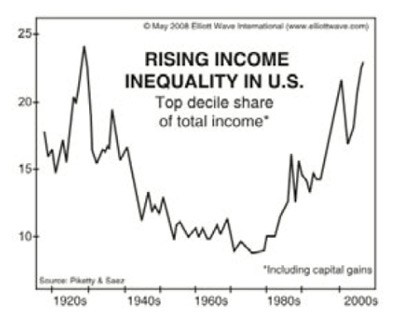
income-inequality-08

When are we going to learn anything from what happens to us?
Why do we continue to waste the accumulated lessons collectively known as ‘history‘?


Spoken words have three dimensions.

Their ‘intrinsic’ meaning, the context where the speaker ‘introduces’ them and the manner in which they are received by those who hear them.

Evaluating ‘words’ along these three dimensions offers us the opportunity to gouge not only what the speaker wanted to say but also his general attitude towards the subject/audience and what the audience feels about the whole thing.

‘I could shoot someone!’

US Republican frontrunner Donald Trump is so confident in his support base that he said he could stand on New York’s Fifth Avenue “and shoot somebody” and still not lose voters.

Donald Trump is just trying to build up the audience for Thursday’s debate, for which we thank him,” said a Fox News spokesman.

‘I tried to get that house!’

I wanted to get that house to build a building that would have employed tremendous numbers of people. But when the woman didn’t want to sell, ultimately I said forget about it.”

Well… not exactly…
First of all, he wasn’t trying to build anything bigger than a parking lot.
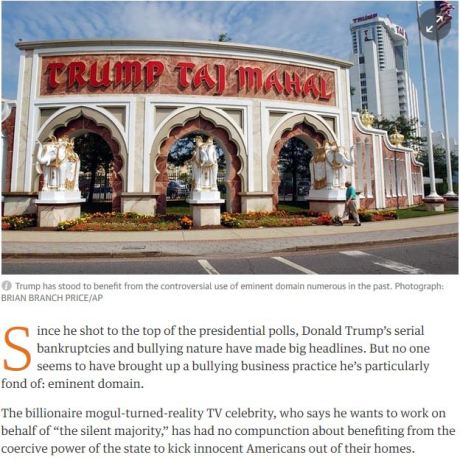
Secondly, he didn’t say anything like ‘forget about it’. He had been taken to court by the owner of the building – a widowed lady in her 70’s, where he was told by the judge that eminent domain was not intended for that kind of situations.

Despite these two incidents he had been nominated by the Republican National Convention to run for US President in 2016.

That bad was the Republican’s need to win those elections.

‘Grab them by the pussy!’

I better use some Tic Tacs just in case I start kissing her. You know I’m automatically attracted to beautiful – I just start kissing them. It’s like a magnet. Just kiss. I don’t even wait. And when you’re a star they let you do it. You can do anything.

(Billy) Bush: Whatever you want.

Trump: Grab them by the p****. You can do anything.

Trump later brushed aside this incident as “locker room banter” while his “former campaign manager Corey Lewandowski told CNN that the American people would appreciate that Mr Trump “talked from the heart. We’re electing a leader, not a sunday school teacher”“.

Eventually, enough of the ‘American People’ obliged for ‘the Donald’ to become the 45th President of the US.
Proving:
1. How desperate those Americans  were to elect a Republican to the White House and
2. How despondent the rest of the American People were at the thought of Hillary Clinton manning the office where her husband had ‘not had sex with that woman’.

‘Sh- – hole.’

“Why are we having all these people from shithole countries come here?” Trump said, after being presented with a proposal to restore protections for immigrants from those countries as part of a bipartisan immigration deal.

“Certain Washington politicians choose to fight for foreign countries, but President Trump will always fight for the American people,” said Raj Shah, a White House spokesman. “Like other nations that have merit-based immigration, President Trump is fighting for permanent solutions that make our country stronger by welcoming those who can contribute to our society, grow our economy and assimilate into our great nation.”“Certain Washington politicians choose to fight for foreign countries, but President Trump will always fight for the American people,” said Raj Shah, a White House spokesman. “Like other nations that have merit-based immigration, President Trump is fighting for permanent solutions that make our country stronger by welcoming those who can contribute to our society, grow our economy and assimilate into our great nation.”

The difference being that this was President Trump speaking, not the candidate…

Yet while a biased media hyperventilating is no virtue, Trump’s great flaw is that he keeps giving them ammunition. One minute he’s riding high, the next he’s running for his life.

The “s—hole” storm is a perfect case in point.

Still basking in the afterglow of getting tax reform passed, Trump confidently convened a bipartisan group of congressional members for a televised meeting Wednesday on the “Dreamers” and related ­immigration issues.

The president presided in such CEO fashion that even CNN — yes, CNN — declared the meeting remarkable and Trump’s leadership commendable.

The next day, the president boasted about the compliments — and then acted as if he were ­beloved from sea to shining sea. At a follow-up meeting, he unleashed the furies with his derogatory ­remarks.

Did he forget that Democrats are out for his blood? Didn’t he learn anything from the torrent of White House leaks that bedeviled his early months?

Considering that the last excerpt comes from an article authored by Michael Goodwin and  published by Fox News, is it possible that at least some of Trump’s followers have had enough?
Will he be able to oblige them?

‘I have two leftovers. I call them leftovers. They haven’t been very nice to me. I will beat them. After I beat them I will be so presidential,’ Trump told Fox News Sunday host Chris Wallace, referring to Sen. Ted Cruz and Ohio Gov. John Kasich, the other two GOP candidates in the presidential race.

‘You’re going to be so bored, you’re going to say this is the most boring human being I’ve ever interviewed,’ Trump continued. 

‘I think if I act very presidential I’ll be dull, but that will be fine,’ he added.

Let me first clear up something.
I’m an engineer. Converted to sociology, indeed, but still an engineer.
So don’t expect any fancy wording or very sophisticated philosophical considerations!

Let’s pretend, for a moment, that we’ve just arrived on this planet. Just ‘you and me’, not ‘us humans’.
Being sent by some alien civilization to see what’s going on here.
Like we, ‘the civilized people’, study the natives still living in the Amazonian forest – minimum contact and so on, no intention what-so-ever to invade the territory or any other-way purposely intervene in the natural evolution of things.

I don’t know about you, but my report would be something like this:

The most interesting aspect of the planet is the manner in which the intelligent inhabitants have evolved.
Those living in a relatively small and isolated corner of the landmass have somehow developed the most consequential culture and then imposed some very important aspects of it on most of the rest.

Even more baffling is the fact that all major religions observed on this planet start from the same tenet.

the golden rule

The only thing which singles out those who had managed to impose their culture on most the rest being that they apply the rule in a ‘pro-active’ manner.
‘Do unto others what you wish others to do unto you’ versus ‘do not do unto others what you don’t like being done unto you’. ‘Normative’ versus ‘preemptive’.

– Why are you so baffled about any of this? The universal law of evolution maintains that things which are not suitable enough for the environment where they happen to exist will eventually disappear… Each culture produces a certain civilization – modifies the environment according to its wishes/as a consequence of its mistakes, and the other cultures have to adapt/evolve to the new situation… nothing new or peculiar here…

– Nothing new, indeed, except for the fact that while most of the cultures on this planet learned to ‘live and let live’ – “do not do unto others…”, while the two most successful ones have adopted the slightly but very consequentially different “do unto others…”, a.k.a. ‘who’s not like us is against us’….

– Is there any explanation for the most aggressive attitude being the most successful one?
Until now, at least… considering that the two cultures which share the ‘do unto others what you wish to be done unto you’ attitude seem to ‘have worked themselves up’ into a rather ‘confrontational situation’… both intra and inter culturally…

– The only putative explanation I can come up with for such a divergent evolution is that Plato, the seminal intellectual figure of the ‘doers’, taught his followers not only that the world is knowable but also that he who has reached a learned state must, forcefully if necessary, lead his peers to the ‘light’ he had found while the ‘significant others’ believe that the learned ones should speak out, at their discretion, only when somebody asks them to.

.

.

– One more thing.
The immediate consequence of Plato’s teachings was that Alexander – an emperor who was tutored by Plato’s eminent student, Aristotle, had conquered most of the then civilized world only to die, untimely, a drunkard’s death… intoxicated by booze, intoxicated by power… who cares?

The current President of the United States describes himself as a man always making good use – as a manner of speaking, anyway, of all opportunities he ever identifies.

grab them by the pussy

Erotically as well as financially.

trump eminent domain

“Trump turned to a government agency – the Casino Reinvestment Development Authority (CRDA) – to take Coking’s property. CRDA offered her $250,000 for the property – one-fourth of what another hotel builder had offered her a decade earlier. When she turned that down, the agency went into court to claim her property under eminent domain so that Trump could pave it and put up a parking lot.

Peter Banin and his brother owned another building on the block. A few months after they paid $500,000 to purchase the building for a pawn shop, CRDA offered them $174,000 and told them to leave the property. A Russian immigrant, Banin said: “I knew they could do this in Russia, but not here. I would understand if they needed it for an airport runway, but for a casino?” “

Now, after climbing a new pinnacle of popularity, he has become, himself, a very lucrative opportunity.

donations for coming out

“The Hill reported Friday that Bloom worked with campaign donors and tabloid media outlets to arrange compensation for the alleged victims and a commission for herself, offering to sell their stories. In one case, Bloom reportedly arranged for a donor to pay off one Trump accuser’s mortgage and attempted to score a six-figure payment for another woman. The former ultimately declined to come forward after being offered $750,000, the clients told The Hill.”

The first question which crossed my mind after reading this was:
‘OK, so why would any one bring all this up? What difference does it make if those women get some money for telling their stories? It’s the facts themselves which are really important here, right?

‘But what if?’ was the second one…
What if, after seeding enough ‘oblique doubt’ into people’s minds, facts start to look rather different than at ‘face value’?

I told you so

Remember that XX-th century aphorism, “The best defense is a good offense”?
And the smoke screen tactics pioneered by the military but also very important to those who study the Bible?

“When studying the Bible with teens, the term “smoke screen” refers to a commonly deployed tactic designed to avoid exposure of the heart. Smoke screens, though not unique to teens, are important to understand and overcome.

Each of us have areas in our lives and places in our hearts we do not want exposed. Sometimes we are afraid of what others may feel about us; sometimes we realize these areas in our lives and places in our hearts need to change, but we don’t want to change them or even believe that we can.

Practically, smoke screens are often the emotion we express, the issue we lead with, or the confusion we claim, in order to deflect what is really going on in the heart. When emotions are present, the words that are flowing out of a teenager’s mouth are rarely communicating what is actually driving them.

Getting past a smoke screen takes understanding and the willingness to go deep. It takes understanding and depth to remain calm when our teen is using emotions to derail a conversation that might be getting to the heart of the matter at hand. We learn depth when we are willing to look into our own hearts and be honest about the smoke screens we use.”

Cambridge Dictionary lists ‘riddle’ as being “a type of question that describes something in a difficult and confusing way and has a clever or funny answer, often asked as a game

What if there’s way lot more than this, hidden ‘in plain sight’ under the ‘difficult and confusing’ cloak draped over each of them?

“Black sheep on a white field;
He who knows them, leads them.”

“My father, the son of a subsistence farmer and his barely literate wife, used riddles to try to foster critical thinking in his daughters.”

This particular one is a classic in Eastern Europe and I stumbled on this version while Googling for an English translation. The quote belongs to Daiva Markelis, a Lithuanian American Professor with a PhD in linguistics… go figure… I included the part about the father because it illustrates perfectly the point I’m trying to make with this post.

That words, and letters, mean nothing by themselves.
We are the ones who attach meaning to each of them.
We are the ones who ‘lead’ them… even if sometimes unknowingly…

And precisely this is what riddles are for!
To tell us that languages, and letters, can and have to be mastered.
That unless we get to really know them, we’ll never be able to lead them where we want them.

But there’s an even deeper reason for riddles enjoying so much popularity.
Knowingly or unknowingly we somehow ‘feel’ that being familiar with letters and able to speak is not enough. That no matter how well we ‘know’ a language we’ll never grasp the full intended meaning of what is being spoken around/to us.

Yes, when speaking we should be forthcoming… to the tune of not becoming self detrimental, of course… and when listening we must remember to look for the intended meaning, not jump to conclusions according to our own opinion on the matter…

From the airlift which kept the flame of liberty alight in West Berlin to “Trump’s decision (to stop supplying arms to Kurdish fighters in Syria) appeared to catch both the Pentagon and the U.S. State Department off guard. Officials at both agencies, who would normally be informed of changes in U.S. policy toward arming the Syrian Kurds, said they were unaware of any changes. The officials spoke on condition of anonymity. It was unclear whether the Trump administration notified the Kurds of the move before telling the Turks. Nor was it how much significance the change would have on the ground, considering the fight against Islamic State is almost over.

Ich bin ein Berliner

What happened to “Ich bin ein Berliner”?!?

I’m afraid that  too many people continue to not understand what’s ‘the big issue between the free world’ and the authoritarianism which still encroaches it. They should indeed ‘go to Berlin’!

From a friend’s FB wall:

“African proverb:
Every morning in Africa, a gazelle wakes up.
It knows it must run faster than the fastest lion or it will be killed.
Every morning a lion wakes up.
It knows it must outrun the slowest gazelle or it will starve to death.

It doesn’t matter weather you are a lion or a gazelle.
When the sun comes up, you better start running.”

(from The World Is Flat, by Thomas L. Friedman)

It seems that the modern world is gradually becoming more and more ‘African’.
We’re so busy running ourselves out that we’re failing to remember the essential.

That we’re people.
Neither gazelle nor lion!
And that most of us have long ago left the jungle and now live in cities!

How about ‘taking five‘ from our incessant quest for trinkets and use the time to remember “togetherness”?
As in “communion”?

In the civilized world, ‘Dog eat dog’ was supposed to be an exception, not an everyday occurrence…

Ruthless acquisition or competition, as in With shrinking markets, it’s dog eat dog for every company in this field. This contradicts a Latin proverb which maintains that dog does not eat dog, first recorded in English in 1543. Nevertheless, by 1732 it was put as “Dogs are hard drove when they eat dogs” (Thomas Fuller, Gnomologia).”

PS.
After reading this, my son pointed out that lions are the only cats which hunt cooperatively on a constant basis.
Could this be the reason for which they are seen as the royals of the animal world?

Fake news

“Federal lawmakers on Wednesday released samples of 3,000 Facebook ads purchased by Russian operatives during the 2016 presidential campaign. The ads conveyed the wide range of influence Russian-linked groups tried to enact on Americans…”

Let’s zoom out in order to gain some perspective over all this.

Fake news are defined by Oxford Learner’s Dictionaries as “false reports of events, written and read on websites“.

The way I see it, “fake news” have a lot in common with counterfeit currency.
In more ways than one!

First of all, most money in current use is ‘fiat money’.
We are dealing with either printed pieces of paper or otherwise useless pieces of metal.
We ‘trust’ them for trading purposes simply because we are convinced that the institution which stand behind them – Central Banks, free(ish) markets and law enforcement, will do what they are meant to do. We trust that the Central Banks will not print too many of those pieces of paper, that the free(ish) markets will set a reasonable price to everything and that the police will manage to weed out (most of) those who try to circulate fake money.
Not even a return to ‘real’ money – a.k.a. gold,  wouldn’t insulate us from crooks. Gold coins can be, and had been, tampered with in so many ways. Human greed is a very powerful motivator but not necessarily a good mentor.

Which brings us to the reason for why fake money came to be.
Simply because some ‘industrious’ people ‘make’ them and some other, equally greedy, people knowingly distribute them.

In conclusion, we wouldn’t have to deal with fake money if money wasn’t essential for an efficient free market and we would have a lot less of it if greed were not such a widespread attitude. And no, a cash-less economy would not solve the problem. A printing press is no longer essential for faking money. Hacking skills have become  a good enough substitute.

Let’s translate this rationale to (fake) news.

We need to know what’s going on around us so we’ve developed an equivalent to the financial system. The mass media.
Which has a more or less equivalent set of ‘guardians’.
The ‘printers’ are responsible for the equivalence between their ‘product’ and the reality it represents while the market (readers, that is) is responsible for ‘setting the price’.

Of course, there are also differences.
‘Law enforcement’ has indeed a role to play in the news industry but its scope is a lot narrower than in the first case. And rightfully so. The ‘information’ market needs to be a lot more ‘flexible’ than the one dealing in ‘economic goods’. There’s a lot to discuss on this subject, I’ll leave it here.
There’s also no Central Bank to ‘tug at the sleeves’ of those who ‘jump the shark’.

As a consequence of these two differences, the ‘counterfeiters’ have an easier life and the consumers/victims a far greater responsibility for what’s going on. Simply because the consumers/potential victims cannot rely on any third party to do their job. To sniff out the ‘bad thing’.

But what if ‘it’s the thief who plays the victim’?
That very much depends on who the ‘thief’ is!

Let’s go back in time for a short while.
First to the American Revolutionary War. During which the British attempted to crash the American economy by injecting in it enough counterfeit money to cause hyperinflation. “No economy, no more war.” The British did manage to produce and distribute a huge amount of fake money yet the outcome was not the intended one. “Even when at one point the amount of counterfeit currency in circulation may have exceed the amount of legitimate currency, the economy hung on by its eye teeth and never fully collapsed.”
One and a half centuries later, the British had found themselves at the receiving end of the same game. “…during World War II the Nazis almost destroyed the credibility of the British pound sterling by producing near-perfect forgeries, The Telegraph reports. By the end of the war the forgeries were so rife that Bank of England notes would not be accepted by any neutral country on the Continent “except at a very large discount…”.
Hitler was even less successful than the British had been but the inflicted injuries were huge nonetheless.
Now, would Hitler have attempted this on his own, without the British establishing a precedent?
We’ll never know… Sufficient to say that the US has also used fake money, obviously fake this time. For propaganda reasons and not as an attempt to ‘crash the economies’ of the countries they were fighting.

To close the circle, we must ask ourselves how successful would Putin’s trolls have been if Trump wouldn’t have beaten so hard the ‘birther’ drum…

Seriously now, propaganda is a very efficient weapon. Maybe more efficient than guns.
But, and in total contrast with a gun, propaganda is useless against really determined people.
“Sticks and stones may break my bones but names can never hurt me” is true. But only as long as those being called names are in the right state of mind. As soon as they start feeling hurt, all hell comes loose.

If you think of it, Trump’s birther campaign, fake as it was – he had admitted that much, eventually, was a very successful ‘fake news campaign’. It had established Donald Trump as  shrewd  media manipulator.
Unfortunately, it had an even worse outcome. It had very much helped those who wanted the American public split into warring parties.

And who are now pushing these parties further and further apart.

PS. While researching for this post, I found out that “fake news” has been declared ‘word of the year’ for 2017. A fitting development… last year’s ‘champion’ was “post truth”…
What next? Doublethink?

Plato, without actually saying so, was planning to ‘kill’ it.
A society run by his king-priests would have been ‘perfect’. Hence in no need of improvement. Not exactly dead but how would you describe something that doesn’t change in time? Anything but alive, right? And since ‘no change’ means ‘no history’…

Four centuries later, Jesus Christ had warned us about the ‘Final Countdown‘. Last Judgement, sorry. But what difference does it make? Final… Last…

Fast forward to the XIXth century, when Karl Marx was breathing new life into Plato’s ideas.
The Communists, therefore, are on the one hand, practically, the most advanced and resolute section of the working-class parties of every country, that section which pushes forward all others; on the other hand, theoretically, they have over the great mass of the proletariat the advantage of clearly understanding the line of march, the conditions, and the ultimate general results of the proletarian movement.” (Karl Marx et al, Manifesto of the Communist Party),
Which very able and extremely wise communists were supposed to solve all past, present and future problems through a very simple measure. Abolition of private property and of the state needed to protect such property.
And since not everybody was yet ready to receive ‘the good news’, the communists were given a free hand to use revolutionary force in order to accomplish what they had to do.

To finally bring order to the World. To end history, that is.

Am I thick headed or the difference between Marx’s and Plato’s words is small enough to be insignificant?

You have again forgotten, my friend, said I, that the law is not concerned with the special happines of any class in the state, but is trying to produce this condition in the city as a whole, harmonizing and adapting the citizens to one another by persuasion and compulsion, and requiring them to impart to one another any benefit which they are severally able to bestow upon the community, and that it itself creates such men in the state, not that it may allow each to take what course pleases him, but with a view to using them to the binding together of the commonwealth.” (Plato, Collected Dialogues, The Cave)

A short century later, another optimist announced that ‘now, after the communist gulag had finally imploded, liberal democracy – a system flexible enough to absorb/solve any input/problem – will take over the entire planet. And, of course, bring over “The End of History” “.

Three decades later things are going on, as if nothing had happened.

There are still plenty rulers who behave as if “L’etat c’est moi” was coined yesterday and, even more sadly, too many people who look up to them.

The end of history has been postponed. Indefinitely.