Archives for category: Choices we make

Men grow up ‘against’ their fathers.
Women grow up with their mothers.

Men try to ‘fix’ their relationship before the older one ‘grows out’.
Women don’t have this problem. By the time they have reached that stage of the relationship, they are beyond the point of no return.  Either not really speaking to each other or so ‘in sync’ that there’s no difference of opinion left to speak of.

Statistically speaking, of course.
For both genders.

Scientists haven’t made up their minds yet. They cannot agree whether viruses are actually alive or not.
They do pass over their genetic information to the next generation but that’s it.
They don’t do anything else of what all other living organisms do. Viruses don’t ‘eat’, don’t excrete, don’t feel anything…
A virus doesn’t do anything else but somehow injects itself into a ‘host’, hijacks its ‘control mechanism’ and ‘coerces’ the host to ‘mass produce’ another generation of future invaders.

Same difference exists between regular people and ‘ideologues’.

Regular people ‘earn’ their keep by being useful. The more they do for their communities, the more comfortable is the life they lead.
OK, for this to happen as described here the market would have to be actually free… I’m discussing principles here…. you get my drift.

On the other hand, ideologues act very much like viruses.
They get inside the heads of the unsuspecting and convince them to change their behavior according to the ‘ideological’ view of the world.

This is not necessarily a bad thing.
Some of the viruses have been useful for the living world
The problem is that most of the time the process takes place ‘under the table’. Most of the people don’t even know what’s being done to them. Hence they have nothing to say about it.
Because they have been kept in the dark, people are being denied their most important function.
Because they’ve been kept in the dark, the people have been robbed of their ability/opportunity to choose.

As much as we’d like it to be unique, reality is a spectrum.

Varying from factual to ‘seat of the pants’. And everything in between.

But what is this thing we call ‘reality’?

The key word here being “we”, of course!

First of all, reality is a concept. Which covers everything we know it exists ‘out there’.
Mind you, not everything ’which exists out there’, only ‘what we know about’.

We know about how?
Here’s where things become really interesting.

Maturana says that we, humans, are the first animals able to ‘observe themselves observing’ – his definition of ‘self-awareness’.
We not only observe things, we’ve developed the ability to set them apart from us. To understand that ‘things’ are both separated from us and still connected to us.
Even this understanding of ours comes in various degrees.
Some of us behave as if there is no tomorrow while others have developed intricate thought systems which connect our past actions (a.k.a. ‘sins’) with our future (a.k.a. ‘redemption’).

‘But most of the religious people base their faith on myths rather than facts!’

Well… myths are facts too.
Not in the sense that all the content of all myths had necessarily happened!
My point being that a story becomes a myth/fact as soon as enough people believe in it. Regardless of that story being a factual description of a real incident, an interpretation thereof or even the figment of somebody’s imagination.

Too much confusion… facts are no longer factual, reality is no longer real… everything is in a sort of limbo…

Yep. You’ve got the gist of it.
Our own consciousness has thrown us in limbo. Which, obviously, is yet another of our own inventions…
The funniest thing being that our consciousness hates being in limbo. And tries to explain everything it comes in contact with. Which explains why we have so many myths.

Now, if we want to explain the difference between the factual and the seat of the pants realities, we need to retrace the whole argument.

We have the ‘real’ reality – everything that exists out there, and the conceptual one. Everything that actually exists versus what we know it exists. Or it may exist.
What we know it exists can be further divided into things we think we have completely understood, things we ‘know’ but we still cannot fully explain and things which continue to baffle us.
For instance, we think we know everything there is to be known about internal combustion engines, we know when we are in love but we cannot explain ‘love’ and we are completely baffled by the callousness of some of our brethren.

Chapter 1.
Feelings, perceptions, facts.

Everything starts with a feeling.
Followed by a reaction.
Which, in biology/psychology/sociology is whatever the feeling organism does after it has been ‘poked’.
At this level, everything happens ‘mechanically’. Even for the most ‘sophisticated’. None of us is aware of what’s going on inside out gut yet a lot of information is being exchanged during the digestion process. We might ‘be there’ when we eat but our presence is not requested while our digestive tracts break down our food into usable ‘chemicals’.

Organisms which are capable of learning sometimes transform their feelings into perceptions.
In the sense that their reactions are no longer determined exclusively by their genes. In some instances they use their learned knowledge to improve their reactions, hence their chances to survive.
Think, for instance, of the many things our dogs do for us. Without having a clear understanding of whats going on but, nevertheless, faring a lot better than their wild cousins, the wolves. Or about the huge amount of data passed from one generation of elephant matriarchs to the other.

Further up the decision chain are the conscious species.
Those whose individuals are capable of ‘observing themselves observing’.
This self awareness is what makes the difference between being capable of being trained and that of actually being able to learn. To choose what you consider to be important and to decide according to that particular piece of information.

This being how facts are born.
We, self aware intelligent individuals, notice something. Deem it to be of a certain importance and, hence, call it a ‘fact’.
Regardless of that something actually having happened or being nothing more than a figment of our imagination.


Perfection is absolute. Hence unattainable.
Yet chasing it constantly improves the reckless who attempt it… simultaneously keeping their pride at bay.

Success is relative. Hence always reachable.
All you have to do is beat all your opponents. Preferably to a pulp.
The only limitation being that you are expected to remain inside the rules.
Only nobody says anything if you bend them. No matter how ‘creatively’.

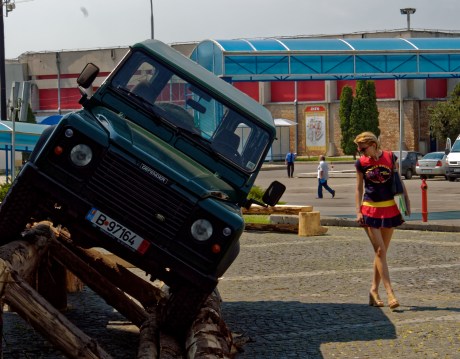
‘You can’t beat a picture like this one.’

_DSC0158.jpg

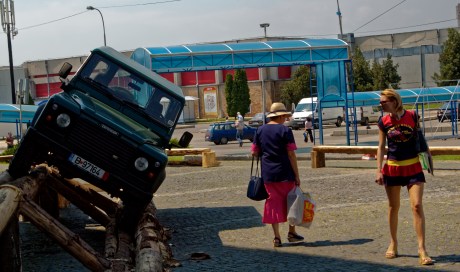
‘Yeah, right…’

_DSC0159

DSC_0007

The way I see it, this lady is freer, in body and mind, than most of us will ever be.

Authoritarianism, of all ‘flavors’, depends on the ‘father figure’ being absolutely convinced that he is well above the rest. And it is this height which enables him to despise the rest, to the tune of not caring, at all, about how they feel about things.

‘I’m calling the shots, because I can, and the rest of you would better suck it up!’

Democracy, on the other hand, depends on people relying on each other. Enough of them are convinced that none of them is above error. Regardless of their ideological convictions, people who are convinced that democracy works are willing to accept advice from their peers. Or, at least, they listen carefully to what their peers have to say about issues.

The key word here being ‘peers’.

Nobody pays real attention to ideas coming from below or from above. If from below, that idea has to be almost obvious to pass the filter while everything coming from above is interpreted as an order. And executed if there’s no alternative or stalled/ignored whenever possible.

Both authoritarianism and democracy have proved themselves useful.

No war has ever been won by a democratically led army and no authoritarian regime has ever resisted for long. Meanwhile no democracy has ever crumbled as long as it has retained enough of its democratic spirit.
Yes, there are many examples of democracies becoming corrupted and eventually failing. Only this had happened after the democratic spirit had vanished into the smoke of ‘politics’.

Let me remind you that Alexandre the Great, one of the most admired generals and state-men of the world, was educated by Aristotle. Who was the favorite pupil of Plato. The esteemed philosopher who had invented the concept of ‘priest-kings’ – specially educated individuals who were meant to rule the rest.
Needless to add that Plato had witnessed Pericles simultaneously building the Parthenon and burying the Athenian democracy.
While Aristotle (384-322 BC) had lived long enough to witness his pupil conquering the entire ‘civilized world’ and dying an abject drunkard.
Greece, one of the places which had nurtured an enormously important part of the human culture, never fully recovered from the consequences of Plato’s ideas being put in practice.

Are we going down the same chute?
Is this the proper manner in which to engage those ‘on the other side of the isle’?

giving birth to a democrat

Well, this is yet another perfect example of a sentence simultaneously true, false and indeterminable …

First of all, it is indeterminable simply because we’ll never know, let alone ‘for sure’, everything ‘under the sun’.
It is obviously false because we continuously discover things previously unknown to us. From another trench on the bottom of the ocean to a new satellite circling around Jupiter. Not to mention the huge number of materials and gadgets which have not ‘seen the light of day’ until the moment they have been invented by us. And they might have been made starting with raw materials which had previously existed… but denying their novelty would be shortsighted… to say the least.
And it is obviously true because no matter how many things we have discovered/invented, we have remained practically the same. We entertain the same passions and fears, we continue to behave in certain ways…

And the worst part is our refusal to learn from past experiences…

We’ve experienced the malignant consequences of the extreme ‘propaganda’ used by the nazis during WWII.
By the communist regimes trying to build ‘the new man’.
And we’re currently ‘repackaging’ the same king of destructive propaganda into ‘fake news‘…

Are we nuts?

Specially that we already know that what we learn actually changes our brain

Until some two and a half centuries ago, there were two kinds of people.
Those who did, because they could, almost all that crossed their minds.
And those who had to suck it up, because that was all they could do.

OK, there had been, for a few millennia, a Middle Eastern religion whose teachings suggested that all humans had been created equal – because all of them had been made to resemble their creator,… but not very many people used to bother with this interpretation…

Then, all of a sudden, “We hold these truths to be self-evident, that all men are created equal, that they are endowed by their Creator with certain unalienable Rights, that among these are Life, Liberty and the pursuit of Happiness. — That to secure these rights, Governments are instituted among Men, deriving their just powers from the consent of the governed”

From that moment on, all of us have started to ‘have rights’. To express our opinions about things, to carry arms…

And we eventually made full use of those rights… by publishing porn magazines, by buying, for our own protection, AR-15s…

Some American states, Florida among them, have recently stated that people have the right to ‘stand their ground’. Or, more exactly, to defend the ground where they happen to be at any one moment. Using deadly force, if necessary. As if it that ground were their castle.

A few days ago, a guy had parked his car on a spot reserved for people with special needs. Right in front of a convenience store. He went in, accompanied by his five years old boy to buy something, leaving his woman and his other children in the car.
Another guy, apparently having ‘the right’ to park in that spot – the first one didn’t, came up and engaged the woman about the whole situation. The driver came back from the store, exchanged some words with the ‘challenger’ and then shoved him to the ground.
The challenger drew his gun and shot the offending driver, despite the fact that he wasn’t in any immediate danger – after shoving the challenger to the ground, the bully had retreated a few paces.

According to Florida statutes, what had happened was nothing more than ‘self defense’, a.k.a. ‘holding your ground’. Furthermore, the gun involved in the incident was registered and the owner had a permit to carry it around. No charges was pressed.

Which makes me wonder…
We have these “unalienable rights”… including that to ‘pursue our happiness’ … but do we really need to press them on… regardlessly?

The ‘bully’ parked where he was not supposed to because he wanted to buy an ice-cream for his toddler – I’m imagining things here, I confess.
The ‘shooter’ wanted to use his right to park there, so he confronted the woman he found in the wrongfully parked car.
The bully returned to his car and, perceiving a threat to his family, used his right to defend it.
The shooter eventually ‘stood his ground’ and walked scot-free…

You see, I not trying to make any fine point here. To contest the concept of ‘standing your ground’ or the idea of people carrying heat when shopping for groceries…

I’m just wondering… what happened to the concept of ‘rights’? Why some of us have arrived to see them as obligations?

The whole thing might have started as the deceased parked in the wrong place…. but if the shooter had chosen to call the cops instead of confronting the guy… he wouldn’t have had to shoot the ‘bully’ in front of his children….

https://www.vox.com/identities/2018/7/23/17602312/stand-your-ground-florida-michael-drejka-markeis-mcglockton